
📚 Parasitology Syllabus • General Parasitology (Host, Parasite, Vector) • Protozoa (Amoeba, Naegleria flowleri, Giardia, Leishmania, Plasmodium, Toxoplasma, Trichomonas) • Helminths (Cestodes, Trematodes, Nematodes) • Important Parasitic Diseases (Ascariasis, Enterobiasis, Hookworm, Filariasis, Trichinellosis, Dracunculiasis, Chagas Disease) • Laboratory Diagnosis • Prevention & Control of Parasitic Infections
Reading File
Now let me search the library for parasitology content across all major topics simultaneously.
Finding Sources
Finding Sources
Excellent. Let me now read the key parasitology sections from the best sources simultaneously.
Reading File
Reading File
I have rich content. Let me read more sections - the helminths and parasitic diseases sections, plus more protozoa content.
Reading File
Reading File
Excellent - I now have very comprehensive data. Let me read the helminths section and remaining protozoa content.
Reading File
Reading File
I now have comprehensive content from the textbooks. I have enough rich material to write a thorough, well-structured parasitology study guide. Let me now compile the full notes.
📚 Complete Parasitology Notes
Sources: Quick Compendium of Clinical Pathology 5th ed., Medical Microbiology 9e (Murray), Sherris & Ryan's Medical Microbiology 8th ed., Jawetz Melnick & Adelberg's Medical Microbiology 28th ed.
PART 1 - GENERAL PARASITOLOGY
Key Definitions
| Term | Definition |
|---|---|
| Parasite | An organism that lives in or on another organism (host) and benefits at the host's expense |
| Host | The organism that harbors the parasite |
| Definitive host | Host in which the parasite undergoes sexual reproduction (e.g., humans for Taenia, mosquito for Plasmodium) |
| Intermediate host | Host in which asexual reproduction or larval development occurs |
| Reservoir host | A non-human host that harbors the parasite and serves as a source of human infection |
| Paratenic host | Carries the larval form without further development; acts as a "transport" host |
| Vector | An arthropod that transmits the parasite (biological or mechanical) |
| Zoonosis | Infection transmitted from animals to humans |
Types of Parasitism
- Ectoparasite - lives on the surface (e.g., lice, scabies)
- Endoparasite - lives inside the host (e.g., Plasmodium, Ascaris)
- Obligate parasite - cannot survive without a host
- Facultative parasite - can live free or parasitically (e.g., Naegleria)
Parasite Life Stages
- Trophozoite - active, feeding, motile form (vegetative)
- Cyst - dormant, infective, environmentally stable form
- Sporozoite - infective stage injected by mosquito
- Merozoite - released after hepatic schizogony; invades RBCs
- Gametocyte - sexual stage; ingested by vector
Types of Vectors
- Biological vector - parasite develops/multiplies inside (e.g., Anopheles mosquito for malaria, Aedes for filariasis)
- Mechanical vector - parasite is carried without development (e.g., fly carrying cysts)
PART 2 - PROTOZOA
Overview
Protozoa are unicellular eukaryotes. Classified by mode of motility:
- Sarcodina - move by pseudopodia (amoeba)
- Mastigophora - move by flagella (Giardia, Leishmania, Trichomonas)
- Ciliophora - move by cilia (Balantidium)
- Sporozoa/Apicomplexa - non-motile adults (Plasmodium, Toxoplasma, Cryptosporidium)
2.1 ENTAMOEBA HISTOLYTICA (Amoebiasis)
| Feature | Detail |
|---|---|
| Transmission | Fecal-oral; contaminated food/water |
| Infective stage | Cyst (4 nuclei) |
| Disease stage | Trophozoite (ingested RBCs = pathognomonic!) |
| Habitat | Large intestine |
| Disease | Amoebic dysentery, amoebic liver abscess |
Pathogenesis:
- Trophozoites invade colonic mucosa → flask-shaped ulcers
- Portal spread → liver abscess ("anchovy paste" / chocolate brown pus)
- Rarely: lung, brain abscess
Cyst morphology:
- 10-20 μm, 4 nuclei with central karyosome
- Chromatoid bars (cigar-shaped) with rounded ends
- Glycogen vacuoles
Trophozoite morphology:
- 15-60 μm, ingested RBCs visible inside
- Eccentric nucleus with central karyosome
Diagnosis:
- Stool O&P (3 specimens, ≥24 hrs apart)
- Serology (positive in invasive disease)
- Trichrome stain on stool
Treatment: Metronidazole + luminal agent (paromomycin or iodoquinol)
Non-pathogenic species to know: E. dispar, E. coli, E. hartmanni, Iodamoeba bütschlii, Endolimax nana
2.2 NAEGLERIA FOWLERI
| Feature | Detail |
|---|---|
| Classification | Free-living amoeba (thermophilic) |
| Habitat | Warm stagnant freshwater, soil |
| Entry | Nasal mucosa → cribriform plate → olfactory nerve → frontal lobe |
| Disease | Primary Amoebic Meningoencephalitis (PAM) |
| Population | Children/young adults swimming in warm freshwater |
| Prognosis | Nearly always fatal (>97% mortality) |
Key facts:
- No cysts found in brain tissue (unlike Acanthamoeba)
- Trophozoites: 10-35 μm, small nucleus with large dense central karyosome; can be mistaken for macrophages in CSF
- Culture: grown on agar with E. coli lawn
- CSF specimens must NOT be refrigerated before culture (organisms die in cold)
Diagnosis: Trophozoites in CSF; PCR; culture on E. coli
Treatment: Amphotericin B + azithromycin + rifampin (rarely successful)
Compare with other free-living amoeba:
| Feature | Naegleria | Acanthamoeba | Balamuthia |
|---|---|---|---|
| Disease | PAM | GAE + Keratitis | GAE |
| Host | Immunocompetent | Immunocompromised | Both |
| Cysts in brain? | No | Yes | Yes |
| Entry route | Nasal (cribriform) | Hematogenous | Hematogenous |
| Course | Acute (days) | Subacute/chronic | Subacute/chronic |
| Contact lens risk? | No | Yes (keratitis) | No |
Quick Compendium of Clinical Pathology 5th ed., p. 124
2.3 GIARDIA INTESTINALIS (syn. G. lamblia, G. duodenalis)
| Feature | Detail |
|---|---|
| Transmission | Fecal-oral, contaminated water ("beaver fever") |
| Infective stage | Cyst (4 nuclei) |
| Disease stage | Trophozoite |
| Habitat | Duodenum and jejunum (NOT colon) |
| Disease | Giardiasis - fatty diarrhea, malabsorption, bloating, flatulence |
Trophozoite morphology (classic):
- Pear/teardrop-shaped, bilaterally symmetrical
- 2 nuclei (gives "owl-eye" or "monkey face" appearance)
- 4 pairs of flagella
- Sucking disk (adhesive disk) - attaches to intestinal villi
- Ventral concavity
Cyst morphology:
- Oval, 8-12 μm, 4 nuclei
- Intracytoplasmic fibrils
Pathogenesis: Mechanical blockade of intestinal epithelium + villous flattening → malabsorption (fat-soluble vitamins A, D, E, K)
Diagnosis:
- Stool O&P (3 specimens - intermittent shedding)
- String test (Enterotest)
- Stool antigen ELISA / DFA - more sensitive
- Note: no peripheral eosinophilia (intestinal protozoa don't invade)
Treatment: Metronidazole or tinidazole; nitazoxanide
2.4 LEISHMANIA SPECIES
| Disease | Species | Vector | Geography |
|---|---|---|---|
| Visceral (Kala-azar) | L. donovani, L. infantum | Female Phlebotomus sandfly | Asia, Africa, Mediterranean |
| Cutaneous (Oriental sore) | L. major, L. tropica | Female Phlebotomus sandfly | Middle East, Africa |
| Mucocutaneous (Espundia) | L. braziliensis | Lutzomyia sandfly | South America |
Life cycle:
- Promastigote (flagellated) - in sandfly, infective stage
- Amastigote (no flagellum) - intracellular in macrophages/reticuloendothelial cells of human host
Visceral leishmaniasis (Kala-azar):
- "Kala-azar" = black sickness (Hindi)
- Massive hepatosplenomegaly, fever, weight loss, pancytopenia
- Hypergammaglobulinemia
- Amastigotes in macrophages of liver, spleen, bone marrow
Cutaneous: Painless papule → ulcer with raised indurated borders ("volcano crater")
Diagnosis:
- Giemsa-stained bone marrow/spleen aspirate (amastigotes within macrophages)
- Culture on NNN medium
- PCR, serology (rK39 antigen for visceral)
Treatment: Liposomal amphotericin B (drug of choice); pentavalent antimonials (sodium stibogluconate)
2.5 PLASMODIUM SPECIES (Malaria)
Five species infecting humans:
| Species | Fever Pattern | RBC Change | Key Features | Relapse? |
|---|---|---|---|---|
| P. falciparum | Quotidian → malignant tertian (36-48h) | Smaller, multiple rings, Maurer's clefts | Most dangerous; cerebral malaria; banana-shaped gametocytes | No (no hypnozoites) |
| P. vivax | Benign tertian (48h) | Enlarged, Schüffner's dots | Widest distribution; DARC receptor | Yes (hypnozoites) |
| P. ovale | Benign tertian (48h) | Enlarged, fimbriated/oval edges, Schüffner's dots | Africa, milder | Yes (hypnozoites) |
| P. malariae | Quartan (72h) | Smaller, band trophozoites | Causes nephrotic syndrome | No (but recrudescence) |
| P. knowlesi | Daily (24h = quotidian) | Normal/small | Zoonosis (macaques), SE Asia | No |
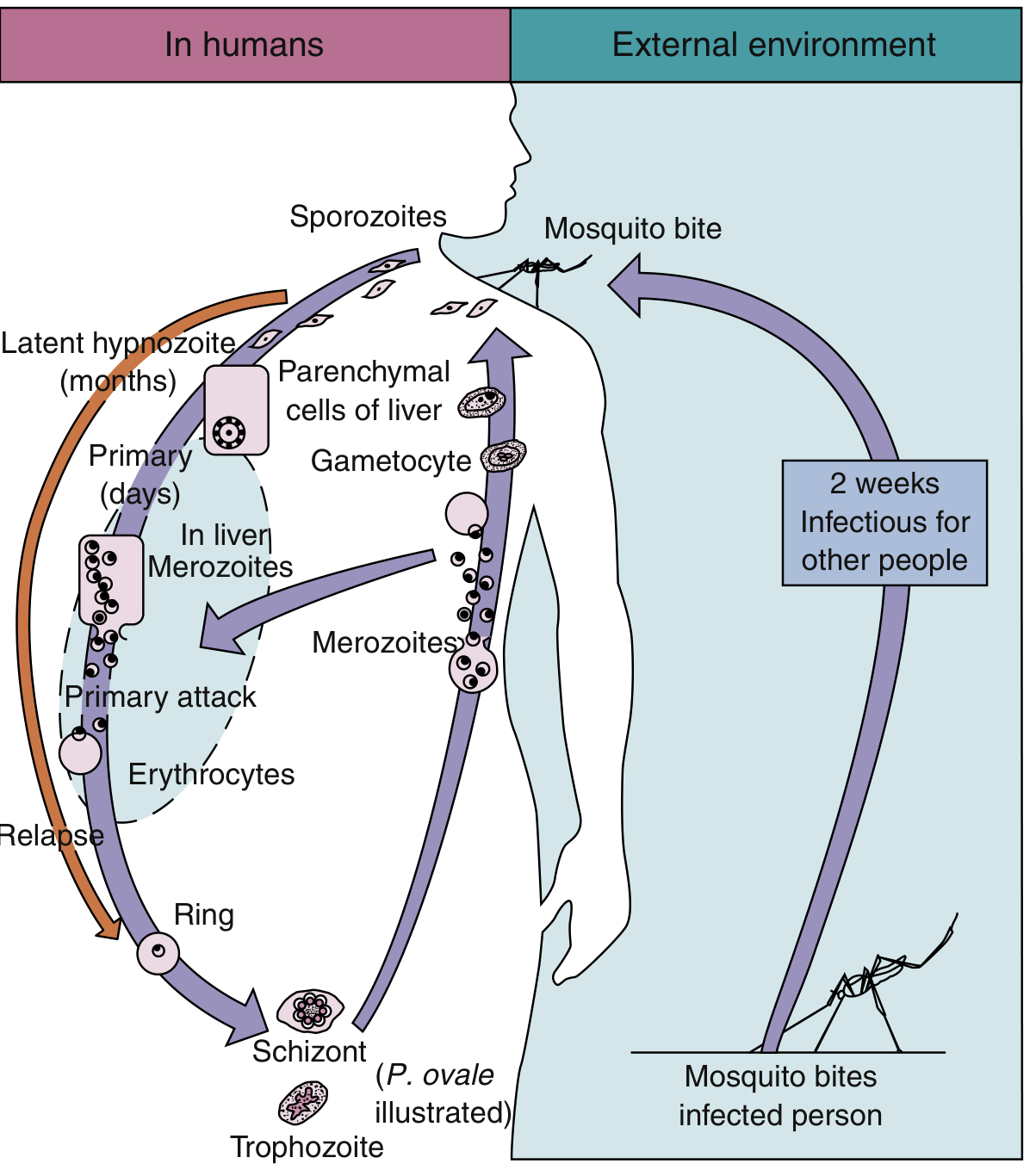
Life Cycle:
- Mosquito bite → sporozoites enter blood → liver (exoerythrocytic schizogony, 8-25 days)
- Hepatocytes rupture → merozoites released → enter RBCs
- Erythrocytic cycle: ring → trophozoite → schizont → rupture → merozoites (fever paroxysm at this point)
- Some merozoites → gametocytes (sexual stage)
- Anopheles mosquito ingests gametocytes → sporogony in mosquito → sporozoites in salivary glands
- P. vivax/ovale: some sporozoites become hypnozoites (dormant liver forms → relapse)
P. falciparum special features (most virulent):
- Cytoadherence (knobs on RBC surface) → capillary sludging → cerebral malaria
- Rosette formation
- No persistent liver stage (no relapse, only recrudescence)
- Infects all RBC ages; others are age-selective
- Banana/crescent-shaped gametocytes
Complications:
- Cerebral malaria (P. falciparum)
- Blackwater fever: massive hemolysis → hemoglobinuria → dark urine
- Nephrotic syndrome (P. malariae)
- Splenic rupture
- Severe anemia, thrombocytopenia
Diagnosis:
- Thick blood film (screening - concentration): Giemsa or Wright stain
- Thin blood film (speciation - morphology)
- Rapid diagnostic test (RDT) - antigen detection (HRP2 for P. falciparum)
- PCR (most sensitive/specific)
Treatment:
- Chloroquine-sensitive: chloroquine
- Chloroquine-resistant P. falciparum: artemisinin combination therapy (ACT)
- P. vivax/ovale relapse prevention: primaquine (G6PD screen first - risk of hemolysis)
- Severe malaria: IV artesunate (preferred) or IV quinine
Prevention: Mosquito nets, insect repellent (DEET), chemoprophylaxis (chloroquine, mefloquine, doxycycline, atovaquone-proguanil)
2.6 TOXOPLASMA GONDII
| Feature | Detail |
|---|---|
| Definitive host | Cats (only host for sexual cycle/oocysts in stool) |
| Intermediate host | Humans, most warm-blooded animals |
| Infective forms | Oocysts (in cat feces), tissue cysts (in undercooked meat), tachyzoites (congenital) |
| Transmission | Ingestion of oocysts (contaminated soil, cat litter), undercooked meat, congenital (transplacental), blood transfusion/organ transplant |
Forms:
- Tachyzoite - rapidly replicating, active infection, crescent/banana shaped (active disease)
- Bradyzoite - slowly replicating, in tissue cysts (latent infection, especially brain and muscle)
- Oocyst - sexual form shed in cat feces; environmentally resistant
Disease presentation:
| Population | Manifestation |
|---|---|
| Immunocompetent | Usually asymptomatic or mild mononucleosis-like (cervical lymphadenopathy) |
| AIDS/Immunocompromised | Toxoplasmic encephalitis (ring-enhancing lesions on MRI, basal ganglia) |
| Congenital | Triad: chorioretinitis, hydrocephalus, intracranial calcifications |
| Pregnant women | Can cause fetal death, spontaneous abortion |
Congenital toxoplasmosis - Classic Triad:
Chorioretinitis + Hydrocephalus + Intracranial calcifications (periventricular)
Diagnosis:
- Serology (IgM = acute; IgG = past/chronic)
- PCR of CSF or amniotic fluid
- Brain biopsy (ring-enhancing lesions)
- Neonatal IgM (does not cross placenta)
Treatment: Pyrimethamine + sulfadiazine + leucovorin (folinic acid to prevent myelosuppression)
- Prophylaxis in HIV: TMP-SMX (also prevents PCP)
2.7 TRICHOMONAS VAGINALIS
| Feature | Detail |
|---|---|
| Classification | Flagellated protozoan (mastigophora) |
| Transmission | Sexually transmitted (STI) - most common non-viral STI worldwide |
| Infective/disease stage | Trophozoite only (no cyst stage) |
| Habitat | Vagina/male urethra |
| Morphology | Pear-shaped, 4 anterior flagella + 1 recurrent flagellum (on undulating membrane), axostyle |
Clinical:
- Women: vaginitis, yellow-green frothy vaginal discharge, "strawberry cervix" (petechiae), pH >4.5
- Men: usually asymptomatic; urethritis possible
- Characteristic jerky, tumbling, non-directional motility on wet mount
Diagnosis:
- Wet mount (direct microscopy) - motile trophozoites; sensitivity ~60%
- Nucleic acid amplification test (NAAT) - most sensitive/specific
- Culture on Diamond's medium
- Pap smear can detect incidentally
Treatment: Metronidazole (2g single dose) - treat both partners; tinidazole is alternative
PART 3 - HELMINTHS
Helminths are multicellular worms. Divided into:
- Cestodes (tapeworms) - flat, segmented
- Trematodes (flukes) - flat, unsegmented
- Nematodes (roundworms) - cylindrical, unsegmented
General: Lab Finding - Eosinophilia
- Eosinophilia is the hallmark of tissue-invasive helminth infections
- Pure intestinal protozoa (Giardia, E. histolytica) do NOT cause eosinophilia
- Highest eosinophilia: Trichinella, visceral larva migrans, Strongyloides, early Ascaris migration
3.1 CESTODES (Tapeworms)
All tapeworms have:
- Scolex (head) - with suckers ± hooks for attachment
- Neck - region of growth
- Proglottids - body segments (immature → mature → gravid)
3.1.1 Taenia saginata (Beef Tapeworm)
- Transmission: ingestion of undercooked beef containing cysticerci
- Definitive host: humans; Intermediate host: cattle
- Scolex: 4 suckers, no hooks (unarmed)
- Proglottids: 15-30 uterine branches per side
- Does NOT cause cysticercosis in humans (eggs not infectious to humans)
- Treatment: praziquantel or niclosamide
3.1.2 Taenia solium (Pork Tapeworm)
- Transmission: ingestion of undercooked pork (cysticerci) → intestinal tapeworm; OR ingestion of eggs (fecal-oral) → cysticercosis
- Scolex: 4 suckers + hooks (armed/rostellum) - "armed tapeworm"
- Neurocysticercosis = most common cause of acquired epilepsy worldwide
- Cysts in brain (ring-enhancing lesions, calcifications on CT)
- Treatment: albendazole + steroids + antiepileptics
- Treatment of intestinal form: praziquantel or niclosamide
3.1.3 Echinococcus species (Hydatidosis / Cystic Echinococcosis)
- Definitive host: dogs; Intermediate hosts: sheep, cattle, humans (accidental)
- Transmission: ingestion of eggs from dog feces
- Disease: hydatid cysts in liver (70%), lungs (20%), rarely brain
- Cysts contain protoscoleces ("hydatid sand")
- Never aspirate/needle biopsy - risk of anaphylactic shock + dissemination
- Diagnosis: imaging (CT/US) + serology (IHA, ELISA)
- Treatment: PAIR (Puncture, Aspiration, Injection, Re-aspiration) + albendazole; surgical resection
3.1.4 Diphyllobothrium latum (Fish Tapeworm)
- Transmission: ingestion of raw/undercooked freshwater fish
- Intermediate hosts: copepods (1st) → freshwater fish (2nd)
- Largest tapeworm infecting humans (up to 10 meters)
- Vitamin B12 deficiency → megaloblastic anemia (tapeworm preferentially absorbs B12)
- Egg: oval with unshouldered operculum + abopercular knob
- Treatment: praziquantel
3.1.5 Hymenolepis nana (Dwarf Tapeworm)
- Smallest cestode infecting humans
- Unique: can complete entire life cycle in one host (autoinfection possible)
- Transmission: ingestion of infected beetles or person-to-person
- Treatment: praziquantel
3.2 TREMATODES (Flukes)
All trematodes (except Schistosoma) are hermaphroditic.
3.2.1 Schistosoma species (Blood Flukes)
- Unique: dioecious (separate sexes), the female lives in the groove of the male
- Vector: freshwater snails (Biomphalaria, Bulinus, Oncomelania)
- Transmission: cercariae penetrate intact skin while wading/swimming in freshwater
| Species | Site of Eggs | Disease |
|---|---|---|
| S. mansoni | Lateral spine, stool | Intestinal/hepatic schistosomiasis, periportal fibrosis |
| S. haematobium | Terminal spine, urine | Urogenital schistosomiasis, bladder cancer (SCC) |
| S. japonicum | Small lateral spine, stool | Most eggs per worm; severe hepatosplenomegaly |
Cercarial dermatitis ("swimmer's itch") = immediate hypersensitivity at entry site
Katayama fever = acute schistosomiasis - fever, urticaria, eosinophilia (Serum sickness-like)
Chronic: portal hypertension, "Symmer's clay pipe-stem fibrosis" (S. mansoni/japonicum)
Diagnosis: Eggs in stool/urine; Kato-Katz thick smear; serology; rectal biopsy
Treatment: Praziquantel (drug of choice for all species)
3.2.2 Fasciola hepatica (Liver Fluke)
- Transmission: ingestion of aquatic plants (watercress) with encysted metacercariae
- Intermediate host: freshwater snail (Lymnaea)
- Disease: biliary obstruction, cholangitis, eosinophilia
- Treatment: triclabendazole (NOT praziquantel - resistant)
3.2.3 Clonorchis sinensis (Chinese Liver Fluke)
- Transmission: raw freshwater fish
- Risk: cholangiocarcinoma (biliary)
- Treatment: praziquantel
3.2.4 Paragonimus westermani (Lung Fluke)
- Transmission: raw/undercooked crabs or crayfish
- Disease: pulmonary paragonimiasis - hemoptysis, brown eggs in sputum (mimics TB)
- Egg: oval, shouldered operculum
- Treatment: praziquantel
3.3 NEMATODES (Roundworms)
Key concept: Nematodes have separate sexes. Eosinophilia during migration phase.
3.3.1 Intestinal Nematodes
Ascaris lumbricoides (Giant Roundworm)
- Largest intestinal nematode (up to 35 cm)
- Transmission: fecal-oral, ingestion of embryonated eggs
- Löffler's syndrome (pulmonary eosinophilia) during larval migration through lungs
- Worms may obstruct intestines, bile duct, appendix
- Diagnosis: eggs in stool (mammillated outer coat), adults may be passed in stool
- Treatment: albendazole or mebendazole
Enterobius vermicularis (Pinworm)
- Most common helminth infection in the US
- Transmission: fecal-oral, autoinfection; nocturnal perianal migration of female worm
- Perianal pruritus (especially nocturnal) = hallmark
- Diagnosis: Scotch tape test (cellophane tape applied to perianal area at night)
- Eggs: asymmetrically flattened on one side ("D-shaped")
- Treatment: mebendazole or albendazole (repeat dose in 2 weeks); treat entire household
Hookworm (Ancylostoma duodenale, Necator americanus)
- Transmission: filariform larvae penetrate intact skin (walking barefoot)
- "Ground itch" at entry site; Löffler's syndrome during lung migration
- Adults attach to small intestinal mucosa → iron-deficiency anemia (blood-sucking)
- A. duodenale also transmits via ingestion/breast milk; more aggressive blood-sucking
- N. americanus = most common hookworm worldwide (Americas, Africa, Asia)
- Diagnosis: eggs in stool (thin shell, 4-8 cell morula inside)
- Treatment: albendazole or mebendazole + iron supplementation
Trichuris trichiura (Whipworm)
- Transmission: fecal-oral (embryonated eggs)
- Egg: "barrel/football" shaped with 2 polar plugs (pathognomonic)
- Anterior end (thin/whip) embeds in mucosa; posterior (thick) hangs free
- Heavy infection: "whip-worm dysentery," rectal prolapse in children
- Treatment: mebendazole or albendazole
Strongyloides stercoralis
- Unique: can cause hyperinfection/dissemination in immunocompromised hosts
- Transmission: filariform larvae penetrate skin; unique direct development cycle
- Autoinfection possible (larvae can penetrate intestinal wall without leaving host)
- Hyperinfection in corticosteroid users, HTLV-1 infection, transplant recipients
- Larva currens = rapidly migrating urticarial track in skin
- Diagnosis: stool O&P (rhabditiform larvae); serology (ELISA); Baermann technique
- Treatment: ivermectin (drug of choice); albendazole as alternative
3.3.2 Tissue Nematodes
Wuchereria bancrofti / Brugia malayi - Lymphatic Filariasis
- Vector: Culex mosquito (W. bancrofti), Mansonia/Anopheles (B. malayi)
- Disease: lymphatic obstruction → elephantiasis (lymphedema of limbs/scrotum)
- Microfilariae show nocturnal periodicity (peak at night in peripheral blood)
- Diagnosis: blood smear (thick film, midnight sample); microfilariae in blood
- Treatment: DEC (diethylcarbamazine) ± albendazole; ivermectin + albendazole
Onchocerca volvulus - River Blindness
- Vector: Simulium (blackfly), breeds in fast-flowing rivers
- Disease: skin nodules (onchocercomas), dermatitis ("leopard skin"), blindness (keratitis, chorioretinitis from microfilariae dying in eye)
- No blood microfilaremia (microfilariae stay in skin/eye)
- Diagnosis: skin snip (not blood) - microfilariae in superficial skin; slit lamp exam
- Treatment: Ivermectin (drug of choice, mass distribution program); kills microfilariae NOT adults; DEC is contraindicated (causes Mazzotti reaction → severe inflammation)
Loa loa (African Eye Worm)
- Vector: Chrysops (mango fly / deer fly)
- Disease: Calabar swellings (transient migratory subcutaneous edema), adult worm migrating across conjunctiva
- Diurnal periodicity of microfilariae (peak during daytime)
- Diagnosis: microfilariae in daytime blood sample; observing worm under conjunctiva
- Treatment: DEC
PART 4 - IMPORTANT PARASITIC DISEASES (Detailed)
4.1 ASCARIASIS
- Causative agent: Ascaris lumbricoides
- Transmission: ingestion of embryonated eggs (fecal-oral); contaminated soil/vegetables
- Life cycle highlights:
- Eggs ingested → hatch in small intestine → larvae penetrate intestinal wall
- Larvae migrate via portal blood → liver → heart → lungs (Löffler's syndrome)
- Larvae migrate up trachea → swallowed → mature in small intestine
- Adults (up to 35 cm) live in jejunum
- Clinical:
- Pulmonary phase: cough, wheezing, eosinophilia (Löffler's syndrome)
- Intestinal phase: usually asymptomatic; heavy infection → malnutrition, obstruction
- Complications: biliary/pancreatic duct obstruction, intestinal obstruction, appendicitis
- Diagnosis: Eggs in stool (fertilized egg: oval, brown, mammillated); unfertilized eggs also seen
- Treatment: Albendazole (400 mg single dose) or mebendazole; pyrantel pamoate
4.2 ENTEROBIASIS (Pinworm)
- Causative agent: Enterobius vermicularis
- Epidemiology: Most common helminth in USA; mainly children, institutional settings
- Transmission: Fecal-oral, autoinfection, airborne (eggs can float in dust)
- Life cycle: Eggs ingested → mature in cecum → females migrate to perianal area at night to deposit eggs → pruritus ani
- Complications: Secondary bacterial infection from scratching; rarely appendicitis; vaginal/pelvic migration in girls
- Diagnosis: Scotch tape test (morning, before bathing) - asymmetric D-shaped eggs
- Treatment: Mebendazole or albendazole (single dose, repeat in 2 weeks); treat all household members; hygiene measures
4.3 HOOKWORM DISEASE
- Causative agents: Ancylostoma duodenale (Old World), Necator americanus (New World)
- Transmission: Filariform (L3) larvae in warm moist soil penetrate intact skin
- Life cycle:
- L3 larvae penetrate skin → blood → lungs (Löffler's syndrome) → swallowed
- Mature in small intestine; attach to mucosa by buccal capsule with teeth/plates
- Blood-sucking causes iron deficiency anemia and hypoalbuminemia
- Clinical:
- "Ground itch" (dermatitis at penetration site)
- Pulmonary migration symptoms
- Iron-deficiency anemia (most important complication): weakness, pallor, dyspnea
- Hypoproteinemia, growth retardation in children
- Diagnosis: Eggs in stool; Harada-Mori filter paper technique to detect larvae
- Treatment: Albendazole or mebendazole; iron supplementation; nutritional support
4.4 FILARIASIS
- See tissue nematodes section above
- Key summary:
| Parasite | Vector | Microfilariae periodicity | Key disease | Dx sample |
|---|---|---|---|---|
| Wuchereria bancrofti | Culex mosquito | Nocturnal | Elephantiasis | Midnight blood |
| Brugia malayi | Mansonia/Anopheles | Nocturnal | Elephantiasis (arms) | Midnight blood |
| Loa loa | Chrysops fly | Diurnal | Calabar swellings, eye worm | Daytime blood |
| Onchocerca volvulus | Simulium blackfly | N/A (skin) | River blindness | Skin snip |
| Mansonella spp. | Midges (Culicoides) | Aperiodic | Mild/asymptomatic | Blood |
4.5 TRICHINELLOSIS (Trichinosis)
- Causative agent: Trichinella spiralis (and related species)
- Transmission: Ingestion of undercooked pork (or bear, wild boar) containing encysted larvae
- Unique: Humans are accidental dead-end hosts; the same individual is both definitive and intermediate host
- Life cycle:
- Encysted larvae in muscle → ingested → released in stomach → mature in small intestinal enterocytes
- Female worms release larvae → penetrate mucosa → migrate via blood → encyst in striated muscle (preferred: diaphragm, intercostal muscles, tongue, extraocular muscles)
- Clinical phases:
- Intestinal phase (day 1-7): nausea, vomiting, diarrhea
- Muscle invasion phase (day 7-21): myalgia (especially jaw, tongue, extraocular), periorbital edema (classic!), fever, eosinophilia
- Encystment phase: symptoms subside; calcified cysts remain in muscle
- Classic presentation: Periorbital edema + myalgia + eosinophilia after eating pork
- Diagnosis: Serology; muscle biopsy (encysted larvae "nurse cells"); CBC (marked eosinophilia); elevated CK
- Treatment: Albendazole or mebendazole + corticosteroids (for severe cases)
4.6 DRACUNCULIASIS (Guinea Worm Disease)
- Causative agent: Dracunculus medinensis
- Transmission: Ingestion of cyclops (copepods/water fleas) in contaminated drinking water
- Life cycle:
- Cyclops in water ingested → larvae released in intestine → penetrate gut wall → mature in retroperitoneum
- Gravid female (up to 1 m long!) migrates to skin (usually lower leg) over ~1 year
- Female creates blister → ruptures on contact with water → releases larvae into water → cyclops ingest larvae
- Clinical:
- Mostly asymptomatic during migration
- Blister and ulcer on lower extremity; intensely painful
- Secondary bacterial infection is the main complication
- Severe: arthritis, septicemia
- Diagnosis: Clinical (visible worm emerging from skin); no effective serological test
- Treatment: No drug treatment! Traditional slow extraction: wind worm around stick (a few cm/day over weeks); cannot pull quickly (worm breaks → anaphylaxis + severe infection)
- Prevention/Eradication: Filtering drinking water through fine cloth/pipe filter; education; DEET in water sources to kill cyclops. Currently near-complete global eradication (Carter Center program)
4.7 CHAGAS DISEASE (American Trypanosomiasis)
- Causative agent: Trypanosoma cruzi
- Vector: Triatomine bug (Triatoma, Rhodnius, Panstrongylus) = "Kissing bug" / "Reduviid bug"
- Transmission: Bug defecates near bite wound; parasite in feces enters wound (NOT the bite itself); also: blood transfusion, congenital, organ transplant, undercooked food
- Distribution: Central and South America
- Life cycle:
- Trypomastigotes in bug feces enter wound → enter macrophages → transform to amastigotes (intracellular)
- Amastigotes replicate in tissue cells (especially heart muscle) → rupture → release trypomastigotes → infect other cells or ingested by another bug
Clinical Phases:
| Phase | Features |
|---|---|
| Acute | Romaña's sign (painless periorbital edema = entry via conjunctiva), chagoma (skin nodule at entry site), fever, lymphadenopathy, hepatosplenomegaly; rarely myocarditis/meningitis in children |
| Indeterminate | Asymptomatic, positive serology, normal ECG/imaging; most remain here |
| Chronic | Chagasic cardiomyopathy (dilated, arrhythmias, heart failure, sudden death); megaesophagus and megacolon (enteric nerve destruction) |
Romaña's sign = unilateral painless periorbital edema = classic sign of acute Chagas
"Megadisease" = hallmark of chronic Chagas (megaesophagus, megacolon)
Diagnosis:
- Acute: blood smear (trypomastigotes with C/U shape), buffy coat; PCR
- Chronic: serology (2 different tests required per WHO); xenodiagnosis (let clean bugs feed on patient then examine bug feces - gold standard historically)
- ECG: right bundle branch block + left anterior fascicular block is classic Chagas pattern
Treatment:
- Nifurtimox or benznidazole - effective in acute phase; limited efficacy in chronic phase
- Chronic cardiomyopathy: standard heart failure treatment, ICD, transplant
Compare with African Trypanosomiasis:
| Feature | Chagas (American) | African Sleeping Sickness |
|---|---|---|
| Agent | T. cruzi | T. brucei gambiense/rhodesiense |
| Vector | Triatome (kissing bug) | Tsetse fly (Glossina) |
| Transmission | Feces in wound | Bite |
| Reservoir | Many mammals | Humans (gambiense), animals (rhodesiense) |
| Target | Heart/GI tract (intracellular) | CNS (extracellular) |
| CNS disease | Rare | Hallmark (sleeping sickness) |
| Treatment | Nifurtimox/Benznidazole | Suramin, melarsoprol, eflornithine |
PART 5 - LABORATORY DIAGNOSIS OF PARASITES
Stool Examination (O&P - Ova and Parasites)
- Specimen requirement: 3 specimens collected at least 24 hours apart (to account for intermittent shedding)
- Fresh specimen: examine within 1 hour; if delay, use preservative (formalin, PVA, SAF)
- Do NOT refrigerate specimens if cultured for free-living amoeba
Techniques:
| Technique | Purpose |
|---|---|
| Direct wet mount | Motile trophozoites (Giardia, Trichomonas, amoeba) |
| Concentration methods (zinc sulfate flotation, formalin-ethyl acetate) | Increase sensitivity for cysts/eggs/larvae |
| Permanent stains (Trichrome, Iron hematoxylin) | Morphologic identification of protozoa |
| Modified acid-fast stain | Cryptosporidium, Cyclospora, Cystoisospora (oocysts are acid-fast) |
| Giemsa stain | Blood parasites (malaria, Leishmania, trypanosomes, microfilariae) |
| Scotch tape test | Enterobius vermicularis (pinworm) eggs |
| Kato-Katz | Helminth egg counts (intensity of infection) |
| Harada-Mori | Culture of hookworm/Strongyloides larvae |
| Baermann technique | Strongyloides larvae (uses gravity and heat) |
| Skin snip | Onchocerca volvulus microfilariae |
| NNN/Diamond's medium | Culture of Leishmania (NNN), Trichomonas (Diamond's) |
Blood Parasite Diagnosis:
| Method | Detail |
|---|---|
| Thick blood film | Concentration; used for screening/detection |
| Thin blood film | Morphology; used for species identification |
| Giemsa stain | Standard for blood parasites |
| Wright stain | Alternative to Giemsa |
| Midnight blood sample | Wuchereria (nocturnal microfilariae) |
| Daytime blood sample | Loa loa (diurnal microfilariae) |
| Buffy coat | Trypanosomes, microfilariae concentration |
Immunological Methods:
- Serology (ELISA, IFA, IHA): Toxoplasma, Echinococcus, Leishmania (rK39), Schistosoma, Trypanosoma
- Antigen detection: Giardia/Cryptosporidium (stool EIA/immunochromatography); Plasmodium RDTs (HRP-2)
- PCR: Most sensitive/specific; used for malaria, Toxoplasma, Leishmania, microsporidia, Strongyloides
Parasite by Body Site Summary (from Quick Compendium of Clinical Pathology):
| Body Site | Key Parasites |
|---|---|
| Intestinal tract | Entamoeba, Giardia, Cryptosporidium, Ascaris, Enterobius, hookworm, Strongyloides, Taenia, Schistosoma (eggs) |
| Blood | Plasmodium (RBCs), Leishmania (leukocytes), Trypanosoma, microfilariae |
| CNS | Naegleria fowleri, Acanthamoeba, Toxoplasma, T. solium (neurocysticercosis), Trypanosoma brucei |
| Liver/Spleen | Echinococcus, E. histolytica, Leishmania, Fasciola, Schistosoma |
| Muscle | Trichinella, Taenia (cysticercus), T. cruzi |
| Lungs | Paragonimus, Echinococcus, Strongyloides larvae, Toxoplasma |
| Skin | Leishmania, Onchocerca, microfilariae, Sarcoptes scabiei, Loa loa |
| Urogenital | Trichomonas vaginalis, Schistosoma haematobium (eggs) |
| Eye | Acanthamoeba (keratitis), Toxoplasma (chorioretinitis), Onchocerca, Loa loa |
PART 6 - PREVENTION & CONTROL OF PARASITIC INFECTIONS
General Principles (Interrupting Transmission)
| Strategy | Examples |
|---|---|
| Safe food/water | Boiling/filtering water (Giardia, Cryptosporidium, cholera), cooking meat well (Trichinella, Toxoplasma, Taenia), avoiding raw fish (Diphyllobothrium, Clonorchis) |
| Personal protection | Wearing shoes (hookworm, Strongyloides), insect repellent (DEET), bed nets (malaria, filariasis) |
| Vector control | Insecticides (indoor residual spraying - malaria), larval control, draining stagnant water |
| Sanitation | Proper sewage disposal, handwashing, avoiding open defecation |
| Mass drug administration (MDA) | Ivermectin (onchocerciasis, lymphatic filariasis), DEC + albendazole (LF elimination program) |
| Animal reservoir control | Treating dogs (Echinococcus, Leishmania), meat inspection (Taenia, Trichinella) |
| Chemoprophylaxis | Malaria prophylaxis (chloroquine, mefloquine, doxycycline, atovaquone-proguanil) |
| Water filtering | Dracunculiasis - filtering with pipe filter/cloth |
| Vaccination | No licensed human vaccines for most parasites; trials ongoing for malaria (RTS,S/AS01 = MosquirixTM) |
Disease-Specific Control:
| Disease | Key Control Measures |
|---|---|
| Malaria | Insecticide-treated bed nets (ITNs), IRS (indoor residual spraying), ACT treatment, RTS,S vaccine (partial efficacy), chemoprophylaxis |
| Filariasis | Annual MDA (albendazole + ivermectin or DEC), vector control, morbidity management (lymphedema care) |
| Onchocerciasis | Annual ivermectin MDA (CDTI - community-directed treatment); blackfly control (larviciding rivers) |
| Dracunculiasis | Water filtering, health education, case containment, ABATE (temephos) in water sources; near eradication globally |
| Chagas Disease | Triatomine bug control (insecticide spraying), blood screening, congenital screening |
| Schistosomiasis | Praziquantel MDA, snail control (molluscicides), avoiding contaminated water, sanitation |
| Soil-transmitted helminths | Periodic deworming (MDA with albendazole/mebendazole), sanitation, hygiene education |
| Giardia/Cryptosporidium | Water treatment (boiling, filtration, UV - NOT chlorination for Cryptosporidium), handwashing |
| Neurocysticercosis | Meat inspection, sanitation, pork cooking, taeniasis treatment in communities |
| Toxoplasmosis | Avoid cat litter in pregnancy, cook meat well, wash produce; screening of pregnant women |
HIGH-YIELD MNEMONICS & QUICK FACTS
Malaria Species Memory Aid: "FaKt Vivid Oh My"
- Falciparum - malignant tertian, cerebral, banana gametocytes
- Knowlesi - quotidian, zoonosis (monkeys, SE Asia)
- Tertian benign = Vivax - largest distribution, Schüffner's dots
- Ovale - benign tertian, Africa
- Mylariae (Malariae) - quartan (72h), nephrotic syndrome
Drug-Parasite Matches (High Yield):
| Drug | Key Use |
|---|---|
| Metronidazole | Giardia, E. histolytica, Trichomonas |
| Praziquantel | Most cestodes and trematodes |
| Albendazole | Broad spectrum: roundworms, hookworm, Echinococcus, neurocysticercosis |
| Mebendazole | Soil-transmitted helminths (Ascaris, hookworm, Trichuris, pinworm) |
| Ivermectin | Strongyloides (DOC), Onchocerca (DOC), lymphatic filariasis, scabies |
| DEC | Lymphatic filariasis (W. bancrofti, Brugia), Loa loa |
| Pyrimethamine + sulfadiazine | Toxoplasmosis |
| Nifurtimox / Benznidazole | Chagas disease |
| Triclabendazole | Fasciola hepatica (NOT praziquantel) |
| Primaquine | Radical cure of P. vivax/ovale (kills hypnozoites) |
| Artesunate (IV) | Severe malaria |
| Liposomal amphotericin B | Visceral leishmaniasis (drug of choice) |
| Amphotericin B | Naegleria fowleri PAM |
Vectors Summary:
| Vector | Parasite |
|---|---|
| Anopheles mosquito | Plasmodium (malaria) |
| Aedes mosquito | Brugia timori; also Dengue, Zika (not parasitic) |
| Culex mosquito | Wuchereria bancrofti, Brugia malayi |
| Simulium blackfly | Onchocerca volvulus |
| Chrysops (deer/mango fly) | Loa loa |
| Phlebotomus sandfly | Leishmania (Old World) |
| Lutzomyia sandfly | Leishmania (New World) |
| Tsetse fly (Glossina) | T. brucei (African sleeping sickness) |
| Triatomine bug (kissing bug) | T. cruzi (Chagas disease) |
| Cyclops (water flea) | Dracunculus medinensis |
| Freshwater snail | Schistosoma (cercariae), Fasciola, Paragonimus |
| Ixodes tick | Babesia |
Sources: Quick Compendium of Clinical Pathology 5th ed. | Medical Microbiology 9e (Murray, Rosenthal, Pfaller) | Sherris & Ryan's Medical Microbiology 8th ed. | Jawetz, Melnick & Adelberg's Medical Microbiology 28th ed.
This is a shared conversation. Sign in to Orris to start your own chat.