
Fate of somites
Reading File
Somites are transient mesodermal structures that give rise to several key tissues. Their fate: the sclerotome forms vertebrae and ribs, the dermomyotome splits into the dermotome (dermis) and myotome (skeletal muscles), and the syndetome forms tendons/ligaments.
Searching sources...
Finding Sources
Finding Sources
Reading File
Reading File
Reading File
Reading File
Reading File
Loading Image
Loading Image
Finding Sources
Loading Image
Reading File
Here is a complete, textbook-based overview of the fate of somites:
Fate of Somites
1. Origin and Formation
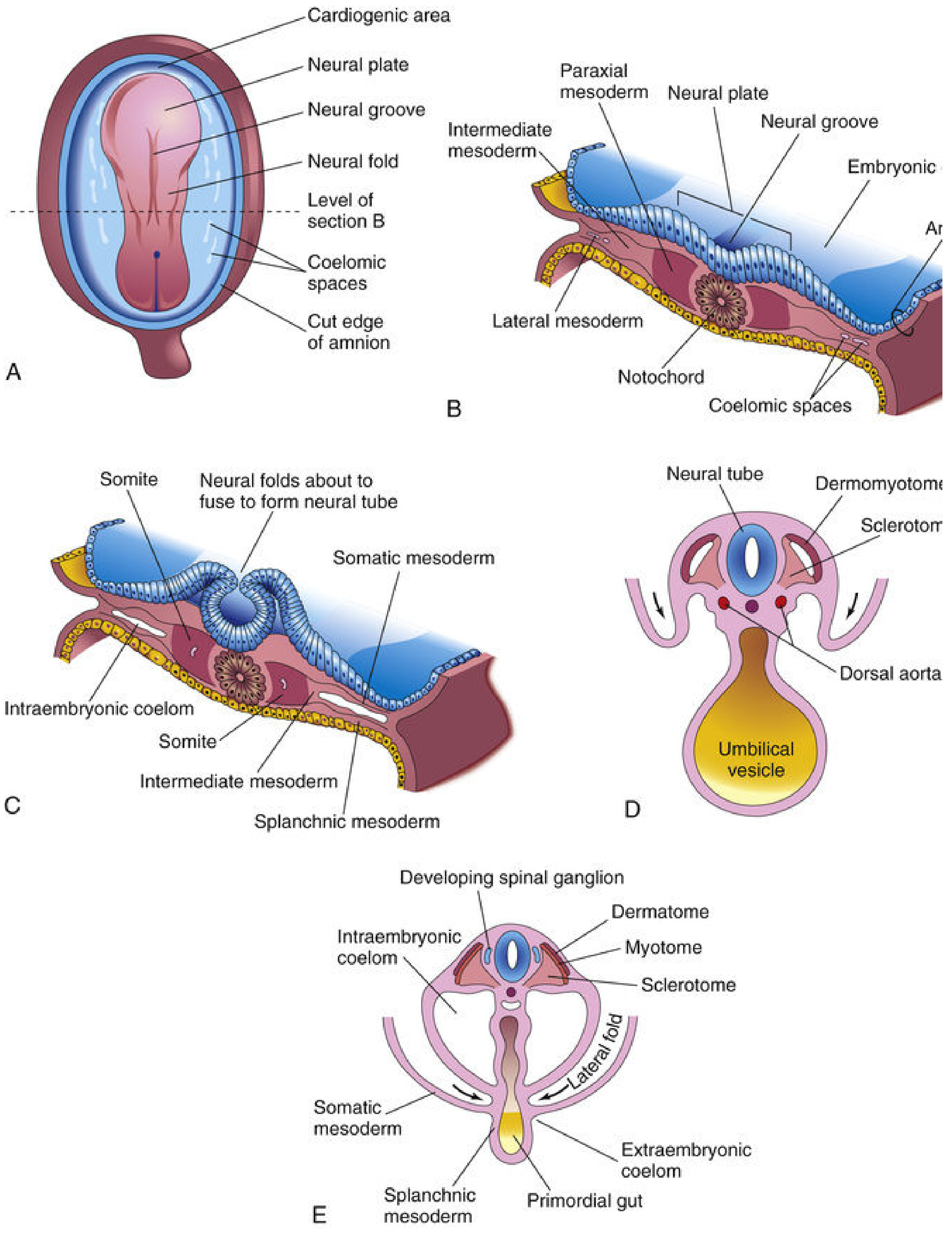
Somites are paired, condensed blocks of paraxial mesoderm that form on either side of the notochord and neural tube. They begin appearing around day 20 of development and are added in a craniocaudal direction until the end of the 5th week.
Total number: ~42-44 pairs
- 4-5 occipital pairs
- 8 cervical pairs
- 12 thoracic pairs
- 5 lumbar pairs
- 5 sacral pairs
- 8-12 coccygeal pairs
The 1st occipital pair and most caudal coccygeal pairs regress and disappear. The remaining somites form the axial skeleton, musculature, and dermis.
2. Differentiation of Each Somite
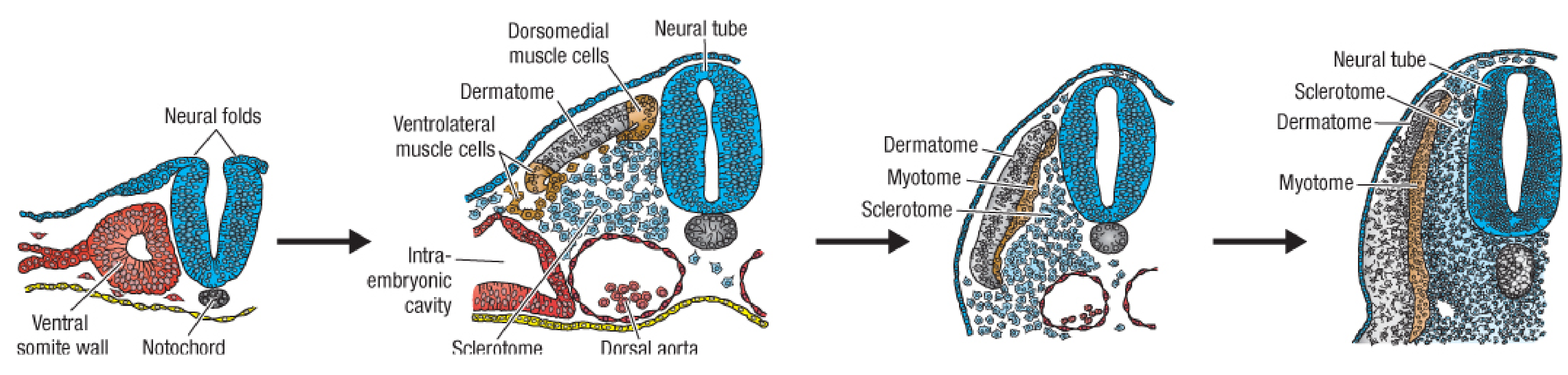
Each somite differentiates into two main regions:
A. Sclerotome (Ventromedial part)
- Cells become mesenchymal and migrate to surround the notochord and neural tube
- Give rise to:
- Vertebral bodies and arches
- Ribs (thoracic sclerotome)
- Intervertebral discs (nucleus pulposus from the notochord remnant, annulus fibrosus from sclerotome)
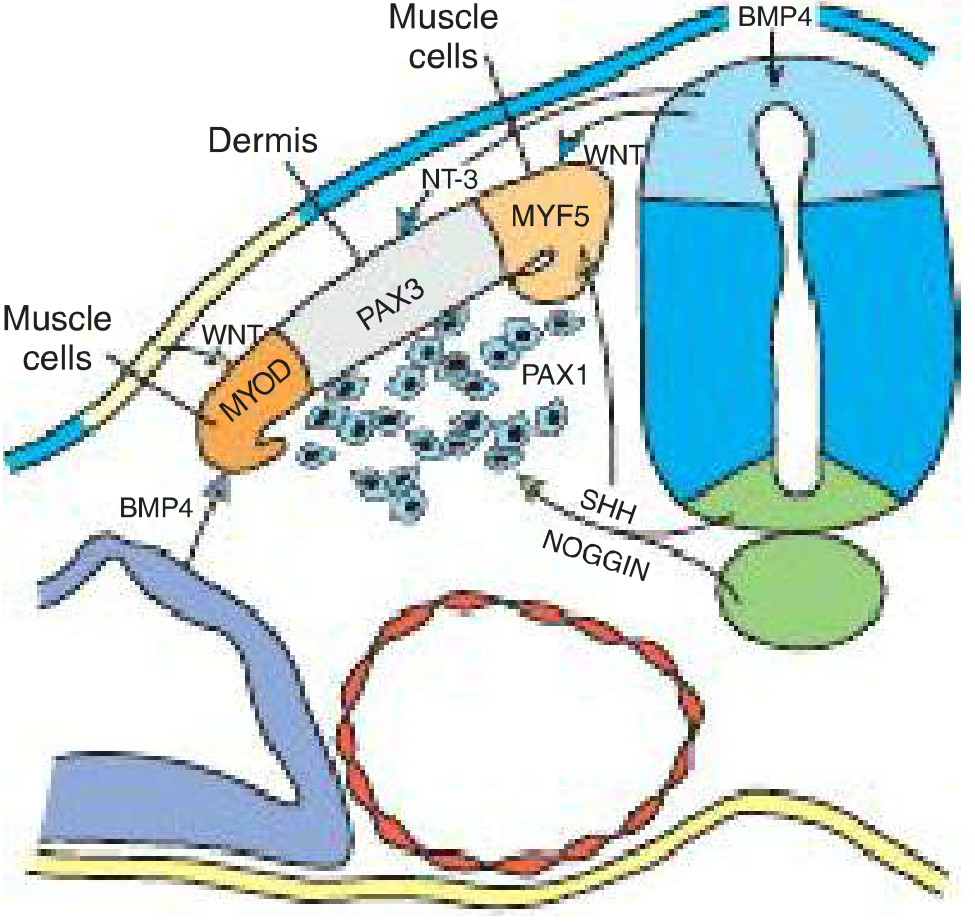
- Molecular signal: Sonic hedgehog (SHH) and Noggin from the notochord and floor plate activate PAX1, which drives chondrogenesis and vertebral formation
B. Dermomyotome (Dorsolateral part)
Splits further into two sub-regions:
Myotome
- Forms skeletal muscle of the trunk and limbs
- Divides into:
- Epaxial (primaxial) myotome - dorsomedial lip (DML) → intrinsic back muscles (erector spinae); innervated by dorsal primary rami
- Hypaxial (abaxial) myotome - ventrolateral lip (VLL) → anterolateral abdominal wall muscles (obliques, transversus, rectus abdominis), limb muscles, intercostals, and diaphragm; innervated by ventral primary rami
- Some VLL cells also migrate into lateral plate mesoderm to form infrahyoid and limb muscles
- Molecular signal: WNT proteins from the dorsal neural tube activate MYF5 (dorsomedial) and MyoD (ventrolateral) to specify muscle cell fate
Dermatome
- Forms dermis of the dorsal skin (fibroblasts)
- Molecular signal: Neurotrophin-3 (NT-3) from the dorsal neural tube directs dermatome cells to become dermis; WNT proteins activate PAX3
C. Syndetome (between sclerotome and myotome borders)
- A fourth, less commonly emphasized compartment
- Forms tendons and ligaments attaching muscles to bones
- Regulated by the transcription factor SCLERAXIS
3. Molecular Regulation Summary
| Signal | Source | Target compartment | Key transcription factor |
|---|---|---|---|
| SHH + Noggin | Notochord / floor plate | Sclerotome | PAX1 |
| WNT (dorsal) | Dorsal neural tube (DML) | Myotome - epaxial | MYF5 |
| WNT + BMP4 inhibition | Dorsal neural tube (VLL) | Myotome - hypaxial | MyoD |
| NT-3 | Dorsal neural tube | Dermatome | PAX3 |
4. Summary Table
| Somite Region | Position | Fate |
|---|---|---|
| Sclerotome | Ventromedial | Vertebrae, ribs, intervertebral disc annulus |
| Myotome (epaxial) | Dorsomedial lip | Intrinsic back muscles |
| Myotome (hypaxial) | Ventrolateral lip | Abdominal wall, limb, intercostal, diaphragm muscles |
| Dermatome | Dorsal | Dermis of the back |
| Syndetome | Borders | Tendons and ligaments |
5. Special Notes
- Head somitomeres (rostral to occipital somites) contribute to head and neck musculature (pharyngeal arch muscles, extraocular muscles) but do not segregate into recognizable sclerotome/dermomyotome regions
- Smooth muscle does NOT come from somites - it arises from splanchnic/visceral mesoderm
- Cardiac muscle arises from visceral mesoderm surrounding the heart tube
Sources: The Developing Human (Moore & Persaud), Langman's Medical Embryology, Fischer's Mastery of Surgery, THIEME Atlas of Anatomy
This is a shared conversation. Sign in to Orris to start your own chat.