
Antidepressant drugs
Reading File
Now I'll search the medical library for antidepressant drugs content in parallel.
Finding Sources
Finding Sources
Good. Now I'll read the most comprehensive sources in parallel - Harrison's antidepressant drugs section and Kaplan & Sadock's antidepressant section, plus a pharmacology-focused source.
Finding Sources
Reading File
Reading File
Let me search for the core pharmacology/psychiatry section on antidepressants for a comprehensive classification and mechanism overview.
Finding Sources
Reading File
Finding Sources
Reading File
Finding Sources
Finding Sources
Reading File
Finding Sources
Searching PubMed
"antidepressant"[MeSH Terms] AND "depression"[MeSH Terms]
Reading File
Reading File
Reading File
Loading Image
I now have comprehensive information to provide a detailed, well-structured answer on antidepressant drugs.
Antidepressant Drugs
Antidepressants are a broad class of psychotropic agents used primarily for depressive disorders, but also widely employed for anxiety disorders, neuropathic pain, OCD, PTSD, eating disorders, and functional GI conditions. They are classified by their mechanism of action and chemical structure.
Classification
| Class | Examples |
|---|---|
| SSRIs | Fluoxetine, sertraline, paroxetine, citalopram, escitalopram, fluvoxamine |
| SNRIs | Venlafaxine, desvenlafaxine, duloxetine, levomilnacipran, milnacipran |
| TCAs | Imipramine, amitriptyline, doxepin (tertiary); desipramine, nortriptyline, protriptyline (secondary) |
| MAOIs | Phenelzine, tranylcypromine (irreversible); moclobemide (reversible RIMA); selegiline (transdermal) |
| Atypicals | Bupropion, mirtazapine, trazodone, nefazodone, vortioxetine, vilazodone, gepirone |
1. Selective Serotonin Reuptake Inhibitors (SSRIs)
Mechanism: Block the presynaptic serotonin transporter (SERT), preventing reuptake of 5-HT from the synaptic cleft - increasing serotonergic neurotransmission. (See the serotonin synapse diagram below, site 8 = serotonin transporter)
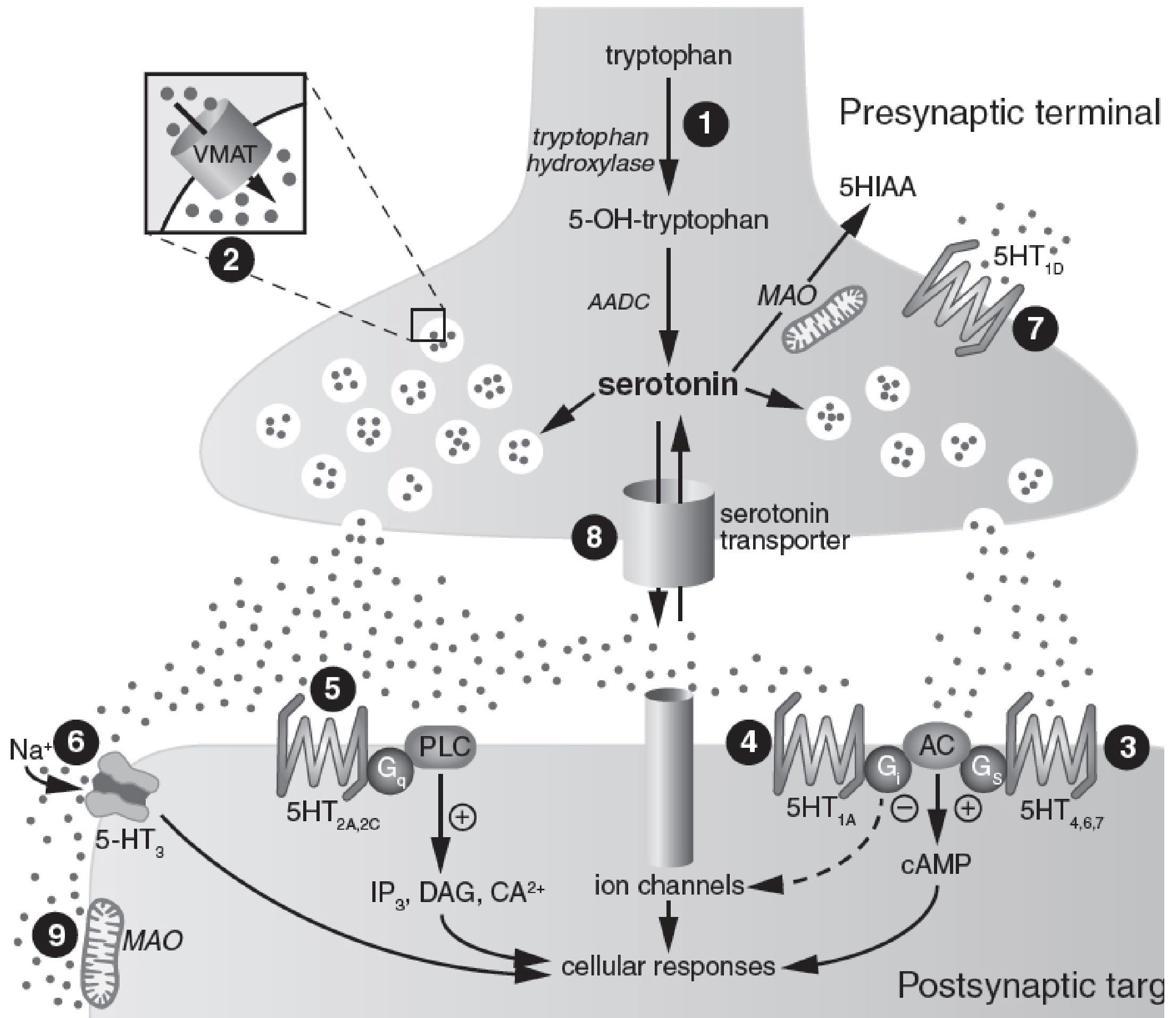
Drugs & uses:
- Fluoxetine (Prozac) - long half-life (~1-4 days), good for adherence issues
- Sertraline (Zoloft) - broad use, relatively few drug interactions
- Paroxetine (Paxil) - also for anxiety/OCD; most anticholinergic of SSRIs
- Citalopram / Escitalopram - QTc prolongation risk at higher doses
- Fluvoxamine - mainly used for OCD
Side effects:
- GI: nausea, diarrhea (common early)
- Sexual dysfunction (common - in a proportion of patients)
- Insomnia or hypersomnia
- Weight changes
- Serotonin syndrome in overdose or combination with other serotonergic agents: delirium, hypertension, tachycardia, diaphoresis, muscle rigidity, myoclonus, hyperthermia, clonus, dilated pupils
- May precipitate mania in unrecognized bipolar disorder
- Pulmonary hypertension risk in neonates of mothers exposed during pregnancy
CYP interactions: Most SSRIs inhibit CYP enzymes to varying degrees. Fluoxetine and paroxetine inhibit CYP2D6 (affecting type 1C antiarrhythmics). Sertraline acts on CYP3A4 (affecting carbamazepine, digoxin). Citalopram and escitalopram have the fewest interactions.
2. Serotonin-Norepinephrine Reuptake Inhibitors (SNRIs)
Mechanism: Block reuptake of both serotonin and norepinephrine. Retain much of the pain-relieving efficacy of TCAs with a better side effect profile.
Drugs:
- Venlafaxine (Effexor) - monitor diastolic BP; requires extended-release form for less GI upset; relatively linear dose-response
- Duloxetine (Cymbalta) - approved for diabetic neuropathy, fibromyalgia, GAD, chronic musculoskeletal pain
- Desvenlafaxine - active metabolite of venlafaxine
- Levomilnacipran - most noradrenergic SNRI; potentially better for fatigue/anergia
Side effects: fewer anticholinergic/cardiotoxic effects vs TCAs; nausea, sweating, sexual dysfunction, hypertension (especially venlafaxine)
3. Tricyclic Antidepressants (TCAs)
Mechanism: Block reuptake of norepinephrine and serotonin via the presynaptic amine transporter. Also have significant anticholinergic, antihistaminic, and alpha-1 adrenergic blocking activity.
Subclasses:
- Tertiary amines (imipramine, amitriptyline, doxepin, trimipramine): inhibit both NE and 5-HT reuptake; more sedating
- Secondary amines (desipramine, nortriptyline, protriptyline, amoxapine): preferential NE reuptake inhibition; better tolerated
Therapeutic uses beyond depression:
- Neuropathic pain (diabetic neuropathy, postherpetic neuralgia) at lower doses than required for depression - effect appears independent of antidepressant action
- Migraine prophylaxis (amitriptyline)
- IBS (motility modulation + visceral sensory effects)
- Fibromyalgia, chronic low back pain, tension headache
Plasma levels and dosing: Daily dose typically 100-200 mg for imipramine/amitriptyline; target plasma level 150-300 ng/mL. Steady-state plasma levels can vary >10-fold between individuals. Ethnic differences are significant (Hispanic, Asian, and Black patients often require lower doses).
Side effects:
- Anticholinergic: dry mouth, constipation, urinary retention, blurred vision
- Sedation (antihistaminic)
- Orthostatic hypotension
- Cardiac: conduction delay, heart block, arrhythmias - contraindicated in cardiovascular disease
- Memory impairment (especially in elderly)
- Overdose is lethal - cardiac tachyarrhythmias and AV block. Desipramine carries the greatest overdose risk. Prescribe only 10-day supply when suicide risk is present.
Do not combine with MAOIs - serious reactions can occur even days after stopping the MAOI.
4. Monoamine Oxidase Inhibitors (MAOIs)
Mechanism: Inhibit MAO enzymes (MAO-A and/or MAO-B), reducing degradation of serotonin, norepinephrine, and dopamine.
Types:
- Irreversible, non-selective: Phenelzine (Nardil), tranylcypromine (Parnate), isocarboxazid - oldest agents
- Selective MAO-B inhibitor: Selegiline (transdermal patch = Emsam) - transdermal delivery minimizes GI/hepatic MAO-A inhibition, reducing tyramine risk
- Reversible MAO-A inhibitor (RIMA): Moclobemide - available in 50+ countries; safer tyramine profile
Indications: Particularly effective in atypical depression (hypersomnia, hyperphagia, mood reactivity, rejection sensitivity) and treatment-resistant cases.
Tyramine ("cheese") reaction:
- MAO-A in intestinal mucosa normally metabolizes dietary tyramine
- When inhibited, tyramine enters the circulation, triggers norepinephrine/epinephrine release - causes hypertensive crisis
- Foods to avoid: aged cheese, cured meats, fermented foods, wine/beer, broad beans
Other side effects: Orthostatic hypotension, weight gain, insomnia, sexual dysfunction
Drug interactions:
- SSRIs + MAOIs = serotonin syndrome (must observe 1-2 week washout when switching)
- TCAs + MAOIs = hyperadrenergic crisis
- Sympathomimetics = hypertensive crisis
5. Atypical Antidepressants
Bupropion (Wellbutrin)
- Mechanism: enhances noradrenergic (and possibly dopaminergic) function
- No anticholinergic, sedating, or orthostatic effects; minimal sexual side effects (unlike SSRIs)
- Also approved for smoking cessation
- Lowers seizure threshold - avoid in eating disorders and seizure history
- Stimulant-like side effects possible
- An extended-release formulation combining bupropion + dextromethorphan (NMDA antagonist) may accelerate response
Mirtazapine (Remeron)
- Tetracyclic; blocks presynaptic α2-adrenergic receptors (increasing NE/5-HT release) and postsynaptic 5-HT2 and 5-HT3 receptors
- Strongly antihistaminic - produces sedation (useful in depressed patients with insomnia)
- Notable weight gain
- Relatively few sexual side effects
Trazodone / Nefazodone
- Block serotonin reuptake and 5-HT2 receptors
- Sedating; trazodone widely used for insomnia at low doses
Vortioxetine
- SERT blocker + 5-HT1A agonist, 5-HT1B partial agonist, 5-HT1D/5-HT3/5-HT2 antagonist
- May improve cognitive symptoms of depression
- Relatively linear dose-response curve
Vilazodone
- SERT blocker + partial 5-HT1A agonist
Gepirone
- Partial 5-HT1A agonist and 5-HT2 antagonist; recently approved
General Principles of Use
- Onset of action: Therapeutic effect typically takes 2-4 weeks - patients must be counseled about this
- First-line: SSRIs or SNRIs in most cases, due to tolerability and safety in overdose
- Switching: If an SSRI fails at full doses after 4-6 weeks, switching to bupropion, sertraline, venlafaxine, or an MAOI is reasonable (25% success rate in one major NIH-funded trial)
- Maintenance: Continued for 6-12 months after remission; longer for recurrent depression
- Treatment-resistant depression: ECT, rTMS, VNS; intravenous/intranasal ketamine (esketamine FDA-approved); investigationally, psilocybin and deep brain stimulation
Side Effect Comparison (by class)
| Feature | SSRIs | SNRIs | TCAs | MAOIs | Bupropion | Mirtazapine |
|---|---|---|---|---|---|---|
| Anticholinergic | None/slight | None | High | Moderate | None | Low |
| Sedation | Low | Low | High | Moderate | None | High |
| Sexual dysfunction | High | Moderate | Moderate | Moderate | Low | Low |
| Weight gain | Slight | Slight | Moderate | Moderate | None | High |
| Cardiac risk | Low | Low (BP) | High | Moderate | Low | Low |
| Orthostatic hypotension | Low | Low | High | High | Low | Low |
| Seizure risk | Low | Low | Low-moderate | Low | Moderate | Low |
Sources:
- Adams and Victor's Principles of Neurology, 12th Ed., Tricyclic Antidepressants & Serotonin Reuptake Inhibitors sections
- Harrison's Principles of Internal Medicine, 22nd Ed. (2025), Depressive Disorders chapter
- Kaplan & Sadock's Comprehensive Textbook of Psychiatry, Antidepressant section with side-effect table
- Harrison's Principles of Internal Medicine, 22nd Ed., Antidepressant Medications for Pain Management
This is a shared conversation. Sign in to Orris to start your own chat.