
Gangerene wet and dry
Reading File
Now let me search the medical library for gangrene content in parallel.
Finding Sources
Finding Sources
Good results. Let me now read the key sections from Bailey & Love (GANGRENE heading) and S Das (CLINICAL TYPES) in parallel, as they seem most comprehensive.
Reading File
Reading File
Let me read the rest of both files and also get the S Das capillary section with the image.
Reading File
Reading File
Reading File
I have excellent content from the textbooks. Let me also fetch a couple of key clinical images to include in the answer.
Loading Image
Finding Sources
Finding Sources
I now have comprehensive content. Let me also get the Current Surgical Therapy section for a full treatment summary, and fetch one more image.
Reading File
Reading File
I have comprehensive information from multiple authoritative textbooks. Now I'll compose a complete, well-structured answer.
Gangrene: Dry and Wet
Gangrene is defined as the death and putrefaction of macroscopic portions of tissue, which turns black due to breakdown of haemoglobin and the formation of iron sulphide. Most commonly it results from irreversible ischaemia. The peripheral circulation (toes, digits) is most vulnerable because collaterals are lacking. - Current Surgical Therapy 14e
Signs of Gangrene (General)
- Change of colour - pale, then bluish-purple, finally black
- Loss of temperature (cold)
- Loss of sensation
- Absent pulsation
- Loss of function
On examination: in dry gangrene the part is hard and shrivelled; in wet gangrene the part is oedematous, with or without crepitation. - S Das, Manual on Clinical Surgery 13th Ed
Causes of Gangrene
| Category | Examples |
|---|---|
| Cardiovascular | Atherosclerosis (senile gangrene), embolism, Buerger's disease, Raynaud's disease, cervical rib |
| Traumatic | Direct arterial injury, crushing |
| Infective | Carbuncle, cancrum oris, gas gangrene (Clostridium) |
| Metabolic | Diabetic gangrene |
| Neurological | Leprosy, syringomyelia, tabes dorsalis |
| Physical | Frostbite, radiation, burns, pressure necrosis |
- S Das, Manual on Clinical Surgery 13th Ed
Dry Gangrene
Mechanism: Results from gradual occlusion of arterial circulation - most commonly seen in atherosclerosis (atheromatous occlusion of arteries). The slow reduction in blood flow allows the tissue to desiccate rather than become infected.
Pathophysiology:
- Gradual slowing of the bloodstream leads to desiccation of tissue
- Disintegration of haemoglobin causes discolouration
Clinical Features:
- Affected part is dry, shrivelled, hard, mummified, and discoloured
- Hard to the touch (unlike wet gangrene)
- Clear line of demarcation between viable and dead tissue - appears within days when proximal blood supply is adequate
- Separation is neat, with minimal infection
- No odour (or faint odour)
- If bone is involved, separation takes longer; the stump tends to be conical as bone has better blood supply than its coverings
Common sites: Distal aspects of toes; seen classically in peripheral arterial disease (PAD)
Outcome: Autoamputation (auto-separation) can occur. Surgical amputation is done conservatively where possible.
- Bailey & Love's Short Practice of Surgery 28th Ed; S Das Manual on Clinical Surgery 13th Ed
Wet (Moist) Gangrene
Mechanism: Results when an artery is suddenly blocked (e.g. by an embolus) OR when gangrene is superimposed on inflammation/infection. The tissue retains some turgor and becomes a medium for bacterial growth.
Pathophysiology:
- Superadded bacterial infection and putrefaction
- Tissue is partially perfused, remains moist
- Gas-forming organisms (often Clostridium or gram-negative organisms) may be present, especially in diabetic patients
Clinical Features:
- Affected part is oedematous (swollen, soft)
- Blebs (blisters) may be present on the skin
- Crepitus on palpation when gas-forming organisms are present
- Foul odour (putrefaction)
- No clear line of demarcation - infection and suppuration extend into neighbouring living tissue, causing the final demarcation line to be more proximal
- May spread proximally if untreated
Emergency: Wet gangrene with crepitus from gas-forming organisms is a surgical emergency requiring urgent tissue debridement or amputation. - Bailey & Love
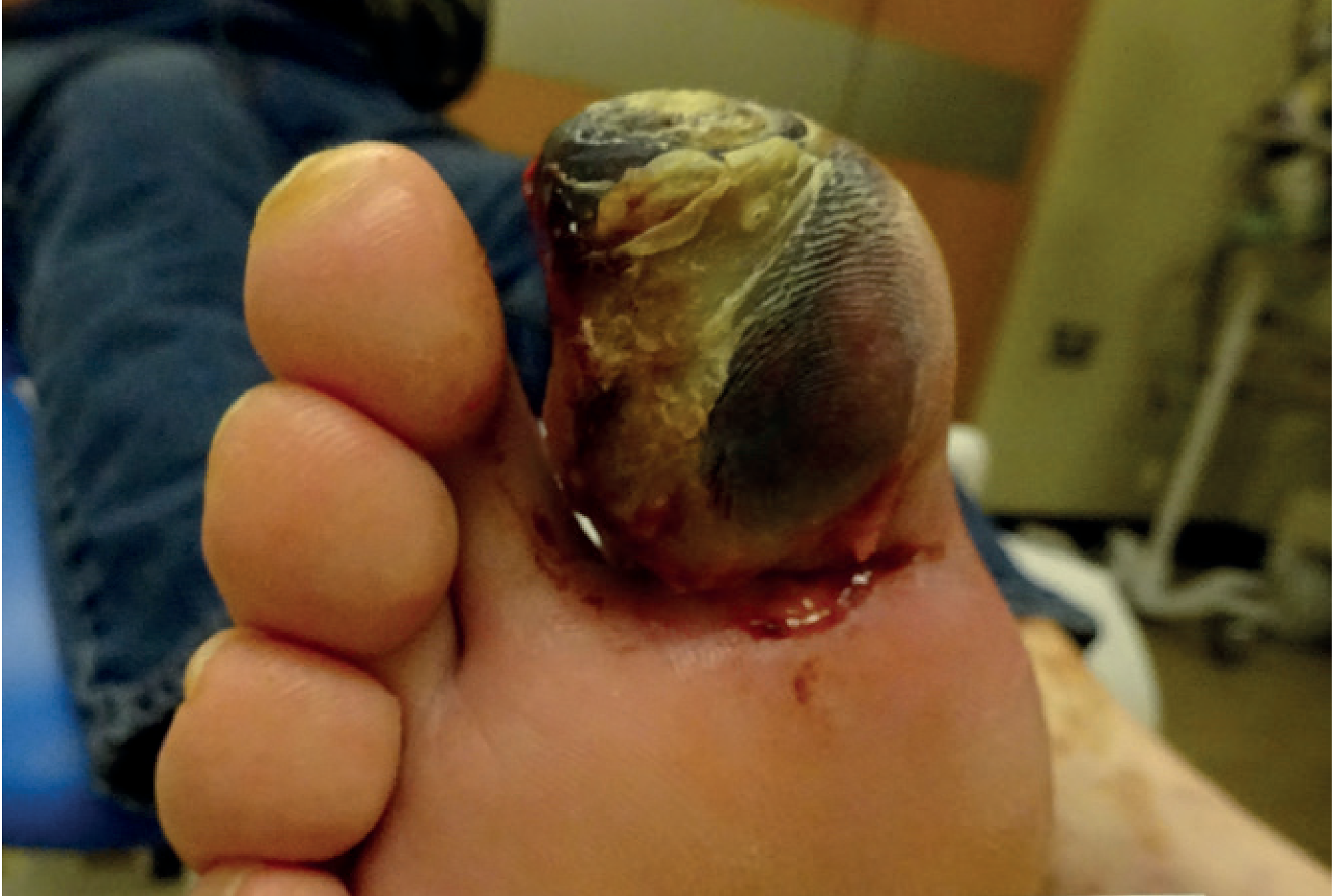
Comparison Table: Dry vs Wet Gangrene
| Feature | Dry Gangrene | Wet (Moist) Gangrene |
|---|---|---|
| Cause | Gradual arterial occlusion (atherosclerosis) | Sudden arterial occlusion + infection |
| Texture | Hard, shrivelled, mummified | Oedematous, soft, boggy |
| Odour | None / faint | Foul (putrefaction) |
| Infection | Absent / minimal | Present (putrefactive bacteria) |
| Crepitus | Absent | Present if gas-forming organisms |
| Blebs | Absent | Present |
| Line of demarcation | Clear, well-defined | Poorly defined / absent |
| Colour | Black, shrivelled | Dusky, mottled, swollen |
| Spread | Limited | Spreads proximally |
| Urgency | Less acute (can observe) | Surgical emergency |
| Example | Atherosclerotic toe | Diabetic foot, embolic gangrene |
Three Recognised Types (Current Classification)
- Dry gangrene - ischaemic, desiccated, demarcated
- Wet gangrene - ischaemic + infected, no clear demarcation, may have partial perfusion
- Gas gangrene - anaerobic bacteria (Clostridium species) produce gas and toxins; spreads rapidly and is potentially fatal if not promptly treated
- Current Surgical Therapy 14e
Separation of Gangrene
- A zone of demarcation (granulation tissue layer) forms between dead and living tissue
- In dry gangrene: clear line appears within days; separation is neat, with minimal infection
- In wet gangrene: suppuration extends into adjacent living tissue; the line of demarcation is more proximal and less neat
- If proximal arterial supply is poor: the line of demarcation may never form; gangrene may spread as skip lesions further up the limb
- Bailey & Love's Short Practice of Surgery 28th Ed
Diabetic Gangrene (Special Type)
Caused by three converging factors:
- Ischaemia from macrovascular disease (atherosclerosis of crural vessels) + microvascular dysfunction
- Peripheral sensorimotor neuropathy (PSN) - trophic skin changes, loss of protective reflexes, abnormal pressure loading, callosities
- Immunosuppression from hyperglycaemia - predisposes to rapid-spreading infection
Infection can spread rapidly in subfascial planes leading to fulminant foot sepsis, gangrene, and death.
- Bailey & Love's Short Practice of Surgery 28th Ed
Treatment Principles
| Step | Action |
|---|---|
| Assess blood supply | Pulse exam, ABI, Doppler, angiography |
| Revascularisation | Where possible, to improve proximal perfusion and allow more conservative debridement |
| Dry gangrene | Observe for autoamputation; conservative/distal amputation when line forms |
| Wet gangrene | Urgent debridement of necrotic tissue + antibiotics; drainage of pus |
| Gas gangrene | Surgical emergency - wide debridement/amputation + IV penicillin + hyperbaric O2 |
| Major amputation | Required for life-threatening sepsis, non-improvable blood supply, or non-functional limb |
Key principle: amputation in the presence of poor circulation will fail - gangrene will reappear at the wound edges. Revascularisation must precede or accompany surgery where possible. - Bailey & Love
Sources:
- Bailey and Love's Short Practice of Surgery, 28th Ed, pp. 1030-1031
- S Das: A Manual on Clinical Surgery, 13th Ed, pp. 89, 96
- Current Surgical Therapy, 14th Ed
This is a shared conversation. Sign in to Orris to start your own chat.