
Mechanism of heat cramps
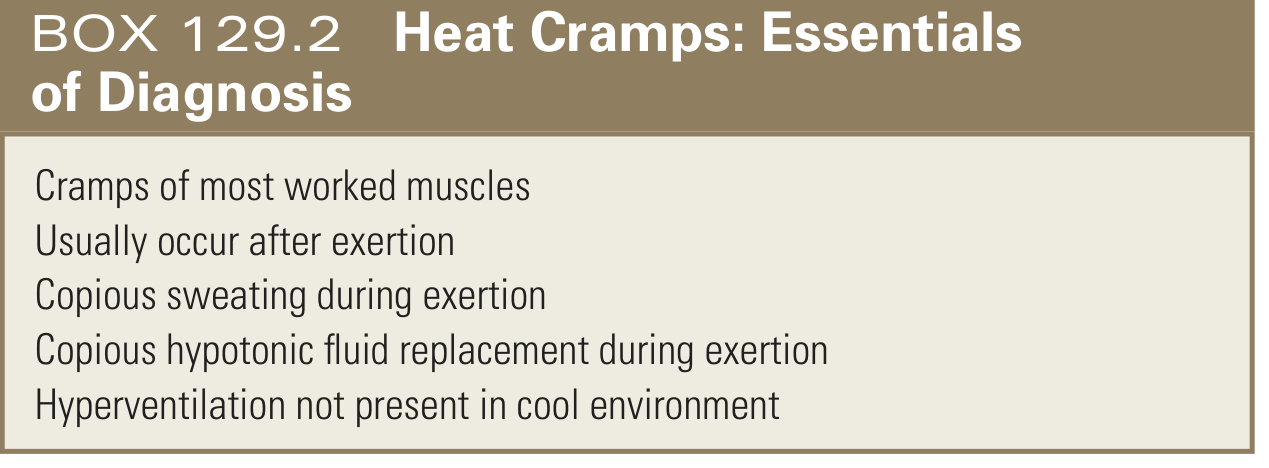
Heat cramps result from salt (sodium) depletion due to heavy sweating, combined with rehydration using plain water rather than electrolyte solutions. The low sodium state triggers involuntary, painful muscle contractions. They typically affect heavily used muscles and occur during or after intense exertion in the heat.
Searching sources...
Reading File
Finding Sources
Finding Sources
Reading File
Reading File
Reading File
Reading File
Loading Image
Here is a detailed account of the mechanism of heat cramps, drawn from Rosen's Emergency Medicine, Tintinalli's Emergency Medicine, and Harrison's Principles of Internal Medicine (22e).
Mechanism of Heat Cramps
Heat cramps (also called exercise-associated muscle cramps) are brief, intermittent, intensely painful, involuntary spasmodic contractions of skeletal muscles. Understanding their mechanism requires following the chain of events from sweat production to muscle membrane excitability.
1. Profuse Sweating and Sodium Loss
Sweat is a hypotonic fluid but contains significant sodium and chloride. During heavy exertion in a hot environment - especially in unacclimated individuals - the sweat rate is high AND sweat sodium concentration is high (non-acclimated persons lose more salt per liter of sweat than acclimatized ones). This results in large losses of sodium and chloride from the extracellular fluid (ECF).
2. Replacement with Hypotonic Fluid
The key precipitating event is that the individual replaces these fluid losses with plain water or other hypotonic solutions (e.g., most soft drinks, dilute juices). This does two things simultaneously:
- Fails to replenish lost sodium
- Further dilutes the already low serum sodium, worsening hyponatremia and hypochloremia
3. Electrolyte Deficit at Muscle Level
According to Harrison's (22e), "the precise pathogenesis appears to involve a relative deficiency of sodium, potassium, and fluid at the intracellular level." Tintinalli's also implicates a relative deficiency of sodium, potassium, and magnesium at the muscle level.
The resulting low ECF sodium creates an osmotic gradient, drawing water intracellularly. This disrupts normal electrochemical gradients across the muscle cell membrane, lowering the threshold for spontaneous depolarization.
4. Impaired Calcium-Dependent Muscle Relaxation
Harrison's specifically states that the hyponatremia and hypochloremia result in muscle cramps "due to calcium-dependent muscle relaxation" being impaired. Normal muscle relaxation requires calcium reuptake into the sarcoplasmic reticulum. When electrolyte balance is disturbed, this process is disrupted, leading to sustained or repetitive contraction.
5. Muscle Fatigue as a Trigger
Cramps preferentially occur in muscles that are most fatigued by heavy work - classically the calves, thighs, and shoulders. Muscle fatigue itself increases intramuscular metabolite accumulation, lowers intracellular pH, and increases neuromuscular excitability, which compounds the electrolyte-driven susceptibility.
6. Timing: Why Cramps Occur After, Not During, Exercise
Characteristically, heat cramps occur after the person stops working, during the rest period. This is thought to be because:
- Sweat production peaks during exertion and the electrolyte deficit accumulates gradually
- Post-exercise, blood is redistributed and local muscle ischemia/metabolite concentrations shift
- This timing distinguishes heat cramps from exercise-induced cramps, which occur during activity and are relieved by stretching
7. Role of Non-Acclimatization
Non-acclimatized individuals are at highest risk because their sweat has a much higher sodium concentration than acclimatized individuals. Acclimatization (mediated partly by aldosterone) reduces sweat sodium concentration, making electrolyte loss per liter of sweat smaller.
Summary Table
| Step | Event |
|---|---|
| Heavy sweating | Large NaCl loss in sweat (especially in unacclimated) |
| Hypotonic rehydration | Serum Na+ and Cl- fall further (hyponatremia, hypochloremia) |
| Intracellular shift | Osmotic gradient draws water intracellularly, disrupting membrane potentials |
| K+/Mg2+ depletion | Further impairs membrane stability |
| Impaired Ca2+-mediated relaxation | Sustained involuntary muscle contraction |
| Muscle fatigue | Lowers threshold in already-stressed muscles |
| Post-exercise period | Cramps manifest after work stops |
Clinical Correlation
- Labs: Hyponatremia + hypochloremia are the hallmark findings
- Rhabdomyolysis: Very rare with isolated heat cramps (muscles involved are limited in mass)
- Treatment rationale: Salt solutions (oral or IV normal saline) correct the deficit and rapidly resolve cramps - confirming sodium depletion as the central mechanism
- Key distinction from hyperventilation tetany: Tetany features carpopedal spasm and perioral paresthesias; heat cramps do not
Sources: Rosen's Emergency Medicine (9th ed.), Ch. 129; Tintinalli's Emergency Medicine (9th ed.), Ch. 17; Harrison's Principles of Internal Medicine, 22e, Ch. 53
This is a shared conversation. Sign in to Orris to start your own chat.