
Complete ulna bone
Reading File
Finding Sources
Searching Images
ulna bone anatomy complete labeled diagram
Reading File
Finding Sources
Reading File
Loading Image
Now let me fetch the textbook's own ulna diagram images:
Finding Sources
Searching Images
ulna bone full labeled anterior posterior view olecranon coronoid styloid process
Reading File
Loading Image
Loading Image
Reading File
I now have comprehensive information from the textbooks. Let me compile a complete answer.
The Ulna — Complete Anatomy
The ulna is a long bone located on the medial (little finger) side of the forearm, running parallel to the radius. It is the primary stabilizing bone of the forearm and forms the main articulation at the elbow.
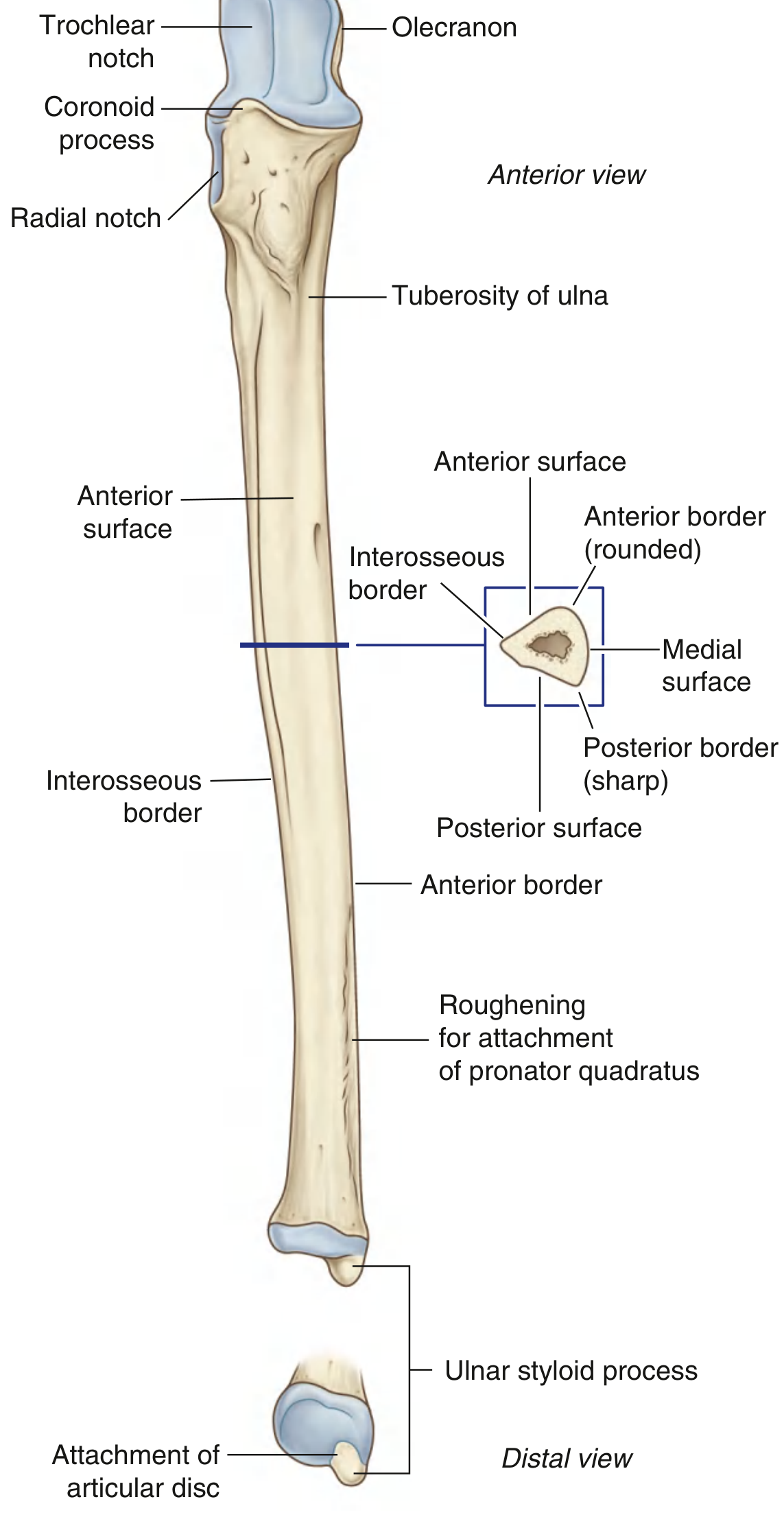
Overview
The ulna has a broad, hook-like proximal end that articulates with the distal humerus, and a narrow distal end that articulates with the radius and carpal bones. It can be divided into:
- Proximal end
- Shaft (body)
- Distal end
1. Proximal End
Olecranon
- A large, prism-shaped bony prominence on the posterior-superior aspect of the proximal ulna
- Its superior surface is rough and quadrilateral — insertion point for the triceps brachii and part of the posterior ligament
- Its posterior surface is triangular, smooth, and covered by the olecranon bursa
- Its anterior surface is smooth and concave, forming the upper part of the trochlear (semilunar) notch
- Medial surface: attachment for the posterior and oblique bands of the ulnar collateral ligament, and the flexor carpi ulnaris
- Lateral surface: attachment for the anconeus muscle
Trochlear (Semilunar) Notch
- A large, C-shaped concave articular surface between the olecranon and coronoid process
- Articulates with the trochlea of the humerus at the humeroulnar joint (a hinge joint allowing flexion/extension)
Coronoid Process
- A triangular bony projection on the anterior-superior aspect of the proximal ulna
- Its superior surface is smooth and concave, forming the inferior part of the trochlear notch
- Composed of: tip, body, anterolateral facet, and anteromedial facet
- The radial notch is on its lateral surface — a narrow oval articular depression for the radial head (proximal radioulnar joint)
- The sublime tubercle on the anteromedial facet is the insertion for the anterior bundle of the medial collateral ligament
- Muscle origins: Brachialis (inserts here), flexor digitorum superficialis (from medial margin), flexor digitorum profundus, and pronator teres (from medial surface)
Tuberosity of the Ulna
- Located at the junction of the anterior surface of the coronoid process and the anterior ulnar shaft
- Secondary insertion site for brachialis
2. Shaft (Body)
The shaft is triangular in cross-section proximally and mid-portion, becoming cylindrical distally.
Three Borders
| Border | Description | Key Attachments |
|---|---|---|
| Anterior border | Smooth and rounded; extends from medial coronoid process to styloid process base | Upper ¾: flexor digitorum profundus; lower ¼: pronator quadratus |
| Posterior border | Sharp, palpable along its entire length; originates from confluence of medial and lateral borders of olecranon | Aponeurosis of flexor carpi ulnaris, extensor carpi ulnaris, flexor digitorum profundus (upper ¾) |
| Interosseous border | Lateral crest arising from lateral edge of radial notch; sharp | Attachment for the interosseous membrane (which links ulna to radius); supinator originates here |
Three Surfaces
| Surface | Description | Key Attachments |
|---|---|---|
| Anterior surface | Between anterior and interosseous borders; concave; narrows distally; contains a nutrient canal proximal to its midpoint | Upper ¾: flexor digitorum profundus; lower ¼: pronator quadratus |
| Medial surface | Between anterior and posterior borders; convex and smooth | Upper ¾: one head of flexor digitorum profundus |
| Posterior surface | Between interosseous and posterior borders; divided into three areas by ridges | Anconeus (above proximal ridge); supinator (along ridge margin); extensor pollicis longus, abductor pollicis longus (lateral area below ridge) |
3. Distal End
The distal ulna is slightly expanded, consisting of two parts:
Head of the Ulna
- Rounded, small
- Lateral (convex) surface: articulates with the sigmoid (ulnar) notch of the radius at the distal radioulnar joint
- Inferior surface: articulates with the articular disc (triangular fibrocartilage complex, TFCC), which separates the ulna from the carpus
Styloid Process of the Ulna
- A rounded osseous projection from the posteromedial aspect of the distal ulna
- Projects distally
- Attachment site for the ulnar collateral ligament
- Morphological variations are common: elongated, angulated, hypertrophic, or unfused (separate ossification center)
Ulnar Variance (Clinically Important)
| Type | Definition | Clinical Association |
|---|---|---|
| Ulnar-neutral | Distal cortex of ulnar head level with proximal lunate fossa cortex | Normal |
| Negative ulnar variance | Ulna shortened >2.5 mm; ulnar head cone-shaped and small | Associated with avascular necrosis (Kienböck disease) |
| Positive ulnar variance | Ulna longer — increases load on ulnocarpal joint | Associated with ulnar impaction syndrome; ulnar shortening osteotomy is the main treatment |
At neutral variance, the distal ulna bears ~18% of the load transmitted to the wrist. If the ulna is 2.5 mm longer, the ulnocarpal joint receives 42% more stress. — Imaging Anatomy: Bones, Joints, Vessels and Nerves
Articulations Summary
| Joint | Bones | Type |
|---|---|---|
| Humeroulnar | Trochlear notch ↔ Humeral trochlea | Hinge (flexion/extension) |
| Proximal radioulnar | Radial notch ↔ Radial head | Pivot (pronation/supination) |
| Distal radioulnar | Head of ulna ↔ Sigmoid notch of radius | Pivot |
| Ulnocarpal (indirect) | Head of ulna ↔ TFCC ↔ carpus | Through articular disc |
Key Muscle Attachments
| Muscle | Attachment Site on Ulna |
|---|---|
| Triceps brachii | Superior surface of olecranon (insertion) |
| Brachialis | Coronoid process + ulnar tuberosity (insertion) |
| Anconeus | Lateral surface of olecranon + posterior surface of shaft |
| Flexor carpi ulnaris | Medial surface of olecranon |
| Supinator | Upper posterior surface + interosseous border |
| Flexor digitorum profundus | Anterior + medial surfaces (upper ¾ of shaft) |
| Flexor digitorum superficialis | Anterior margin of medial coronoid surface |
| Pronator quadratus | Lower ¼ of anterior surface (insertion) |
| Pronator teres | Medial surface of coronoid process (origin) |
| Extensor carpi ulnaris | Posterior border (upper ¾) |
| Extensor pollicis longus, Abductor pollicis longus | Lateral area of posterior surface |
| Ulnar collateral ligament | Medial olecranon; styloid process |
| Anterior bundle of medial collateral ligament | Sublime tubercle (anteromedial coronoid facet) |
Ossification
The ulna ossifies from three centers:
- Primary center: shaft (diaphysis) — appears ~8th week of fetal life
- Secondary center for olecranon — appears ~10 years; fuses ~16 years
- Secondary center for distal head — appears ~5 years; fuses ~20 years
Sources: Gray's Anatomy for Students, p. 893–894 | Imaging Anatomy: Bones, Joints, Vessels and Nerves, pp. 96–97
This is a shared conversation. Sign in to Orris to start your own chat.