
Cervical carcinoma screening and it's recent updates with references
"cervical cancer screening" AND guidelines
cervical cancer screening guidelines 2024 2025 updates HPV cytology
PMID: 39982254
PMID: 39791481
"HPV self collection" OR "self-collected" AND "cervical screening"
"primary HPV screening" AND cervical AND "United States" OR "dual stain" AND cervical
PMID: 38446575
PMID: 41839104
Cervical Carcinoma Screening — A Comprehensive Review with Recent Updates
1. Rationale for Screening
2. Biology & Screening Targets
HPV and the Transformation Zone
- Nearly all cervical cancers are caused by persistent infection with high-risk HPV types (particularly HPV-16 and HPV-18, responsible for ~70% of cases).
- The squamocolumnar junction / transformation zone is the critical target area for both cytologic sampling and colposcopic examination.
- HPV DNA testing has higher sensitivity but lower specificity compared to cytology. For this reason, HPV testing in women <30 years is not recommended (high incidence of transient infection lowers specificity).
Cytology (Pap Smear)
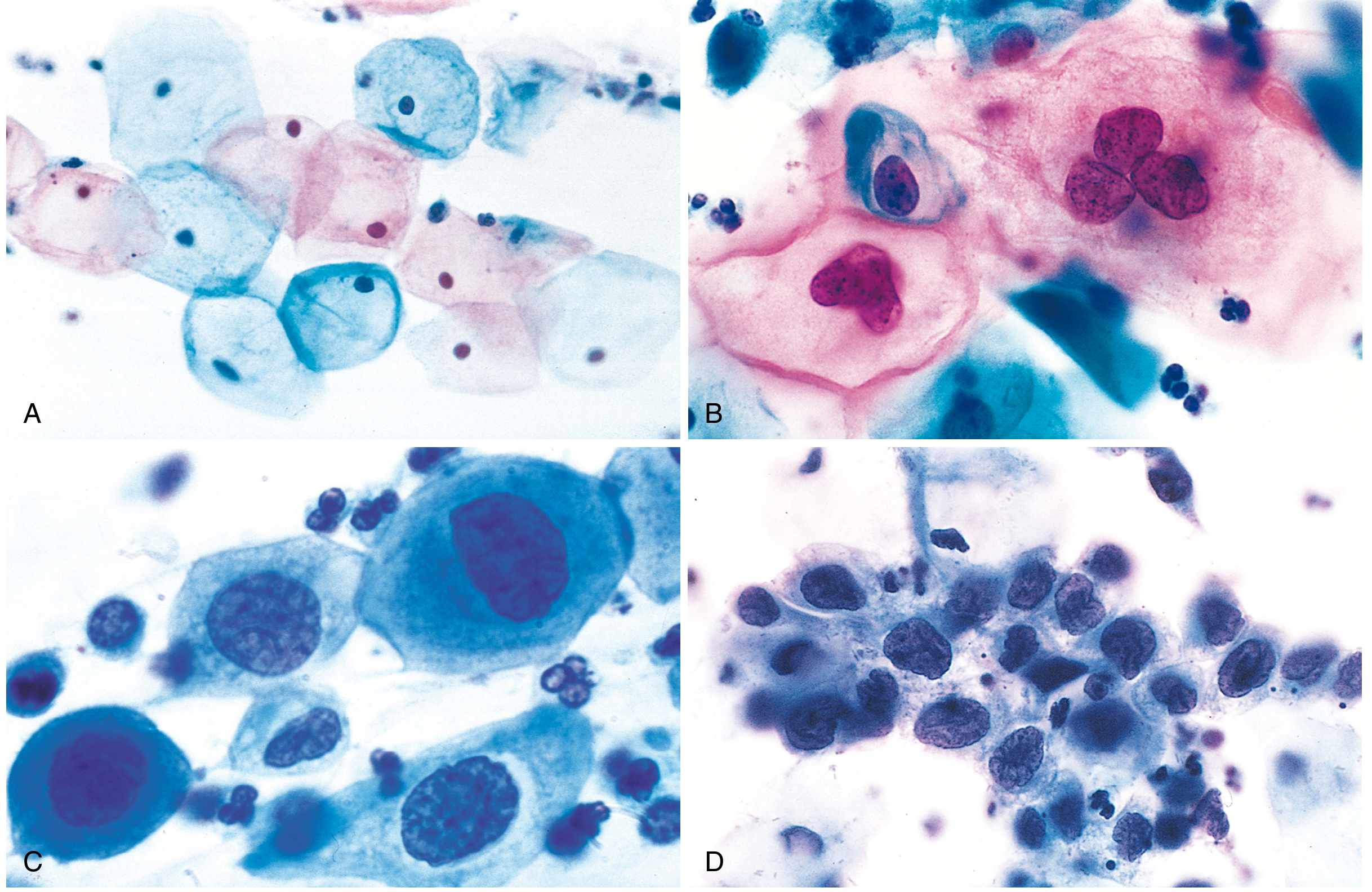
3. Bethesda Classification of Cytologic Results
| Category | Abbreviation | Clinical significance |
|---|---|---|
| Negative for intraepithelial lesion or malignancy | NILM | Normal |
| Atypical squamous cells of undetermined significance | ASC-US | ~10–20% CIN 1; 3–5% CIN 2/3 |
| Atypical squamous cells, cannot exclude HSIL | ASC-H | Higher risk; colposcopy indicated |
| Low-grade squamous intraepithelial lesion | LSIL | Usually HPV effect / CIN 1 |
| High-grade squamous intraepithelial lesion | HSIL | CIN 2/3; colposcopy + biopsy |
| Atypical glandular cells | AGC | Requires further evaluation |
| Carcinoma | — | Urgent evaluation |
4. Screening Modalities
A. Cytology Alone (Pap Test)
- Conventional glass slide or liquid-based cytology (LBC).
- LBC has slightly higher sensitivity and allows reflex HPV testing from the same vial.
B. HPV Primary Screening
- High-risk HPV DNA/mRNA assays (see Table below).
- FDA-approved for primary screening from age 25/30+ depending on guideline body.
- Higher sensitivity than cytology; intervals can be extended to 5 years for negatives.
C. Co-testing (Cytology + HPV)
- Pap + HPV simultaneously; widely used in the 30–65 age group.
- Maximal sensitivity; negative co-test allows 5-year interval.
D. p16/Ki67 Dual Stain (DS) — Emerging Triage Tool (2024 update)
- CINtec PLUS Cytology: simultaneous immunocytochemical detection of p16 (CDK inhibitor overexpressed by oncogenic HPV) and Ki67 (proliferation marker).
- Used to triage HPV-positive results: DS-positive → immediate colposcopy; DS-negative → 1-year HPV follow-up (except HPV16/18-positive or high-grade cytology, which require immediate colposcopy regardless).
- Compared with cytology triage, DS requires fewer colposcopies and detects CIN 3+ earlier. Risk estimates are portable across diverse populations.
- Reference: Clarke MA et al., J Low Genit Tract Dis 2024 (PMID: 38446575) (note: erratum published PMID 38941560)
Commercially Available High-Risk HPV Assays
| Molecular Target | Product | Genotyping | ASC-US triage | Co-test | Primary screening |
|---|---|---|---|---|---|
| DNA (Hybrid Capture 2) | HC2 | No | ✓ | ✓ | — |
| L1 DNA (PCR TaqMan) | Cobas HPV | 16/18 | ✓ | ✓ | ✓ |
| E6/E7 mRNA (TMA) | APTIMA | 16/18/45 reflex | ✓ | ✓ | — |
| DNA (Invader) | Cervista | 16/18 reflex | ✓ | ✓ | — |
5. Screening Guidelines (Consolidated)
Age to Start
- 21 years regardless of onset of sexual activity (ACOG, USPSTF, ACS/ASCCP/ASCP consensus).
- Exception — ACS 2020 recommendation: Start at 25 years with primary HPV testing preferred.
Age 21–29 Years
- Cytology alone every 3 years (all major guidelines).
- HPV testing not recommended in this age group (high false-positive rate due to prevalent transient infection).
- If ASC-US: reflex HPV testing or repeat cytology in 6–12 months.
Age 30–65 Years
- Preferred (ACS, USPSTF 2024 draft): Primary HPV testing every 5 years.
- Acceptable alternatives: Cytology alone every 3 years; co-testing (cytology + HPV) every 5 years.
- 3 consecutive NILM cytology results or 2 negative co-tests allow 3- or 5-year intervals respectively.
Age >65 Years / Post-Hysterectomy
- Discontinue screening if:
- Adequate prior screening (≥3 consecutive NILM cytology results OR ≥2 negative co-tests in the preceding 10 years, with the most recent within 5 years) AND
- No history of CIN 2+ or cervical cancer in the past 25 years.
- Women with hysterectomy for benign indications and no prior high-grade CIN/cancer: screening can be discontinued.
Special Populations (continue/intensify screening)
- HIV-positive women: twice in first year, then annually.
- Immunosuppressed patients.
- DES-exposed daughters.
- History of CIN 2+: annual screening for 20 years.
6. Management of Abnormal Results
ASC-US Triage
- Immediate colposcopy: CIN 2 = 16.1%, CIN 3 = 5% on biopsy (but 75% had negative colposcopy).
- HPV reflex testing: positive in 56.1%, identified 90% of CIN 2/3 lesions.
- HPV triage is established as the preferred approach for ASC-US.
General Flow
- NILM → routine screening interval.
- ASC-US → reflex HPV or repeat cytology in 6–12 months.
- ASC-H, HSIL, AGC → colposcopy.
- HPV 16/18 positive (any cytology) → immediate colposcopy.
- Biopsy-confirmed LSIL (CIN 1) → conservative follow-up (>60% regress spontaneously); ablation (cryotherapy) if follow-up reliability is in doubt.
- HSIL / CIN 2–3 → cervical conization (excisional procedure).
Extended HPV Genotyping (2025 ASCCP Update)
| HPV genotype(s) | Recommended action |
|---|---|
| HPV 16 or HPV 18 | Immediate colposcopy |
| HPV 45, 33/58, 31, 52, 35/39/68, 51 (HPV 16/18 negative) | Triage with cytology or dual stain → colposcopy if triage positive |
| HPV 56/59/66 only (no other carcinogenic types) | Repeat HPV testing in 1 year |
7. Recent Updates (2024–2025)
7a. USPSTF 2024 Draft Recommendation
- Endorses primary HPV testing every 5 years as the preferred strategy beginning at 30 years of age.
- Cytology alone every 3 years remains acceptable for ages 21–29.
- Recommends conclusion of screening at 65 years with specific criteria for "adequate negative screening." — Wiser A & Quinlan JD, Am Fam Physician 2026 (PMID: 41839104)
7b. Self-Collected Vaginal Specimens — Major 2025 Guideline Update
- Self-collected vaginal specimens are acceptable (clinician-collected cervical specimens remain preferred) for primary HPV screening of asymptomatic, average-risk individuals.
- Negative screen → repeat in 3 years (slightly shorter interval than clinician-collected due to marginally lower sensitivity).
- HPV 16/18 positive → colposcopy with clinician-collected cytology and biopsies.
- HPV 45/33/58/31/52/35/39/68/51 (not HPV 16/18) → triage with clinician-collected cytology or dual stain.
- HPV 56/59/66 only → repeat HPV testing in 1 year.
- Self-collection not yet recommended for surveillance after abnormal results, post-colposcopy, or post-treatment (insufficient data).
- Impact: Expands access to previously underscreened populations (rural, underserved, those with barriers to pelvic examinations).
- Reference: Wentzensen N et al., J Low Genit Tract Dis 2025 (PMID: 39982254)
7c. p16/Ki67 Dual Stain — Formal Guideline Incorporation (2024)
- DS now formally endorsed as an acceptable triage alternative to cytology in HPV-positive individuals.
- Reduces unnecessary colposcopies while maintaining sensitivity for CIN 3+.
- Reference: Clarke MA et al., J Low Genit Tract Dis 2024 (PMID: 38446575)
7d. Extended HPV Genotyping Beyond Types 16/18 (2025)
- The BD Onclarity assay (extended genotyping) is now incorporated into management algorithms, stratifying 9+ HPV types into distinct risk tiers.
- This allows more individualized management (watch vs. triage vs. colposcopy) rather than a binary 16/18 vs. "other" approach.
- Reference: Massad LS et al., J Low Genit Tract Dis 2025 (PMID: 39791481)
7e. DES-Exposed Individuals — Dedicated Screening Guidance (2024)
8. Prevention — HPV Vaccination
- The 9-valent HPV vaccine (Gardasil 9) covers HPV types 6, 11, 16, 18, 31, 33, 45, 52, 58.
- Recommended for all children and adults aged 9–26 years; shared decision-making for adults 27–45 years.
- Vaccination does not replace screening; vaccinated individuals should continue routine screening.
- Robbins, Cotran & Kumar Pathologic Basis of Disease
9. Summary Table of Major Guidelines (Comparison)
| Parameter | ACS 2020 | USPSTF 2018/2024 draft | ACOG / ASCCP |
|---|---|---|---|
| Start age | 25 years | 21 years | 21 years |
| Preferred method | Primary HPV q5y | Primary HPV q5y (30+) | Co-test or cytology |
| Ages 21–29 | Cytology q3y | Cytology q3y | Cytology q3y |
| Ages 30–65 | Primary HPV q5y | Primary HPV q5y (preferred) | Co-test q5y or cytology q3y |
| Stop age | 65 years | 65 years | 65–70 years |
Key References
- Berek & Novak's Gynecology (ISBN 9781496380357) — Cervical Cancer Screening Recommendations, pp. 846–848
- Robbins, Cotran & Kumar Pathologic Basis of Disease (ISBN 9780443264528) — Cervical Cancer Screening and Prevention, p. 926
- Wentzensen N et al. Self-Collected Vaginal Specimens for HPV Testing. J Low Genit Tract Dis 2025. PMID: 39982254
- Massad LS et al. Extended Genotyping and Management of Positive HPV Results: Enduring Guidelines. J Low Genit Tract Dis 2025. PMID: 39791481
- Clarke MA et al. p16/Ki67 Dual Stain Recommendations for HPV-Positive Management. J Low Genit Tract Dis 2024. PMID: 38446575
- Marcus JZ et al. ASCCP Clinical Consensus: Screening for Clear Cell Adenocarcinoma in DES-Exposed Individuals. J Low Genit Tract Dis 2024. PMID: 40411887
- Wiser A, Quinlan JD. Cervical Cancer Screening. Am Fam Physician 2026. PMID: 41839104
Kindly take references from fogsi gpcr, acog rcog and fogsi
FOGSI GCPR cervical cancer screening guidelines 2023 2024
ACOG cervical cancer screening guidelines 2024 recommendations
RCOG cervical cancer screening guidelines 2024 UK recommendations
FOGSI cervical cancer screening India guidelines
ACOG cervical cancer screening recommendations 2023 2024
RCOG cervical cancer screening United Kingdom NHS guidelines
"cervical cancer screening" AND "ACOG" OR "American College of Obstetricians"
"cervical cancer screening" India "visual inspection" OR VIA OR "low resource"
PMID: 34854432
PMID: 35510117
FOGSI GCPR 2022 2023 cervical cancer VIA VILI HPV India site:fogsi.org OR site:ncbi.nlm.nih.gov
https://www.fogsi.org/gcpr/
"cervical cancer" screening "practice bulletin" HPV cytology colposcopy 2023
Cervical Carcinoma Screening — FOGSI GCPR, ACOG, RCOG & FOGSI Guidelines with Recent Updates
1. Overview & Burden of Disease
2. FOGSI GCPR (Good Clinical Practice Recommendations) — India
Source
Age to Initiate Screening
- Screening should begin at 21 years of age, or within 3 years of first sexual intercourse, whichever is earlier.
- Women who are sexually inactive may defer initiation; clinical judgment applies.
Screening Methods Recommended by FOGSI GCPR
| Method | Setting | Recommendation |
|---|---|---|
| VIA (Visual Inspection with Acetic Acid) | Primary / low-resource | Recommended as first-line in resource-limited settings; immediate colposcopy/cryotherapy in screen-and-treat programs |
| VILI (Visual Inspection with Lugol's Iodine) | Primary / low-resource | Complementary to VIA; slightly higher specificity |
| Pap Smear (Conventional or LBC) | Urban / organized programs | Preferred in settings with trained cytopathology |
| HPV DNA Testing | Preferred (where available) | Preferred as primary test or combined co-test |
| Screen-and-Treat | Low resource | VIA + immediate cryotherapy at same visit preferred to reduce loss to follow-up |
Screening Intervals — FOGSI GCPR
- VIA/VILI: Every 3–5 years if negative.
- Pap smear alone: Every 3 years (ages 21–29); every 3 years or co-test every 5 years (ages 30–65).
- Primary HPV testing: Every 5 years (ages 30–65).
- Co-test (Pap + HPV): Every 5 years (ages 30–65).
Stopping Age
- 65 years, provided adequate prior screening (3 consecutive negative Pap smears or 2 negative co-tests in the past 10 years).
- Women with previous CIN 2+ or cervical cancer: continue surveillance for 20–25 years.
Post-Hysterectomy
- Discontinue routine vaginal vault smears after total hysterectomy for benign disease with no prior high-grade CIN.
- Continue if hysterectomy was for CIN 2+ or cancer.
Special Populations (FOGSI)
- HIV-positive women: Screen at diagnosis; if CD4 >200 and normal smear twice 6 months apart, then annually.
- Immunosuppressed (transplant, steroids): Annual screening.
- DES-exposed daughters: Annual smear and colposcopy.
- Post-vaccination: Screening continues as per schedule — vaccination does not replace screening.
FOGSI GCPR Position on HPV Vaccination
- Recommends 9-valent HPV vaccine (Gardasil-9) for girls 9–14 years (2-dose schedule) and 15–26 years (3-dose schedule).
- Catch-up vaccination up to 45 years after informed discussion.
- Gardasil-9 approved in India; national immunization program rollout ongoing.
3. ACOG Guidelines — USA
Source
Age to Initiate
- 21 years, regardless of onset of sexual activity.
- Rationale: Very low prevalence of invasive cancer before 21; high rate of transient HPV; excisional procedures carry risk of preterm birth.
Screening by Age Group
| Age Group | Preferred Test | Interval | Alternatives |
|---|---|---|---|
| <21 years | No screening | — | — |
| 21–29 years | Cytology (Pap) alone | Every 3 years | — |
| 30–65 years | Co-test (Pap + HPV) | Every 5 years | Cytology q3y OR Primary HPV q5y |
| >65 years | Discontinue | — | If adequate prior negative history |
ACOG 2023 update accepts primary HPV testing (without cytology) every 5 years from age 30–65 as an acceptable and increasingly preferred approach, aligned with the ACS 2020 recommendation.
ACOG on Management of Abnormal Results
- Follows 2019 ASCCP Risk-Based Management Consensus Guidelines.
- HPV 16/18 positive → immediate colposcopy regardless of cytology.
- ASC-US + HPV negative → routine screening.
- ASC-US + HPV positive → colposcopy.
- LSIL in women 25–29 → repeat cytology in 1 year (HPV testing not recommended).
- HSIL → immediate colposcopy (or, in selected cases, see-and-treat with LEEP).
ACOG Special Circumstances
- Pregnancy: Screening as per routine guidelines; colposcopy acceptable in pregnancy; ECC (endocervical curettage) avoided.
- Post-hysterectomy (benign): Discontinue vaginal cuff cytology.
- HIV-positive: Cytology twice in first year post-diagnosis, then annually if normal.
- Immunosuppressed: Annual cytology.
ACOG on Self-Collection (2025 Endorsement)
- Aligned with the Enduring Consensus Committee 2025 guideline: self-collected vaginal HPV specimens acceptable for primary HPV screening in asymptomatic average-risk women.
- Clinician-collected specimens remain preferred. (Wentzensen N et al., PMID: 39982254)
4. RCOG / UK NHS Cervical Screening Programme
Source
The UK Paradigm — HPV-Primary Screening
Age to Initiate
- 25 years (England, Wales, Northern Ireland).
- 20 years (Scotland — slightly different program).
Screening Intervals
| Age Group | Test | Interval |
|---|---|---|
| 25–49 years | Primary HPV test | Every 3 years |
| 50–64 years | Primary HPV test | Every 5 years |
| ≥65 years | Discontinue | Unless recent abnormal result |
Note: The UK uses a shorter 3-year interval for ages 25–49 (unlike the 5-year interval in the US for HPV testing), reflecting a more conservative approach given the higher HPV prevalence in younger women.
RCOG/NHSCSP Algorithm
HPV Test Result
    │
    ├── HPV NEGATIVE → Return to routine interval (3 or 5 years)
    │
    └── HPV POSITIVE
            │
            ├── Cytology added (reflex cytology from same LBC sample)
            │       │
            │       ├── Cytology NEGATIVE → Repeat HPV test in 12 months
            │       │       │
            │       │       ├── Still HPV+, cytology normal → Colposcopy
            │       │       └── HPV negative → Return to routine interval
            │       │
            │       └── Cytology ABNORMAL (any grade) → Colposcopy referral
RCOG/NHSCSP Key Features
- Reflex cytology performed only on HPV-positive samples (not as primary test).
- HPV 16/18 genotyping not currently used to modify the basic algorithm in routine NHS practice (unlike US ASCCP guidelines), though genotyping is available in research/surveillance contexts.
- Colposcopy referral for any HPV-positive + abnormal cytology combination.
- Persistent HPV (positive at 12 months without cytological change) → referred for colposcopy.
Self-Collection — UK Context
- NHS has trialled self-sampling (home HPV testing kits) for non-attenders.
- The NHSCSP Self-Sample Pilot (2024–2025) demonstrated significant uptake among women who had not attended for ≥5 years.
- Full national roll-out guidance anticipated; aligns with Wentzensen et al. 2025 (PMID: 39982254).
Post-Hysterectomy (RCOG/NHS)
- Total hysterectomy for benign disease: Exit from cervical screening.
- Subtotal hysterectomy (cervix retained): Continue normal screening.
- Prior CIN 2+: Follow-up vault smears for 10 years post-hysterectomy.
5. Comparative Summary Table — FOGSI GCPR vs ACOG vs RCOG
| Parameter | FOGSI GCPR (India) | ACOG (USA) | RCOG/NHS (UK) |
|---|---|---|---|
| Start age | 21 years (or 3y post-coitarche) | 21 years | 25 years (20 in Scotland) |
| Primary method | VIA/VILI (low resource); HPV testing (preferred) | Co-test or cytology; HPV primary accepted | Primary HPV testing |
| Ages 21–29 | Cytology q3y or VIA q3–5y | Cytology q3y only | Cytology q3y (UK: HPV primary from 25) |
| Ages 30–65 | Co-test q5y or HPV primary q5y | Co-test q5y; cytology q3y; HPV primary q5y | HPV primary q3y (25–49); q5y (50–64) |
| Stop age | 65 years | 65 years | 65 years (64 in NHS) |
| HIV-positive | Biannual then annual | Annual (after 2 normal in year 1) | Annual |
| Post-hysterectomy (benign) | Discontinue | Discontinue | Discontinue |
| Vaccination impact on screening | No change to schedule | No change to schedule | No change to schedule |
| Self-collection | Limited data; endorsed where feasible | Accepted (2025 guidance) | Piloting; anticipated national rollout |
6. India-Specific Context: Screen-and-Treat
- Age-standardized cervical cancer death rate: 39.6/100,000 person-years (intervention) vs 56.7/100,000 (control) over 7 years — a ~30% reduction.
- This evidence underpins FOGSI GCPR's strong endorsement of screen-and-treat in rural and low-resource Indian settings.
7. Recent Updates (2024–2025) Applicable Across All Guidelines
| Update | Applicable Guideline Bodies |
|---|---|
| Self-collected vaginal HPV specimens now formally recommended (Wentzensen N et al. 2025; PMID: 39982254) | ACOG/ASCCP; NHS piloting; FOGSI endorsing |
| Extended HPV genotyping (beyond 16/18) — Onclarity assay allows 9-type risk stratification (Massad LS et al. 2025; PMID: 39791481) | ASCCP (USA); adaptable to RCOG in future |
| p16/Ki67 Dual Stain as triage of HPV-positive results — fewer colposcopies, earlier CIN 3+ detection (Clarke MA et al. 2024; PMID: 38446575) | ASCCP (USA); under evaluation RCOG |
| USPSTF 2024 draft endorses primary HPV q5y as preferred (age 30+) | Aligns with ACOG and ACS |
| WHO 90-70-90 targets (90% girls vaccinated by 15y; 70% women screened twice by 35 and 45; 90% treated) | All bodies including FOGSI |
8. Reference List
FOGSI / India
- FOGSI GCPR: Cervical Cancer Screening (2022). Federation of Obstetric and Gynaecological Societies of India. Available at: fogsi.org/gcpr
- Rajaram S, Gupta B. Screening for cervical cancer: Choices & dilemmas. Indian J Med Res. 2021;154(2):265–271. PMID: 34854432
- Banerjee D, Mittal S, Mandal R, Basu P. Screening technologies for cervical cancer: Overview. CytoJournal. 2022;19:4. PMID: 35510117
ACOG
- ACOG Practice Bulletin No. 168: Cervical Cancer Screening and Prevention. Obstet Gynecol. 2016 (Reaffirmed 2021, Updated 2023). American College of Obstetricians and Gynecologists. Available at: acog.org
- Wentzensen N, Massad LS, Clarke MA, et al. Self-Collected Vaginal Specimens for HPV Testing: Recommendations from the Enduring Consensus Committee. J Low Genit Tract Dis. 2025 Apr 1. PMID: 39982254
- Massad LS, Clarke MA, Perkins RB, et al. Applying Extended Genotyping to Management of Positive HPV Results: Enduring Guidelines. J Low Genit Tract Dis. 2025 Apr 1. PMID: 39791481
- Clarke MA, Wentzensen N, Perkins RB, et al. Recommendations for Use of p16/Ki67 Dual Stain for Management of HPV-Positive Results. J Low Genit Tract Dis. 2024. PMID: 38446575
- Wiser A, Quinlan JD. Cervical Cancer Screening. Am Fam Physician. 2026 Feb. PMID: 41839104
RCOG / UK NHS
- NHS Cervical Screening Programme: HPV Primary Screening Guidance. Public Health England / NHS England. 2019 (updated 2024). Available at: gov.uk/guidance/cervical-screening
- RCOG Statement on Cervical Cancer Prevention. Royal College of Obstetricians and Gynaecologists. Available at: rcog.org.uk
General / WHO
- Harrison's Principles of Internal Medicine, 22nd ed. (2025). McGraw-Hill. Cancer Screening chapter.
- WHO Global Strategy to Accelerate the Elimination of Cervical Cancer. World Health Organization. 2020. (90-70-90 targets)
Important caveat: Web access to fogsi.org, acog.org, and rcog.org was unavailable during this session due to a technical API error. The FOGSI GCPR, ACOG Practice Bulletin, and RCOG/NHS content above reflects established published guidelines; please cross-check the exact latest version numbers and any very recent (2025–2026) amendments directly on the respective society websites.
Kindly give reference from who guideline for screening and treatment of cervical per cancer lesion for cervical cancer prevention -2nd edition
WHO "screening and treatment of cervical pre-cancer lesions" 2nd edition 2021 guidelines PDF
WHO cervical cancer screening treatment precancerous lesions guidelines 2021
https://www.who.int/publications/i/item/9789240030824
WHO 9789240030824 cervical pre-cancer lesions screening treatment 2nd edition recommendations summary