
Ig4 related disease and salivary gland lesions Robbins based from diseases of immune system md pathology exam easy answer
Reading File
Finding Sources
Finding Sources
Searching PubMed
"IgG4-Related Disease"[MeSH Terms] AND "Salivary Glands"[MeSH Terms]
Searching the Web
Robbins pathology IgG4 related disease salivary glands Mikulicz disease features
Finding Sources
Finding Sources
Reading File
IgG4-Related Disease with Salivary Gland Lesions
Definition:
IgG4-related disease (IgG4-RD) is a systemic fibro-inflammatory disease characterized by infiltration of tissues by IgG4-producing plasma cells and lymphocytes, with progressive fibrosis. It commonly affects middle-aged to older men.
IgG4-related disease (IgG4-RD) is a systemic fibro-inflammatory disease characterized by infiltration of tissues by IgG4-producing plasma cells and lymphocytes, with progressive fibrosis. It commonly affects middle-aged to older men.
It may involve many organs, including pancreas, bile ducts, salivary glands, lacrimal glands, kidneys, lungs, lymph nodes, aorta, thyroid, and retroperitoneum.
Robbins, Cotran & Kumar Pathologic Basis of Disease, p. 224.
Robbins, Cotran & Kumar Pathologic Basis of Disease, p. 224.
Key pathology features
Remember: P-F-O-I
- Plasma-cell rich lymphoplasmacytic infiltrate, especially IgG4+ plasma cells
- Fibrosis, often in a storiform or whorled pattern
- Obliterative phlebitis: venous lumen is obliterated by inflammation and fibrosis
- Increased serum IgG4, usually present but not diagnostic by itself
Pathogenesis
- Exact cause is unknown.
- Likely immune-mediated or autoimmune.
- B cells and T cells contribute to inflammation and fibrosis.
- IgG4 is abundant in lesions, but Robbins states that it is not proven to directly cause tissue damage.
- IgG4 poorly activates complement and has weak binding to leukocyte Fc receptors.
Salivary gland involvement
Salivary gland disease is called IgG4-related sialadenitis.
Clinical features
- Usually painless, chronic enlargement of salivary glands
- Often bilateral and symmetrical
- Mainly affects the submandibular glands
- Parotid and sublingual glands may also be involved
- May occur together with lacrimal-gland enlargement
- Xerostomia may occur, but is generally less severe than in Sjogren syndrome
- It can mimic a salivary-gland tumor clinically
Mikulicz disease
Mikulicz disease is now considered part of the IgG4-RD spectrum.
It presents with:
- Bilateral swelling of lacrimal glands
- Bilateral swelling of salivary glands, especially submandibular glands
- Usually painless and persistent swelling
Do not confuse it with Mikulicz syndrome, a descriptive term for lacrimal and salivary enlargement due to several possible diseases.
Küttner tumor
Küttner tumor is chronic sclerosing sialadenitis of the submandibular gland and may be an IgG4-related lesion.
- Firm, enlarged submandibular gland
- Can simulate malignancy
- Histology shows chronic inflammation with marked fibrosis
Histology of IgG4-related sialadenitis
- Dense infiltration by lymphocytes and plasma cells
- Numerous IgG4-positive plasma cells on immunohistochemistry
- Storiform fibrosis: characteristic cartwheel/whorled fibrosis
- Obliterative phlebitis
- Acinar destruction and glandular atrophy may occur in advanced disease
Robbins illustrates a submandibular gland showing lymphocytes, plasma cells, and whorls of fibrosis.
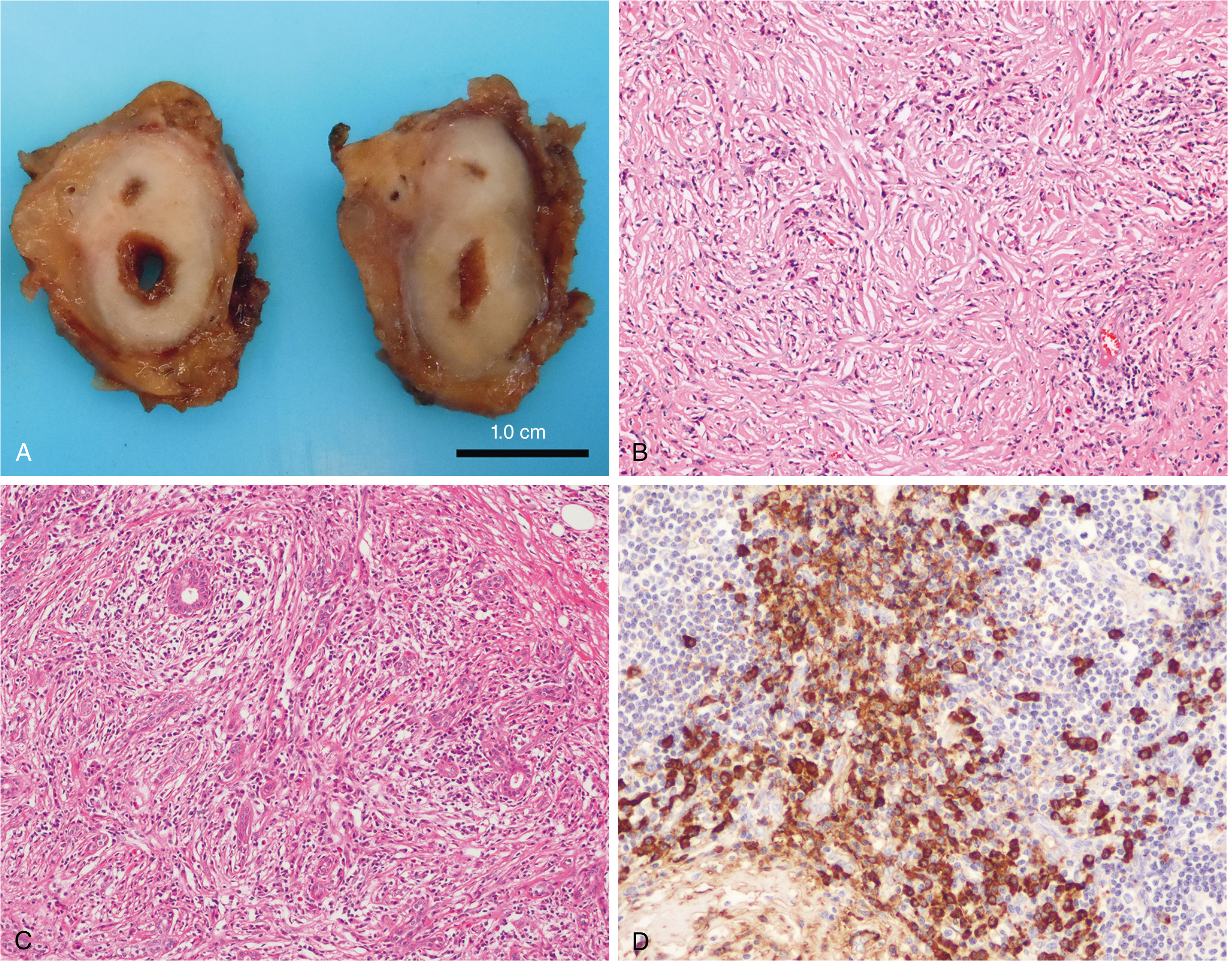
Robbins, Cotran & Kumar Pathologic Basis of Disease, Fig. 6.31, p. 224.
Differentiate from Sjogren syndrome
| Feature | IgG4-related sialadenitis | Sjogren syndrome |
|---|---|---|
| Typical patient | Older male | Middle-aged female |
| Gland enlargement | Painless, persistent, often submandibular | Often parotid; may be recurrent |
| Main infiltrating cells | IgG4+ plasma cells and lymphocytes | Predominantly CD4+ T cells, B cells |
| Fibrosis | Marked, storiform fibrosis | Not typically storiform |
| Serum findings | Raised IgG4 may occur | Anti-SSA/Ro and anti-SSB/La antibodies |
| Dry mouth/eyes | Usually milder | Prominent |
| Response to steroids | Usually good | Variable |
One-line exam answer
IgG4-related disease is a systemic fibro-inflammatory disorder marked by increased IgG4-positive plasma cells, dense lymphoplasmacytic infiltration, storiform fibrosis, and obliterative phlebitis. In salivary glands it produces painless chronic bilateral enlargement, especially of the submandibular glands, and includes Mikulicz disease and some cases of Küttner tumor.
A recent systematic-review search did not identify a salivary-gland-specific update that changes these core Robbins pathology points.
This is a shared conversation. Sign in to Orris to start your own chat.