
explain me length tension relationship and length velocity relationship in skeletal msucle
Reading File
Now let me search the library for both topics in parallel.
Finding Sources
Finding Sources
Finding Sources
Finding Sources
Excellent - found great sources. Let me read the key sections from Costanzo Physiology and Ganong's in parallel.
Reading File
Reading File
Now let me read the Force-Velocity section from Costanzo and get the Guyton section, plus fetch the key images - all in parallel.
Reading File
Finding Sources
Loading Image
Loading Image
Now let me fetch the force-velocity diagram and get the Guyton sarcomere overlap detail:
Loading Image
Reading File
Reading File
Loading Image
I now have everything needed for a thorough answer. Let me also fetch the Guyton force-velocity curve image:
Loading Image
I now have rich material from multiple authoritative textbooks. Here is the complete explanation:
Length-Tension Relationship in Skeletal Muscle
What It Describes
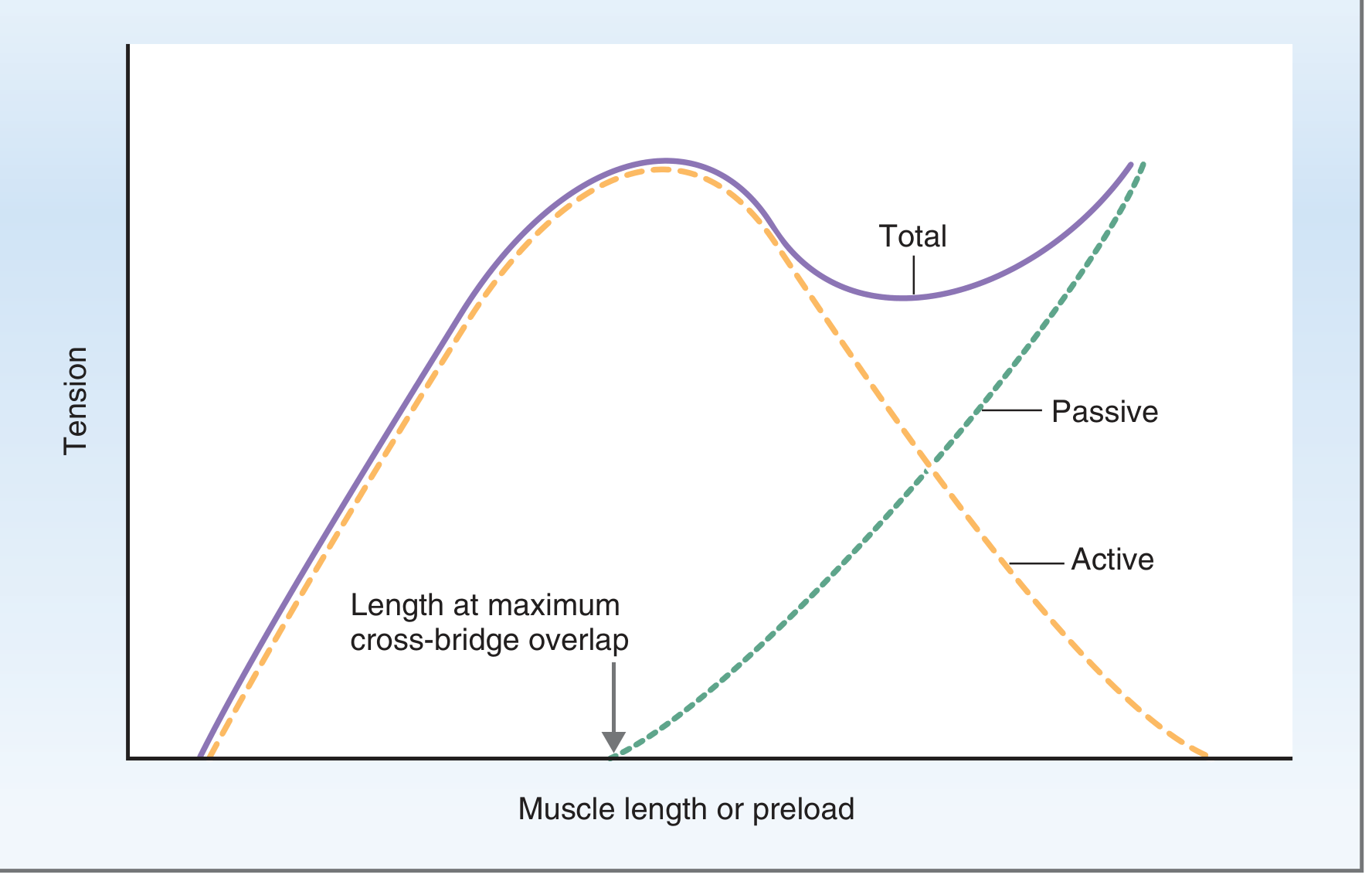
The length-tension relationship describes how the amount of tension a muscle fiber can develop during an isometric contraction depends on the muscle's initial length (preload) before it contracts. It is measured by fixing the muscle at various lengths, stimulating it electrically, and recording the tension generated at each length.
- Costanzo Physiology 7th Edition, p. 47
Three Components of Tension
| Component | Definition |
|---|---|
| Passive tension | Tension produced simply by stretching the resting, unstimulated muscle (like stretching a rubber band). Comes from elastic connective tissue elements. |
| Total tension | Tension measured when the muscle is stimulated to contract isometrically at each preset length. |
| Active tension | Total tension minus passive tension. Represents the true contractile force generated by cross-bridge cycling. |
Length-tension curve from Costanzo Physiology:
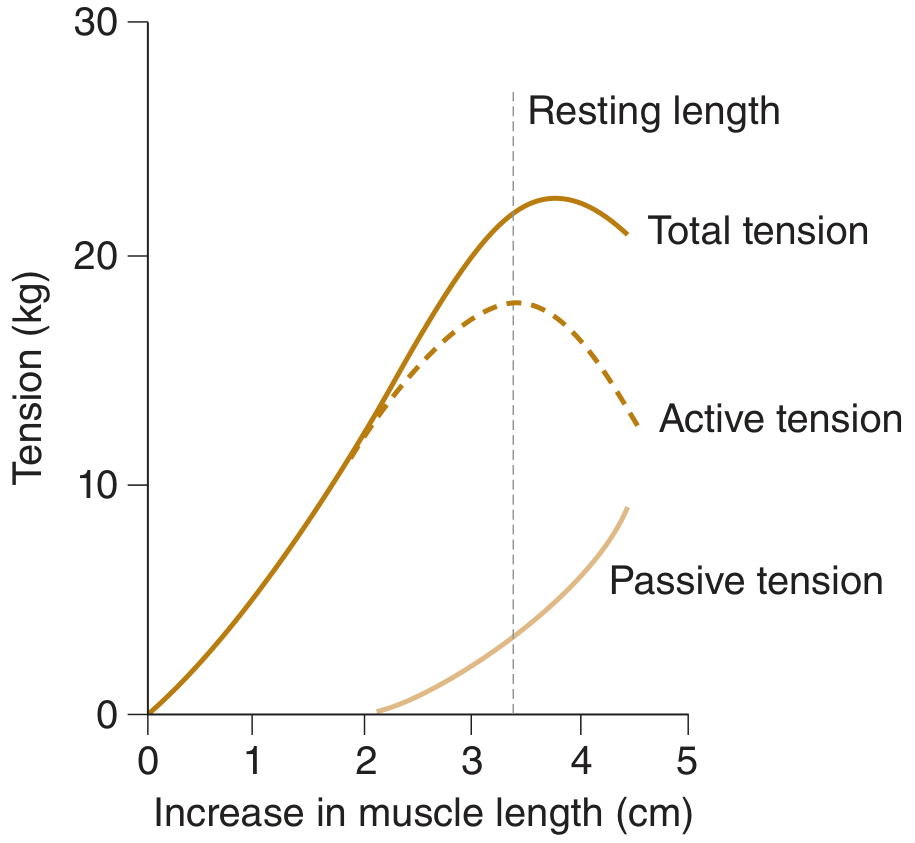
Length-tension curve from Ganong's (with actual values for human triceps):
Sarcomere-Level Explanation (The Key Mechanism)
This is best explained by looking at what happens at individual sarcomere lengths. The classic data comes from Gordon, Huxley, and Julian (1964), shown in Guyton & Hall:
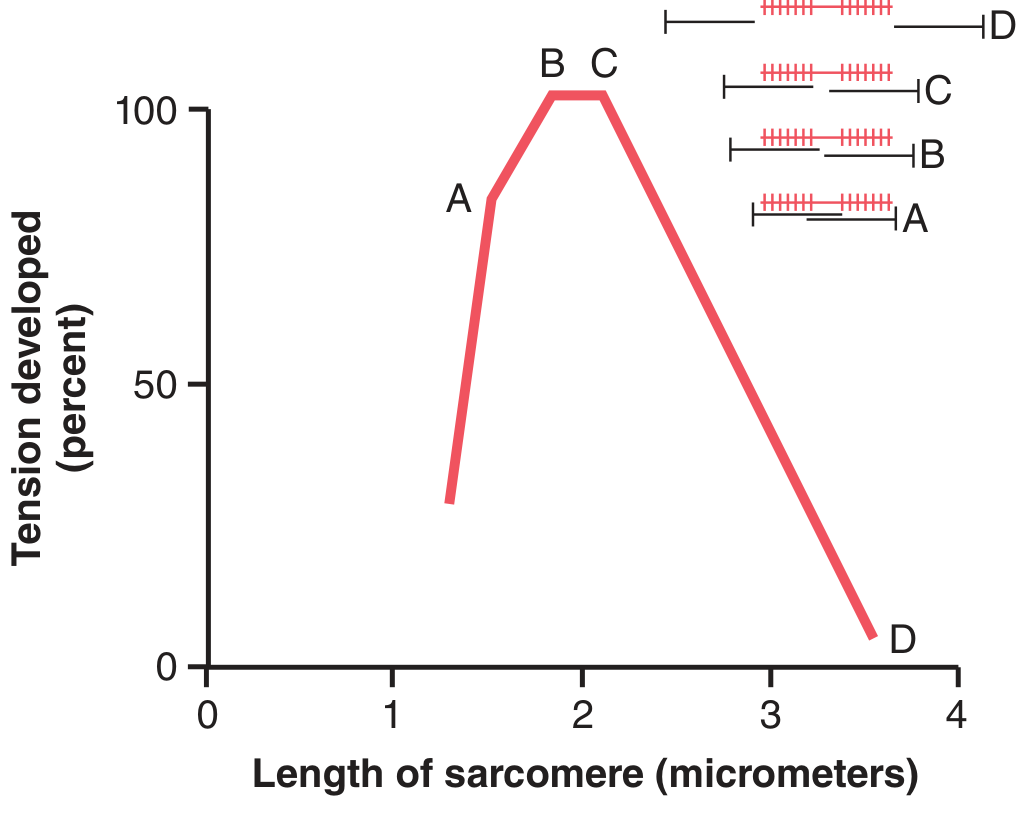
Active tension is directly proportional to the number of active actin-myosin cross-bridges. Here's what happens at each point:
| Sarcomere Length | Point | Cross-bridge Status | Tension |
|---|---|---|---|
| ~3.6 µm | D | Actin pulled completely out of myosin - zero overlap | ~0% |
| 2.2-2.0 µm | B-C | All cross-bridges on myosin are overlapping actin - maximal overlap | 100% (optimal) |
| ~1.65 µm | A | Z-disks abut ends of myosin filaments - actin filaments from both sides begin to overlap each other, reducing effective cross-bridges | ~75% and falling |
| <1.65 µm | Below A | Myosin filaments are crumpled - contraction approaches zero | Near 0% |
- Guyton and Hall Textbook of Medical Physiology, p. 96
Key principle: The length at which active tension is maximal is the optimal resting length (Lo). In most muscles in the body, the resting length in situ corresponds closely to this optimal length.
Why Passive Tension Rises at Long Lengths
At long muscle lengths, even though active tension falls (fewer cross-bridges), total tension is partially maintained because passive tension rises steeply. Passive tension comes from stretching of elastic proteins (mainly titin, the giant structural protein connecting myosin to the Z-disk) and connective tissue. This prevents over-stretching of sarcomeres.
Summary of the Active Tension Curve Shape
- Ascending limb (too short): Active tension increases as length increases, because more myosin cross-bridges become available as actin-myosin overlap improves.
- Plateau/optimum: Maximum cross-bridge cycling. Maximum active tension.
- Descending limb (too long): Stretching pulls actin out of myosin - overlap and cross-bridge number fall - active tension declines.
Length-Velocity (Force-Velocity) Relationship
What It Describes
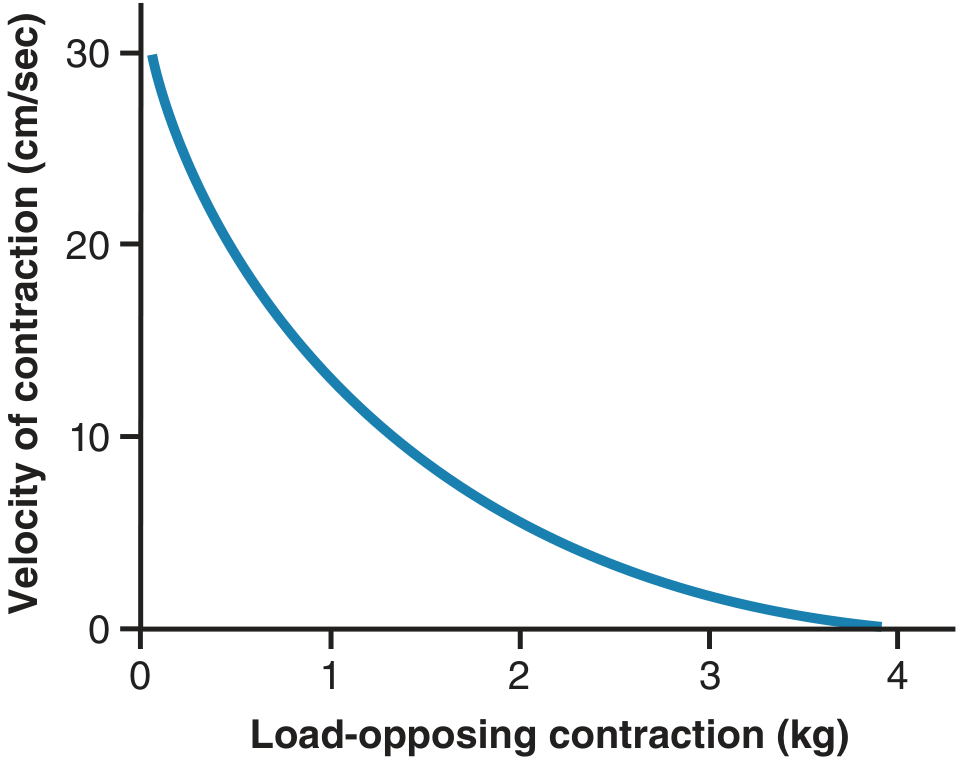
The force-velocity relationship describes how the velocity of muscle shortening changes as the afterload (the force opposing contraction) is varied. Unlike the length-tension relationship, this uses isotonic contractions - the force is fixed, and the muscle is allowed to shorten freely.
- Costanzo Physiology 7th Edition, p. 48
The Core Relationship
Velocity and afterload are inversely related - they follow a hyperbolic curve:
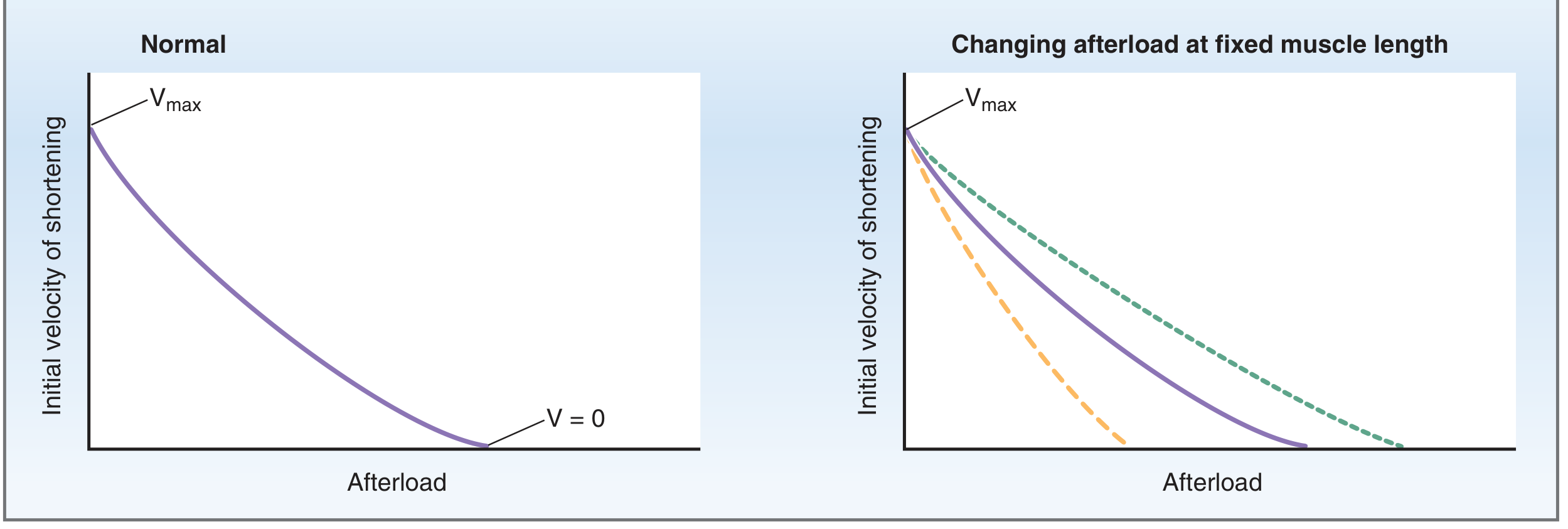
Key Points on the Curve
| Afterload | Velocity |
|---|---|
| Zero (no load) | V-max - maximum velocity of shortening. Cross-bridges cycle as fast as possible. |
| Increasing load | Velocity decreases progressively. The load opposes cross-bridge movement, slowing the cycle rate. |
| Load = maximum isometric force | V = 0. No shortening occurs despite full activation. This is the equivalent of an isometric contraction. |
- Guyton and Hall Textbook of Medical Physiology, p. 97
Mechanism
When a load is applied to a contracting muscle, it acts as a reverse force opposing the contractile force. The net force available to cause shortening = contractile force minus load. As the load increases, this net force decreases, and so does the velocity. At zero afterload, the muscle can cycle cross-bridges at maximum speed because there is no opposing force to slow them down.
"The velocity of shortening reflects the speed of cross-bridge cycling." - Costanzo Physiology
Effect of Preload on the Force-Velocity Curve
When the muscle is first set to different preloads (initial lengths) and then made to shorten against varying afterloads, a family of curves is generated (right panel in the Costanzo figure above). Each curve corresponds to a different preload:
- All curves converge at the same V-max (top of y-axis) when afterload = 0
- The curves differ in where they hit V = 0 on the x-axis - a muscle with greater preload (and thus more active tension) can overcome a greater afterload before V reaches zero
Relationship Between Length and Velocity
These two relationships are connected:
"The velocity of muscle contraction varies inversely with the load on the muscle. At a given load, the velocity is maximal at the resting length and declines if the muscle is shorter or longer than this length." - Ganong's Review of Medical Physiology, 26th Ed.
So the same optimal length (Lo) that gives maximum active tension in the length-tension curve also gives maximum velocity at any given load - because optimal overlap means more cross-bridges are available to generate force and drive faster cycling.
Quick Comparison
| Feature | Length-Tension | Force-Velocity |
|---|---|---|
| Contraction type | Isometric (length fixed) | Isotonic (force fixed) |
| X-axis | Muscle length / preload | Afterload (force) |
| Y-axis | Tension developed | Velocity of shortening |
| Mechanism | Cross-bridge number (overlap) | Cross-bridge cycling rate |
| Key extremes | Max tension at optimal Lo; zero at extremes | V-max at zero load; V=0 at max isometric force |
| What changes the curve | Changing preload shifts the family of force-velocity curves | Changing preload shifts the x-intercept; V-max stays constant |
This is a shared conversation. Sign in to Orris to start your own chat.