
functions of limbic system
I'll look this up in the medical library for an authoritative answer.
Reading File
Now let me search the medical library for limbic system content, in parallel with a web search.
Finding Sources
Searching the Web
limbic system functions anatomy neuroscience
Excellent sources found. Let me now read from the most authoritative textbooks in parallel - Guyton & Hall (physiology), Adams & Victor (neurology), and Kaplan & Sadock (psychiatry).
Reading File
Reading File
Reading File
Excellent content retrieved. Let me also get the Guyton & Hall content on specific limbic functions (hippocampus, amygdala, etc.) and fetch the anatomical diagram.
Reading File
Loading Image
Loading Image
I now have very rich content from multiple authoritative sources. Let me also quickly read the hippocampus and amygdala function sections from Guyton & Hall.
Finding Sources
Finding Sources
I now have comprehensive information from multiple authoritative sources. Let me compile the full answer.
Functions of the Limbic System
The word "limbic" comes from the Latin limbus meaning "border." The limbic system is the neuronal circuitry that controls emotional behavior, motivational drives, memory, and autonomic/endocrine regulation - essentially the interface between conscious experience and the body's internal environment.
Anatomy at a Glance
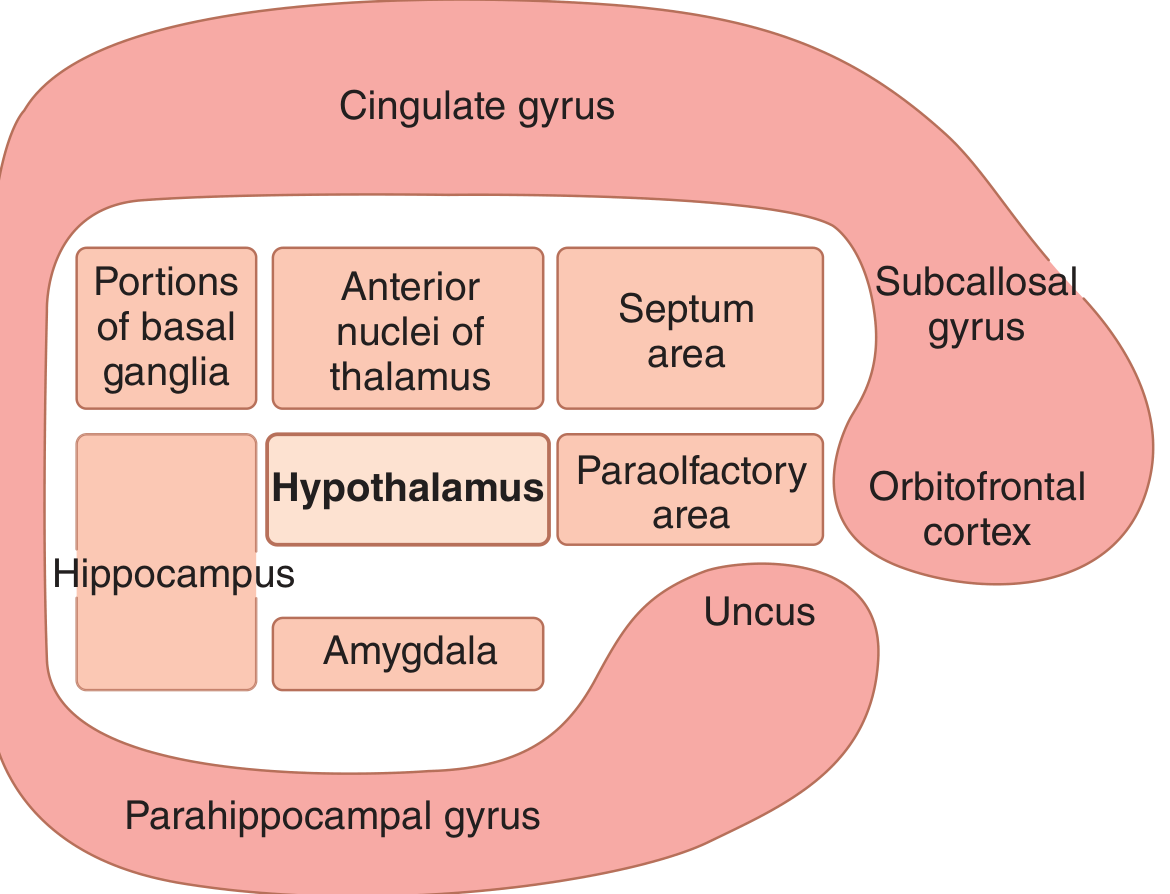
The limbic system showing the central position of the hypothalamus, surrounded by the hippocampus, amygdala, septum, cingulate gyrus, parahippocampal gyrus, and orbitofrontal cortex.
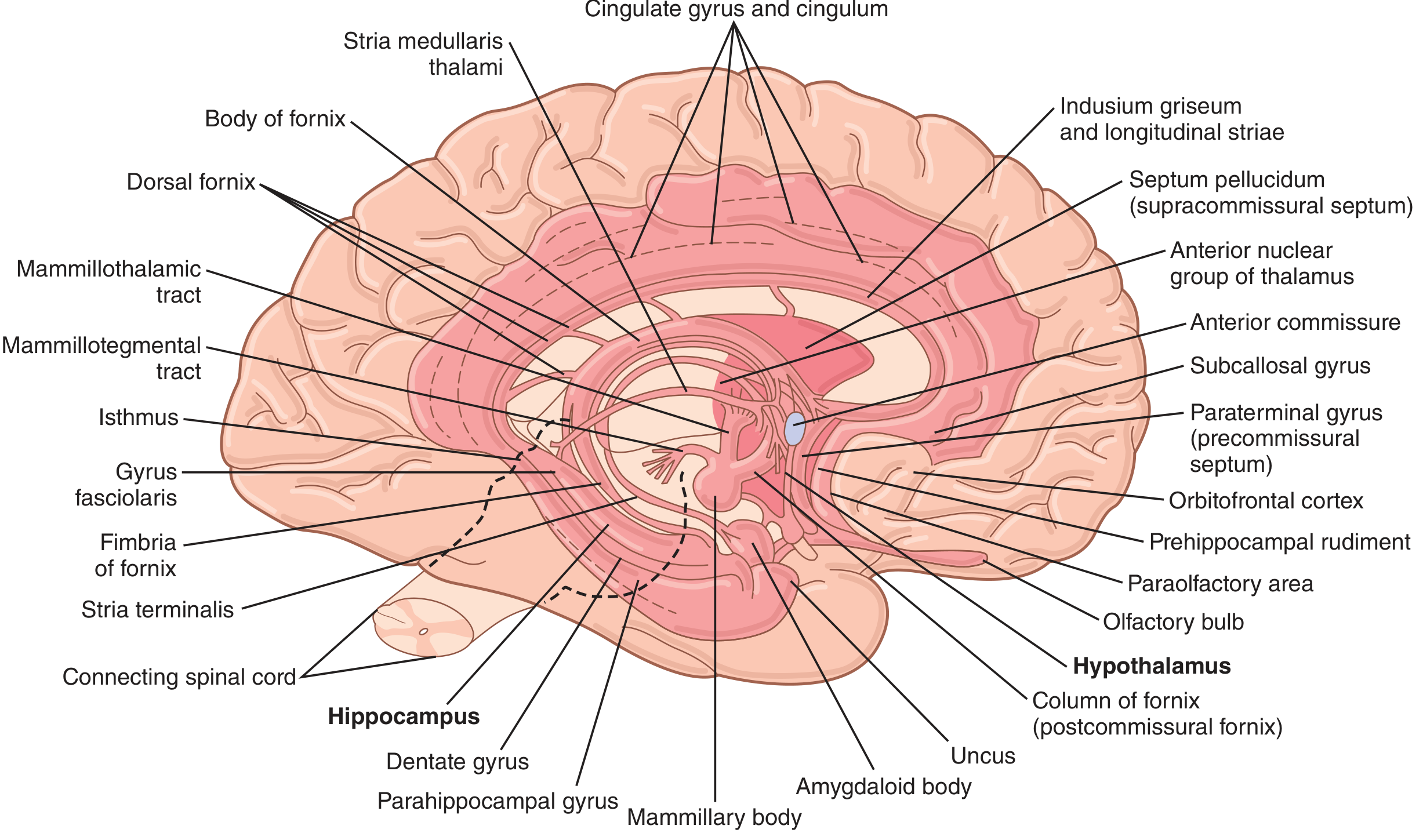
Full anatomical view showing all major structures including the fornix, mammillary body, dentate gyrus, and connecting tracts.
Major Components
| Structure | Key Functions |
|---|---|
| Hippocampus | Long-term memory consolidation, spatial navigation |
| Amygdala | Fear, threat detection, emotional learning |
| Hypothalamus | Vegetative/endocrine control, homeostasis |
| Cingulate gyrus | Emotion processing, pain perception, attention |
| Parahippocampal gyrus | Relaying cortical info to hippocampus |
| Orbitofrontal cortex | Smell perception, reward-based decision making |
| Mammillary bodies | Memory circuits (part of Papez circuit) |
| Anterior thalamic nuclei | Relay station in Papez circuit |
| Septal nuclei | Pleasure, reward, social behavior |
Functions in Detail
1. Emotional Behavior and Expression
The limbic system is the primary substrate for emotional experience. Stimulation experiments show that it mediates fear, rage, placidity, pleasure, and aggression. The classic demonstration was Bard's "sham rage" in cats - removing the cerebral hemispheres while leaving the hypothalamus and limbic structures intact produced exaggerated rage responses to all stimuli. Conversely, bilateral amygdala removal in normally aggressive macaques produced profound placidity. - Adams and Victor's Principles of Neurology, 12th Ed.
2. Memory
The hippocampus is the most important structure for declarative (explicit) memory - the ability to learn and recall recent episodes and experiences. This function is also supported by the entorhinal cortex, parahippocampal gyrus, and limbic nuclei of the thalamus. Damage to the hippocampus (as in Alzheimer's disease or herpes encephalitis) causes dense anterograde amnesia. The Papez circuit (hippocampus → fornix → mammillary bodies → anterior thalamus → cingulate gyrus → entorhinal cortex → back to hippocampus) is the key memory loop. - Harrison's Principles of Internal Medicine, 22nd Ed.
3. Fear Conditioning and Threat Detection
The amygdala is the best-characterized structure for emotional processing. It mediates:
- Fear conditioning - learned associations between neutral stimuli and danger
- Innate fear responses - activation of the hypothalamus and brainstem to produce autonomic responses (tachycardia, sweating, freezing)
- Threat sensitivity - rapid, below-conscious detection of potential danger
Lesions of the human amygdala impair fear learning and the recognition of fearful facial expressions. - Principles of Neural Science, 6th Ed. (Kandel)
4. Vegetative and Homeostatic Control (via Hypothalamus)
The hypothalamus (weighing only ~4 grams, <1% of brain mass) is the central executive of the limbic system for bodily regulation. Its functions include:
- Cardiovascular regulation - control of heart rate and blood pressure
- Temperature regulation (thermoregulation)
- Hunger and satiety - lateral hypothalamus drives feeding; ventromedial nucleus signals satiety
- Thirst and water balance - osmoreceptors trigger drinking and ADH release
- Sleep-wake cycles and arousal
- Sexual behavior and drives
Hypothalamic output travels: (1) backward to brainstem autonomic centers, (2) upward to limbic cortex and thalamus, and (3) to the pituitary gland via the infundibulum. - Guyton & Hall Textbook of Medical Physiology
5. Endocrine and Neuroendocrine Control
The hypothalamus contains neurosecretory cells that release releasing/inhibiting hormones into the portal circulation, controlling the anterior pituitary (FSH, LH, ACTH, TSH, GH, prolactin). It also controls the posterior pituitary (ADH, oxytocin). This makes the limbic system a direct link between psychological stress and hormonal responses - the basis of psychoneuroendocrinology. - Guyton & Hall
6. Olfaction and Olfactory-Emotional Linkage
The olfactory bulb and olfactory cortex project directly into the limbic system (one of the few senses with a direct limbic connection, bypassing the thalamus). This explains the powerful emotional and memory associations triggered by smells.
7. Reward, Motivation, and Drive
The septal nuclei and nucleus accumbens (ventral striatum, closely related to limbic circuitry) are central to the reward/pleasure pathway. Dopaminergic projections from the ventral tegmental area (VTA) to these areas mediate motivated behavior - the drive to seek food, water, sex, and social contact. This circuit is also central to addiction.
8. Social Behavior and Aggression
Stimulation or lesioning of various limbic structures modulates social behaviors. The amygdala regulates social hierarchies and reading of social signals. The septal area is associated with social affiliation. Bilateral amygdala damage (Klüver-Bucy syndrome) causes hypersexuality, hyperorality, loss of fear, and visual agnosia - a dramatic demonstration of the limbic system's role in social/emotional behavior. - Adams and Victor's Principles of Neurology
9. Autonomic Integration ("Fight-or-Flight")
The limbic system, primarily through the hypothalamus and amygdala, activates the sympathoadrenal axis in response to threat:
- Pupil dilation, tachycardia, increased blood pressure
- Bronchodilation, increased respiratory rate
- Redistribution of blood to muscles
- Cortisol release via HPA axis
This is the neural basis of Cannon's fight-or-flight response.
The Papez Circuit (Memory Circuit)
Hippocampus → Fornix → Mammillary bodies → Anterior thalamic nucleus → Cingulate gyrus → Entorhinal cortex → Hippocampus
Proposed by James Papez in 1937, this circuit was originally thought to mediate emotional experience, but is now understood to be primarily a memory consolidation circuit. Lesions at any point cause anterograde amnesia (e.g., Korsakoff syndrome damages the mammillary bodies; Alzheimer's disease attacks the hippocampus and entorhinal cortex). - Kaplan & Sadock's Comprehensive Textbook of Psychiatry
Summary Table
| Function | Primary Structure(s) |
|---|---|
| Emotional experience | Amygdala, cingulate gyrus, prefrontal cortex |
| Fear and threat response | Amygdala |
| Explicit/declarative memory | Hippocampus, Papez circuit |
| Hunger/thirst/satiety | Hypothalamus (lateral & ventromedial nuclei) |
| Temperature regulation | Hypothalamus (preoptic area) |
| Pituitary/endocrine control | Hypothalamus |
| Reward and motivation | Septal nuclei, nucleus accumbens |
| Olfaction | Olfactory bulb, piriform cortex |
| Autonomic regulation | Hypothalamus → brainstem |
| Sexual behavior | Hypothalamus, amygdala |
| Social behavior | Amygdala, orbitofrontal cortex |
Sources: Guyton & Hall Textbook of Medical Physiology | Adams and Victor's Principles of Neurology, 12th Ed. | Kaplan & Sadock's Comprehensive Textbook of Psychiatry | Principles of Neural Science, 6th Ed. (Kandel) | Harrison's Principles of Internal Medicine, 22nd Ed.
This is a shared conversation. Sign in to Orris to start your own chat.