
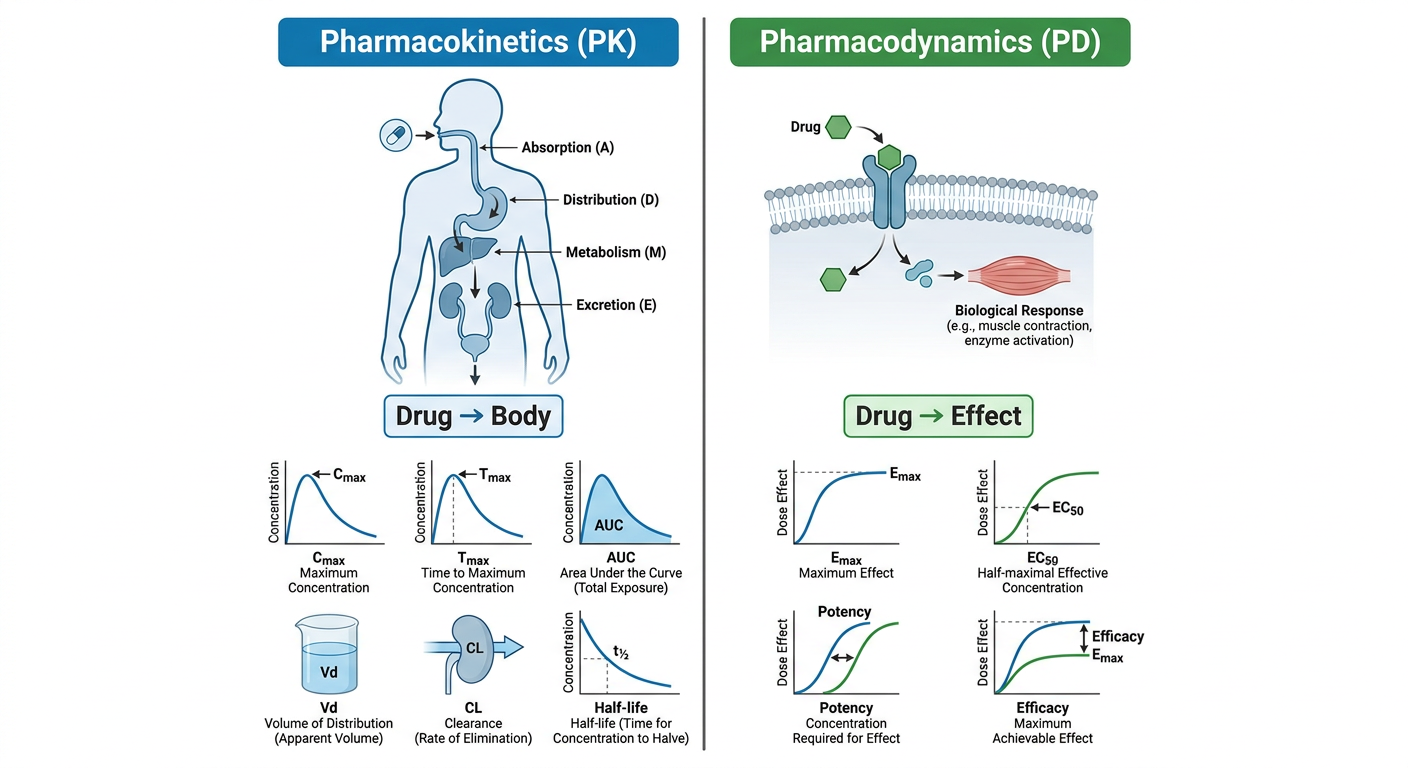
| **Parameter** | **Pharmacokinetics (PK)** | **Pharmacodynamics (PD)** | | ------------------------ | ----------------------------------------------------------- | --------------------------------------------------------------- | | **Definition** | Study of what the **body does to the drug** | Study of what the **drug does to the body** | | **Main focus** | Movement and fate of drug in the body | Pharmacological effects produced by the drug | | **Major processes** | **ADME** – Absorption, Distribution, Metabolism, Excretion | Drug–receptor interaction and biological response | | **Primary concern** | Drug **concentration** in the body | Drug **effect/response** | | **Measures** | Drug concentration versus time | Drug effect versus drug concentration/dose | | **Important parameters** | Cmax, Tmax, AUC, Vd, CL, t½ | Emax, EC50, potency, efficacy | | **Absorption** | Determines how quickly and how much drug enters circulation | Not directly concerned with absorption | | **Distribution** | Determines movement of drug into tissues | Determines drug availability at the site of action | | **Metabolism** | Determines how the drug is chemically transformed | Metabolites may contribute to or alter drug effects | | **Excretion** | Determines removal of drug from the body | Not directly concerned with drug elimination | | **Receptors** | Generally not the primary focus | **Major focus** of drug action | | **Dose relationship** | Helps determine appropriate dose and dosing interval | Determines relationship between dose/concentration and response | | **Clinical application** | Dose optimization and therapeutic drug monitoring | Understanding therapeutic and adverse effects | | **Simple concept** | 💊 **Drug → Body** | 🎯 **Drug → Effect** | generate an image regreading this
An educational infographic comparing Pharmacokinetics (PK) and Pharmacodynamics (PD) in pharmacology. Two side-by-side columns: left labeled "Pharmacokinetics (PK)" with icon of a pill moving through a human body silhouette showing absorption, distribution, metabolism, excretion (ADME) stages, with a simple concept label "Drug -> Body"; right labeled "Pharmacodynamics (PD)" with icon of a drug molecule binding to a receptor on a cell producing a biological response, with a simple concept label "Drug -> Effect". Include small labeled icons/diagrams representing key parameters: Cmax, Tmax, AUC, Vd, CL, half-life on the PK side, and Emax, EC50, potency, efficacy on the PD side. Clean medical textbook style diagram, organized layout with clear headers and dividing line between the two columns.
- Pharmacokinetics (PK) - ADME processes: Absorption, Distribution, Metabolism, Excretion in detail
- PK parameters: Cmax, Tmax, AUC, Vd (volume of distribution), CL (clearance), t½ (half-life), and how they're calculated/used clinically
- Pharmacodynamics (PD) - drug-receptor interactions: Types of receptors, agonists/antagonists, signal transduction
- PD parameters: Emax, EC50, potency vs efficacy, dose-response curves, therapeutic index
- Clinical application - Therapeutic Drug Monitoring (TDM): Using PK/PD principles to individualize dosing
- PK/PD in special populations: Renal/hepatic impairment, pediatrics, elderly, pregnancy
- Drug interactions: PK-based (e.g., enzyme induction/inhibition) vs PD-based (synergism/antagonism) interactions
Which topic would you like to go deeper into?