
ppt of Acute and chronic pain management in anaesthesia point of view
Who is this presentation for? · How detailed should the deck be? · Any specific areas to emphasize?
"acute pain" AND "postoperative analgesia"
acute and chronic pain management anaesthesia guidelines multimodal analgesia 2024
WHO analgesic ladder diagram three step pain management
epidural anesthesia anatomy needle placement diagram
patient controlled analgesia PCA pump device
ultrasound guided peripheral nerve block regional anesthesia
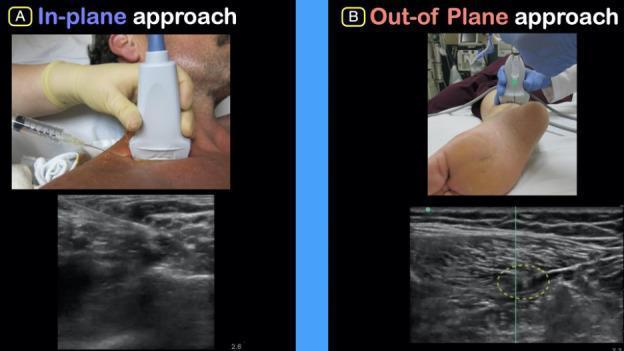
This composite educational image demonstrates ultrasound-guided regional anesthesia techniques, comparing in-plane and out-of-plane needle approaches for a peripheral tibial nerve block. Section A (left) displays the in-plane approach, featuring a clinical photograph of the transducer-needle orientation and a corresponding sonogram. The sonogram shows the needle shaft and tip clearly visualized in the longitudinal axis, entering from the lateral aspect toward the target nerve. Anechoic fluid (local anesthetic) is visible accumulating around the nerve structure. Section B (right) illustrates the out-of-plane approach, showing the needle tip appearing as a hyperechoic dot as it transects the ultrasound beam's short axis. The target nerve is demarcated by a dashed yellow ellipse, surrounded by hypoechoic tissue. The graphic serves to teach needle-beam alignment, sonographic visualization of injectate distribution, and spatial orientation during ultrasound-guided interventions. It is intended for intermediate medical training in anesthesiology and emergency medicine.
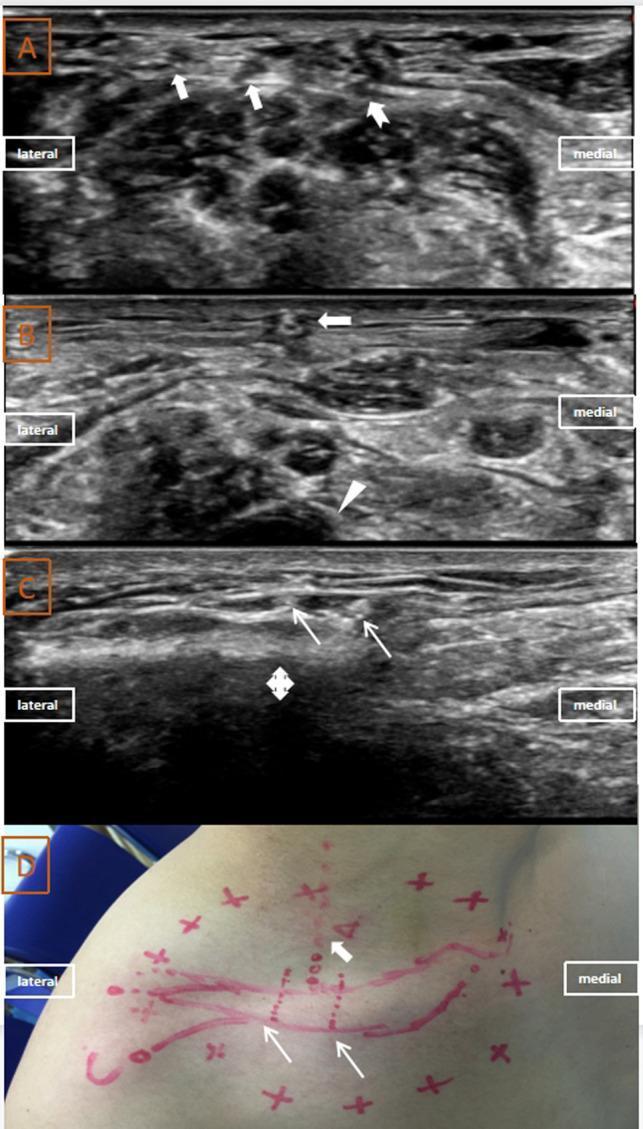
A multi-panel educational figure demonstrating the ultrasound-guided identification and surface mapping of the supraclavicular nerve. Panel A displays a transverse high-frequency ultrasound image of the neck at the posterior border of the sternocleidomastoid muscle, identifying hypoechoic dots representing the phrenic nerve (swallowtail arrow) on the scalenus anterior and branches of the superficial cervical plexus (thick white arrows) on the medial scalenus. Panel B shows a caudal progression, identifying a supraclavicular nerve branch (thick white arrow) situated anterior to the hypoechoic, oval supraclavicular artery (white arrowhead). Panel C depicts the nerve branches near the clavicle as fascicular hyperechoic masses (thin white arrows) superior to the bony landmark of the clavicle (cross arrow). Panel D is a clinical photograph showing surface markings on a patient’s shoulder/clavicular region, mapping the projected path of the supraclavicular nerve (white arrows) and the resulting sensory block area (red circles) following anesthetic injection. This material is designed for regional anesthesia training and peripheral nerve block localization.
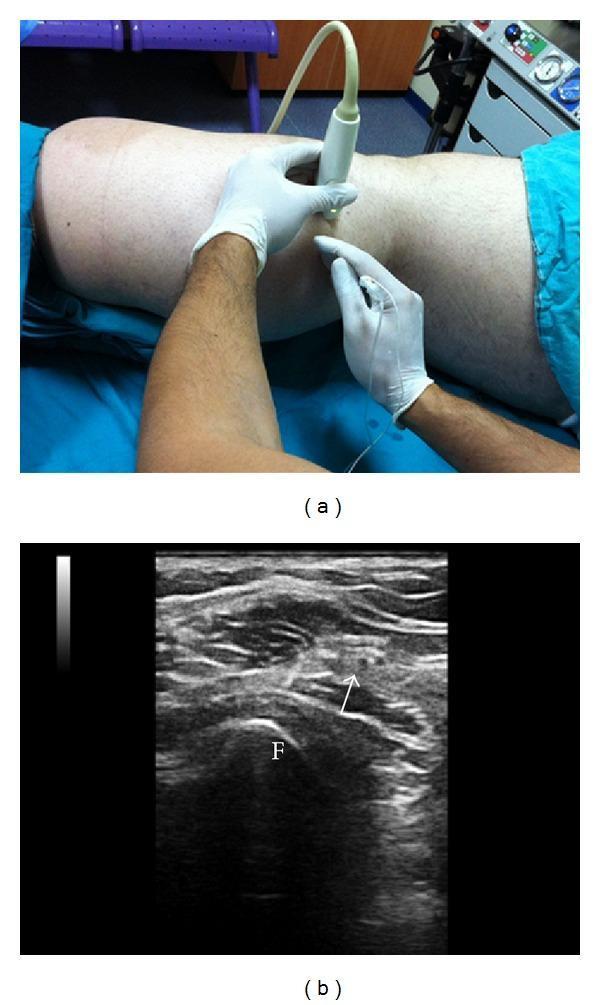
This composite educational image demonstrates the technique for an ultrasound-guided peripheral nerve block of the common peroneal nerve. Image (a) is a clinical photograph showing the transverse placement of a linear ultrasound probe on the lateral aspect of the lower extremity, specifically at the level of the fibular head. The patient is in a supine position with the leg stabilized by a clinician. Image (b) is a corresponding transverse (short-axis) sonogram of the anatomical region. Key landmarks include the hyperechoic cortical surface of the fibula (labeled 'F') with characteristic posterior acoustic shadowing. Superficial and lateral to the fibula, the common peroneal nerve is identified (indicated by the white arrow) appearing as a small, relatively hypoechoic oval structure with a subtle fascicular 'honeycomb' internal pattern. The surrounding musculature and subcutaneous tissues show varying echogenicity. This visual guide is intended for anesthesia and pain management training, highlighting the anatomical relationship between the fibular head and the common peroneal nerve to facilitate safe needle placement during regional anesthesia.
/tmp/workspace
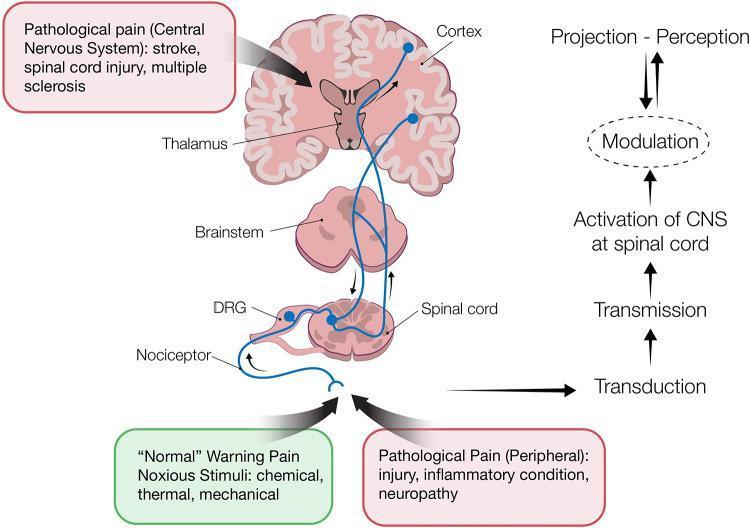
mkdir -p /tmp/workspace/pain-ppt/assets && cd /tmp/workspace/pain-ppt && python /tmp/skills/shared/scripts/fetch_images.py "https://cdn.orris.care/cdss_images/pmc_clinical_VQA_25362a85e7d8437d09039e32ea1d18dc50c7c8176ea2e116994930f30402b5c2.jpg" "https://cdn.orris.care/cdss_images/pmc_clinical_VQA_3d0ad6cf7a5b9889fa823491ff982cefec61151973c849459a9f7c75f899f531.jpg" > fetch_out.json 2>fetch_err.log; python3 -c " import json, base64 data = json.load(open('fetch_out.json')) names = ['pain_pathway.jpg','nerve_block.jpg'] for img, name in zip(data, names): if img.get('base64'): b64 = img['base64'].split(',',1)[-1] with open(f'assets/{name}', 'wb') as f: f.write(base64.b64decode(b64)) print('saved', name) else: print('FAILED', img.get('url'), img.get('error')) "
~/pain-ppt/build.py
from pptx import Presentation
from pptx.util import Inches, Pt, Emu
from pptx.dml.color import RGBColor
from pptx.enum.text import PP_ALIGN, MSO_ANCHOR
from pptx.enum.shapes import MSO_SHAPE

NAVY = RGBColor(0x0B, 0x2E, 0x4E)
BLUE = RGBColor(0x1F, 0x6F, 0xA8)
LIGHT = RGBColor(0xEC, 0xF4, 0xFA)
WHITE = RGBColor(0xFF, 0xFF, 0xFF)
DARK = RGBColor(0x22, 0x22, 0x22)
ACCENT = RGBColor(0xE0, 0x7A, 0x2C)
GREY = RGBColor(0x55, 0x55, 0x55)

prs = Presentation()
prs.slide_width = Inches(13.333)
prs.slide_height = Inches(7.5)
BLANK = prs.slide_layouts[6]
SW, SH = prs.slide_width, prs.slide_height

def bg(slide, color):
    r = slide.shapes.add_shape(MSO_SHAPE.RECTANGLE, 0, 0, SW, SH)
    r.fill.solid(); r.fill.fore_color.rgb = color
    r.line.fill.background(); r.shadow.inherit = False
    slide.shapes._spTree.remove(r._element)
    slide.shapes._spTree.insert(2, r._element)
    return r

def footer(slide, text, num):
    tb = slide.shapes.add_textbox(Inches(0.5), Inches(7.15), Inches(9), Inches(0.3))
    tb.text_frame.text = text
    tb.text_frame.paragraphs[0].runs[0].font.size = Pt(10)
    tb.text_frame.paragraphs[0].runs[0].font.color.rgb = GREY
    tb2 = slide.shapes.add_textbox(Inches(12.5), Inches(7.15), Inches(0.6), Inches(0.3))
    tb2.text_frame.text = str(num)
    tb2.text_frame.paragraphs[0].runs[0].font.size = Pt(10)
    tb2.text_frame.paragraphs[0].runs[0].font.color.rgb = GREY

def title_bar(slide, title, kicker=None):
    bg(slide, WHITE)
    bar = slide.shapes.add_shape(MSO_SHAPE.RECTANGLE, 0, 0, SW, Inches(1.15))
    bar.fill.solid(); bar.fill.fore_color.rgb = NAVY
    bar.line.fill.background(); bar.shadow.inherit = False
    accent = slide.shapes.add_shape(MSO_SHAPE.RECTANGLE, 0, Inches(1.15), SW, Inches(0.07))
    accent.fill.solid(); accent.fill.fore_color.rgb = ACCENT
    accent.line.fill.background(); accent.shadow.inherit = False
    tb = slide.shapes.add_textbox(Inches(0.5), Inches(0.18), Inches(11.5), Inches(0.8))
    tf = tb.text_frame; tf.word_wrap = True
    p = tf.paragraphs[0]; p.text = title
    p.runs[0].font.size = Pt(28); p.runs[0].font.bold = True; p.runs[0].font.color.rgb = WHITE
    p.runs[0].font.name = "Calibri"
    if kicker:
        kb = slide.shapes.add_textbox(Inches(0.5), Inches(0.02), Inches(8), Inches(0.3))
        kb.text_frame.text = kicker.upper()
        kb.text_frame.paragraphs[0].runs[0].font.size = Pt(12)
        kb.text_frame.paragraphs[0].runs[0].font.color.rgb = RGBColor(0xA9,0xC6,0xDB)
        kb.text_frame.paragraphs[0].runs[0].font.bold = True

def bullets_box(slide, items, left=0.7, top=1.55, width=11.9, height=5.4, size=18, gap_size=8, color=DARK):
    tb = slide.shapes.add_textbox(Inches(left), Inches(top), Inches(width), Inches(height))
    tf = tb.text_frame; tf.word_wrap = True
    first = True
    for item in items:
        if isinstance(item, tuple):
            text, level, bold = item
        else:
            text, level, bold = item, 0, False
        p = tf.paragraphs[0] if first else tf.add_paragraph()
        first = False
        prefix = "" if level == 0 else ("  -  " if level == 1 else "     .  ")
        bullet = "\u25A0  " if level == 0 else ""
        p.text = prefix + bullet + text
        r = p.runs[0]
        r.font.size = Pt(size if level == 0 else size - 2)
        r.font.bold = bold
        r.font.color.rgb = NAVY if (level == 0 and bold) else color
        r.font.name = "Calibri"
        p.space_after = Pt(gap_size)
    return tb

def content_slide(num, title, items, kicker=None, footer_text="Acute & Chronic Pain Management - Anaesthesia Perspective", size=18):
    s = prs.slides.add_slide(BLANK)
    title_bar(s, title, kicker)
    bullets_box(s, items, size=size)
    footer(s, footer_text, num)
    return s

def image_slide(num, title, img_path, items, kicker=None, footer_text="Acute & Chronic Pain Management - Anaesthesia Perspective"):
    s = prs.slides.add_slide(BLANK)
    title_bar(s, title, kicker)
    bullets_box(s, items, left=0.7, top=1.6, width=6.5, height=5.3, size=16)
    try:
        s.shapes.add_picture(img_path, Inches(7.5), Inches(1.7), width=Inches(5.2))
    except Exception as e:
        pass
    footer(s, footer_text, num)
    return s

def table_slide(num, title, headers, rows, kicker=None, footer_text="Acute & Chronic Pain Management - Anaesthesia Perspective", col_widths=None):
    s = prs.slides.add_slide(BLANK)
    title_bar(s, title, kicker)
    nrows = len(rows) + 1
    ncols = len(headers)
    left, top, width, height = Inches(0.7), Inches(1.6), Inches(11.9), Inches(0.55*nrows)
    gtable = s.shapes.add_table(nrows, ncols, left, top, width, height).table
    if col_widths:
        for i, w in enumerate(col_widths):
            gtable.columns[i].width = Inches(w)
    for j, h in enumerate(headers):
        cell = gtable.cell(0, j)
        cell.text = h
        cell.fill.solid(); cell.fill.fore_color.rgb = NAVY
        p = cell.text_frame.paragraphs[0]
        p.runs[0].font.bold = True; p.runs[0].font.color.rgb = WHITE; p.runs[0].font.size = Pt(15)
    for i, row in enumerate(rows, start=1):
        for j, val in enumerate(row):
            cell = gtable.cell(i, j)
            cell.text = str(val)
            cell.fill.solid()
            cell.fill.fore_color.rgb = LIGHT if i % 2 == 0 else WHITE
            p = cell.text_frame.paragraphs[0]
            p.runs[0].font.size = Pt(13.5)
            p.runs[0].font.color.rgb = DARK
    footer(s, footer_text, num)
    return s

def section_slide(num, big_title, subtitle):
    s = prs.slides.add_slide(BLANK)
    bg(s, NAVY)
    accent = s.shapes.add_shape(MSO_SHAPE.RECTANGLE, 0, Inches(3.55), Inches(2.2), Inches(0.09))
    accent.fill.solid(); accent.fill.fore_color.rgb = ACCENT; accent.line.fill.background(); accent.shadow.inherit=False
    accent.left = Inches(0.7)
    tb = s.shapes.add_textbox(Inches(0.7), Inches(2.6), Inches(11.5), Inches(1.2))
    tf = tb.text_frame; tf.word_wrap=True
    p = tf.paragraphs[0]; p.text = big_title
    p.runs[0].font.size = Pt(44); p.runs[0].font.bold=True; p.runs[0].font.color.rgb = WHITE
    tb2 = s.shapes.add_textbox(Inches(0.7), Inches(3.8), Inches(11.5), Inches(0.8))
    tf2 = tb2.text_frame; tf2.word_wrap=True
    p2 = tf2.paragraphs[0]; p2.text = subtitle
    p2.runs[0].font.size = Pt(20); p2.runs[0].font.color.rgb = RGBColor(0xB9,0xD3,0xE6)
    footer(s, "Acute & Chronic Pain Management - Anaesthesia Perspective", num)
    return s

# ---------- SLIDE 1: TITLE ----------
s = prs.slides.add_slide(BLANK)
bg(s, NAVY)
band = s.shapes.add_shape(MSO_SHAPE.RECTANGLE, 0, Inches(4.7), SW, Inches(0.06))
band.fill.solid(); band.fill.fore_color.rgb = ACCENT; band.line.fill.background(); band.shadow.inherit=False
tb = s.shapes.add_textbox(Inches(0.9), Inches(2.5), Inches(11.5), Inches(1.8))
tf = tb.text_frame; tf.word_wrap = True
p = tf.paragraphs[0]; p.text = "Acute and Chronic Pain Management"
p.runs[0].font.size = Pt(46); p.runs[0].font.bold = True; p.runs[0].font.color.rgb = WHITE
p2 = tf.add_paragraph(); p2.text = "An Anaesthesiologist's Perspective"
p2.runs[0].font.size = Pt(26); p2.runs[0].font.color.rgb = RGBColor(0xE0,0x7A,0x2C); p2.runs[0].font.bold=True
tb2 = s.shapes.add_textbox(Inches(0.9), Inches(4.95), Inches(10), Inches(0.6))
tb2.text_frame.text = "Physiology - Assessment - Pharmacology - Regional Techniques - Interventional Pain Medicine"
tb2.text_frame.paragraphs[0].runs[0].font.size = Pt(16)
tb2.text_frame.paragraphs[0].runs[0].font.color.rgb = RGBColor(0xB9,0xD3,0xE6)

# ---------- SLIDE 2: OBJECTIVES ----------
content_slide(2, "Learning Objectives", [
    ("By the end of this session, you should be able to:", 0, True),
    ("Define pain and differentiate acute from chronic pain", 1),
    ("Describe the pain pathway and its physiological basis", 1),
    ("Apply validated pain-assessment tools in clinical practice", 1),
    ("Outline the principles of multimodal analgesia for acute (perioperative) pain", 1),
    ("Discuss regional/neuraxial techniques and PCA in acute pain control", 1),
    ("Understand chronic pain pathophysiology (peripheral & central sensitization)", 1),
    ("Apply the WHO analgesic ladder and interventional options for chronic/cancer pain", 1),
    ("Recognize the anaesthesiologist's role in preventing acute-to-chronic pain transition", 1),
])

# ---------- SLIDE 3: DEFINITIONS ----------
content_slide(3, "Definitions", [
    ("IASP Definition of Pain (2020, revised)", 0, True),
    ("\u201cAn unpleasant sensory and emotional experience associated with, or resembling that associated with, actual or potential tissue damage.\u201d", 1),
    ("Acute Pain", 0, True),
    ("Recent onset, protective, self-limiting; resolves with tissue healing (e.g. surgical, traumatic, obstetric pain)", 1),
    ("Duration typically < 3 months; well-defined cause", 1),
    ("Chronic Pain", 0, True),
    ("Persists beyond normal tissue-healing time, usually > 3 months (IASP/ICD-11)", 1),
    ("Loses protective value; associated with neuroplastic (central) changes, psychosocial impact", 1),
    ("May be nociceptive, neuropathic, nociplastic, or mixed in mechanism", 1),
], size=19)

# ---------- SLIDE 4: PAIN PATHWAY (image) ----------
image_slide(4, "The Pain Pathway", "assets/pain_pathway.jpg", [
    ("Four physiological processes:", 0, True),
    ("Transduction", 1, False),
    ("Noxious stimulus converted to electrical signal at nociceptor", 2) if False else ("  Noxious stimulus -> electrical signal at nociceptor", 2),
    ("Transmission", 1),
    ("  Impulse conducted via A-delta/C fibres, dorsal root ganglion, to dorsal horn", 2),
    ("Modulation", 1),
    ("  Descending inhibitory/facilitatory pathways alter signal in dorsal horn", 2),
    ("Perception", 1),
    ("  Conscious awareness via thalamocortical projection", 2),
    ("Anaesthetic relevance: each step is a drug/technique target -> basis of multimodal analgesia", 0, True),
])

# ---------- SLIDE 5: CLASSIFICATION ----------
table_slide(5, "Classification of Pain", ["Type", "Mechanism", "Examples"], [
    ["Nociceptive - Somatic", "Activation of nociceptors in skin/muscle/bone", "Surgical incision, fracture"],
    ["Nociceptive - Visceral", "Activation of visceral nociceptors, poorly localized", "Bowel distension, biliary colic"],
    ["Neuropathic", "Lesion/disease of somatosensory nervous system", "Post-herpetic neuralgia, diabetic neuropathy"],
    ["Nociplastic", "Altered nociception without clear tissue/nerve damage", "Fibromyalgia, chronic low back pain"],
    ["Mixed", "Combination of mechanisms", "Cancer pain, chronic post-surgical pain"],
], col_widths=[3.2,4.7,4.0])

# ---------- SLIDE 6: ASSESSMENT ----------
content_slide(6, "Pain Assessment Tools", [
    ("Unidimensional scales (acute pain, quick bedside use)", 0, True),
    ("Numeric Rating Scale (NRS) 0-10; Visual Analogue Scale (VAS); Verbal Rating Scale", 1),
    ("Behavioural / observational scales (non-communicative patients)", 0, True),
    ("FLACC (paediatric); CPOT and BPS (critically ill, ventilated ICU patients); PAINAD (dementia)", 1),
    ("Multidimensional tools (chronic pain)", 0, True),
    ("McGill Pain Questionnaire; Brief Pain Inventory (BPI); DN4 questionnaire for neuropathic pain", 1),
    ("Functional & psychosocial assessment", 0, True),
    ("Sleep, mood, activity/disability scores; screening for anxiety/depression and opioid misuse risk (chronic pain)", 1),
    ("Reassess regularly and after every intervention - pain is what the patient reports", 0, True),
])

# ---------- SLIDE 7: SECTION - ACUTE PAIN ----------
section_slide(7, "Acute Pain Management", "Perioperative and post-traumatic pain control")

# ---------- SLIDE 8: PRINCIPLES ----------
content_slide(8, "Principles of Acute Pain Management", [
    ("Goals", 0, True),
    ("Effective analgesia with minimal side effects; early mobilization; faster recovery (ERAS)", 1),
    ("Multimodal (\u201cbalanced\u201d) analgesia", 0, True),
    ("Combine drugs/techniques with different mechanisms for additive/synergistic effect", 1),
    ("Reduces opioid dose and opioid-related adverse effects (PONV, sedation, ileus, respiratory depression)", 1),
    ("Pre-emptive / preventive analgesia", 0, True),
    ("Initiate analgesia before the noxious stimulus to reduce central sensitization", 1),
    ("Procedure-specific & patient-tailored plans (PROSPECT recommendations)", 0, True),
    ("ASA/ASRA 2021 consensus: multimodal analgesia + regional blockade whenever feasible, individualized dosing", 0, True),
])

# ---------- SLIDE 9: OPIOIDS ----------
content_slide(9, "Systemic Analgesics - Opioids", [
    ("Mainstay for moderate-severe acute pain; act on mu-opioid receptors", 0, True),
    ("Common agents: morphine, fentanyl, oxycodone, tramadol, buprenorphine", 1),
    ("Routes: IV bolus/infusion, IV-PCA, oral, transdermal, neuraxial", 1),
    ("Adverse effects", 0, True),
    ("Respiratory depression, sedation, nausea/vomiting, pruritus, constipation, urinary retention", 1),
    ("Opioid-induced hyperalgesia and tolerance with prolonged/high-dose use", 1),
    ("Anaesthesia considerations", 0, True),
    ("Opioid-sparing strategy preferred; caution in opioid-tolerant, elderly, OSA and renal/hepatic impairment", 1),
    ("Recent evidence: buprenorphine shows comparable analgesia to full agonists with fewer adverse effects (meta-analysis, 2025)", 1),
])

# ---------- SLIDE 10: NON-OPIOIDS ----------
content_slide(10, "Systemic Analgesics - Non-Opioids", [
    ("Paracetamol (Acetaminophen)", 0, True),
    ("Step 1 WHO ladder; central COX inhibition; excellent safety, opioid-sparing; around-the-clock dosing", 1),
    ("NSAIDs / COX-2 inhibitors", 0, True),
    ("Inhibit prostaglandin synthesis peripherally and centrally; effective for somatic and inflammatory pain", 1),
    ("Caution: renal impairment, GI bleeding, cardiovascular risk, platelet dysfunction; avoid/limit in elderly & hypovolemia", 1),
    ("COX-2 selective agents (e.g. celecoxib, parecoxib) reduce GI/platelet risk", 1),
    ("Recommended around-the-clock unless contraindicated as part of multimodal regimen (ASA/ASRA guidance)", 0, True),
])

# ---------- SLIDE 11: ADJUVANTS ----------
content_slide(11, "Adjuvant Agents", [
    ("Ketamine (NMDA antagonist)", 0, True),
    ("Low-dose IV infusion reduces opioid consumption, hyperalgesia, and chronic pain transition (ASRA/ASA/AAPM consensus)", 1),
    ("Gabapentinoids (gabapentin, pregabalin)", 0, True),
    ("Reduce central sensitization and neuropathic component; useful peri-operatively, caution with sedation in elderly", 1),
    ("IV Lidocaine infusion", 0, True),
    ("Systemic local anaesthetic; reduces pain, opioid use, ileus (evidence strongest in abdominal/hysterectomy surgery)", 1),
    ("Alpha-2 agonists (dexmedetomidine, clonidine)", 0, True),
    ("Sedation + analgesia + opioid-sparing; useful adjunct to regional/neuraxial blocks", 1),
    ("Corticosteroids (dexamethasone)", 0, True),
    ("Reduces pain, PONV and opioid requirement when given intra-operatively", 1),
])

# ---------- SLIDE 12: NEURAXIAL ----------
content_slide(12, "Neuraxial Analgesia", [
    ("Epidural Analgesia", 0, True),
    ("Continuous infusion of local anaesthetic +/- opioid via epidural catheter", 1),
    ("Thoracic epidural: superior analgesia for major abdominal/thoracic surgery; reduces pulmonary & cardiac morbidity, earlier return of GI function", 1),
    ("Complications: hypotension, motor block, urinary retention, epidural haematoma/abscess (rare), high spinal block", 1),
    ("Intrathecal (Spinal) Analgesia", 0, True),
    ("Single-shot opioid (e.g. morphine) at spinal anaesthesia; effective but risk of delayed respiratory depression - needs monitoring", 1),
    ("Contraindications", 0, True),
    ("Coagulopathy, local infection, patient refusal, severe hypovolemia, raised ICP", 1),
], size=18)

# ---------- SLIDE 13: NERVE BLOCKS (image) ----------
image_slide(13, "Peripheral Nerve Blocks & Regional Techniques", "assets/nerve_block.jpg", [
    ("Ultrasound-guided peripheral nerve blocks", 0, True),
    ("Single-shot or continuous catheter techniques", 1),
    ("Examples: brachial plexus, femoral/fascia iliaca, sciatic, TAP, erector spinae, paravertebral blocks", 1),
    ("Benefits", 0, True),
    ("Site-specific analgesia, opioid-sparing, fewer systemic side effects vs epidural", 1),
    ("Reasonable alternative to epidural in low-to-moderate risk surgery (Miller's Anesthesia)", 1),
    ("Risks", 0, True),
    ("LA systemic toxicity (LAST), nerve injury, block failure, haematoma", 1),
])

# ---------- SLIDE 14: PCA ----------
content_slide(14, "Patient-Controlled Analgesia (PCA)", [
    ("Concept", 0, True),
    ("Patient self-administers pre-set analgesic bolus via programmable pump; matches individual pharmacokinetic variability", 1),
    ("Routes", 0, True),
    ("IV-PCA (most common - morphine, fentanyl, tramadol); Epidural-PCA (EPCA); PCA with regional catheters", 1),
    ("Parameters set by clinician", 0, True),
    ("Bolus dose, lockout interval, background infusion (optional), 1/4-hourly & 4-hourly limits", 1),
    ("Safety requirements", 0, True),
    ("Only the patient should press the button; regular sedation/respiratory rate monitoring; naloxone available", 1),
    ("Advantages: improved patient satisfaction, individualized titration, reduced nursing workload vs intermittent IM/IV dosing", 0, True),
])

# ---------- SLIDE 15: PREVENTION & ERAS ----------
content_slide(15, "Preventive Analgesia, ERAS & Special Populations", [
    ("Pre-emptive / preventive analgesia", 0, True),
    ("Analgesics started before incision and continued to blunt central sensitization and reduce chronic pain risk", 1),
    ("Enhanced Recovery After Surgery (ERAS)", 0, True),
    ("Multimodal opioid-sparing analgesia is a core ERAS pillar - enables early mobilization, reduced LOS", 1),
    ("Special populations", 0, True),
    ("Opioid-tolerant patients: higher baseline requirement, involve pain team, continue baseline opioid + multimodal add-ons", 1),
    ("Elderly: reduced drug clearance, higher sensitivity to sedatives/opioids, avoid NSAIDs if renal impairment", 1),
    ("Paediatric: weight-based dosing, regional blocks preferred, behavioural scales (FLACC)", 1),
    ("Pregnancy/lactation: prefer paracetamol/regional techniques, avoid NSAIDs in 3rd trimester", 1),
])

# ---------- SLIDE 16: ACUTE TO CHRONIC ----------
content_slide(16, "Acute-to-Chronic Postsurgical Pain Transition", [
    ("Chronic post-surgical pain (CPSP): persistent pain > 3 months after surgery", 0, True),
    ("Risk factors", 0, True),
    ("Severe uncontrolled acute pain, nerve injury during surgery, pre-existing chronic pain/anxiety/depression, younger age, genetic predisposition, certain surgeries (thoracotomy, amputation, breast surgery)", 1),
    ("Prevention strategies", 0, True),
    ("Aggressive multimodal analgesia, regional/neuraxial techniques, perioperative ketamine/gabapentinoid, psychological preparation", 1),
    ("Non-opioid analgesics (ketamine, lidocaine) show benefit in preventing CPSP - 2023 network meta-analysis (BJA)", 1),
    ("Early identification and referral to pain clinic if pain persists beyond expected healing time", 0, True),
])

# ---------- SLIDE 17: SECTION CHRONIC ----------
section_slide(17, "Chronic Pain Management", "Mechanisms, pharmacotherapy and interventional options")

# ---------- SLIDE 18: PATHOPHYSIOLOGY ----------
content_slide(18, "Chronic Pain: Pathophysiology", [
    ("Peripheral sensitization", 0, True),
    ("Reduced threshold of peripheral nociceptors after repeated/ongoing tissue injury or inflammation", 1),
    ("Central sensitization", 0, True),
    ("Increased excitability of dorsal horn/CNS neurons -> \u201cwind-up\u201d phenomenon, NMDA receptor activation", 1),
    ("Results in allodynia (pain from non-noxious stimuli) and hyperalgesia (exaggerated pain response)", 1),
    ("Loss of descending inhibitory control", 0, True),
    ("Impaired descending noradrenergic/serotonergic inhibition perpetuates pain signalling", 1),
    ("Neuroplastic and psychosocial changes", 0, True),
    ("Cortical reorganization, mood disorders, sleep disturbance, fear-avoidance behaviour reinforce chronic pain cycle", 1),
])

# ---------- SLIDE 19: WHO LADDER ----------
table_slide(19, "WHO Analgesic Ladder", ["Step", "Pain intensity", "Recommended agents"], [
    ["Step 1", "Mild pain", "Paracetamol, NSAIDs \u00b1 adjuvant"],
    ["Step 2", "Mild-moderate pain", "Weak opioids: codeine, tramadol + step 1 agents \u00b1 adjuvant"],
    ["Step 3", "Moderate-severe pain", "Strong opioids: morphine, oxycodone, fentanyl + step 1 agents \u00b1 adjuvant"],
], col_widths=[2.0,3.5,6.4])
s = prs.slides[-1]
tb = s.shapes.add_textbox(Inches(0.7), Inches(4.2), Inches(11.9), Inches(2.3))
tf = tb.text_frame; tf.word_wrap = True
p = tf.paragraphs[0]; p.text = "Originally designed for cancer pain (WHO, 1986); now applied broadly to chronic pain."
p.runs[0].font.size = Pt(16); p.runs[0].font.italic = True; p.runs[0].font.color.rgb = GREY
p2 = tf.add_paragraph(); p2.text = "Adjuvants at any step: antidepressants, anticonvulsants, corticosteroids, muscle relaxants, bisphosphonates."
p2.runs[0].font.size = Pt(16); p2.runs[0].font.color.rgb = DARK
p3 = tf.add_paragraph(); p3.text = "\"Elevator\" concept now favoured over strict step-wise escalation - start at the step matching pain severity."
p3.runs[0].font.size = Pt(16); p3.runs[0].font.color.rgb = DARK

# ---------- SLIDE 20: PHARMACOTHERAPY ----------
content_slide(20, "Pharmacological Management of Chronic/Neuropathic Pain", [
    ("Antidepressants", 0, True),
    ("TCAs (amitriptyline) and SNRIs (duloxetine, venlafaxine) - first-line for neuropathic pain; enhance descending inhibition", 1),
    ("Anticonvulsants / Gabapentinoids", 0, True),
    ("Gabapentin, pregabalin - strong evidence in diabetic neuropathy, post-herpetic neuralgia, spinal cord injury pain", 1),
    ("Opioids", 0, True),
    ("Reserved for refractory cases; careful risk-benefit assessment, monitor for tolerance, hyperalgesia, dependence, misuse", 1),
    ("Topical agents", 0, True),
    ("Lidocaine patch, capsaicin - useful for localized neuropathic pain with fewer systemic effects", 1),
    ("NMDA antagonists / other adjuvants", 0, True),
    ("Ketamine infusions for refractory central/neuropathic pain in specialist settings", 1),
])

# ---------- SLIDE 21: INTERVENTIONAL ----------
content_slide(21, "Interventional Pain Management", [
    ("Diagnostic & therapeutic nerve blocks", 0, True),
    ("Epidural steroid injections, facet joint injections, medial branch/sympathetic blocks", 1),
    ("Neurolytic techniques", 0, True),
    ("Radiofrequency ablation, chemical neurolysis (phenol/alcohol), cryoablation - for refractory/cancer pain", 1),
    ("Neuromodulation", 0, True),
    ("Spinal cord stimulation, peripheral nerve stimulation, motor cortex stimulation for select central/neuropathic pain", 1),
    ("Intrathecal drug delivery systems", 0, True),
    ("Implanted pumps deliver opioid/local anaesthetic/ziconotide directly to CSF - reserved for refractory pain", 1),
    ("Anaesthesiologist's role", 0, True),
    ("Trained pain physicians perform most of these image-guided procedures in dedicated pain clinics", 1),
])

# ---------- SLIDE 22: CANCER PAIN ----------
content_slide(22, "Cancer Pain & Palliative Considerations", [
    ("Often mixed nociceptive + neuropathic mechanism; may be disease-, treatment-, or debility-related", 0, True),
    ("WHO ladder remains foundational; do not withhold strong opioids due to prognosis", 0, True),
    ("Breakthrough pain managed with fast-onset opioid formulations", 0, True),
    ("Neuropathic component (17-28% of advanced cancer) needs adjuvant anticonvulsants/antidepressants", 0, True),
    ("Interventional options for refractory cases: neurolytic coeliac plexus block (pancreatic cancer), intrathecal pumps, cordotomy", 0, True),
    ("Goal: maximize function and quality of life, individualized and reassessed regularly, integrate palliative care early", 0, True),
])

# ---------- SLIDE 23: ROLE OF ANAESTHESIOLOGIST ----------
content_slide(23, "The Anaesthesiologist's Role", [
    ("Perioperative physician", 0, True),
    ("Designs multimodal, procedure-specific analgesic plans; performs regional/neuraxial techniques", 1),
    ("Acute Pain Service", 0, True),
    ("Ward rounds, PCA/epidural management, troubleshooting inadequate analgesia or side effects", 1),
    ("Pain medicine specialist", 0, True),
    ("Runs multidisciplinary chronic pain clinics with psychology, physiotherapy, and palliative care input", 1),
    ("Performs interventional procedures: nerve blocks, RF ablation, neuromodulation, intrathecal pumps", 1),
    ("Advocate for opioid stewardship", 0, True),
    ("Balances effective analgesia with minimizing tolerance, hyperalgesia, dependence and diversion risk", 1),
])

# ---------- SLIDE 24: SUMMARY ----------
content_slide(24, "Key Takeaways", [
    ("Pain is subjective; assess with validated tools and reassess often", 0, True),
    ("Acute pain: multimodal, opioid-sparing, pre-emptive analgesia; regional/neuraxial techniques and PCA are key tools", 0, True),
    ("Chronic pain: driven by peripheral & central sensitization; management is pharmacological + interventional + psychosocial", 0, True),
    ("WHO analgesic ladder guides stepwise/elevator pharmacotherapy for chronic and cancer pain", 0, True),
    ("Prevent acute-to-chronic transition through aggressive, individualized perioperative pain control", 0, True),
    ("The anaesthesiologist plays a central role across the entire pain continuum - perioperative to chronic pain clinic", 0, True),
], size=19)

# ---------- SLIDE 25: REFERENCES ----------
content_slide(25, "Key References", [
    ("Miller's Anesthesia, 10th Edition - Acute & Postoperative Pain chapters", 0),
    ("Morgan & Mikhail's Clinical Anesthesiology, 7th Edition - Pain Management chapters", 0),
    ("Barash, Cullen & Stoelting's Clinical Anesthesia, 9th Edition - Acute & Chronic Pain Management", 0),
    ("Bailey & Love's Short Practice of Surgery, 28th Ed - Principles of Chronic Pain Management", 0),
    ("WHO. Cancer Pain Relief. World Health Organization, Geneva.", 0),
    ("ASA/ASRA Multi-society Consensus Statement, Reg Anesth Pain Med, 2021", 0),
    ("Doleman B, et al. Non-opioid analgesics for prevention of chronic postsurgical pain. Br J Anaesth. 2023 (PMID 37059625)", 0),
    ("Hickey TR, et al. Buprenorphine vs full agonist opioids for acute postoperative pain. Reg Anesth Pain Med. 2026 (PMID 39753290)", 0),
], size=17)

import os
os.makedirs("output", exist_ok=True)
prs.save("output/Acute_Chronic_Pain_Management_Anaesthesia.pptx")
print("Saved. Total slides:", len(prs.slides.__iter__.__self__._sldIdLst))
cd /tmp/workspace/pain-ppt && python3 build.py
~/pain-ppt/build.py
Successfully replaced 1 instance(s) of the string in '/tmp/workspace/pain-ppt/build.py'
cd /tmp/workspace/pain-ppt && python3 build.py && ls -la output/
- Title & Learning Objectives
- Definitions (IASP pain definition, acute vs chronic)
- Pain pathway physiology (with diagram)
- Classification of pain (table)
- Pain assessment tools
- Acute pain section: principles of multimodal analgesia, opioids, non-opioids, adjuvants (ketamine, gabapentinoids, lidocaine, dexmedetomidine, dexamethasone), neuraxial analgesia, peripheral nerve blocks (with diagram), PCA, ERAS/preventive analgesia, special populations, acute-to-chronic pain transition
- Chronic pain section: central/peripheral sensitization, WHO analgesic ladder (table), pharmacotherapy for neuropathic/chronic pain, interventional pain management (RF ablation, neuromodulation, intrathecal pumps), cancer pain, the anaesthesiologist's role
- Key takeaways & references (including current evidence: BJA 2023 network meta-analysis on non-opioids preventing chronic postsurgical pain, and a 2025/26 systematic review on buprenorphine vs full-agonist opioids)
Acute Chronic Pain Management Anaesthesia
Presentation · PPTX