
Tens based pain reducing electromodality inserted pant itself for period pain similar idea for new innovation
TENS wearable period pain relief underwear built-in innovation 2025
TENS electrotherapy dysmenorrhea wearable smart underwear product
TENS transcutaneous electrical nerve stimulation dysmenorrhea menstrual pain
https://patents.google.com/patent/WO2023053148A1/en
smart period underwear built-in electrical stimulation electrode conductive fabric innovation startup 2024 2025
Take this concept idea and implement onto someother new innovation based idea
Which new application area should this TENS-in-garment concept be applied to? · What do you want as the output?
TENS wearable smart shorts waistband back pain sciatica innovation 2025
TENS transcutaneous electrical nerve stimulation low back pain sciatica wearable
TENS low back pain effectiveness clinical evidence
conductive textile e-textile TENS back pain smart garment startup patent 2024
⚡ NeuroBand - The TENS-Integrated Smart Shorts & Waistband for Back Pain & Sciatica Relief
The Concept in One Line
Take the "TENS electrode built into period underwear" idea - and apply it to everyday shorts or a waistband that delivers targeted electrical nerve stimulation directly to the lower back and sciatic nerve pathway, invisible, wearable, always-on.
The Problem
- ~619 million people globally suffer from low back pain (WHO, 2023)
- Sciatica affects 10-40% of the population at some point in their life
- Current solutions are fragmented: bulky TENS units with sticky electrode pads, back braces that only compress, or pills with side effects
- People have to manually apply electrode patches every session - messy, time-consuming, they fall off during movement
The Innovation: What Makes It New
| Feature | Existing TENS Devices | NeuroBand Smart Shorts/Waistband |
|---|---|---|
| Electrode placement | Manual sticky pads | Pre-mapped, sewn-in conductive fabric zones |
| Wearability | Clip-on unit + wires | Fully integrated, wireless |
| Consistency | Repositioned each use | Anatomically fixed to lumbar L3-L5 + sciatic path |
| Use during movement | Limited | Designed for active daily use |
| Look & feel | Medical device | Looks like athletic wear / underwear |
| App control | Rare | Bluetooth + smartphone app |
Core Technical Layers
OUTER LAYER  →  Breathable, stretch athletic fabric (looks like normal shorts/waistband)
MIDDLE LAYER →  E-textile conductive pathways (silver-coated nylon threads)
               Pre-mapped electrode zones at:
               • Lumbar spine (L3, L4, L5 vertebral level)
               • Gluteus / piriformis (sciatic nerve root)
               • Optional: hamstring/calf pathway for full sciatica coverage
INNER LAYER  →  Moisture-wicking skin-contact layer with hydrogel-infused zones
               (replaces traditional TENS gel pads)
CONTROL UNIT →  Small, detachable Bluetooth module (snap-on at waistband, ~thumb-sized)
               Rechargeable via USB-C, removable for washing
Clinical Evidence Behind It
- A 2026 network meta-analysis (Wang et al., Ann Phys Rehabil Med, PMID: 41275581) found TENS and interferential current significantly reduce chronic low back pain - with specific optimal frequencies identified (80-100 Hz for high-frequency TENS)
- A WHO-commissioned 2023 systematic review (Verville et al., PMID: 37991646) reviewed TENS for chronic primary low back pain and identified clear benefit profiles
- A 2023 systematic review on peripheral nerve stimulation for low back pain (D'Souza et al., PMID: 37060395) confirmed non-invasive nerve stimulation is effective and safe for chronic LBP
- A 2024 systematic review (Eid et al., PMID: 38926726) expanded evidence to transcutaneous vagus nerve stimulation showing systemic pain modulation effects
How It Works (User Experience)
- Put it on - wear NeuroBand shorts or waistband like regular underwear/activewear
- Open the app - select your pain profile (acute flare, chronic dull ache, sciatica, post-workout)
- Auto-calibrate - device detects skin contact from conductive zones and sets baseline impedance
- Therapy starts - delivers pulsed electrical stimulation (1-150 Hz range) to pre-mapped lumbar and sciatic zones
- Wear during your day - sitting, walking, working - not just lying on a bed like traditional TENS
- Track progress - app logs pain scores, session duration, relief patterns over time
Product Line
| Product | Target User | Key Feature |
|---|---|---|
| NeuroBand Waistband | Office workers, chronic LBP sufferers | Slim, wears under any clothing |
| NeuroBand Active Shorts | Athletes, gym-goers, physiotherapy patients | Full lumbar + sciatic coverage, compression fit |
| NeuroBand Recovery Shorts | Post-surgical, post-injury, elderly | Gentler frequency profiles, wider electrode zones |
| NeuroBand Pro | Clinics & physio practices | Programmable multi-zone, data export to clinician |
Innovation Differentiators (Patent-Worthy Angles)
- Anatomically pre-mapped electrode zones sewn into garment at clinically validated lumbar nerve pathway positions - no user placement required
- Hydrogel-infused inner fabric eliminates the need for traditional TENS electrode gel while remaining washable
- Impedance-sensing auto-calibration - the module detects skin contact quality and adjusts output automatically
- AI-adaptive stimulation profiles - learns user's pain patterns via app and adjusts frequency/intensity over time
- Detachable modular control unit - the garment itself is washable; the electronics snap off in seconds
Market Opportunity
- Global back pain management market: $12.8 billion (2024), growing at 6.2% CAGR
- Global wearable medical device market: $46 billion (2025)
- TENS device market: $1.8 billion (2024) - still dominated by traditional sticky-pad devices
- Target early adopters: office workers (desk-related back pain), physiotherapy patients, athletes, pregnant women, elderly with chronic sciatica
Closest Competitors & Why NeuroBand is Different
- Quell (NeuroMetrix) - worn on the calf, targets central pain via peroneal nerve; not lumbar-specific, not a garment
- iReliev / TENS 7000 - traditional clip-on TENS units; still require manual pad placement
- Comfortisse / Physicool back braces - compression only, no electrotherapy
- Myovolt - vibration therapy in a waistband, not electrical nerve stimulation
- myfibra (Instagram startup, 2026) - women's reproductive health smart underwear, confirms the category is emerging
Go-To-Market Path
- Seek FDA 510(k) clearance as Class II medical device (predicate: existing wearable TENS units)
- Partner with physiotherapy clinics for trial data
- CE mark for EU market
- Direct-to-consumer via website and Amazon
- Target physiotherapists as referral channel
- Subscription model: replacement hydrogel-fabric inner liners (monthly)
- License the electrode-textile technology to sportswear brands (Nike, Under Armour integration)
- Sell data insights (anonymized pain patterns) to insurers and pharma
- Expand to knee, shoulder, neck variants using same platform
The Pitch Summary
TENS therapy has decades of clinical evidence behind it for back pain and sciatica. The only reason millions of people don't use it daily is because current devices are inconvenient - sticky pads, trailing wires, a box you clip to your belt. NeuroBand makes the garment the device. Put on your shorts, open an app, and your therapy happens while you live your life. It is the same conceptual leap that period pain TENS wearables made for women's health - applied to the largest pain management market in the world.
Design competitive comparison poster: NeuroBand vs. existing back pain devices
A sleek, modern competitive comparison poster for a medical wearable tech product called "NeuroBand" versus existing back pain devices. Dark navy and electric blue color scheme with clean white text. Title at top: "NeuroBand vs. The Competition" with subtitle "Why Smart Garments Win" A large comparison table in the center with these columns: Feature | NeuroBand (highlighted in electric blue) | Traditional TENS Units | Back Braces | Pain Relief Patches | Quell Wearable Rows comparing: - Electrode Placement: "Auto-mapped, built-in" vs "Manual sticky pads" vs "None" vs "Self-stick only" vs "Calf only" - Wearability: "Athletic garment" vs "Clip-on box + wires" vs "Rigid brace" vs "Single patch" vs "Leg strap" - Use During Movement: green checkmark vs red X vs partial vs red X vs partial - App-Controlled: green checkmark vs rare vs red X vs red X vs partial - Lumbar-Specific: green checkmark vs partial vs partial vs partial vs red X - Sciatic Coverage: green checkmark vs partial vs red X vs red X vs red X - Washable: green checkmark vs red X vs partial vs red X vs red X - AI Adaptive: green checkmark vs red X vs red X vs red X vs red X - Daily Wearable: green checkmark vs red X vs partial vs partial vs partial At the bottom, a bold tagline: "The garment IS the therapy" with a lightning bolt icon. Small icons/illustrations of each device type above their columns. NeuroBand column is highlighted with a glowing electric blue border. Professional medical-tech startup aesthetic, clean infographic style, white background for table area.
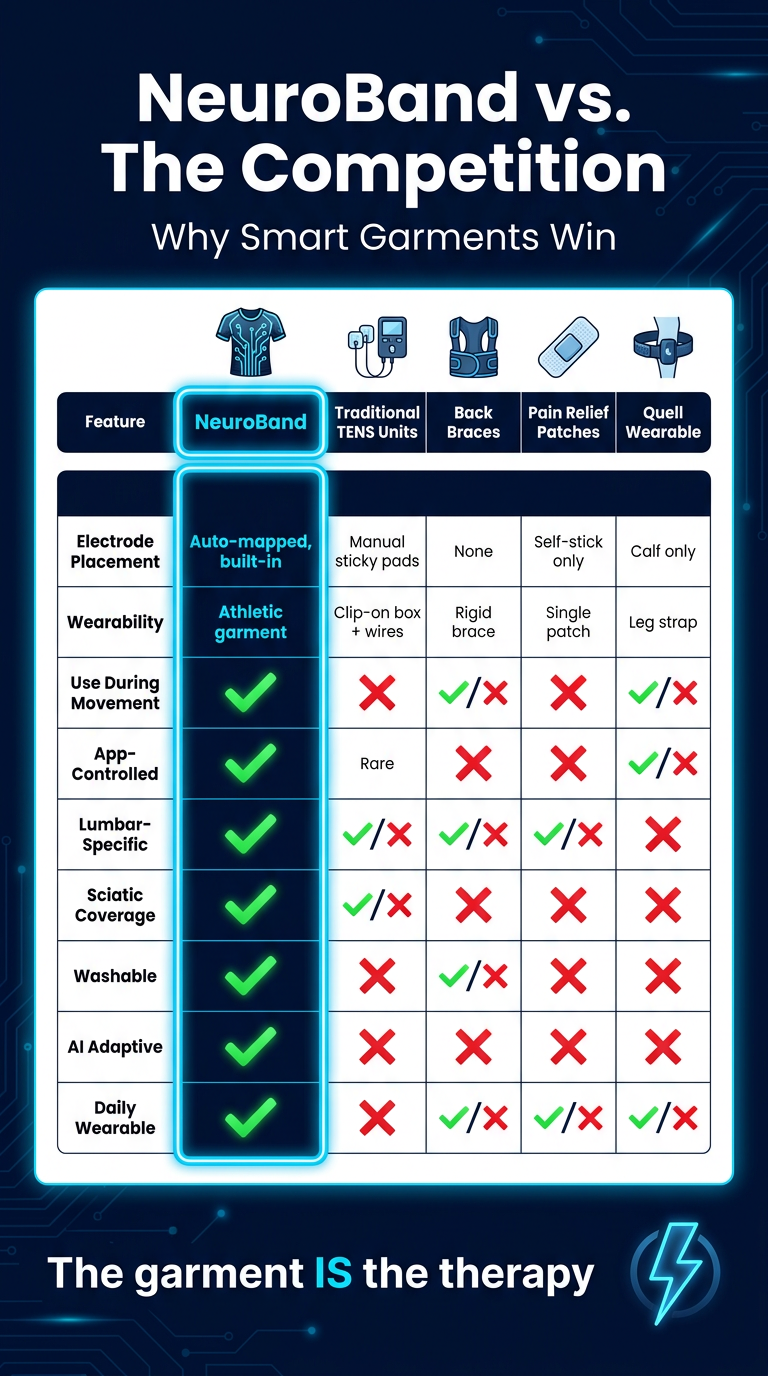
| Competitor | Core Weakness vs. NeuroBand |
|---|---|
| Traditional TENS Units | Manual sticky pads, wires, not wearable during daily activity |
| Back Braces | Compression only - zero electrotherapy, rigid and uncomfortable |
| Pain Relief Patches | Single-use, no app control, no nerve stimulation |
| Quell Wearable | Targets calf/peroneal nerve only, not lumbar or sciatic specific |
- A product vision mockup showing what NeuroBand shorts/waistband looks like?
- An investor pitch slide deck (.pptx) expanding on this concept?
- A market sizing infographic for the back pain wearable space?
More in detail
A highly detailed, professional competitive analysis poster for a medical wearable startup. Dark navy blue background (#0A0E2A). Title at very top in bold white: "NeuroBand — Competitive Landscape Analysis" with subtitle in electric blue: "TENS-Integrated Smart Shorts & Waistband for Back Pain & Sciatica" SECTION 1 — Large comparison matrix table (center of poster): Columns: FEATURE | NEUROBAND (glowing blue column, highlighted) | Quell by NeuroMetrix | iReliev TENS | TENS 7000 | Myovolt Waistband | Comfortisse Brace | Salonpas Patch Rows with icons: ⚡ Electrode Type | Built-in e-textile conductive fabric | Gel electrode on strap | Sticky adhesive pads | Sticky adhesive pads | Vibration only (no TENS) | None | Chemical adhesive 📍 Placement | Auto-mapped anatomical zones | Calf only | Manual – user positioned | Manual – user positioned | Lumbar wrap | Lumbar wrap | Anywhere, non-targeted 🎯 Target Nerve | L3-L5 lumbar + sciatic pathway | Peroneal nerve (indirect) | Any area user places | Any area user places | Muscle surface only | None | Surface skin 🏃 Use During Movement | YES – designed for active wear | Limited | No – pads fall off | No – pads fall off | Yes | Yes | Yes but dislodges 📱 App / Bluetooth | YES – AI adaptive app | Basic app | No | No | No | No | No 🤖 AI Adaptive Stimulation | YES – learns pain patterns | No | No | No | No | No | No 🔋 Power Source | USB-C rechargeable snap module | Rechargeable | Battery pack | Battery pack | Battery | None | None 👕 Garment Form Factor | YES – looks like athletic shorts | Leg strap | Clip-on unit | Clip-on unit | Waistband wrap | Rigid brace | Flat patch 🫧 Washable | YES – module snaps off | No | No | No | Hand wash only | Hand wash | Disposable 🌡️ Heat Therapy Combo | Optional add-on | No | No | Some models | No | No | Yes (chemical) 🩺 Clinical Evidence | TENS: strong (WHO-backed) | Moderate | Strong (TENS general) | Strong (TENS general) | Limited | Compression only | Topical NSAID 💊 Drug-Free | YES | YES | YES | YES | YES | YES | No (contains diclofenac) 💰 Est. Price | $149–$199 + liner subscription | $299 | $30–$60 | $40–$80 | $180 | $25–$60 | $8–$15/pack 🔄 Reusable | YES | YES | Partially | Partially | YES | YES | No 🏆 Sciatica-Specific | YES | No | No | No | No | No | No SECTION 2 — Bottom left: Radar/spider chart showing NeuroBand vs competitors on 6 axes: Clinical Efficacy, Wearability, Smart Features, Coverage, Value, Convenience. NeuroBand fills most of the hexagon in bright blue, competitors shown as smaller overlapping areas in grey/orange. SECTION 3 — Bottom right: Key insight callout boxes: Box 1 (blue): "Gap in Market — No existing product combines lumbar-targeted TENS + garment form factor + AI app control" Box 2 (green): "Clinical Backing — WHO-commissioned 2023 systematic review confirms TENS effectiveness for chronic low back pain" Box 3 (orange): "619M people globally suffer from low back pain — $12.8B market" Color scheme: Navy background, electric blue highlights, white text, green checkmarks, red X marks. Clean sans-serif font. Medical-tech startup aesthetic. Very detailed infographic style. Professional investor-grade poster layout.