
Bartholin cyst removal
Reading File
Finding Sources
Finding Sources
Searching PubMed
Bartholin cyst treatment management
Good results found. Let me now read the most detailed procedure-focused sections in parallel.
Reading File
Reading File
Reading File
I have rich content. Let me get the remaining key sections — the Word catheter procedure steps continuation, the marsupialization detail, and fetch the key procedural image.
Reading File
Reading File
Loading Image
I now have comprehensive information from multiple authoritative textbooks. Let me also get the marsupialization and excision details.
Reading File
Loading Image
I now have comprehensive information from multiple authoritative sources. Here is the complete clinical overview:
Bartholin Cyst/Abscess — Management & Removal
Anatomy
The Bartholin glands are paired mucus-secreting glands located at the 5 and 7 o'clock positions of the posterior vaginal introitus. Duct obstruction causes mucus accumulation (cyst), and superimposed infection produces an abscess.
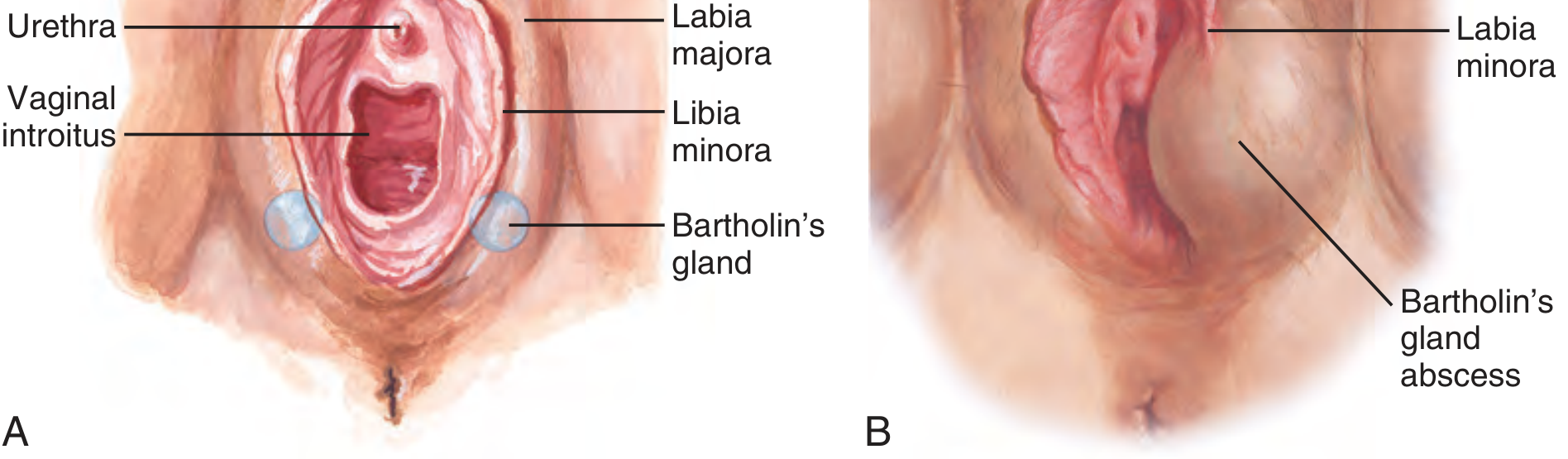
When to Treat
| Scenario | Management |
|---|---|
| Small, asymptomatic cyst | No treatment needed |
| Symptomatic cyst (painful, growing) | Word catheter or marsupialization |
| Abscess | Drainage (Word catheter or I&D ± marsupialization) |
| Age >40 with solid mass or suspicious epithelium | Excision + biopsy to exclude carcinoma |
Treatment Options
1. Word Catheter Placement (First-line for abscess/symptomatic cyst)
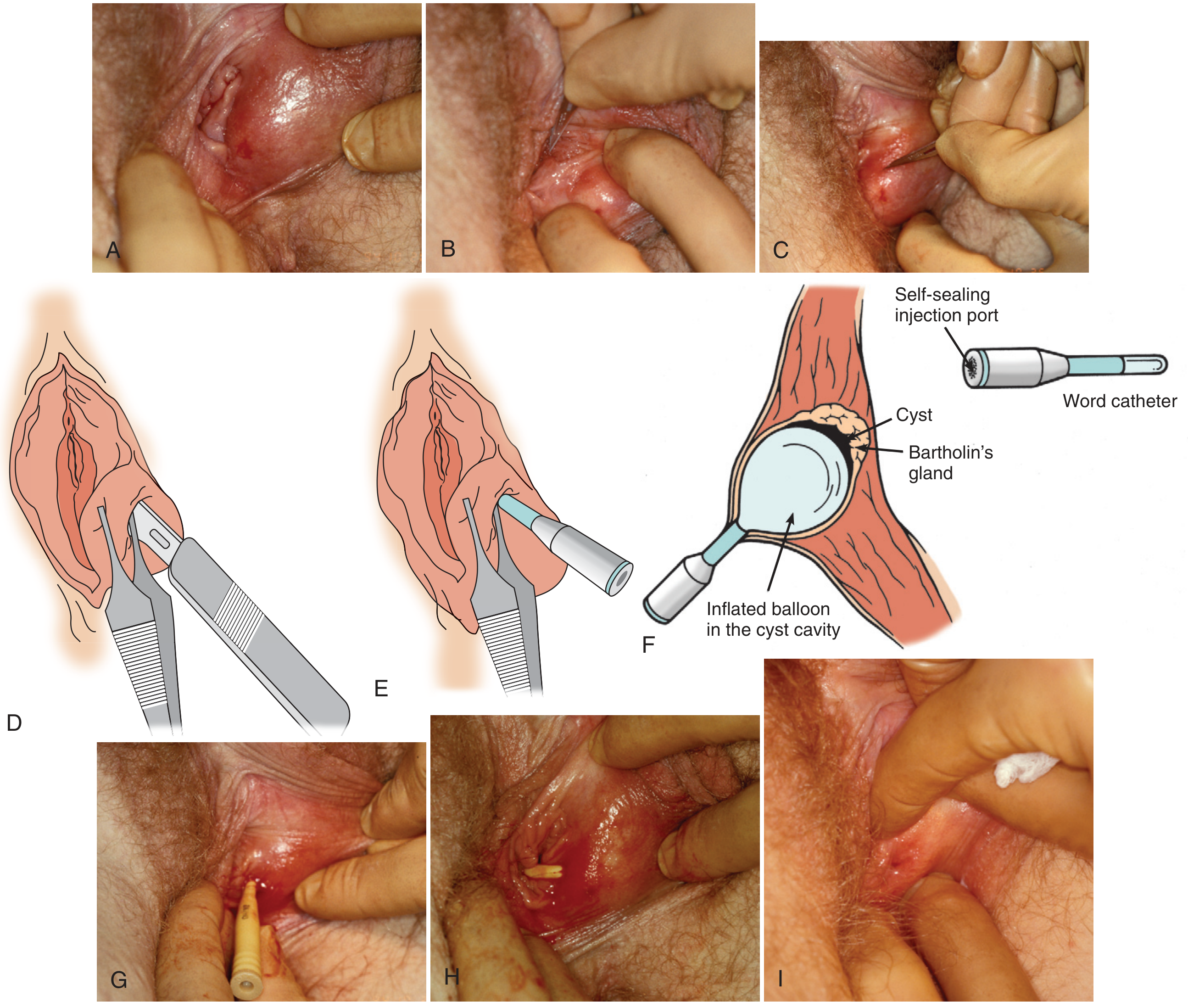
The Word catheter is a small inflatable balloon-tipped catheter that maintains a drainage tract, allowing epithelialization of a permanent gland opening over 4–6 weeks.
Equipment: No. 11 blade, Word catheter, 3 mL syringe + 22-gauge needle (for inflation), 2% lidocaine with epinephrine, pickups with teeth, povidone-iodine.
Step-by-Step Procedure:
- Position: Dorsal lithotomy.
- Prep: Clean with povidone-iodine. Infiltrate over the most prominent point of the cyst/abscess with lidocaine — preferably on the mucosal (vaginal) surface, not the skin, just inside the hymenal ring.
- Incise: Use a No. 11 blade to make a 3–4 mm stab incision through the mucosal surface. Penetration is confirmed by free flow of pus or mucus. Culture if indicated (abscesses are often polymicrobial; Neisseria gonorrhoeae is common).
- Avoid false tract: Before removing the blade, slide Adson forceps with teeth alongside it into the lumen to grasp the tissue — this stabilizes the cavity opening and guides catheter insertion. Remove the blade but keep forceps in place.
- Insert catheter: Pass the Word catheter along the forceps into the cavity. Remove forceps.
- Inflate: Inject 2.5–3 mL saline (not air) through the self-sealing injection port to inflate the balloon. Gently tug to confirm it won't fall out.
- Tuck: If the incision is intravaginal, tuck the catheter stem into the vagina for patient comfort.
- Duration: Leave in place 4–6 weeks, then deflate and remove, leaving a small permanent ostium.
Note: Antibiotics are of no proven benefit once drainage is performed, though practice varies.
2. Marsupialization (Preferred for recurrent cysts; reduces recurrence)
Marsupialization surgically converts the cyst into an open pouch permanently sutured to the vaginal mucosa.
Anesthesia: 2% lidocaine with epinephrine (local block) or pudendal block. Spinal/general anesthesia is an option in a same-day surgery setting.
Step-by-Step:
- Retract the labium laterally and identify the incision site inside the hymenal ring.
- Make a longitudinal fusiform incision 1–2 cm wide through the vaginal mucosa over the cyst wall (not the external skin).
- Before removing the ellipse, grasp the cyst wall with two small hemostats (to prevent collapse). Remove any loculations.
- Biopsy: In patients >40 years, inspect for suspicious epithelium — send for pathology to exclude Bartholin gland carcinoma.
- Irrigate cavity with normal saline.
- Suture the cut edge of the cyst wall to the vaginal mucosa using interrupted 4-0 Vicryl, effectively everting the cyst open. The intent is to keep at least 1 cm gap across the marsupialization.
- No dressing required; apply a pad for drainage.
- Postoperative care: Sitz baths starting the following day.
3. Simple I&D (Emergency setting — highest recurrence rate)
- 5 mm stab incision through the mucosal surface (not skin) at the point of maximal fluctuance.
- Drain contents; may insert a wick or Word catheter.
- High recurrence; gynecology follow-up recommended for definitive marsupialization.
4. Excision of the Bartholin Gland (Reserved for specific indications)
- CPT 56740
- Indicated for: recurrent cysts/abscesses unresponsive to other treatment; age >40 with suspected malignancy.
- More technically demanding; risk of bleeding and hematoma is higher.
- Complete gland removal eliminates recurrence but is not routine.
Key Points
- Location: Always incise on the mucosal surface (vaginal side), not external skin — reduces scarring and improves cosmesis.
- Age >40: Any Bartholin cyst/abscess requires a biopsy to rule out Bartholin gland carcinoma (a rare but important diagnosis).
- Microbiology: Abscesses are commonly polymicrobial; N. gonorrhoeae, E. coli, anaerobes.
- Recurrence: Simple I&D > Word catheter > marsupialization (lowest recurrence).
- Antibiotics: Not routinely indicated after adequate drainage in immunocompetent patients.
Sources: Pfenninger & Fowler's Procedures for Primary Care (3rd ed.); Roberts & Hedges' Clinical Procedures in Emergency Medicine; Berek & Novak's Gynecology; Sabiston Textbook of Surgery
This is a shared conversation. Sign in to Orris to start your own chat.