
Organ preserving laryngeal surgery in detail according to standard ENT te
Reading File
Now let me search the medical library for comprehensive content on organ-preserving laryngeal surgery.
Finding Sources
Finding Sources
Finding Sources
Excellent - I found the main sources. Now let me read the core content from Cummings (the dedicated chapter on Conservation Laryngeal Surgery) and Scott-Brown's simultaneously.
Reading File
Reading File
Good content coming in. Let me now read more of the Cummings chapter (the detailed sections) and more of Scott-Brown's simultaneously.
Reading File
Reading File
Excellent - very rich content. Let me now read the detailed sections on glottic and supraglottic procedures from Cummings, and the laser/endoscopic surgery sections.
Reading File
Finding Sources
Reading File
Finding Sources
Reading File
Reading File
I now have comprehensive content from both Cummings and Scott-Brown's. Let me fetch a couple of key images and read one more section on contraindications and functional outcomes.
Reading File
Loading Image
Loading Image
I now have extensive, comprehensive content from both Cummings Otolaryngology and Scott-Brown's. Let me compile the full detailed answer.
Organ-Preserving Laryngeal Surgery
Based on Cummings Otolaryngology Head and Neck Surgery (7th ed.) and Scott-Brown's Otorhinolaryngology Head & Neck Surgery
1. Fundamental Principles
Four core principles govern organ-preservation surgery and provide consistent oncologic and functional outcomes (Cummings, Ch. 108):
- Local control - the primary oncologic objective
- Accurate assessment of the 3D extent of the tumor - critical for surgical planning
- The cricoarytenoid unit as the basic functional unit of the larynx - preservation of at least one functional cricoarytenoid unit is the minimum requirement for a functioning larynx without a permanent tracheostomy
- Resection of normal tissue to achieve an expected functional outcome - the extent of resection predicts functional outcome
The basic philosophy distinguishes conservation laryngeal surgery from non-surgical organ-preservation: whereas chemoradiation accepts some local failures (relying on salvage), the conservation surgeon progressively removes more laryngeal tissue as the lesion enlarges to maintain local control - accepting reduced laryngeal function in exchange for avoiding local recurrence and total laryngectomy.
2. Patient Selection
General criteria
- Tumor confined within anatomical boundaries amenable to partial resection
- Sufficient pulmonary reserve - the patient must tolerate some post-operative aspiration. Pulmonary function tests are rarely used; a practical criterion is the ability to climb two flights of stairs without breathlessness
- General health sufficient to withstand surgery
The critical distinction: vocal fold fixation vs. arytenoid fixation
- Vocal fold fixation due to paraglottic space invasion does NOT by itself contraindicate conservation surgery
- Arytenoid fixation (cricoarytenoid joint invasion) IS a contraindication - it signals loss of the functional cricoarytenoid unit
Pre-operative workup
- Indirect laryngoscopy and staging operative endoscopy are mandatory
- CT/MRI for 3D tumor assessment, cartilage invasion, and pre-epiglottic space involvement
- Assessment of neck nodes for concurrent neck dissection planning
3. Classification of Procedures
Conservation laryngeal surgery is broadly divided into:
| Approach | Procedure | Primary Target |
|---|---|---|
| Endoscopic | Transoral Laser Microsurgery (TLM) | Glottic / Supraglottic T1-T2 (selected T3) |
| Endoscopic | Transoral Robotic Surgery (TORS) | Supraglottis |
| Open (vertical) | Vertical Hemilaryngectomy (VHL) | Glottis |
| Open (vertical) | Frontolateral Hemilaryngectomy | Glottis (anterior commissure) |
| Open (vertical) | Anterior Vertical Laryngectomy | Anterior commissure |
| Open (horizontal) | Horizontal Supraglottic Laryngectomy (HSPL) | Supraglottis T1-T2 |
| Open (horizontal) | SCPL-CHEP | Glottis T2-T3 / transglottic |
| Open (horizontal) | SCPL-CHP | Supraglottis with glottic extension |
4. Open Partial Laryngectomy - Vertical Procedures (Glottic)
First performed by Theodor Billroth in 1874. All vertical partial laryngectomies (VPL) share a common approach: vertical transection through the thyroid cartilage and paraglottic space with "blind" entry into the larynx through a narrow exposure.
4a. Vertical (Anterolateral) Hemilaryngectomy
Indications: T1-T2 glottic carcinomas not involving the anterior commissure, with one mobile vocal cord involved.
Technique:
- Exposure of the thyroid cartilage below the strap muscles
- Ipsilateral perichondrium lifted to preserve it
- Vertical midline laryngofissure cuts through the thyroid cartilage
- Resection of the majority of ipsilateral thyroid cartilage, true vocal cord, portions of subglottic mucosa, and false cord
- Reconstruction: strap muscles closed over residual perichondrium to form a pseudocord
- Tracheostomy and feeding tube generally required for 3-7 days
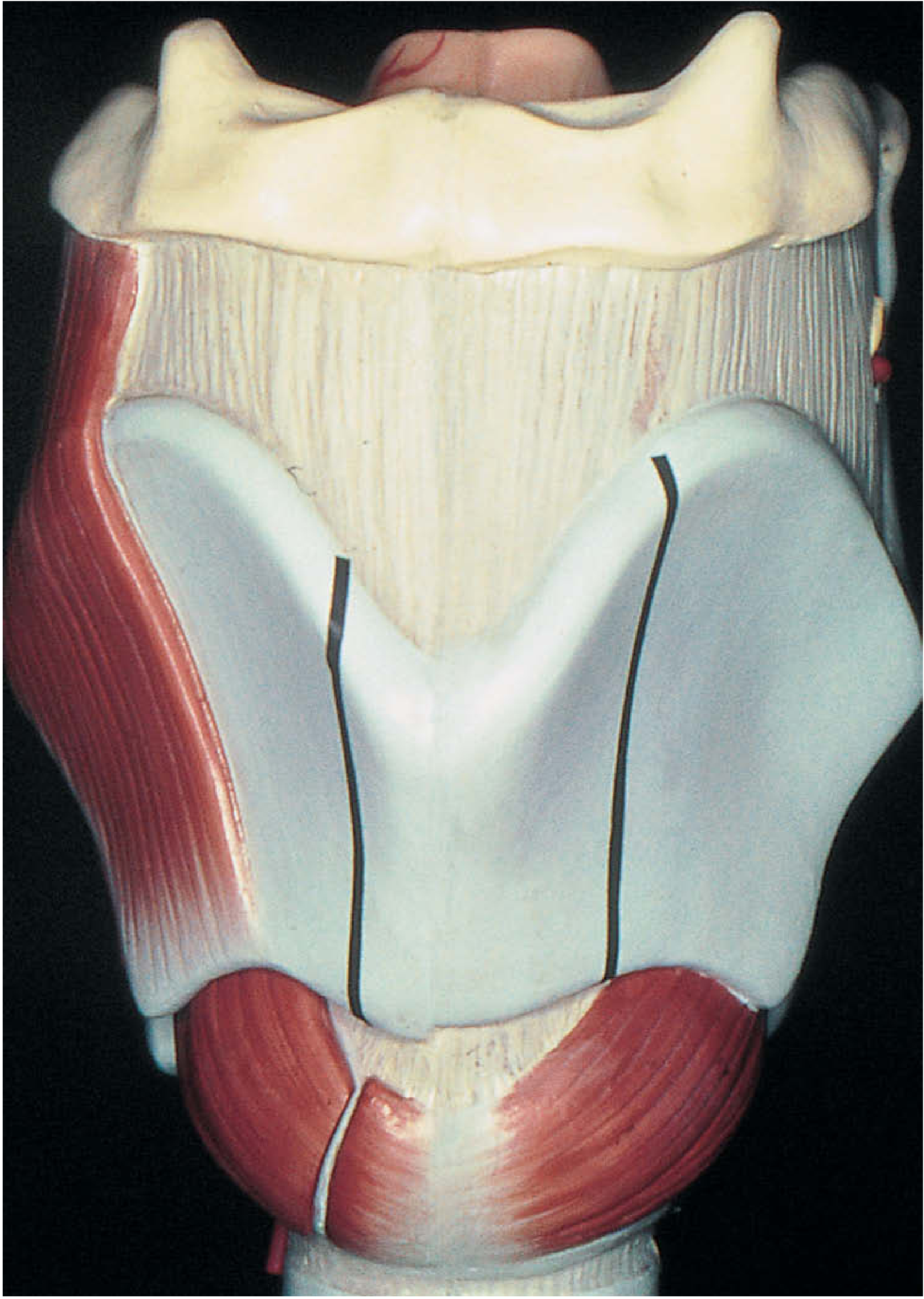
Oncologic results (T1): Local recurrence rates 4-11% across series; local control >90% in most series. For anterior commissure involvement, local failure rate rises to 25%, with most recurrences in the subglottis. T2 lesions with impaired mobility or extension beyond the glottis have substantially worse outcomes.
Limitations: Should be avoided for advanced T2 lesions and all T3-T4 lesions. Functional results are variable depending on extent of resection and type of reconstruction.
4b. Frontolateral Hemilaryngectomy
Indications: Tumors involving the ipsilateral cord, anterior commissure, and up to one-third of the contralateral vocal cord.
Technique: The vertical cartilage cut in the thyroid is placed 1 cm paramedian from the anterior midline on the contralateral thyroid ala, allowing wider resection of the anterior larynx.
4c. Anterior Vertical Laryngectomy
Indications: Anterior commissure tumors.
Technique: Two paramedian thyroid cartilage incisions, each ~1 cm from the anterior midline, resecting the anterior segment of the larynx including both anterior vocal cord segments.
5. Supracricoid Partial Laryngectomy (SCPL) - The Modern Workhorse
SCPL is the most significant advance in open conservation surgery in the past three decades, imported to the United States in the 1990s.
What is resected en bloc:
- Both true vocal cords
- Both false cords
- The entire thyroid cartilage
- Both paraglottic spaces
- The preepiglottic space
- A maximum of one arytenoid (when necessary)
What is preserved (minimum requirements):
- The cricoid cartilage
- At least one functional arytenoid (with its recurrent laryngeal nerve supply)
- Both superior laryngeal nerves (SLN) for sensation during swallowing
- Hyoid bone
The cricoarytenoid unit
This is the fundamental concept: the neoglottic valve is formed by the mobile arytenoid(s) approximating against a fixed neoglottic floor. The airway orientation undergoes a 90-degree rotation in the horizontal plane - from the normal antero-posterior slit to a transverse or T-shaped neoglottic valve. This can be closed sufficiently by the mobile arytenoid(s).
5a. SCPL with Cricohyoidoepiglottopexy (SCPL-CHEP)
Indications: Selected T2 and T3 glottic carcinomas, including tumors extending across the midline through the anterior commissure that are not suitable for VHL (involving more than the anterior third of the contralateral cord). Also used for transglottic tumors when the supraglottis remains resectable.
Technique: After en bloc resection, reconstruction is achieved by approximating the hyoid bone to the cricoid with three absorbable sutures:
- One in the midline
- Two placed 1 cm paramedian (to avoid suturing lingual arteries, hypoglossal nerve, and SLN)
- The suprahyoid epiglottis is preserved and reapproximated in the cricohyoidopexy
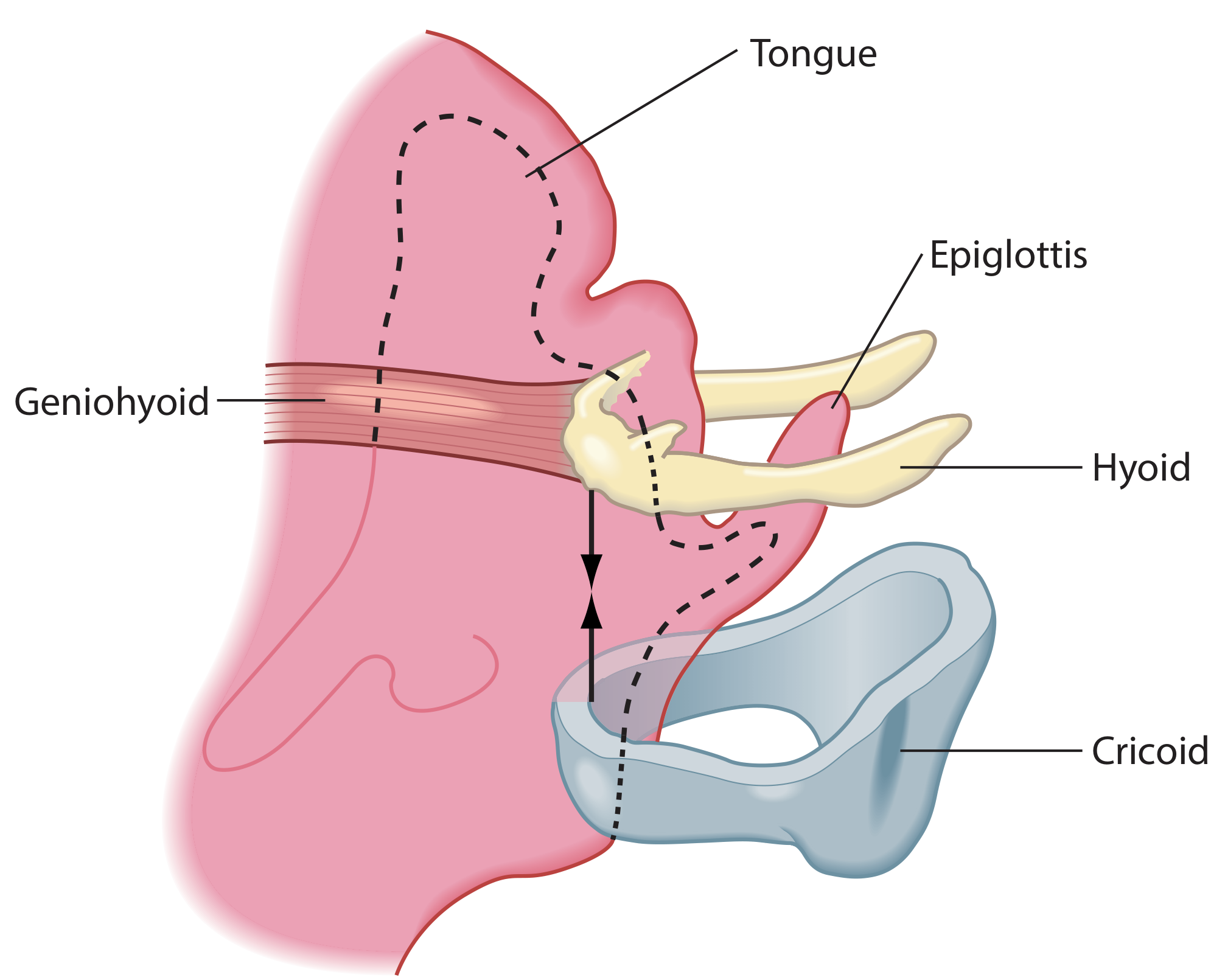
Oncologic results: Local control rates >90% for selected T2 and T3 glottic carcinomas.
Functional results: Highly predictable because of the identical resection and reconstruction in all cases. Temporary tracheostomy required; most patients decannulated early. Nasogastric tube used in most patients, removable at 4-6 weeks with swallowing therapy. Long-term severe dysphagia is rare.
5b. SCPL with Cricohyoidopexy (SCPL-CHP)
Indications: Supraglottic carcinomas in which the glottic level or preepiglottic space is involved, when vocal fold mobility is decreased, or with limited thyroid cartilage invasion. Also for glottic carcinomas with epiglottic or preepiglottic extension.
Key difference from CHEP: The epiglottis is NOT preserved (the entire supraglottis including the epiglottis is resected). Reconstruction = hyoid brought directly to cricoid.
Consequence: Post-operative dysphagia and aspiration tend to be more significant and recovery slower than with SCPL-CHEP. A PEG tube is advocated in older patients, those with a single preserved arytenoid, post-radiation cases, or when there is hypoglossal, SLN, or RLN dysfunction.
General contraindications to SCPL (both CHEP and CHP):
- Subglottic extension >10 mm anteriorly or >5 mm posteriorly
- Arytenoid fixation (implies cricoarytenoid joint invasion)
- Massive preepiglottic space involvement with vallecula involvement
- Extension to the pharyngeal wall, vallecula, base of tongue, postcricoid region, or interarytenoid region
- Cricoid cartilage invasion
- Poor pulmonary reserve
6. Horizontal Supraglottic Laryngectomy (HSPL)
Indications: T1 and T2 supraglottic carcinomas. The standard indication is a supraglottic tumor that does not extend to the glottic level (true vocal cords mobile), does not involve the preepiglottic space massively, and is confined to the supraglottis.
Resection includes: Epiglottis, preepiglottic space, hyoepiglottic ligament, superior portion of thyroid cartilage, aryepiglottic folds, false vocal cords - the horizontal cut is made above the ventricles.
Oncologic results: Excellent for T1-T2 supraglottic carcinomas; local control rates >90%. Outcomes are variable with T3-T4 lesions.
Functional results: Voice is typically excellent (true vocal cords preserved). Temporary dysphagia is expected. More severe dysphagia occurs with extended procedures. Because aspiration is inevitable post-operatively, pulmonary reserve is the limiting factor in patient selection.
In current practice: For T1-T2 supraglottic lesions, endoscopic approaches (TLM or TORS) are now often preferred over open HSPL.
7. Transoral Laser Microsurgery (TLM)
Historical background
Pioneered by Strong and Jako in North America during the 1970s. The conceptual breakthrough came from Steiner's German group in the 1980s-90s: tumor transection in situ - incremental resection, following the tumor's 3D extent in real time, analogous to Mohs surgery. This challenged the traditional principle of en bloc resection but ultimately proved safe in large series.
The CO2 laser
The CO2 laser remains the standard instrument. Key properties: water absorption, precise tissue vaporization/cutting, hemostasis of small vessels. The main limitations are: thermal artifact at cut margins (can affect pathologic assessment), requires line-of-sight (cannot cut around corners), plume production requiring suction and filtration, and anesthesia challenges.
Endoscopic classification of glottic resections (European Laryngological Society - Remacle classification)
| Type | Extent | Indication |
|---|---|---|
| Type I | Subepithelial | Dysplasia, carcinoma in situ |
| Type II | Subligamental | Superficial T1a (Reinke's space) |
| Type III | Transmuscular | T1a with muscle involvement |
| Type IV | Total cordectomy | T1a full-thickness |
| Type V | Extended cordectomy | T1b (both cords) / T2 / with arytenoid |
| Type VI | Posterior commissure resection | Posterior lesions |
TLM for glottic carcinoma
- Standard of care for T1a mid-cord lesions: Very high cure rate with undeniable advantage of higher laryngeal preservation rates
- T1b (anterior commissure): TLM is effective; RT is preferred in many UK/US centers for anterior commissure disease
- T2 glottic: TLM is an option in expert hands; RT often preferred for impaired mobility or extensive T2
- Key advantage: Preserves more normal laryngeal tissue than open procedures; allows outpatient or short-stay surgery without tracheostomy in most T1 cases
TLM for supraglottic carcinoma
- Excellent for T1-T2 supraglottic lesions as an alternative to open HSPL
- Avoids the morbidity of an open neck approach in early lesions
- Requires excellent exposure (adequate mouth opening, favorable anatomy); poor access is a relative contraindication
- Does not reconstruct the defect - secondary intention healing provides acceptable functional outcome for early lesions
TLM vs. open conservation surgery
The ongoing debate centers on:
- TLM: less morbidity, shorter hospital stay, no tracheostomy (usually), preserves more tissue, allows re-treatment
- Open SCPL: more predictable en bloc margins for larger lesions, no access limitations, broader applicability to T2-T3 disease
- Both provide comparable local control for appropriately selected lesions in expert hands
8. Transoral Robotic Surgery (TORS)
Primary role in the larynx: Supraglottic carcinomas (T1-T2), where the robotic platform provides superior 3D visualization and articulated instruments compared to rigid laryngoscopy.
Advantages over TLM: Better access to the supraglottis, angled instrumentation, 3D magnified view, avoids carbon dioxide plume.
Limitations: Cost, setup time, haptic feedback loss, limited to supraglottis and select glottic lesions; cannot be used for subglottic involvement.
9. Conservation Surgery After Prior Radiation (Salvage)
Surgical salvage after radiation failure is a common clinical scenario:
- Post-irradiation tissue changes (edema, fibrosis, poor healing) increase complication rates
- Only about one in three early laryngeal cancers that recur after primary radiation are still amenable to conservation surgery (the remainder require total laryngectomy)
- Salvage VHL: Weighted-average local control rate of 77% across series
- Salvage SCPL-CHEP or SCPL-CHP: Can be used for larger post-radiation recurrences; reported local control ~70%
Contraindications to salvage VHL after RT:
- Tumor involves the arytenoid
- Subglottic extension >10 mm anteriorly, >5 mm posteriorly
- Cartilage invasion (thyroid or cricoid)
Contraindications to salvage supraglottic laryngectomy after RT:
- Large primary tumor
- Recurrence located posteriorly
- Previous anterior commissure involvement
10. The Spectrum: Matching Procedure to Tumor
| Tumor | Preferred Organ-Preserving Option | Notes |
|---|---|---|
| T1a glottic (mid-cord) | TLM | Standard of care |
| T1a glottic (anterior commissure) | TLM or RT | Debate continues; subglottic recurrence risk |
| T1b glottic | TLM extended / Frontolateral VHL | Both effective |
| T2 glottic (mobile cord) | TLM or SCPL-CHEP | TLM preferred in expert centers |
| T2 glottic (impaired mobility) | SCPL-CHEP | VHL contraindicated |
| T3 glottic (cord fixation, paraglottic) | SCPL-CHEP (selected) | Must have at least one mobile arytenoid |
| T1-T2 supraglottic | TLM or HSPL (or TORS) | Endoscopic preferred if access good |
| T2 supraglottic (pre-epiglottic space, reduced mobility) | SCPL-CHP | HSPL inadequate |
| T3 supraglottic (selected) | SCPL-CHP or total laryngectomy | Careful patient selection |
| Transglottic (involving both levels) | SCPL-CHEP or SCPL-CHP | Depends on epiglottic involvement |
11. Post-operative Functional Outcomes Summary
| Procedure | Voice | Swallowing | Tracheostomy |
|---|---|---|---|
| TLM (T1) | Near normal | Normal | None / temporary |
| VHL | Variable (hoarse) | Near normal | Temporary (3-7 days) |
| SCPL-CHEP | Hoarse/rough but functional | Temporary aspiration | Temporary - early decannulation |
| SCPL-CHP | Hoarse | More significant aspiration | Temporary - later decannulation |
| HSPL | Excellent (cords preserved) | Temporary aspiration | Temporary |
Long-term severe dysphagia is rare with SCPL procedures. The key functional concept: preservation of at least one mobile arytenoid with an intact recurrent laryngeal nerve is the minimum requirement for functional voice and swallowing.
12. Current Status and Philosophy
The current standard of care (Cummings) dictates that when VPL, supraglottic laryngectomy, or SCPL is an alternative, patients must be counseled about all options - surgical and non-surgical. If a general otolaryngologist cannot offer the full spectrum of conservation surgery, the patient should be referred to a multidisciplinary center or a surgeon with specific expertise.
A renaissance in conservation laryngeal surgery has been driven by:
- Better understanding of 3D tumor extent from clinicopathologic studies and advanced imaging
- Long-term outcome data confirming predictable oncologic and functional results
- Introduction of new techniques (SCPL, TLM, TORS)
The fundamental choice is between the non-surgical approach (preserve anatomy, accept some failures, rely on salvage) versus the conservation surgical approach (progressively resect more tissue as lesions enlarge, accept reduced function for the entire cohort, minimize local recurrence). Both are legitimate, and the decision must be individualized.
Sources: Cummings Otolaryngology Head and Neck Surgery, Chapter 108 (Conservation Laryngeal Surgery) - Sperry, Weinstein, Laccourreye; Scott-Brown's Otorhinolaryngology Head & Neck Surgery, Chapter 27 (Open Conservation Surgery for Laryngeal Cancer)
This is a shared conversation. Sign in to Orris to start your own chat.