
clindamycin
Reading File
Clindamycin is a lincosamide antibiotic that inhibits bacterial protein synthesis by binding the 50S ribosomal subunit. It's used for anaerobic infections, skin/soft tissue infections, and as an alternative in penicillin-allergic patients.
Searching sources...
Finding Sources
Finding Sources
Searching PubMed
clindamycin clinical use resistance
Good - I have multiple high-quality sources. Let me read the key pharmacology sections now.
Reading File
Reading File
Reading File
I have comprehensive data from Goodman & Gilman's, Katzung's, and Lippincott's. Let me now fetch the clindamycin metabolism diagram for visual clarity.
Loading Image
Reading File
I now have everything needed for a thorough answer. Here is a complete summary of clindamycin:
Clindamycin
Clindamycin is a lincosamide antibiotic - a chlorine-substituted derivative of lincomycin, originally elaborated by Streptomyces lincolnensis.
Mechanism of Action
Clindamycin binds exclusively to the 50S subunit of bacterial ribosomes, suppressing protein synthesis by interfering with:
- Formation of initiation complexes
- Aminoacyl translocation reactions
Its binding site overlaps with erythromycin and chloramphenicol - binding by one may inhibit binding of the others. This makes it bacteriostatic at usual concentrations.
Spectrum of Activity
| Organism | Activity |
|---|---|
| Streptococci, staphylococci, pneumococci | Good (MIC 0.5-5 mcg/mL) |
| MSSA | Usually susceptible |
| MRSA (community-acquired) | Often susceptible, resistance increasing |
| Anaerobes (Bacteroides, Clostridium) | Good, but resistance in Bacteroides spp. is growing |
| Actinomyces israelii, Nocardia | Sensitive |
| Gram-negative aerobes | Resistant (outer membrane impermeability) |
| Enterococci | Resistant |
| C. difficile | Resistant |
Clindamycin is notably more active than macrolides against anaerobes, especially B. fragilis, though resistance is increasing.
Resistance Mechanisms
- Ribosomal methylation (erm genes) - the same mechanism as macrolide resistance. Constitutively expressed methylase confers cross-resistance. If the methylase is inducible (not constitutive), clindamycin may still appear susceptible on initial testing - but a subpopulation of constitutive producers can be selected (the "D-zone test" detects this in staphylococci and streptococci).
- Mutation of the ribosomal receptor site
- Enzymatic inactivation
Note: Clindamycin is not a substrate for macrolide efflux pumps (e.g., mef gene), so strains resistant to macrolides via efflux remain susceptible to clindamycin.
Pharmacokinetics
| Parameter | Details |
|---|---|
| Oral bioavailability | Nearly complete absorption; food does not significantly reduce it |
| Peak level (oral, 150 mg) | 2-3 mcg/mL at ~1 hour |
| IV level (600 mg q8h) | 5-15 mcg/mL |
| Protein binding | ~90% |
| Half-life | ~3 hours (adults); up to 6 h in anuria |
| Distribution | Wide - bones, abscesses, PMNs, alveolar macrophages; crosses placenta |
| CNS penetration | Poor - inadequate even with inflamed meninges (exception: sufficient for cerebral toxoplasmosis) |
| Metabolism | Hepatic - to N-demethylclindamycin and clindamycin sulfoxide |
| Excretion | Bile and urine (only ~10% unchanged in urine) |
| Renal failure | No dose adjustment needed |
| Hepatic failure | Dose adjustment may be required in severe cases |
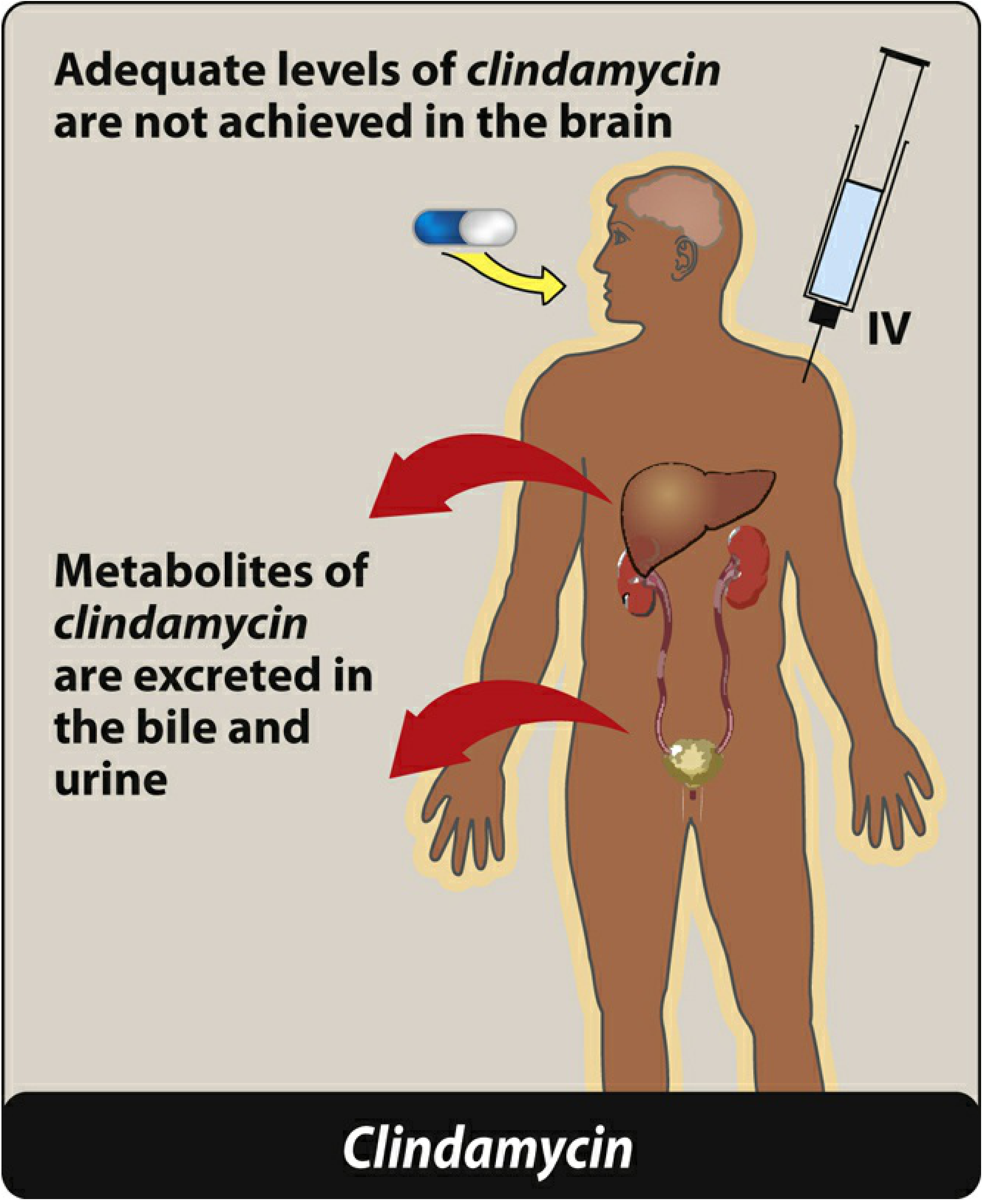
Formulations: IV, oral, topical (acne), vaginal (bacterial vaginosis). Clindamycin palmitate (oral pediatric) and clindamycin phosphate (parenteral) are prodrugs rapidly hydrolyzed in vivo.
Dosing
Adults (oral):
- Mild-moderate: 150-300 mg every 6 hours
- Severe: 300-600 mg every 6 hours
Adults (IV/IM):
- Serious infections: 1200-2700 mg/day in 3-4 divided doses
Children (oral): 8-12 mg/kg/day in 3-4 doses (severe: 13-25 mg/kg/day)
Children (IV): 15-40 mg/kg/day in 3-4 doses
Clinical Uses
- Skin and soft-tissue infections - streptococci, staphylococci; especially useful as a beta-lactam alternative or when MRSA is possible
- Necrotizing fasciitis / toxic shock syndrome - used with a beta-lactam; inhibits toxin production (protein synthesis block suppresses exotoxin output). Typically limited to the first 48-72 hours for this purpose
- Anaerobic infections - intra-abdominal, pelvic (PID, septic abortion), lung abscesses, periodontal abscesses
- Osteomyelitis - excellent bone penetration makes it an alternative agent
- Cerebral toxoplasmosis (HIV/AIDS) - clindamycin + pyrimethamine + leucovorin as alternative to TMP-SMX
- PCP pneumonia (HIV) - clindamycin + primaquine as second-line
- Malaria - clindamycin + quinine for non-severe malaria
- Bacterial vaginosis - vaginal formulation
- Acne vulgaris - topical formulation (often combined with benzoyl peroxide to reduce resistance)
Adverse Effects
| Effect | Details |
|---|---|
| C. difficile colitis | Most serious - boxed warning in the US. Odds ratio ~16 vs. no antibiotics (vs. ~5.5 for cephalosporins or fluoroquinolones). Features: watery diarrhea, fever, elevated WBC. Can be fatal |
| Diarrhea | 2-20% incidence; usually mild and resolves on stopping |
| Skin rash | ~10%; more common in HIV patients |
| Stevens-Johnson syndrome | Uncommon |
| Elevated hepatic transaminases | Reversible, uncommon |
| Neuromuscular blockade | Rare; caution with agents that also block NMJ |
Agents that inhibit peristalsis (e.g., opioids, antidiarrheals) should be avoided if C. difficile colitis is suspected - they can worsen outcomes.
Key Clinical Pearls
- The D-zone (D-test) should be performed when clindamycin is being considered for MRSA or streptococci that are macrolide-resistant - inducible resistance can become constitutive during therapy.
- Clindamycin's anti-toxin effect (not just antibacterial) is why it is added in necrotizing fasciitis and TSS - protein synthesis inhibition rapidly cuts toxin output even before the bacteria are killed.
- Poor urinary excretion of active drug means it is not useful for UTIs.
- Despite historically being listed as endocarditis prophylaxis for penicillin-allergic patients, it has since been removed from current ADA/AHA dental prophylaxis guidelines.
Sources: Goodman & Gilman's Pharmacological Basis of Therapeutics; Katzung's Basic and Clinical Pharmacology, 16e; Lippincott Illustrated Reviews Pharmacology.
This is a shared conversation. Sign in to Orris to start your own chat.