
Diagram of functional and flint and dynamic coveraged and orthosis
Could you clarify what you're looking for? Some terms seem unclear:
functional static dynamic orthosis classification diagram types
A clean medical education diagram showing the classification of orthoses. The main title at the top reads "Classification of Orthoses". Below it, three main branches spread out: 1) STATIC ORTHOSIS (left branch, in blue) - with sub-bullets: "No moving parts", "Maintains position/rest", "Immobilization", "Reduces pain and inflammation", Examples: wrist cock-up splint, resting hand splint. 2) DYNAMIC ORTHOSIS (middle branch, in green) - with sub-bullets: "Has moving parts (springs/rubber bands)", "Allows or assists motion", "Corrects deformity", "Used in nerve palsy/tendon repair", Examples: knuckle-bender splint, dynamic wrist extension splint. 3) FUNCTIONAL ORTHOSIS (right branch, in orange) - with sub-bullets: "Supports function during activity", "Allows purposeful movement", "Compensates for muscle weakness", "Used in daily living tasks", Examples: mobile arm support, hand-based functional splint. At the bottom, a note: "Static-Progressive = static device adjusted periodically to gain ROM". Professional white background, medical textbook style, clear typography, flowchart/tree diagram format.
functional orthosis vs static dynamic splint differences rehabilitation
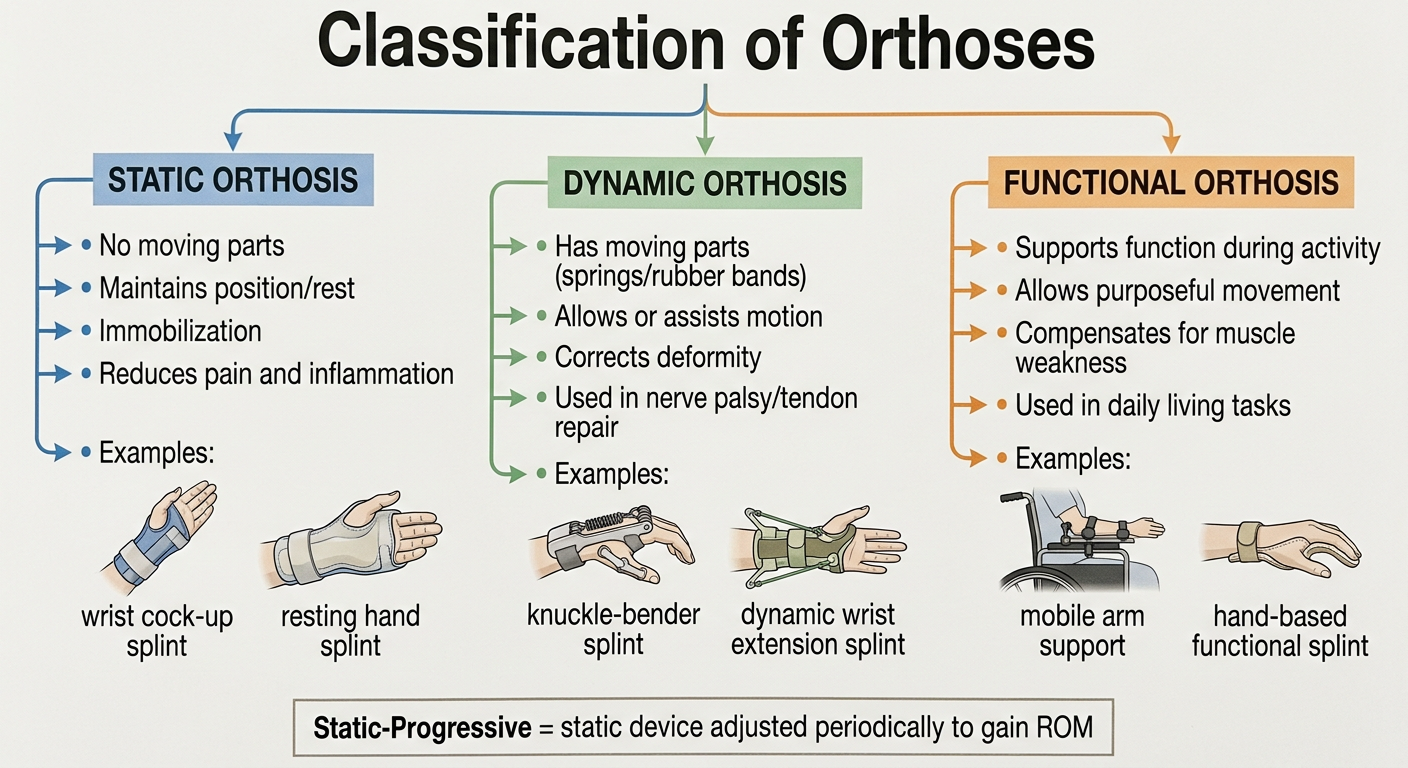
Classification of Orthoses: Functional, Static, and Dynamic
1. Static Orthosis
- No moving parts - holds a body part in a fixed position
- Primary goal: immobilization, rest, pain relief, protection of healing structures
- Mechanism: rigid or semi-rigid shell that prevents motion
- Used for: fractures, post-op protection, inflammation (e.g., rheumatoid arthritis flares), spasticity management
- Examples: resting hand splint, wrist cock-up splint, thumb spica, finger gutter splint
2. Dynamic Orthosis
- Has moving parts - springs, rubber bands, coils, or hinges built onto a static base
- Primary goal: assist or resist motion, correct deformity, substitute for lost muscle function
- Mechanism: applies a continuous low-load force to joints or tendons
- Used for: nerve palsy (radial/ulnar/median), tendon repairs, post-burn contractures, increasing ROM
- Examples: knuckle-bender splint, dynamic wrist extension splint, lumbrical bar splint
- Evidence shows dynamic splints are more effective for hand dexterity recovery than static ones post-nerve injury
3. Functional Orthosis
- Supports active function during daily tasks and purposeful movement
- Primary goal: compensate for muscle weakness/paralysis while allowing the patient to use the limb
- Mechanism: offloads stress while permitting controlled movement; may incorporate outriggers
- Used for: spinal cord injury, upper motor neuron lesions, flaccid paralysis
- Examples: mobile arm support (MAS/MAST), tenodesis splint (uses wrist extension to close fingers), balanced forearm orthosis
Bonus: Static-Progressive Orthosis
Quick Comparison Table
| Feature | Static | Dynamic | Functional |
|---|---|---|---|
| Moving parts | No | Yes | Variable |
| Allows motion | No | Yes (controlled) | Yes (purposeful) |
| Main purpose | Immobilize/rest | Correct/assist motion | Enable ADLs |
| Force applied | None | Continuous low-load | Supportive |
| ROM goal | Maintain | Increase | Compensate |
Note: The original query mentioned "flint" - this may have been a typo for "splint," which is a broader lay term for any orthotic device. All splints are orthoses; the terms are often used interchangeably in clinical settings. The ASSH hand therapy classification also includes Static-Progressive as a distinct fourth category.