
joint
I need a bit more context to help you well. What would you like to know about joints?
Asking for Preferences
What about joints are you interested in?
The user skipped without providing more detail. I'll give a broad overview of joints covering anatomy, classification, and common pathology - drawing from the medical library.
Reading File
Finding Sources
Finding Sources
Reading File
Reading File
Loading Image
Here is a broad overview of joints, drawn from Firestein & Kelley's Textbook of Rheumatology:
Joints - Overview
Joints are the connections between bones. They exist in a wide spectrum of shapes, sizes, and tissue compositions, each tailored to its anatomic location and the type of motion required.
Classification
Joints are classified by their main histologic component and by the degree/type of movement they allow. These two systems correlate closely with each other.
| Type | Also called | Tissue bridge | Mobility | Examples | Location |
|---|---|---|---|---|---|
| Fibrous | Synarthroses | Dense connective tissue | Minimally mobile | Sutures, syndesmoses, gomphoses | Skull, between long bones, teeth |
| Cartilaginous | Amphiarthroses | Hyaline cartilage or fibrocartilage | Slightly mobile | Pubic symphysis, intervertebral disks | Pelvis, spine |
| Synovial | Diarthroses | Synovial cavity + fluid + articular cartilage | Freely moveable | Elbow, shoulder, knee, hip, ankle, wrist | Limbs, jaw |
Fibrous Joints (Synarthroses)
- Bridged by dense connective tissue with no joint cavity
- Little to no movement
- Sutures - flexible at birth, ossify after skull growth completes
- Gomphoses - periodontal fibrous tissue anchoring teeth in their bone sockets
- Syndesmoses - ligament-like connective tissue bridging two bones (e.g., ulna and radius) - slightly moveable
Cartilaginous Joints (Amphiarthroses)
- Bridged by hyaline cartilage or fibrocartilage; some flexibility
- Primary cartilaginous (synchondroses) - e.g., first rib-sternum joint, epiphyseal growth plates
- Secondary cartilaginous - fibrocartilaginous character, e.g., pubic symphysis and intervertebral disks
Synovial Joints (Diarthroses)
The most functionally important and most clinically relevant type. Key structural features:
- Synovial cavity filled with synovial fluid (water + plasma filtrate + lubricants: hyaluronic acid, lubricin, phospholipids)
- Articular cartilage covers the opposing bone ends - resilient, zonal, provides nearly frictionless motion
- Fibrous capsule fully encloses the joint
- Synovial lining delimits the cavity
Classified further by axes of motion:
- Uniaxial - e.g., humeroulnar (elbow)
- Biaxial - e.g., wrist
- Multiaxial - e.g., shoulder (glenohumeral)
And by architectural design:
- Ball and socket - hip
- Hinge - elbow
- Saddle - first carpometacarpal
- Plane - patellofemoral
These designs allow flexion, extension, abduction, adduction, and rotation. Synovial joints are the primary targets of arthritis and other rheumatic diseases.
Synovial Joint Histology
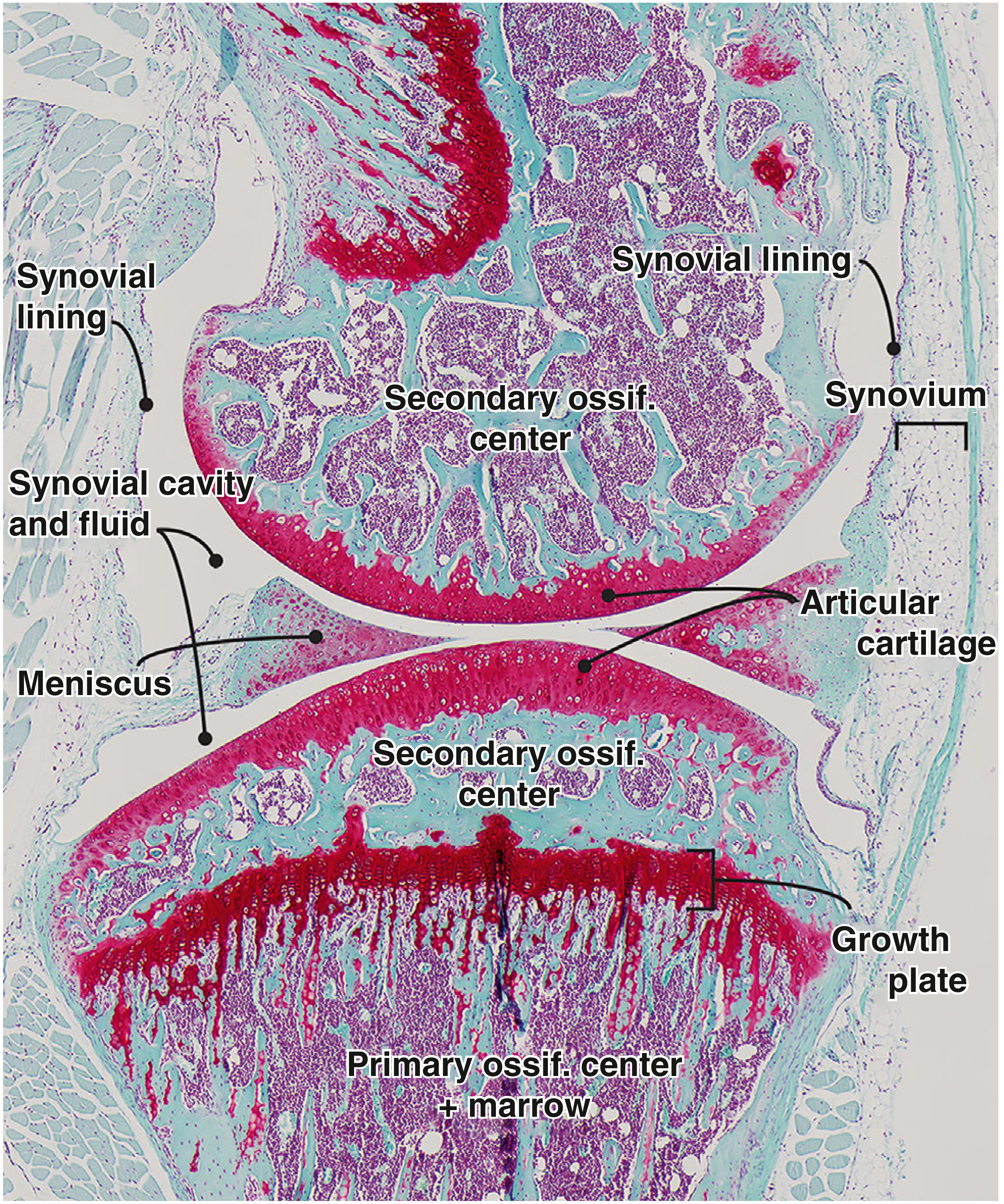
Fig. 1.1 - Frontal section of knee (juvenile mouse), safranin O/fast green stain. Shows articular cartilage, synovial cavity, meniscus, growth plate, and ossification centers. All structures are analogous to those in the human joint.
Source: Firestein & Kelley's Textbook of Rheumatology, Chapter 1 - Classification of Joints
If you want to go deeper on any area - synovial joint diseases (OA, RA, gout), specific joint anatomy (knee, hip, spine), or cartilage biology - just ask.
joint in detail
Searching sources...
Finding Sources
Finding Sources
Finding Sources
Finding Sources
Finding Sources
Reading File
Reading File
Reading File
Finding Sources
Finding Sources
Finding Sources
Reading File
Reading File
Now let me get the synovium lining cell section and a joint diseases overview from paragraphs search:
Finding Sources
Finding Sources
Reading File
Here is a detailed account of joints, synthesized from Firestein & Kelley's Textbook of Rheumatology:
Joints - In Detail
1. What Is a Joint?
A joint (articulation) is the connection between two or more skeletal elements. Joints display a broad spectrum of shapes, sizes, tissue compositions, and overall organization - each uniquely fitted to its anatomic location and the specific type and range of motion required.
2. Classification of Joints
By Histologic Component and Mobility
| Type | Also Called | Bridge Tissue | Mobility | Examples |
|---|---|---|---|---|
| Fibrous | Synarthroses | Dense connective tissue | Minimal to none | Skull sutures, syndesmoses, gomphoses |
| Cartilaginous | Amphiarthroses | Hyaline cartilage or fibrocartilage | Slight | Pubic symphysis, intervertebral disks, growth plates |
| Synovial | Diarthroses | Synovial cavity + fluid + articular cartilage | Freely moveable | Knee, hip, shoulder, elbow, wrist |
3. Fibrous Joints (Synarthroses) - Detail
- No joint cavity; bones are directly linked by dense connective tissue
- Sutures - Found in the skull. Minimally flexible at birth to permit brain growth, they ossify (synostosis) after growth is complete
- Gomphoses - The periodontal ligament connects each tooth root to its alveolar bone socket; allows microscopic tooth movement
- Syndesmoses - Ligament-like connective tissue bridges two bones (e.g., the interosseous membrane between the ulna and radius or tibia and fibula); allows slight movement
4. Cartilaginous Joints (Amphiarthroses) - Detail
Primary Cartilaginous (Synchondroses)
- Bridged by hyaline cartilage
- Allow slight flexibility; eventually ossify
- Examples: first rib-sternum junction, epiphyseal growth plates (physis)
Secondary Cartilaginous
- Bridged by fibrocartilage with a central disc
- More mobile than synchondroses; do not normally ossify
- Examples: pubic symphysis, intervertebral discs, manubriosternal joint
5. Synovial Joints (Diarthroses) - In Full Detail
These are the primary functional joints of the limbs and the main targets of arthritis. They have six defining structural components:
5a. Joint Capsule
- A tough, fibrous tissue sleeve that completely encloses the joint
- Outer layer = fibrous capsule (dense collagen); provides mechanical stability
- Inner layer = synovial membrane (synovium)
- Reinforced regionally by intrinsic or extrinsic ligaments
5b. Synovial Membrane (Synovium)
The synovium lines the inner surface of the capsule everywhere except over the articular cartilage. It has two layers:
Intima (Lining Layer)
- Normally 1-3 cells deep (no basement membrane beneath it - unlike true epithelia)
- Contains two types of synoviocytes:
| Feature | Type A Synoviocyte | Type B Synoviocyte |
|---|---|---|
| Origin | Hematopoietic (macrophage-like) | Mesenchymal (fibroblast-like) |
| Proportion | ~10-20% of lining cells | Predominant cell type |
| Organelles | Vacuoles, prominent Golgi, filopodia; little rough ER | Abundant rough ER |
| Markers | CD68, nonspecific esterase | CD55, UDPGD (hyaluronan synthesis enzyme) |
| Function | Phagocytosis, immune surveillance, debris clearance | Synthesize hyaluronic acid, lubricin, collagens, fibronectin, proteoglycans |
Subintima (Sublining)
- Loose connective tissue containing blood vessels, lymphatics, fat cells, and mast cells
- Highly vascularized to supply the avascular articular cartilage via synovial fluid
- In rheumatoid arthritis (RA), the sublining becomes infiltrated with lymphocytes and plasma cells
5c. Synovial Fluid
- Normal volume: ≤2.5 mL in the knee
- Composition: Plasma ultrafiltrate + hyaluronan (HA, ~3 g/L) + lubricin + phospholipids
- HA is synthesized by Type B synoviocytes; it gives synovial fluid its high viscosity
- Functions:
- Lubrication of articular surfaces (near-frictionless movement)
- Nutrition of avascular articular cartilage (delivers oxygen, glucose)
- Waste removal from the joint space
- Fluid is generated by plasma ultrafiltration across fenestrated synovial capillaries
- Cleared via diffusion back into vasculature and lymphatics (enhanced by joint movement)
- Proteins are present at concentrations inversely proportional to molecular size (albumin in synovial fluid ~45% of plasma concentration)
5d. Articular Cartilage
- Covers the opposing bone ends at the joint surface
- Type: Hyaline cartilage (in most synovial joints)
- Avascular, aneural, alymphatic - depends entirely on synovial fluid for nutrition
Cellular component:
- Chondrocytes are the only cells; they synthesize and maintain the entire extracellular matrix (ECM)
- Chondrocytes are organized in zones from surface to deep
Extracellular Matrix (ECM):
| Component | Function |
|---|---|
| Collagen type II (main) | Tensile strength; forms the fibrillar scaffold |
| Type IX, XI collagens | Stabilize type II fibril network |
| Aggrecan (major proteoglycan) | Highly negatively charged; attracts water, provides compressive stiffness |
| Hyaluronan + link protein | Anchor aggrecan to the ECM |
| Lubricin (SZP) | Surface lubrication |
| COMP (cartilage oligomeric matrix protein) | Fibril organization |
| Fibronectin, integrins | Cell-matrix adhesion |
Zonal organization (surface → deep):
- Superficial (tangential) zone - collagen fibers parallel to surface; highest collagen, lowest proteoglycan; contains lubricin
- Middle (transitional) zone - collagen fibers oblique; highest proteoglycan concentration
- Deep (radial) zone - collagen fibers perpendicular to surface; highest compressive strength
- Calcified cartilage zone - anchors cartilage to subchondral bone; separated from deep zone by the tidemark
Articular cartilage has no capacity for spontaneous repair after significant injury, because chondrocytes cannot migrate to a wound and the tissue is avascular.
5e. Subchondral Bone
- The layer of bone directly beneath the calcified cartilage
- Two components:
- Subchondral cortical plate - compact bone
- Subchondral cancellous bone - trabecular network that cushions transmitted loads
- Constantly remodeled by osteoclasts (bone resorption) and osteoblasts (bone formation), regulated by osteocytes via RANKL/OPG, sclerostin, and DKK-1 (Wnt pathway inhibitors)
- Communicates with articular cartilage via vascular channels that penetrate the calcified cartilage zone
- In osteoarthritis (OA), subchondral bone sclerosis is a key feature; increased bone stiffness may drive early cartilage damage
5f. Intra-articular Structures
Some synovial joints contain additional stabilizing or load-distributing structures:
- Menisci (fibrocartilage discs) - in the knee; deepen the joint, distribute load, improve congruence
- Labrum (fibrocartilaginous rim) - in hip and shoulder; deepens the socket and improves stability
- Intra-articular ligaments - e.g., anterior and posterior cruciate ligaments (ACL/PCL) of the knee
- Intra-articular tendons - e.g., long head of biceps in the shoulder
6. Synovial Joint - Subtypes by Shape and Motion
By Number of Axes
| Axes | Type | Example |
|---|---|---|
| Uniaxial | Hinge, pivot | Elbow (humeroulnar), proximal radioulnar |
| Biaxial | Condyloid, saddle | Wrist, first carpometacarpal |
| Multiaxial | Ball and socket, plane | Shoulder (glenohumeral), hip, patellofemoral |
By Architectural Design
| Design | Motion Allowed | Example |
|---|---|---|
| Ball and socket | Flexion, extension, abduction, adduction, rotation (all planes) | Hip, glenohumeral |
| Hinge | Flexion and extension only | Elbow (humeroulnar), interphalangeal |
| Pivot | Rotation only | Proximal radioulnar, atlantoaxial |
| Saddle | Biaxial motion | First carpometacarpal (thumb) |
| Condyloid (ellipsoid) | Biaxial (no rotation) | Wrist (radiocarpal), MCP joints |
| Plane (gliding) | Gliding/translation | Patellofemoral, acromioclavicular, intercarpal |
7. Innervation of Joints
Joints have a dual nerve supply:
- Specific articular nerves - independent branches penetrating the capsule from adjacent peripheral nerves
- Articular branches of muscle nerves
Key nerve fiber types:
- Myelinated A-delta fibers - in ligaments, fibrous capsule, menisci, periosteum; sense pressure and movement (proprioception)
- Unmyelinated C fibers - free nerve endings in capsule, synovium, ligaments; function as nociceptors (pain); also regulate synovial microvascular tone
- Sympathetic fibers - surround blood vessels; release norepinephrine, substance P, CGRP, neuropeptide Y, and VIP
- Substance P and CGRP modulate joint inflammation and pain in OA and RA
8. Synovial Joint Vasculature and Lymphatics
- The synovium is richly vascularized; blood vessels are the source of synovial fluid ultrafiltrate
- Synovial capillaries are fenestrated, facilitating rapid exchange of small molecules (glucose, lactate, electrolytes)
- Lymphatic vessels drain the synovial fluid and its solutes
- In RA and OA, lymphatic clearance is decreased despite increased lymphatic vessel density - a contributor to chronic joint inflammation
- Synovial blood flow (assessed by Doppler ultrasound) is a marker of disease activity in RA
9. Common Joint Diseases (Overview)
| Disease | Joint Type Affected | Key Mechanism |
|---|---|---|
| Osteoarthritis (OA) | Synovial (weight-bearing: knee, hip) | Cartilage degradation, subchondral bone changes, low-grade synovitis |
| Rheumatoid arthritis (RA) | Synovial (small joints: MCP, PIP, wrist) | Autoimmune synovitis, pannus formation, cartilage and bone erosion |
| Gout | Synovial (1st MTP, knee, ankle) | Monosodium urate crystal deposition in synovial fluid/tissue |
| Pseudogout (CPPD) | Synovial (knee, wrist) | Calcium pyrophosphate crystal deposition |
| Septic arthritis | Synovial (any large joint) | Bacterial infection, rapid cartilage destruction |
| Ankylosing spondylitis | Sacroiliac + spinal joints | Enthesitis, syndesmophyte formation, eventual ankylosis |
| Psoriatic arthritis | Synovial + DIP joints | Enthesitis, dactylitis, bone erosion and new bone formation |
Summary Diagram - Synovial Joint Structure
Frontal section of knee - the labeled structures are directly analogous to the human synovial joint.
Source: Firestein & Kelley's Textbook of Rheumatology (9780323935364), Chapter 1
If you want to go deeper on any specific area - for example, cartilage zones in detail, synovial fluid analysis in disease, specific joint anatomy (knee/hip/shoulder), ligament biomechanics, or a particular joint disease - just ask.That covers joints in full detail across 9 sections. Here's a quick orientation to what's covered:
- Definition - what joints are and why they vary
- Classification - fibrous / cartilaginous / synovial with full table
- Fibrous joints - sutures, gomphoses, syndesmoses
- Cartilaginous joints - synchondroses vs. secondary cartilaginous
- Synovial joints - the most detailed section, covering:
- Joint capsule and ligaments
- Synovial membrane with Type A vs. Type B synoviocytes (table)
- Synovial fluid composition, generation, and clearance
- Articular cartilage - cells, ECM components (table), 4-zone histology
- Subchondral bone and its remodeling
- Intra-articular structures (menisci, labrum, cruciate ligaments)
- Subtypes by shape and motion - hinge, ball-and-socket, saddle, etc.
- Innervation - proprioception, nociception, sympathetic fibers
- Vasculature and lymphatics
- Common joint diseases - OA, RA, gout, septic arthritis, etc.
Let me know which area you'd like to explore further.
joint long type answer
Searching sources... Building a comprehensive long-form answer on joints from the medical textbook library.
Finding Sources
Finding Sources
Finding Sources
Reading File
Finding Sources
Finding Sources
Reading File
Reading File
Reading File
Reading File
Reading File
Finding Sources
Reading File
Reading File
Finding Sources
Reading File
Finding Sources
Finding Sources
Reading File
Loading Image
JOINTS - A Comprehensive Long-Form Answer
PART 1: INTRODUCTION AND DEFINITION
A joint (articulation or articulatio) is the site of union or junction between two or more bones of the skeleton. Joints are not simply passive connectors - they are dynamic, biologically active structures essential for skeletal motion, load distribution, and quality of life. Each joint displays a unique combination of shape, size, tissue composition, and organization, fitted precisely to its anatomic location and the specific type, range, and magnitude of motion its adjacent skeletal elements require.
Because of such structural and functional diversity, multiple classification systems have been developed. The two most important systems classify joints by (1) their predominant histologic component, and (2) their degree and type of movement. These two systems correlate closely and are used together to describe any given joint.
PART 2: CLASSIFICATION OF JOINTS
2.1 Classification by Histologic Tissue Type
| Joint Type | Also Called | Connecting Tissue | Mobility | Examples |
|---|---|---|---|---|
| Fibrous | Synarthroses | Dense fibrous connective tissue | Minimal/none | Skull sutures, syndesmoses, gomphoses |
| Cartilaginous | Amphiarthroses | Hyaline cartilage or fibrocartilage | Slight | Pubic symphysis, intervertebral discs, epiphyseal plates |
| Synovial | Diarthroses | Synovial cavity + fluid + articular cartilage | Freely moveable | Knee, hip, shoulder, elbow, wrist, ankle |
2.2 Classification by Degree of Movement
| Term | Meaning | Joint Type |
|---|---|---|
| Synarthrosis | Immovable | Fibrous |
| Amphiarthrosis | Slightly moveable | Cartilaginous |
| Diarthrosis | Freely moveable | Synovial |
PART 3: FIBROUS JOINTS (SYNARTHROSES)
Fibrous joints are characterized by dense connective tissue directly bridging adjacent bones. They have no joint cavity, permit minimal or no movement, and are the most rigid joint type.
3.1 Sutures
- Found exclusively in the skull
- The bones are linked by a thin layer of fibrous periosteal tissue
- At birth, sutures are minimally flexible to allow the cranial vault to expand and accommodate the growing brain (particularly during vaginal delivery)
- As skull growth completes, sutures progressively ossify - a process called synostosis
- Premature fusion (craniosynostosis) is a pathological condition causing abnormal skull shape
3.2 Gomphoses
- Specialized fibrous joints that anchor teeth in their alveolar bone sockets via the periodontal ligament
- The periodontal fibrous tissue allows microscopic tooth movement (used in orthodontics) while providing firm anchorage
- Inflammation of this structure is periodontitis; loss of these attachments leads to tooth mobility and loss
3.3 Syndesmoses
- Bridged by ligament-like interosseous connective tissue (interosseous membrane or ligament)
- Allow slight movement - technically the most mobile of fibrous joints
- Examples:
- Interosseous membrane between the ulna and radius (allows forearm pronation/supination)
- Interosseous membrane between the tibia and fibula (distal tibiofibular joint - disrupted in high ankle sprains)
PART 4: CARTILAGINOUS JOINTS (AMPHIARTHROSES)
Cartilaginous joints bridge bones through cartilaginous tissue, providing some flexibility while maintaining structural stability. They are subdivided into two groups:
4.1 Primary Cartilaginous Joints (Synchondroses)
- Bridged by hyaline cartilage
- Allow minimal flexibility; most eventually ossify
- Examples:
- First rib-sternum junction (first costochondral joint)
- Epiphyseal growth plates (physis) - permit longitudinal bone growth during childhood and adolescence; once growth is complete, they ossify (physeal closure)
- Spheno-occipital synchondrosis at the base of the skull
4.2 Secondary Cartilaginous Joints (Symphyses)
- Bridged by fibrocartilage with a central disc
- More mobile than synchondroses; do not normally ossify in healthy adults
- Examples:
- Pubic symphysis - permits slight movement during childbirth; can be disrupted in pelvic fractures or symphysis pubis dysfunction in pregnancy
- Intervertebral discs - between adjacent vertebral bodies throughout the spine; act as shock absorbers; herniation of the nucleus pulposus is a major clinical entity
- Manubriosternal joint - between manubrium and body of sternum; can sometimes ossify in older individuals
PART 5: SYNOVIAL JOINTS (DIARTHROSES) - THE MAJOR FUNCTIONAL JOINTS
Synovial joints are the most numerous, most clinically important, and most disease-susceptible joints in the body. They are characterized by a fluid-filled cavity that enables nearly frictionless, high-velocity movement across a wide range of motion. All the major joints of the limbs are synovial.
5.1 Subtypes by Shape and Axes of Motion
By number of axes:
| Axes | Type | Example |
|---|---|---|
| Uniaxial | Movement in one plane only | Humeroulnar (elbow), interphalangeal, atlantoaxial (C1-C2) |
| Biaxial | Movement in two planes | Radiocarpal (wrist), MCP joints, first carpometacarpal |
| Multiaxial | Movement in all three planes | Glenohumeral (shoulder), hip, tarsometatarsal |
By architectural design:
| Design | Motion Permitted | Example |
|---|---|---|
| Hinge | Flexion + extension only | Elbow (humeroulnar), interphalangeal, knee (principally) |
| Pivot | Rotation only | Proximal radioulnar, atlantoaxial (C1-C2) |
| Ball and socket | Flexion, extension, abduction, adduction, rotation, circumduction | Glenohumeral, hip (coxofemoral) |
| Condyloid (ellipsoid) | Biaxial (no rotation) | Radiocarpal, MCP joints |
| Saddle | Biaxial, reciprocally curved surfaces | First carpometacarpal (thumb base) |
| Plane (gliding) | Gliding/translation | Patellofemoral, acromioclavicular, intercarpal, intertarsal |
PART 6: STRUCTURAL COMPONENTS OF SYNOVIAL JOINTS
6.1 The Joint Capsule
The joint capsule is a fibrous tissue sleeve that completely encloses the synovial joint, sealing it from the surrounding environment. It has two distinct layers:
Outer fibrous layer:
- Dense, irregular collagenous connective tissue
- Provides mechanical strength and limits excessive joint movement
- Thickened regionally to form intrinsic ligaments (e.g., glenohumeral ligaments, iliofemoral ligament of hip)
- Perforated by blood vessels and nerves
- Attached to periosteum of adjacent bones, typically close to the articular margins
Inner synovial layer:
- The synovial membrane (see Section 6.2 below)
6.2 The Synovial Membrane (Synovium)
The synovium lines the entire inner surface of the joint capsule except over articular cartilage surfaces. It is a specialized connective tissue with two distinct layers:
The Intima (Synovial Lining Layer)
- Normally 1-3 cells thick (deepened to 4-10 cells in inflammation)
- No basement membrane separates it from the sublining - unlike true epithelia
- Contains two cell types called synoviocytes:
| Feature | Type A Synoviocyte | Type B Synoviocyte |
|---|---|---|
| Origin | Hematopoietic (macrophage lineage) | Mesenchymal (fibroblast lineage) |
| Proportion in health | ~10-20% of lining cells | Predominant (~80-90%) |
| Organelles | Vacuoles, prominent Golgi, filopodia; little rough ER | Abundant rough ER |
| Surface markers | CD68, nonspecific esterase | CD55, UDPGD (hyaluronic acid synthesis enzyme) |
| Main function | Phagocytosis of debris, immune surveillance, particle clearance | Synthesize HA, lubricin, collagen type I, fibronectin, proteoglycans |
| Origin timing | Partially embryonic (CX3CR1+ macrophages); later replenished by MHCII+ sublining precursors | From mesenchymal interzone cells during cavitation |
Type B synoviocytes develop embryonically from the same GDF-5-expressing interzone precursor cells that also give rise to articular cartilage, bone, meniscus, and ligaments. During joint development, these cells condense into the lining layer during cavitation, facilitated by expression of cadherin-11 (a cell adhesion molecule). Notably, cadherin-11 is upregulated at the pannus-cartilage interface in RA, where it mediates the invasive behavior of fibroblast-like synoviocytes.
The Sublining (Subintima)
- Loose connective tissue below the intima
- Contains fibroblasts, blood vessels, lymphatics, fat cells, and mast cells
- The sublining macrophage population includes:
- CX3CR1+ embryonic macrophages (resident from fetal development; anti-inflammatory, express IL-4 and IL-10)
- Bone marrow-derived macrophages (pro-inflammatory, express IL-1β and TNF; recruited during disease)
- Highly vascularized - provides nutrition to the avascular articular cartilage via the synovial fluid
- In RA, the sublining becomes massively infiltrated with T cells (30-50%), B cells, plasma cells, dendritic cells, mast cells, and macrophages, forming a pannus - a destructive, invasive inflammatory tissue
6.3 Synovial Fluid
Synovial fluid fills the joint cavity and is the metabolic lifeline of the avascular articular cartilage.
Normal properties:
- Volume: ≤ 2.5 mL in the knee (just enough to coat the surfaces)
- Appearance: clear, straw-colored, viscous (like egg white - "synovial" from Latin synovia = egg-white)
- pH: ~7.4 (slightly lower than plasma in disease)
Composition:
- Plasma ultrafiltrate (major component)
- Hyaluronic acid (HA) - ~3 g/L; synthesized by Type B synoviocytes; large, heavily hydrated molecule that gives synovial fluid its high viscosity
- Lubricin (proteoglycan 4 / SZP) - glycoprotein synthesized by synoviocytes and chondrocytes; provides boundary lubrication at the cartilage surface
- Phospholipids - contribute to lubrication
- Proteins present at concentrations inversely proportional to molecular size (albumin ~45% of plasma concentration)
- Electrolytes and small molecules at concentrations equivalent to plasma
Generation:
- Formed as a pressure-driven plasma ultrafiltrate across the fenestrated (pore-containing) capillaries of the synovial sublining
- HA and lubricin are added by synoviocytes
- Exchange of small molecules (glucose, lactate) is rapid; assisted by active transport systems
Clearance:
- Via diffusion into synovial vasculature and lymphatic drainage (enhanced by joint movement)
- Lymphatic clearance is independent of molecule size (unlike ultrafiltration)
- In OA and RA, lymphatic clearance is reduced despite increased lymphatic vessel density - contributing to fluid accumulation (effusion) and chronic synovitis
Functions of synovial fluid:
- Lubrication - reduces coefficient of friction to near zero (~0.001-0.01), far lower than any synthetic lubricant
- Nutrition - delivers oxygen and glucose to avascular articular cartilage
- Waste removal - removes CO2 and metabolic waste from the joint
- Shock absorption - distributes compressive forces
- Immune defense - contains complement components, immunoglobulins, and leukocytes at low numbers in health
6.4 Articular Cartilage
Articular cartilage is the hyaline cartilage covering the opposing bone ends at synovial joint surfaces. It is one of the most specialized connective tissues in the body.
Key properties:
- Avascular, aneural, alymphatic - depends entirely on synovial fluid for diffusion-based nutrition
- Nearly frictionless surface
- Resilient under compressive loading across the entire lifespan
- No capacity for spontaneous intrinsic repair after significant damage (no blood vessels to deliver progenitor cells)
Cellular Component: Chondrocytes
- The only cell type in adult articular cartilage
- Responsible for synthesizing and maintaining the entire extracellular matrix
- Comprise only 1-5% of the tissue volume (the rest is ECM)
- Cell density decreases from surface to deep zone
- Cell morphology, volume, and behavior differ by zone (see below)
Extracellular Matrix (ECM) of Articular Cartilage
The ECM determines the mechanical properties of cartilage. It consists of:
Collagens (give tensile strength):
- Type II collagen (predominant ~90% of collagen) - main fibrillar scaffold; confers tensile stiffness
- Type IX, XI - stabilize the type II fibril network
- Type VI - surrounds chondrocytes in the pericellular matrix
- Type X - found in the hypertrophic (calcified) zone only
- Types XII, XIV - minor fibril-associated collagens
Proteoglycans (give compressive stiffness via water retention):
- Aggrecan - the major proteoglycan; consists of a core protein decorated with chondroitin sulfate and keratan sulfate glycosaminoglycan (GAG) chains
- GAGs are highly negatively charged; they attract and bind enormous amounts of water (hydrophilic), creating a swelling pressure that resists compressive loads
- When cartilage is compressed, water is extruded; when load is released, water is reabsorbed - a viscoelastic "sponge" behavior
- Link protein anchors aggrecan to hyaluronan, forming large proteoglycan aggregates
- Smaller proteoglycans: decorin, biglycan, fibromodulin, lumican - regulate collagen fibril assembly
Other structural and regulatory proteins:
- Lubricin (SZP/PRG4) - surface lubrication
- COMP (Cartilage Oligomeric Matrix Protein) - fibril organization; elevated in serum/synovial fluid as a biomarker of cartilage turnover
- Fibronectin, tenascin-C, fibrillin, elastin
- Integrins (cell-matrix adhesion molecules on chondrocyte surfaces)
Zonal Organization of Articular Cartilage
Articular cartilage is organized into 4 distinct zones from the joint surface to subchondral bone:
Zone 1 - Superficial (Tangential) Zone:
- Thinnest zone; directly contacts synovial fluid
- Collagen fibers arranged parallel to the joint surface (tangential array) - resists shear forces
- Highest water content (75-80% wet weight)
- Highest collagen-to-proteoglycan ratio
- Type I collagen present here (in addition to type II)
- Chondrocytes: small, elongated, oriented parallel to surface, sparse pericellular matrix
- Contains high concentrations of lubricin (PRG4) and decorin; low aggrecan
- This zone is the first to be damaged in OA and RA
Zone 2 - Middle (Transitional) Zone:
- Largest zone: 40-60% of cartilage wet weight
- Collagen fibers in oblique, random orientation
- Highest proteoglycan (aggrecan) concentration
- Chondrocytes: spherical, no organized orientation relative to surface
- Mechanically intermediate behavior
Zone 3 - Deep (Radial) Zone:
- Collagen fibers arranged perpendicular to the joint surface - anchors cartilage to subchondral bone; highest compressive strength
- Proteoglycan increases to 50% of dry weight
- Water content decreases to 65-70% wet weight
- Chondrocytes: largest, arranged in columns perpendicular to surface; form "chondrons" (groups of 3+ cells with extensive pericellular matrix)
- Cell density is half to one-third that of the superficial zone
Zone 4 - Calcified Cartilage Zone:
- Formed by endochondral ossification; persists after growth plate closure
- Separated from Zone 3 by the tidemark - a histologically visible basophilic line
- Anchors uncalcified cartilage to underlying subchondral bone
- Acts as a mechanical buffer between the compliant articular cartilage and the stiffer bone
- Biologically active: vascular channels from subchondral marrow penetrate this zone, allowing communication between bone cells and chondrocytes
6.5 Subchondral Bone
The subchondral bone lies directly beneath the calcified cartilage and is intimately linked to the overlying articular cartilage - together they form a biocomposite unit for load distribution.
Structure:
- Subchondral cortical plate - thin layer of compact bone
- Subchondral cancellous (trabecular) bone - spongy network that absorbs and distributes compressive loads
Cellular biology:
- Continuously remodeled throughout life by osteoclasts (resorption) and osteoblasts (formation)
- Regulated by osteocytes via the RANKL/OPG axis (controls osteoclast differentiation) and Wnt pathway inhibitors (sclerostin, DKK-1 - control osteoblast activity)
- Osteocytes form an interconnected lacunocanalicular network sensitive to mechanical loading
Cartilage-bone crosstalk:
- Vascular channels from subchondral marrow penetrate the calcified cartilage, allowing transport of regulatory molecules between osteocytes/osteoblasts and chondrocytes
- In OA, subchondral bone sclerosis (increased stiffness) is thought to adversely affect chondrocyte function; changes in subchondral bone contours further disrupt the biomechanical environment of the joint
6.6 Intra-articular Structures
Some synovial joints contain specialized structures within the joint cavity that improve congruence, stability, and load distribution:
Menisci (fibrocartilaginous discs):
- Present in the knee (medial and lateral menisci) and temporomandibular joint
- Deepen the articular surfaces, improving congruence between femoral condyles and tibial plateau
- Distribute ~50-70% of the compressive load across the knee
- Avascular in adults (except the peripheral one-third), hence poor intrinsic healing capacity
- Torn menisci are a major cause of knee pain and a risk factor for OA
Labrum:
- Fibrocartilaginous ring deepening the socket in the hip (acetabular labrum) and shoulder (glenoid labrum)
- Increases articular contact area, improves stability, and creates a suction seal in the hip
- Labral tears are common in femoroacetabular impingement (hip) and shoulder dislocations/instability
Intra-articular ligaments:
- ACL (anterior cruciate ligament) and PCL (posterior cruciate ligament) of the knee - prevent anterior and posterior translation of the tibia on the femur
- Ligamentum teres (round ligament of femoral head) in the hip - transmits blood to the femoral head in children
Intra-articular tendons:
- Long head of biceps brachii within the glenohumeral joint - minor stabilizer of the shoulder
PART 7: JOINT VASCULATURE AND LYMPHATICS
The synovial membrane is among the most vascularized tissues in the body. This is essential because the avascular cartilage depends entirely on the synovial vasculature (via fluid exchange) for nutrition.
Blood supply:
- An anastomosing periarticular arterial network (circulus articulosus vasculosus) encircles each joint
- Terminal branches penetrate the fibrous capsule and ramify in the synovial sublining
- Synovial capillaries are fenestrated (contain pores) - this facilitates rapid bidirectional exchange of small molecules (glucose, lactate, electrolytes, oxygen, CO2)
- Proteins cross via both fenestrations and vesicular transport
Lymphatic drainage:
- An extensive lymphatic network runs in the sublining
- Drains fluid, macromolecules, and cellular debris from the joint space into regional lymph nodes
- Joint movement actively promotes lymphatic flow (muscle pump effect)
- In RA and OA, lymphatic clearance is impaired (despite increased lymphatic vessel density), contributing to chronic joint effusion and synovial inflammation persistence
- Targeting synovial lymphatic function is being explored as a therapeutic strategy in OA
Angiogenesis in disease:
- In RA, growth factors from synovial fibroblasts and macrophages (VEGF, NGF, angiopoietins) drive new blood vessel formation in the sublining to supply the metabolically demanding inflammatory infiltrate
- Power Doppler ultrasound demonstrating increased synovial blood flow is a clinical marker of active synovitis in RA
PART 8: JOINT INNERVATION
Joints have a sophisticated sensory and autonomic nerve supply essential for proprioception, pain signaling, and regulation of synovial vascularity.
Dual nerve supply:
Each joint is innervated by:
- Specific articular nerves - independent branches penetrating the capsule from adjacent peripheral nerve trunks
- Articular branches of muscle nerves (Hilton's Law: nerves supplying muscles that move a joint also supply that joint)
Fiber types and their functions:
| Fiber Type | Location | Function |
|---|---|---|
| Myelinated A-beta/A-delta fibers | Ligaments, fibrous capsule, menisci, periosteum | Proprioception - sense joint position and velocity of movement |
| Unmyelinated C fibers | Capsule, synovium, adipose tissue, ligaments, menisci, periosteum | Nociception (pain); regulate synovial microvascular tone |
| Sympathetic fibers | Around synovial blood vessels (deeper sublining) | Vasomotor control; release norepinephrine, substance P, CGRP, neuropeptide Y, VIP |
Neuropeptides and pain:
- Substance P and CGRP (calcitonin gene-related peptide) are the key neuropeptides released from sensory nerve terminals into the joint
- Both are upregulated by NGF (nerve growth factor) - which also promotes angiogenesis via shared pathways with VEGF
- Substance P binds G protein-coupled receptors on synovial endothelium - increases vascular permeability
- In OA: reduced nerve density in articular cartilage, but increased nociceptive sensitization in subchondral bone and synovium
- In RA: abnormal neuropeptide release contributes to persistent synovial inflammation
Proprioception:
- Ruffini endings and Golgi tendon organ-like mechanoreceptors in the capsule and ligaments
- Pacinian corpuscles in periarticular fat pads (detect rapid pressure changes)
- These afferents feed into spinal and supraspinal circuits for joint position sense (kinesthesia)
- Injury to joint structures (e.g., ACL tear) impairs proprioception and increases risk of re-injury and OA
PART 9: JOINT DEVELOPMENT (EMBRYOLOGY)
The limb skeleton and synovial joints derive from lateral plate mesoderm progenitor cells that migrate into the developing limb bud. Key developmental steps:
9.1 Mesenchymal Condensation
- Mesodermal cells aggregate in the limb bud, producing adhesion proteins (N-cadherin, N-CAM)
- Form dense, avascular mesenchymal condensations that prefigure the future skeletal elements
- Hox genes provide positional identity:
- Hox10 - stylopod (humerus, femur)
- Hox11 - zeugopod (radius/ulna, tibia/fibula)
- Hox13 - autopod (carpals/tarsals, digits)
9.2 Chondrogenesis
- Mesenchymal condensations commit to chondrogenesis
- Cells acquire a cartilage phenotype
- The condensation forms a continuous cartilaginous template (chondroepiphysis) for the future bone
9.3 Joint Interzone Formation
- At future joint sites, a distinctive population of GDF-5-expressing interzone cells forms between adjacent chondroepiphyses
- Interzone cells are multipotent: they give rise to articular cartilage, the synovial lining, menisci, ligaments, and tendons of the joint
- These cells express markers distinct from proliferating chondrocytes
9.4 Cavitation
- The joint space forms by apoptosis and ECM remodeling within the interzone
- Type B synoviocytes condense to form the lining layer, facilitated by cadherin-11 expression
- Cavitation requires joint movement - embryos that cannot move their limbs fail to develop joint cavities
9.5 Endochondral Ossification
- Primary ossification centers form in the diaphyses of long bones during fetal life
- Secondary ossification centers form in the epiphyses postnatally
- The epiphyseal growth plates (primary cartilaginous joints) drive longitudinal bone growth until physeal closure at puberty/early adulthood
- Articular cartilage persists as the permanent joint surface
PART 10: TENDONS, LIGAMENTS, AND THE ENTHESIS
Tendons
- Functional bridges between muscle and bone
- Concentrate muscle force into a localized bone insertion; can split to distribute force of one muscle across multiple bones
- Structure: longitudinally arranged collagen fibrils (primarily type I collagen) embedded in a hydrated proteoglycan matrix, with fibroblasts (tenocytes) and blood vessels
- Cross-links between collagen chains provide tensile strength
- Many tendons run through tendon sheaths (tenosynovium) - collagenous sheaths lined with synovial-like mesenchymal cells that produce HA and lubricin for gliding
- Enthesis - the fibrocartilaginous transition zone where tendon inserts into bone via: tendon → fibrocartilage → mineralized fibrocartilage → bone. This graded structure minimizes stress concentration at the insertion
- Pathological enthesitis (inflammation at the enthesis) is the hallmark of spondyloarthropathies (ankylosing spondylitis, psoriatic arthritis)
Ligaments
- Collagenous fibrous bands connecting bone to bone across joints
- Provide passive joint stability; limit excessive and abnormal movements
- Classified as:
- Intrinsic (capsular) - thickenings within the fibrous capsule (e.g., iliofemoral, glenohumeral ligaments)
- Extrinsic - separate from the capsule but closely related (e.g., MCL of knee)
- Intra-articular - within the joint cavity (e.g., cruciate ligaments, ligamentum teres)
- Have mechanoreceptors and nociceptors for proprioception and pain
PART 11: AGING OF JOINTS
Aging profoundly affects all joint structures:
Articular cartilage:
- Chondrocyte numbers decrease with age; remaining chondrocytes show reduced synthetic capacity (less collagen and aggrecan produced)
- Collagen cross-links accumulate and stiffen with age (advanced glycation end-products, AGEs)
- Water content decreases slightly; cartilage becomes stiffer and less deformable
- Aggrecan molecular size and sulfation pattern changes
- Oxidative stress from mitochondrial dysfunction contributes to chondrocyte senescence
Synovium:
- Subintimal fat pad increases with age (Hoffa's fat pad enlargement in the knee)
- Mild fibrosis and decreased vascularity
Subchondral bone:
- Bone remodeling becomes less efficient; trabecular bone architecture deteriorates
- In postmenopausal women, estrogen loss accelerates bone loss and increases OA risk
Tendons and ligaments:
- Decreased cellularity, increased stiffness, reduced elasticity
- Increased injury risk and poorer healing capacity with age
PART 12: COMMON JOINT DISEASES
12.1 Osteoarthritis (OA)
OA is the most common joint disease worldwide, affecting primarily weight-bearing synovial joints (knee, hip) and the hands.
Pathophysiology:
- Traditionally viewed as "wear and tear" but now understood as a whole-joint disease involving cartilage, subchondral bone, synovium, ligaments, and muscle
- Initiating event: mechanical overload, injury, or metabolic factors break down the balance between cartilage anabolism and catabolism
- Matrix metalloproteinases (MMPs) and aggrecanases (ADAMTS) degrade collagen and aggrecan
- Chondrocytes cannot regenerate lost tissue
- Subchondral bone sclerosis and osteophyte formation are hallmarks
- Low-grade synovitis contributes to pain and progression
- Impaired lymphatic drainage perpetuates joint fluid accumulation
Radiographic features: joint space narrowing, subchondral sclerosis, osteophytes, subchondral cysts
Clinical: pain on use, stiffness after rest (gelling), crepitus, reduced ROM, bony swelling
12.2 Rheumatoid Arthritis (RA)
RA is a systemic autoimmune inflammatory arthritis affecting ~1% of the population, predominantly women.
Pathology:
- Synovial inflammation and proliferation → pannus formation
- Pannus = thickened cellular membrane of fibroblast-like synoviocytes and granulation tissue that invades and destroys underlying cartilage and bone
- Infiltrate: T cells (30-50%), B cells, plasma cells, dendritic cells, mast cells, macrophages
- Osteoclasts at the pannus-bone interface form resorption lacunae → bone erosions
- Typical sites: periarticular (juxtaarticular) erosions at MCP joints, wrist, and MTP joints
- Periarticular osteopenia; bone marrow edema on MRI (precedes erosions)
- Cartilage degradation: proteoglycan loss predominantly in superficial zones adjacent to synovial fluid; also peri-chondrocytic and subchondral zones
- Generalized osteoporosis from systemic inflammation and glucocorticoid use
Clinical: symmetric small joint synovitis (MCP, PIP, wrist), morning stiffness >1 hour, RF/anti-CCP positive, systemic features (fatigue, nodules, vasculitis, ILD)
12.3 Gout
Gout is a crystal arthropathy caused by deposition of monosodium urate (MSU) crystals in joints and periarticular tissues.
Pathophysiology:
- Hyperuricemia (due to overproduction or underexcretion of uric acid) → MSU crystal deposition in articular cartilage (radially in superficial layers), synovium, tendons, and soft tissues (tophi)
- MSU crystals activate the NLRP3 inflammasome in macrophages → IL-1β release → acute joint inflammation
- Classic presentation: acute monoarticular arthritis of the first MTP joint (podagra), but any joint can be affected
- Recurrent attacks → chronic tophaceous gout with progressive joint destruction
- Erythema overlying the joint during a flare may extend beyond the joint, mimicking cellulitis
Synovial fluid: needle-shaped, negatively birefringent crystals under polarized light microscopy
12.4 Pseudogout (CPPD Disease)
- Caused by deposition of calcium pyrophosphate dihydrate (CPPD) crystals
- Affects the knee, wrist, and other large joints predominantly
- Crystals are rhomboid-shaped, weakly positively birefringent under polarized light
- Radiographic chondrocalcinosis (calcification of menisci or articular cartilage) is characteristic
- Associated with hyperparathyroidism, hemochromatosis, hypomagnesemia
12.5 Septic (Infectious) Arthritis
- Medical emergency - can destroy a joint within days
- Most commonly caused by hematogenous spread (bacteremia seeding the synovial space)
- Most common organism: Staphylococcus aureus (including MRSA)
- In sexually active young adults: consider Neisseria gonorrhoeae
- Synovial space lacks a basement membrane and does not have lymphatics in its lining - bacteria proliferate rapidly
- Pathology: neutrophil-rich synovial fluid → proteolytic enzyme release → rapid cartilage destruction
- Treatment: joint drainage (arthrocentesis or surgical washout) + IV antibiotics - urgent
12.6 Spondyloarthropathies
A group of inflammatory arthritides sharing HLA-B27 association and enthesitis as a cardinal feature:
- Ankylosing spondylitis - sacroiliac joint and spinal involvement; syndesmophyte formation; eventual spinal fusion
- Psoriatic arthritis - DIP joint involvement, dactylitis, enthesitis, bone erosion and new bone formation (pencil-in-cup deformity)
- Reactive arthritis - follows genitourinary or gastrointestinal infection
- IBD-associated arthropathy
12.7 Other Notable Joint Conditions
| Condition | Joint Affected | Key Feature |
|---|---|---|
| Hemarthrosis | Any synovial joint | Blood in joint (trauma, hemophilia, anticoagulation) |
| Charcot joint (neuropathic arthropathy) | Foot, ankle (in diabetes), knee | Joint destruction due to loss of proprioception/pain sensation |
| PVNS (Pigmented Villonodular Synovitis) | Knee most common | Benign synovial proliferation; hemosiderin-laden macrophages |
| Avascular necrosis (AVN) | Femoral head, humeral head, talus | Ischemic bone death; subchondral collapse; leads to OA |
| Hemophilic arthropathy | Large joints (knee, ankle, elbow) | Repeated hemarthrosis → iron deposition → synovitis → cartilage loss |
PART 13: SYNOVIAL FLUID ANALYSIS IN JOINT DISEASE
Arthrocentesis (joint aspiration) and synovial fluid analysis is one of the most diagnostically useful investigations in rheumatology:
| Parameter | Normal | Non-inflammatory (OA) | Inflammatory (RA, Gout) | Septic |
|---|---|---|---|---|
| Appearance | Clear, straw-colored | Clear-yellow | Turbid, yellow | Opaque, purulent |
| Viscosity | High | High/moderate | Low | Very low |
| WBC count | < 200 /mm³ | 200-2,000 | 2,000-50,000 | > 50,000 (often >100,000) |
| PMN % | < 25% | < 25% | > 50% | > 75-90% |
| Glucose | = plasma | = plasma | Low | Very low |
| Crystals | None | None | MSU (gout), CPPD (pseudogout) | None |
| Culture | Negative | Negative | Negative | Positive (in bacterial) |
PART 14: HISTOLOGY OF THE SYNOVIAL JOINT
Fig. 1.1 - Frontal section of a juvenile mouse knee. Safranin O stains cartilage (red-orange); fast green stains non-cartilaginous tissues (green). The synovial lining, synovial cavity, articular cartilage, meniscus, growth plate, and primary and secondary ossification centers are all labeled. All structures are directly analogous to those of the human joint. (Image: Firestein & Kelley's Textbook of Rheumatology)
SUMMARY TABLE: Comparison of Joint Types
| Feature | Fibrous | Cartilaginous (Primary) | Cartilaginous (Secondary) | Synovial |
|---|---|---|---|---|
| Histologic bridge | Dense fibrous CT | Hyaline cartilage | Fibrocartilage | Synovial fluid + articular cartilage |
| Joint cavity | No | No | No | Yes |
| Mobility | None/minimal | Minimal | Slight | Freely moveable |
| Innervation | Minimal | Minimal | Yes (e.g., sacroiliac) | Rich (proprioception + nociception) |
| Vascularity | Poor | Poor | Poor | Richly vascularized synovium |
| Repair capacity | Fair (fibrous tissue) | Poor | Poor | Limited (cartilage) |
| Common disease | Craniosynostosis | Physeal arrest | Disc herniation, symphysis diastasis | OA, RA, gout, septic arthritis |
*Primary sources: Firestein & Kelley's Textbook of Rheumatology (9780323935364); Harrison's Principles of Internal Medicine 22nd Edition (9781265977061); Rheumatology 2-Volume Set, Elsevier (9780702081330)*That is a full long-form answer on joints covering 14 parts. Here is a quick map of what was covered:
| Part | Topic |
|---|---|
| 1 | Introduction and definition |
| 2 | Full classification (histologic + mobility) with tables |
| 3 | Fibrous joints - sutures, gomphoses, syndesmoses |
| 4 | Cartilaginous joints - synchondroses and symphyses |
| 5 | Synovial joint subtypes by axes and shape |
| 6 | Structural components - capsule, synovium (Type A vs B cells), synovial fluid, articular cartilage (4 zones + ECM table), subchondral bone, intra-articular structures |
| 7 | Vasculature and lymphatics |
| 8 | Innervation - fiber types, proprioception, neuropeptides |
| 9 | Embryology and joint development |
| 10 | Tendons, ligaments, and the enthesis |
| 11 | Aging of joints |
| 12 | Joint diseases - OA, RA, gout, pseudogout, septic arthritis, spondyloarthropathies, and others |
| 13 | Synovial fluid analysis table |
| 14 | Histology image of synovial joint |
If you need any section expanded further - for example a deep dive into cartilage repair biology, specific joint anatomy (knee, hip, shoulder), or clinical management of any joint disease - just ask.
joint in detail
I just provided a comprehensive 14-part long-form answer on joints. Could you clarify what additional detail you need?
Asking for Preferences
Which specific aspect of joints would you like covered in more detail?
Your credits are exhausted. You can purchase a top-up or subscribe to a plan to continue using Orris. If you're already subscribed, your daily credits will reset tomorrow.
This is a shared conversation. Sign in to Orris to start your own chat.