
Explain synthesis of thyroid hormone
Reading File
Now I'll search the medical library for thyroid hormone synthesis content, running parallel queries for maximum coverage.
Finding Sources
Finding Sources
Excellent results. Now let me read the most authoritative sources in parallel - Ganong's physiology, Lippincott Pharmacology, and Junqueira's histology sections:
Reading File
Reading File
Reading File
Excellent content. Let me now read the Ganong's section continuation (which was truncated) and fetch the key diagram images simultaneously:
Reading File
Loading Image
Loading Image
Loading Image
I now have comprehensive, well-sourced content and excellent diagrams. Here is the full explanation:
Synthesis of Thyroid Hormone
The thyroid gland produces two main hormones: thyroxine (T4) and triiodothyronine (T3). Synthesis occurs in a unique two-compartment system involving thyroid follicular cells (thyrocytes) and the colloid-filled follicular lumen. The process has six major steps.
Anatomy of the Follicle
The thyroid is made up of spherical follicles, each a single layer of thyrocytes surrounding a lumen filled with colloid - a viscous material composed primarily of thyroglobulin. Synthesis of hormone occurs partly inside the cell and partly in this extracellular colloid space. Both phases are promoted by TSH (thyroid-stimulating hormone).
Step-by-Step Synthesis
Step 1 - Iodide Uptake (Trapping)
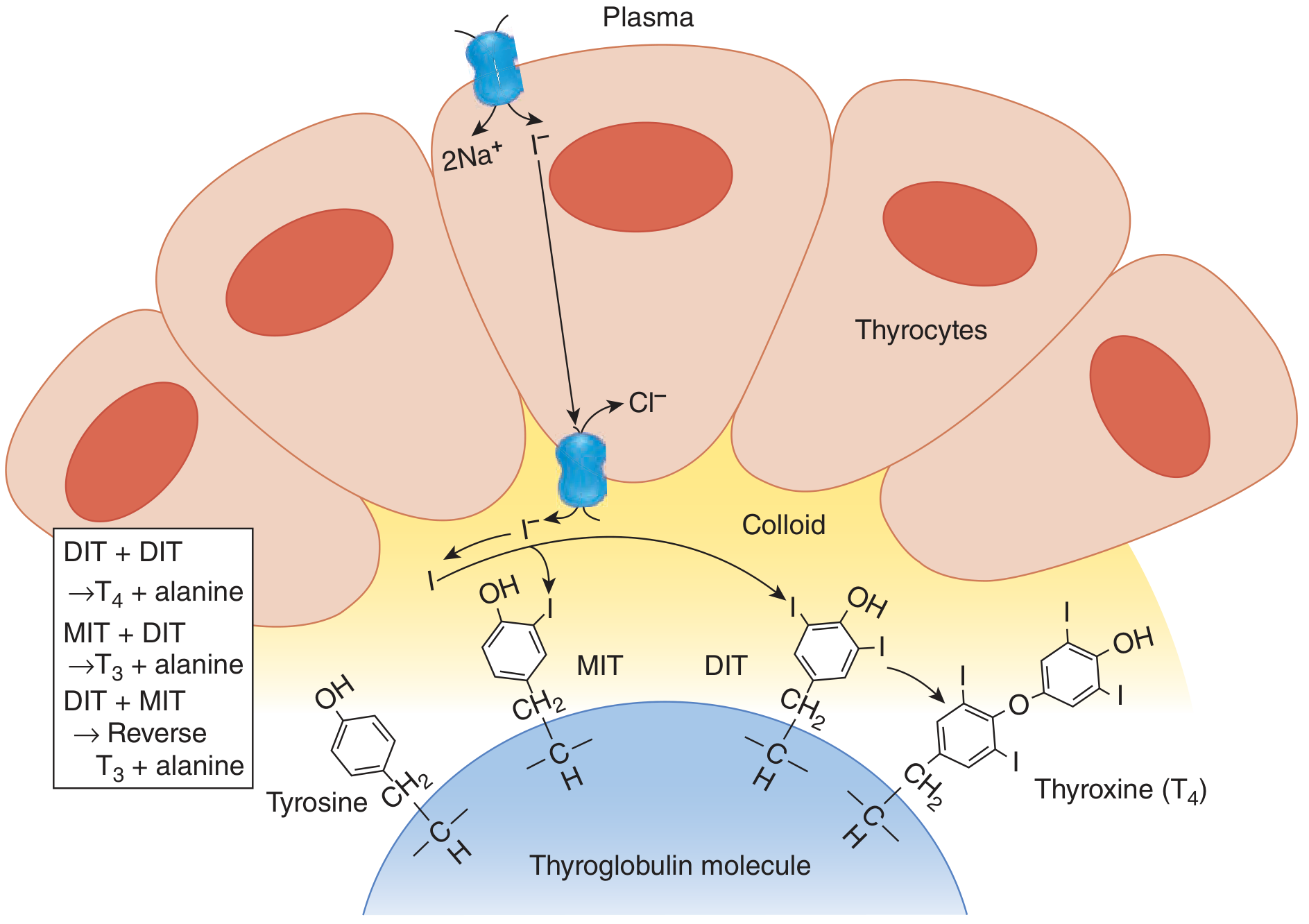
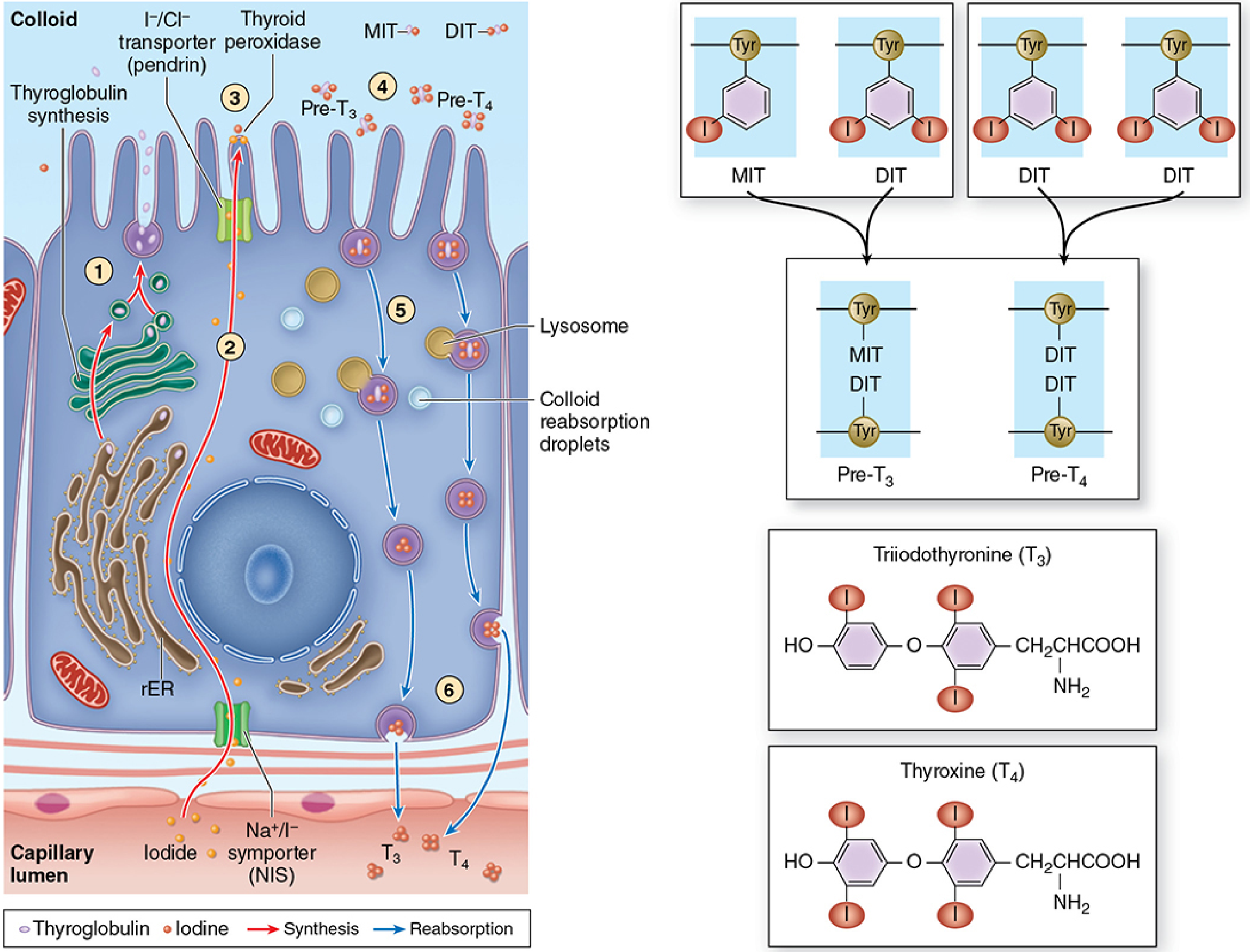
Iodide (I⁻) is actively transported from the blood into thyrocytes across the basolateral membrane by the Na⁺/I⁻ symporter (NIS). This transporter uses the electrochemical gradient of sodium to co-transport iodide against its own concentration gradient, achieving a 30-fold concentration of iodide in thyroid tissue relative to plasma.
- NIS is stimulated by TSH and regulated by iodide availability - low plasma iodide triggers upregulation of NIS to compensate.
- Once inside the cell, iodide is transported across the apical membrane into the colloid via an I⁻/Cl⁻ transporter called pendrin.
Clinically relevant: NIS is the basis for radioiodine (¹³¹I) therapy in thyroid cancer and hyperthyroidism. Thiocyanate and perchlorate competitively inhibit NIS.
Step 2 - Synthesis and Secretion of Thyroglobulin
In parallel with iodide trapping, thyrocytes synthesize thyroglobulin (Tg) - a large glycoprotein (660 kDa, made of two subunits). Tg is:
- Synthesized on the rough ER
- Glycosylated in the Golgi apparatus
- Secreted by exocytosis via apical vesicles into the follicular lumen (colloid)
Thyroglobulin contains approximately 123-140 tyrosyl residues, which serve as the scaffold on which iodination occurs. Tg itself has no hormonal activity - it is purely a precursor matrix. Only 4-8 of its tyrosine residues are typically incorporated into thyroid hormones.
Step 3 - Organification (Iodination of Tyrosines)
At the apical border (colloid-cell interface), iodide undergoes organification:
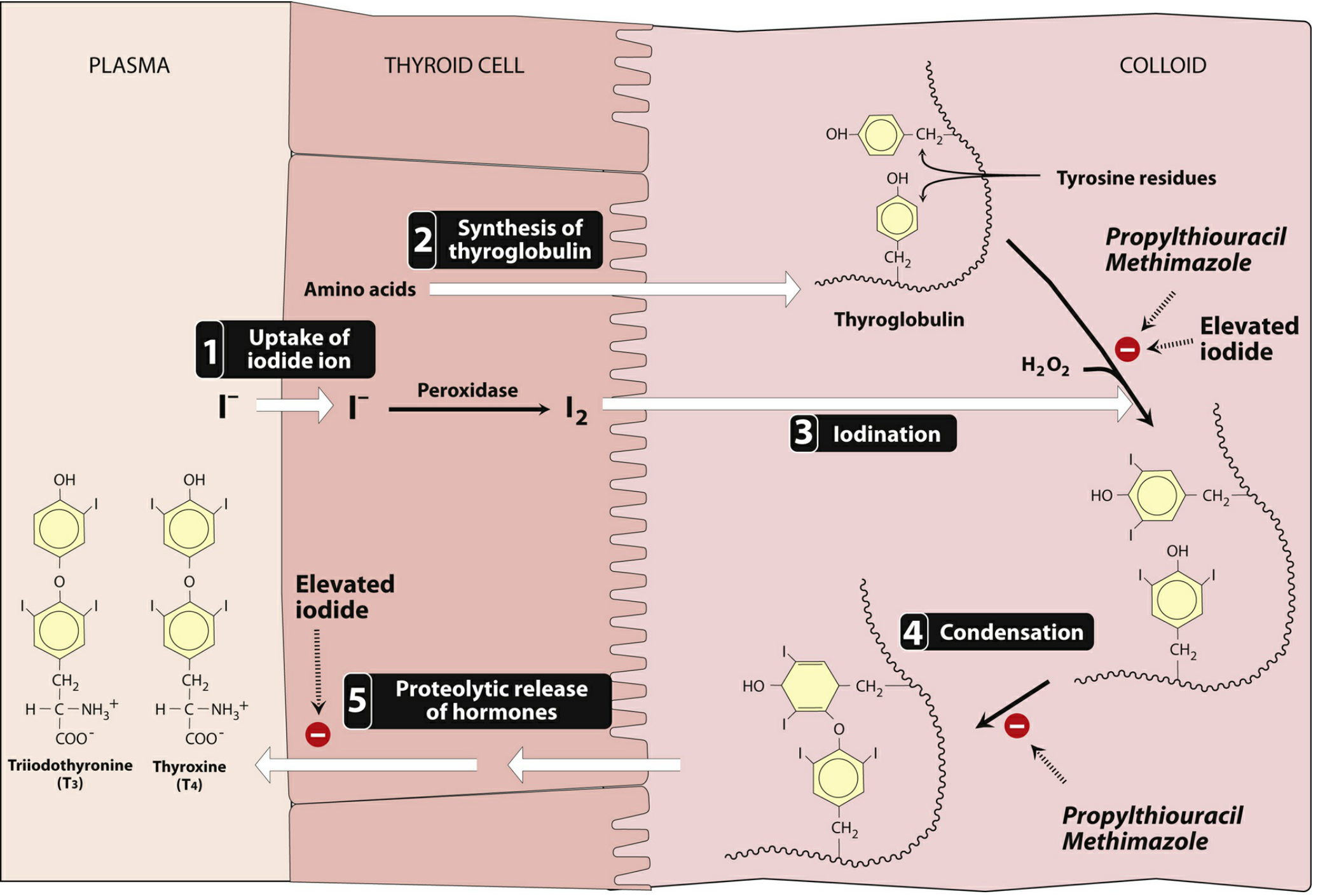
- Iodide (I⁻) is oxidized to iodine (I₀) by thyroid peroxidase (TPO), a membrane-bound heme enzyme on thyrocyte microvilli, using H₂O₂ as the oxidant.
- Reactive iodine is then incorporated into tyrosyl residues on thyroglobulin:
- Addition of one iodine atom → Monoiodotyrosine (MIT)
- Addition of two iodine atoms → Diiodotyrosine (DIT)
The tyrosines remain covalently bound to thyroglobulin throughout this step - no free amino acids are involved.
Clinically relevant: Propylthiouracil (PTU) and methimazole block TPO, inhibiting both oxidation of iodide and the coupling reaction. This is the main mechanism of antithyroid drugs.
Step 4 - Coupling (Condensation)
Still within thyroglobulin in the colloid, TPO also catalyzes the coupling reaction, where two iodinated tyrosines are covalently joined (oxidative coupling), forming an ether linkage between their phenolic rings:
| Coupling | Product |
|---|---|
| DIT + DIT | T4 (thyroxine) + alanine |
| MIT + DIT | T3 (triiodothyronine) + alanine |
| DIT + MIT | Reverse T3 (rT3) + alanine |
The newly formed T3 and T4 molecules remain embedded within the thyroglobulin polypeptide chain in the colloid, where they serve as a reserve. Humans can go up to 2 months on a completely iodide-free diet before circulating thyroid hormone levels fall, thanks to this stored colloid reservoir.
Normal iodinated compound distribution in thyroid:
- MIT: ~3%
- DIT: ~33%
- T4: ~35%
- T3: ~7%
Step 5 - Endocytosis of Thyroglobulin
When thyroid hormone is needed, iodinated thyroglobulin is retrieved from the colloid back into thyrocytes by:
- Receptor-mediated endocytosis (predominant with TSH stimulation)
- Fluid-phase pinocytosis
The endocytic vesicles (colloid reabsorption droplets) fuse with lysosomes, which contain proteases that hydrolyze peptide bonds throughout the thyroglobulin molecule.
Step 6 - Proteolysis and Secretion
Lysosomal proteases cleave thyroglobulin, releasing:
- Free T4 and T3 → secreted across the basolateral membrane into adjacent capillaries
- Free MIT and DIT → these are NOT secreted; instead, they are deiodinated by iodotyrosine deiodinase (in the ER), which recovers iodine for reutilization within the gland
This recycling is efficient: recovered iodine from MIT/DIT normally supplies twice the amount of iodide that NIS brings in from plasma.
Clinically relevant: Congenital absence of iodotyrosine deiodinase causes MIT and DIT to spill into the urine, leading to iodine deficiency despite normal iodide intake.
Regulation of Synthesis
TSH (Primary Regulator)
TSH from the anterior pituitary is the main driver of thyroid hormone synthesis. It acts via TSH receptor (TSHR) on thyrocytes, coupled to:
- cAMP pathway → stimulates iodide uptake, thyroglobulin synthesis, and hormone secretion
- Phospholipase C/Ca²⁺ pathway → involved in synthesis steps
TSH stimulates every step: iodide uptake, thyroglobulin synthesis, iodination, coupling, endocytosis, and secretion.
TRH - TSH - T3/T4 Feedback Axis
- Hypothalamus releases TRH (thyrotropin-releasing hormone)
- TRH stimulates the anterior pituitary to release TSH
- Elevated free T3 and T4 feed back to inhibit both TRH and TSH (classic negative feedback)
Wolff-Chaikoff Effect
When plasma iodide is acutely elevated (as with iodinated contrast agents or amiodarone), organification is transiently inhibited. This is the Wolff-Chaikoff effect, a protective mechanism against excessive thyroid hormone production. The gland normally "escapes" from this effect within days by downregulating NIS.
Products Secreted by the Thyroid
| Hormone | Daily secretion | Notes |
|---|---|---|
| T4 (thyroxine) | ~80 µg/day | Predominant product (90% of circulating TH); prohormone |
| T3 | ~4 µg/day | Biologically more active; 80% derived from peripheral T4 deiodination |
| Reverse T3 (rT3) | ~2 µg/day | Biologically inactive |
| MIT, DIT | Not secreted | Deiodinated and recycled within the gland |
Summary of Steps
| Step | Location | Key Player |
|---|---|---|
| 1. Iodide uptake | Basolateral membrane | NIS (Na⁺/I⁻ symporter) |
| 2. Iodide transport into colloid | Apical membrane | Pendrin (I⁻/Cl⁻ transporter) |
| 3. Thyroglobulin synthesis | rER → Golgi → apical secretion | Thyroglobulin |
| 4. Oxidation + Organification | Colloid (apical surface) | Thyroid peroxidase + H₂O₂ |
| 5. Coupling | Colloid | Thyroid peroxidase |
| 6. Endocytosis | Apical membrane | Receptor-mediated + pinocytosis |
| 7. Proteolysis + release | Lysosomes → basolateral | Lysosomal proteases |
| 8. Iodine recycling | ER | Iodotyrosine deiodinase |
Sources:
- Ganong's Review of Medical Physiology, 26th Ed., pp. 369-370 - thyroid hormone biosynthesis section
- Lippincott Illustrated Reviews: Pharmacology - thyroid hormone synthesis and secretion
- Junqueira's Basic Histology, 17th Ed. - thyrocyte synthesis cycle
This is a shared conversation. Sign in to Orris to start your own chat.