
MALARIA Microbiology 10m Nursing
Reading File
Finding Sources
Finding Sources
Finding Sources
Finding Sources
Malaria is a broad topic that typically spans several subtopics for a 10-mark microbiology/nursing question. Here's the map before we go deep:
Topic Breakdown
- Introduction & Epidemiology - definition, global/regional burden, at-risk populations
- Causative agent - genus Plasmodium (P. vivax, P. falciparum, P. malariae, P. ovale, P. knowlesi) and their distinguishing features
- Vector & mode of transmission - female Anopheles mosquito, other routes (transfusion, congenital, needle-sharing)
- Life cycle of Plasmodium - sexual (sporogony) in mosquito + asexual (schizogony) in human liver and RBCs
- Pathogenesis & clinical features - malarial paroxysm (cold/hot/sweating stages), periodicity by species, complications (cerebral malaria, blackwater fever, severe falciparum malaria)
- Laboratory diagnosis - peripheral blood smear (thick/thin films), rapid diagnostic tests, QBC, PCR
- Treatment - antimalarials (chloroquine, ACTs, primaquine, quinine) by species and severity
- Nursing management - assessment, fever/fluid management, monitoring for complications, drug administration, patient/family education
- Prevention & control - vector control, chemoprophylaxis, personal protective measures, community health nursing role
Brief Overview
Malaria is a febrile parasitic disease caused by protozoa of the genus Plasmodium, transmitted to humans through the bite of an infected female Anopheles mosquito (Sherris & Ryan's Medical Microbiology; Jawetz, Melnick & Adelberg's Medical Microbiology). Four main species cause human disease - P. vivax, P. falciparum, P. malariae, and P. ovale - with P. falciparum being most dangerous due to high fatality risk from severe disease (Robbins & Kumar Basic Pathology, p. 1905-1912). A fifth species, P. knowlesi, a primarily simian parasite, also causes human infection with an unusually rapid 24-hour asexual cycle.
The parasite has a complex life cycle alternating between the mosquito (sporogony) and human host (exoerythrocytic/liver stage followed by erythrocytic stage, where RBC rupture releases merozoites and triggers illness). Clinically, the hallmark is the malarial paroxysm - a three-phase cycle of cold stage (chills/rigors), hot stage (high fever), and sweating stage, accompanied by anemia and splenomegaly (Textbook of Family Medicine 9e; Goldman-Cecil Medicine). Diagnosis relies mainly on microscopic examination of blood films, supported by rapid antigen tests. Management combines species-appropriate antimalarial therapy with supportive nursing care - monitoring for severe complications like cerebral malaria, managing fever and hydration, and patient education on prevention (mosquito nets, chemoprophylaxis for travelers, vector control).
Given the 10-mark nursing exam format, which area would you like me to develop in full depth (with structured content ready for exam writing)?
Asking for Preferences
Which part of Malaria should I go deep on for your 10-mark answer?
Malaria is a broad topic that typically spans several subtopics for a 10-mark microbiology/nursing question. Here's the map before we go deep:
Topic Breakdown
- Introduction & Epidemiology - definition, global/regional burden, at-risk populations
- Causative agent - genus Plasmodium (P. vivax, P. falciparum, P. malariae, P. ovale, P. knowlesi) and their distinguishing features
- Vector & mode of transmission - female Anopheles mosquito, other routes (transfusion, congenital, needle-sharing)
- Life cycle of Plasmodium - sexual (sporogony) in mosquito + asexual (schizogony) in human liver and RBCs
- Pathogenesis & clinical features - malarial paroxysm (cold/hot/sweating stages), periodicity by species, complications (cerebral malaria, blackwater fever, severe falciparum malaria)
- Laboratory diagnosis - peripheral blood smear (thick/thin films), rapid diagnostic tests, QBC, PCR
- Treatment - antimalarials (chloroquine, ACTs, primaquine, quinine) by species and severity
- Nursing management - assessment, fever/fluid management, monitoring for complications, drug administration, patient/family education
- Prevention & control - vector control, chemoprophylaxis, personal protective measures, community health nursing role
Brief Overview
Malaria is a febrile parasitic disease caused by protozoa of the genus Plasmodium, transmitted to humans through the bite of an infected female Anopheles mosquito (Sherris & Ryan's Medical Microbiology; Jawetz, Melnick & Adelberg's Medical Microbiology). Four main species cause human disease - P. vivax, P. falciparum, P. malariae, and P. ovale - with P. falciparum being most dangerous due to high fatality risk from severe disease (Robbins & Kumar Basic Pathology, p. 1905-1912). A fifth species, P. knowlesi, a primarily simian parasite, also causes human infection with an unusually rapid 24-hour asexual cycle.
The parasite has a complex life cycle alternating between the mosquito (sporogony) and human host (exoerythrocytic/liver stage followed by erythrocytic stage, where RBC rupture releases merozoites and triggers illness). Clinically, the hallmark is the malarial paroxysm - a three-phase cycle of cold stage (chills/rigors), hot stage (high fever), and sweating stage, accompanied by anemia and splenomegaly (Textbook of Family Medicine 9e; Goldman-Cecil Medicine). Diagnosis relies mainly on microscopic examination of blood films, supported by rapid antigen tests. Management combines species-appropriate antimalarial therapy with supportive nursing care - monitoring for severe complications like cerebral malaria, managing fever and hydration, and patient education on prevention (mosquito nets, chemoprophylaxis for travelers, vector control).
Given the 10-mark nursing exam format, which area would you like me to develop in full depth (with structured content ready for exam writing)?
Finding Sources
Finding Sources
Searching Images
Plasmodium life cycle diagram malaria mosquito liver erythrocytic
Searching Images
Plasmodium falciparum blood smear ring form gametocyte
query_images_db
Malaria - Microbiology & Nursing (10 Marks)
1. Definition
Malaria is an acute (and sometimes chronic) febrile parasitic disease caused by protozoa of the genus Plasmodium, transmitted to humans by the bite of an infected female Anopheles mosquito (Sherris & Ryan's Medical Microbiology; Henry's Clinical Diagnosis and Management by Laboratory Methods). The name derives from the Italian "mal'aria" - bad air - reflecting old beliefs about its cause.
2. Causative Agent
Five Plasmodium species infect humans (Jawetz, Melnick & Adelberg's Medical Microbiology 28E):
| Species | Notable feature |
|---|---|
| P. falciparum | Most dangerous; high fatality; causes malignant tertian malaria; responsible for most severe/cerebral disease (Robbins & Kumar Basic Pathology, p. 1905-1912) |
| P. vivax | Benign tertian malaria; can relapse (dormant liver hypnozoites) |
| P. ovale | Similar to vivax; can also relapse |
| P. malariae | Quartan malaria; can cause chronic, low-grade infection |
| P. knowlesi | Normally infects macaques; shortest known life cycle (24 hr), can cause severe disease |
3. Mode of Transmission
- Primary: Bite of infected female Anopheles mosquito (vector)
- Other routes: blood transfusion, organ transplant, shared needles (IV drug use), and congenital (mother to fetus)
4. Life Cycle of Plasmodium
The life cycle alternates between the mosquito (sexual cycle - sporogony) and human host (asexual cycle - schizogony) (Katzung's Basic and Clinical Pharmacology; Sleisenger and Fordtran's GI and Liver Disease):
- Inoculation: Infected mosquito injects sporozoites into human blood while feeding.
- Exoerythrocytic (liver) stage: Sporozoites invade hepatocytes, mature into tissue schizonts, which rupture to release merozoites. (In P. vivax/ovale, some remain dormant as hypnozoites, causing later relapse.)
- Erythrocytic stage: Merozoites invade RBCs, develop through trophozoite -> schizont stages, rupture the RBC releasing more merozoites (this rupture causes the clinical paroxysm) and re-invade fresh RBCs - a cyclical process.
- Gametocyte formation: Some merozoites develop into male/female gametocytes in RBCs.
- Mosquito stage: A feeding mosquito ingests gametocytes, which fuse to form a zygote -> oocyst in the mosquito gut wall -> sporozoites, which migrate to the salivary glands, ready to infect the next human host.
5. Clinical Features / Pathogenesis
The hallmark is the malarial paroxysm, a three-stage febrile cycle triggered by synchronized RBC rupture (Textbook of Family Medicine 9e; Sherris & Ryan's Medical Microbiology):
- Cold stage: Sudden chills/rigors, lasting 15 min to a few hours
- Hot stage: High fever (up to 40-41°C), headache, vomiting
- Sweating stage: Profuse sweating, fever resolves, patient feels exhausted
Periodicity varies by species: tertian (every 48h - vivax, ovale, falciparum) or quartan (every 72h - malariae). Other features include anemia, splenomegaly, hepatomegaly, and in severe P. falciparum infection: cerebral malaria (altered consciousness, seizures), blackwater fever (massive hemolysis, hemoglobinuria), acute kidney injury, hypoglycemia, ARDS, and severe anemia.
6. Diagnosis
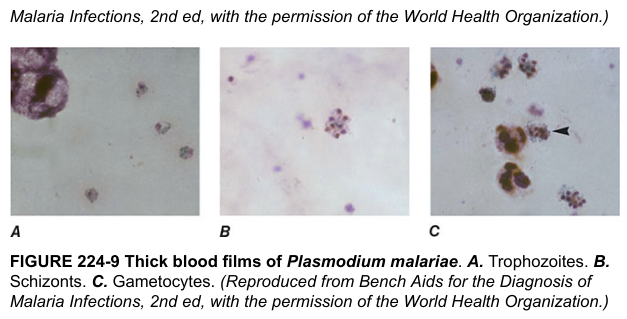
- Peripheral blood smear (thick and thin film with Giemsa stain) - gold standard; thick film detects parasites, thin film identifies species and stage (Harrison's Principles of Internal Medicine 22E). Below is a thick-film example showing P. malariae trophozoites, schizonts, and gametocytes:
- **Rapid Diagnostic Tests (RDTs
TUBERCULOSIS / MYCOBACTERIA Comprehensive 10m answer covering all points
Finding Sources
Finding Sources
Finding Sources
Finding Sources
Finding Sources
Finding Sources
Finding Sources
Finding Sources
Tuberculosis (TB) / Mycobacteria - Comprehensive 10-Mark Answer
1. Definition
Tuberculosis is a chronic granulomatous infectious disease caused by the slow-growing, acid-fast bacillus Mycobacterium tuberculosis (Goldman-Cecil Medicine International Edition). It primarily affects the lungs (pulmonary TB) but can involve almost any organ (extrapulmonary TB - lymph nodes, bones, meninges, kidneys, GI tract).
2. Causative Organism / Microbiology
- Mycobacterium tuberculosis (MTB) - a slender, rod-shaped, non-motile, non-spore-forming bacillus
- Acid-fast: Its lipid-rich cell wall (mycolic acids) resists Gram staining and retains carbol fuchsin dye even after acid-alcohol decolorization - the basis of the Ziehl-Neelsen (ZN) stain (Sherris & Ryan's Medical Microbiology, 8th Ed)
- Slow generation time (15-20 hours), obligate aerobe, grows best on Lowenstein-Jensen medium (colonies take 3-6 weeks - buff-colored, rough, "cauliflower-like")
- Other pathogenic mycobacteria: M. bovis, M. africanum; non-tuberculous mycobacteria (M. avium complex) cause disease mainly in immunocompromised patients
3. Mode of Transmission
- Airborne route: inhalation of droplet nuclei from an infectious person's cough, sneeze, or speech (Schwartz's Principles of Surgery)
- Risk increases with close/prolonged contact, overcrowding, poor ventilation, and immunosuppression (HIV, malnutrition, diabetes, corticosteroid use)
4. Pathogenesis
- Inhaled bacilli reach the alveoli and are phagocytosed by alveolar macrophages, but MTB survives and multiplies intracellularly by evading phagolysosomal killing (Goldman-Cecil Medicine)
- Formation of the primary (Ghon) focus in the lung parenchyma, with spread to hilar lymph nodes -> Ghon complex
- Cell-mediated immunity develops (~2-8 weeks) -> caseating granuloma formation with central necrosis, surrounded by epithelioid cells and multinucleated Langhans giant cells (K J Lee's Essential Otolaryngology; Murray & Nadel's Textbook of Respiratory Medicine)
- Outcome: healing with fibrosis/calcification (latent TB) in most immunocompetent hosts, or progression to primary progressive TB; reactivation later in life produces post-primary (secondary) TB, typically in the lung apices
5. Clinical Features
- Constitutional: low-grade fever (often evening rise), night sweats, anorexia, weight loss, fatigue, malaise (Jawetz, Melnick & Adelberg's Medical Microbiology; Red Book 2021)
- Respiratory: chronic cough (>2-3 weeks) with mucoid/purulent sputum, hemoptysis, chest pain, dyspnea in advanced disease
- Extrapulmonary presentations depending on site: painless cervical lymphadenopathy (scrofula), Pott's disease (spine), tuberculous meningitis (headache, altered sensorium, low CSF glucose), renal/genitourinary TB, GI TB
6. Diagnosis
- Sputum smear microscopy - Ziehl-Neelsen (acid-fast bacilli) stain, 2-3 specimens; simple, widely used but low sensitivity (Bailey and Love's Short Practice of Surgery)
- Sputum culture on Lowenstein-Jensen medium - gold standard but slow (weeks); liquid culture (BACTEC/MGIT) faster
- GeneXpert MTB/RIF (PCR-based NAAT) - rapid, detects MTB DNA and rifampicin resistance simultaneously, recommended by WHO for scale-up
- Tuberculin skin test (Mantoux/PPD) and Interferon-Gamma Release Assays (IGRA) - detect latent infection
- Chest X-ray - upper lobe infiltrates, cavitation, hilar lymphadenopathy, calcified Ghon lesion
- Histopathology of biopsy: caseating granulomas with Langhans giant cells
7. Treatment (Anti-Tubercular Therapy)
WHO/standard first-line regimen uses the RIPE combination (Katzung's Basic and Clinical Pharmacology; Red Book 2021):
| Phase | Drugs | Duration |
|---|---|---|
| Intensive phase | Rifampin + Isoniazid + Pyrazinamide + Ethambutol | 2 months |
| Continuation phase | Rifampin + Isoniazid | 4 months (total 6 months for drug-susceptible TB) |
- DOTS (Directly Observed Treatment, Short-course) - WHO strategy ensuring adherence and reducing drug resistance
- Latent TB infection (LTBI): isoniazid + rifapentine weekly for 3 months, or daily rifampin for 4 months
- Drug-resistant TB (MDR/XDR-TB) requires second-line agents for longer duration under specialist supervision
8. Nursing Management
- Airborne precautions/isolation: negative-pressure room, N95 respirators for staff, patient wears surgical mask outside room until deemed non-infectious (ROSEN's Emergency Medicine; Tietz Textbook of Laboratory Medicine)
- Assessment & monitoring: vital signs, respiratory status, weight, sputum characteristics, monitor for hemoptysis
- Medication adherence: supervise DOTS administration, teach importance of completing full course to prevent drug resistance, monitor for hepatotoxicity (isoniazid/rifampin), peripheral neuropathy (give pyridoxine with isoniazid), visual changes (ethambutol - optic neuritis), and orange discoloration of body fluids (rifampin - reassure patient)
- Nutrition support: high-protein, high-calorie diet to combat weight loss
- Patient/family education: cough hygiene, sputum disposal, ventilation of living spaces, screening of close contacts, avoiding congregate settings until non-infectious
- Psychosocial support: address stigma, ensure follow-up sputum conversion checks
9. Prevention & Control
- BCG vaccination: given at birth in high-burden countries; offers variable protection, best against severe childhood forms (miliary TB, TB meningitis) (Park's Textbook of Preventive and Social Medicine)
- Early case detection and treatment (sputum-positive cases are the main source of transmission)
- Contact tracing and screening of household/close contacts
- Improved ventilation, reduced overcrowding
- Treatment of latent TB in high-risk groups (HIV-positive, immunosuppressed, close contacts)
Note: The RIPE regimen and durations reflect drug-susceptible TB per standard WHO/CDC-aligned guidance in these texts. If you want, I can also pull a rapid PubMed check on the latest WHO 2024-2025 TB treatment updates (e.g., newer 4-month regimens with rifapentine-moxifloxacin) since guidelines evolve - let me know if that's useful for your exam answer.
DIPHTHERIA Comprehensive 10m answer covering all points
Finding Sources
Finding Sources
Finding Sources
Finding Sources
Finding Sources
Finding Sources
Diphtheria - Comprehensive 10-Mark Answer
1. Definition
Diphtheria is an acute toxin-mediated infectious disease caused by Corynebacterium diphtheriae, classically presenting as nasopharyngeal/pharyngeal infection with a characteristic grayish pseudomembrane, and capable of causing systemic toxicity (myocarditis, polyneuropathy) via a potent exotoxin (Harrison's Principles of Internal Medicine 22E).
2. Causative Organism
- Corynebacterium diphtheriae - a gram-positive, pleomorphic, club-shaped bacillus arranged in irregular clusters resembling "Chinese characters" on smear (Scott-Brown's Otorhinolaryngology Head & Neck Surgery)
- Non-spore forming, non-motile, aerobic/facultatively anaerobic
- Toxigenic strains carry the tox gene (via a lysogenic bacteriophage) that codes for diphtheria exotoxin, which inhibits protein synthesis by ADP-ribosylating elongation factor-2 (EF-2) (Sherris & Ryan's Medical Microbiology, 8th Ed; Medical Microbiology 9e)
- Iron represses toxin production (toxin gene expression increases in low-iron conditions)
3. Mode of Transmission
- Respiratory droplets from a case or carrier (person-to-person, close contact)
- Direct contact with skin lesions in cutaneous diphtheria
- Fomites (rare)
- Incubation period: 2-4 days (Sherris & Ryan's Medical Microbiology)
4. Pathogenesis
- Organism colonizes the mucosa of the pharynx/tonsils/larynx (or skin in cutaneous form) without invading deeper tissue
- Local exotoxin production causes necrosis of epithelial cells, fibrin deposition, and an inflammatory exudate that coalesces into a tough, gray-white pseudomembrane, tightly adherent to underlying mucosa - forcible removal causes bleeding (Harrison's Principles of Internal Medicine; Goldman-Cecil Medicine)
- Toxin absorbed into the bloodstream is distributed systemically, with particular affinity for cardiac muscle (myocarditis) and peripheral/cranial nerves (demyelinating polyneuropathy)
- Marked cervical lymphadenopathy and soft tissue edema produce the characteristic "bull neck" appearance (Scott-Brown's Otorhinolaryngology Head & Neck Surgery)
5. Clinical Features
Respiratory (pharyngeal/tonsillar/laryngeal) diphtheria:
- Onset: malaise, low-grade fever, sore throat
- Gray-white pseudomembrane extending from tonsils/uvula to pharyngeal wall, sharply demarcated and adherent (Harrison's Principles of Internal Medicine)
- "Bull neck" - cervical lymphadenopathy with surrounding soft-tissue edema
- Laryngeal involvement: hoarseness, stridor, risk of airway obstruction
- Difficulty swallowing, respiratory distress in severe cases
Cutaneous diphtheria: chronic non-healing ulcers with a membrane, common in tropical/homeless populations
Systemic complications (Red Book 2021; Bradley and Daroff's Neurology in Clinical Practice):
- Myocarditis: arrhythmias, heart block, heart failure; early-onset myocarditis often fatal
- Polyneuropathy: cranial nerve palsies (palatal palsy -> nasal speech, oculomotor palsy), peripheral neuropathy appearing weeks after acute illness
- Upper airway obstruction from membrane extension
6. Diagnosis
- Clinical suspicion is paramount - routine throat culture does NOT detect C. diphtheriae; the laboratory MUST be specifically notified of suspected diphtheria (Sherris & Ryan's Medical Microbiology)
- Throat/nasopharyngeal swab culture on special selective media - Loeffler's medium or tellurite media (Ross's/Scott-Brown's Otorhinolaryngology)
- Smear microscopy: Albert stain or Gram stain shows pleomorphic bacilli in "Chinese character" or "picket fence" arrangement
- Toxigenicity testing (Elek's test or PCR for tox gene) to confirm the strain produces toxin - sent to reference laboratory
- Diagnosis and treatment should not await laboratory confirmation given the urgency of antitoxin therapy
7. Treatment
- Diphtheria antitoxin (DAT) - equine antiserum given promptly on clinical suspicion, without waiting for lab confirmation, to neutralize circulating (unbound) toxin and reduce risk of myocarditis/neuropathy (Harrison's Principles of Internal Medicine; Medical Microbiology 9e)
- Antibiotics: Penicillin or Erythromycin to eradicate the organism and halt further toxin production
- Strict isolation (droplet precautions) until 2 consecutive negative cultures
- Supportive care: airway management (may need tracheostomy/intubation for obstruction), cardiac monitoring for myocarditis
- Glucocorticoids have NOT been shown to reduce myocarditis or polyneuropathy risk
- Contacts: throat swab, prophylactic antibiotics, and booster/primary immunization as indicated
8. Prevention & Control
- Active immunization with diphtheria toxoid (formalin-inactivated toxin) as part of combined vaccines: DPT (diphtheria-pertussis-tetanus), DT, dT (adult type), and pentavalent vaccine (DPT + Hepatitis B + Hib) (Park's Textbook of Preventive and Social Medicine)
- Primary series in infancy per National Immunization Schedule, with booster doses in childhood/adolescence
- Case management: isolation, contact tracing, prophylaxis for close contacts
- Surveillance and outbreak response in endemic areas
9. Nursing Management
- Maintain droplet/respiratory isolation until cultures are negative
- Continuous monitoring of airway patency - watch for stridor, increasing respiratory distress; keep emergency airway/tracheostomy equipment at bedside
- Cardiac monitoring (ECG) for signs of myocarditis - arrhythmia, heart failure signs
- Administer antitoxin and antibiotics as prescribed; observe for hypersensitivity reaction to equine antitoxin (skin test before administration)
- Assess for neurological complications - swallowing difficulty (aspiration risk), palatal/cranial nerve palsies
- Maintain hydration and nutrition (soft diet or NG feeding if swallowing impaired)
- Patient/family education on completing immunization schedule and household contact screening
- Report to public health authorities (notifiable disease)
Since diphtheria cases and vaccination guidance can shift with outbreaks, let me know if you'd like a quick PubMed/WHO check on recent diphtheria outbreak trends or updated antitoxin availability guidance for your exam prep.
This is a shared conversation. Sign in to Orris to start your own chat.