
Siadh how to diagnose
Reading File
Now let me search the medical library for SIADH diagnosis content, running parallel searches:
Finding Sources
Finding Sources
Searching PubMed
SIADH diagnosis hyponatremia
I have excellent hits. Let me now read the most relevant sections - the diagnostic criteria table from Barash and the NKF Primer section:
Reading File
Reading File
Excellent content retrieved. Let me also read the diagnostic criteria table and the Box 7.2:
Reading File
Reading File
Let me also fetch the diagnostic algorithm image and check the Symptom-to-Diagnosis book for the clinical approach:
Loading Image
Reading File
I now have everything needed for a thorough, well-cited answer. Here it is:
Diagnosing SIADH
SIADH (Syndrome of Inappropriate Antidiuretic Hormone Secretion) is a diagnosis of exclusion characterized by euvolemic hyponatremia with inappropriately concentrated urine. The diagnostic framework, unchanged in principle since Bartter and Schwartz described it in 1967, requires meeting all essential criteria after ruling out competing diagnoses.
Step 1 - Confirm True Hypotonic Hyponatremia
Before invoking SIADH, verify:
- Serum Na+ is truly low (not pseudohyponatremia from severe hyperlipidemia or paraproteinemia)
- Hyperglycemia is excluded as a cause of osmotic shift (correct Na+ for glucose if needed)
- Serum osmolality is < 275 mOsm/kg H₂O (true hypotonicity)
Step 2 - The Diagnostic Algorithm
The European Guideline algorithm (shown below) guides the workup systematically:
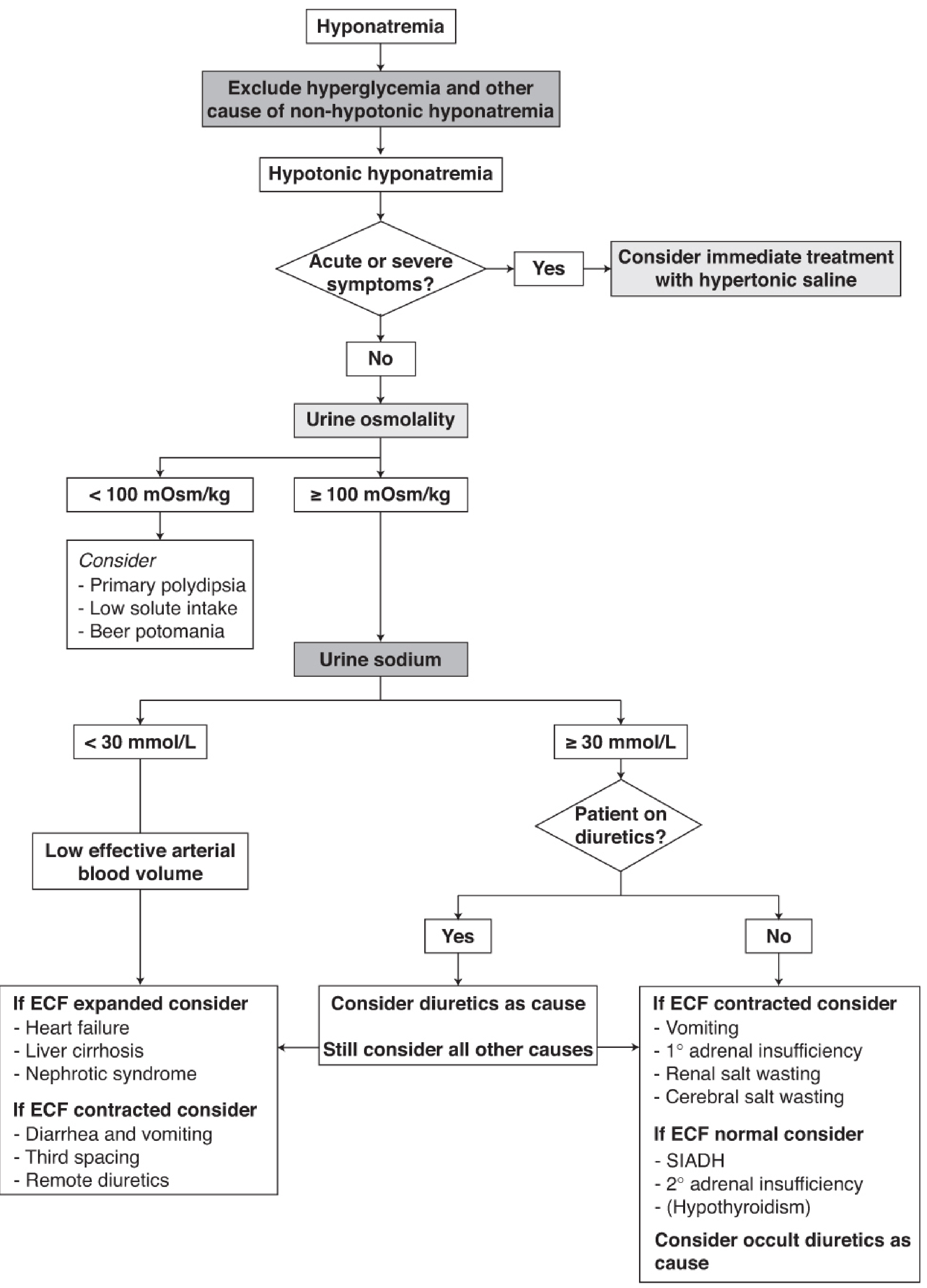
Source: Barash Clinical Anesthesia 9e, Figure 16-5 (European Guidelines, reproduced from Hoorn & Zietse, JASN 2017)
Key branch points:
- Urine osmolality < 100 mOsm/kg → Think primary polydipsia, beer potomania, low solute intake (not SIADH)
- Urine osmolality ≥ 100 mOsm/kg → Check urine sodium
- Urine Na+ < 30 mmol/L → Low effective arterial blood volume (heart failure, cirrhosis, dehydration)
- Urine Na+ ≥ 30 mmol/L + not on diuretics + ECF normal → SIADH (also consider secondary adrenal insufficiency, hypothyroidism)
Step 3 - Essential Diagnostic Criteria (All Must Be Met)
| Criterion | Threshold |
|---|---|
| Serum osmolality | < 275 mOsm/kg H₂O |
| Urine osmolality | > 100 mOsm/kg (inappropriately concentrated) |
| Urine sodium | ≥ 30 mEq/L (with normal salt/water intake) |
| Volume status | Clinical euvolemia - no orthostasis, no edema, no ascites |
| Exclude diuretic use | No active thiazide or K+-sparing diuretic use |
| Normal thyroid, adrenal, and renal function | TSH, cortisol/ACTH stim test, creatinine all normal |
Sources: NKF Primer on Kidney Diseases 8e, Box 7.2; Barash Clinical Anesthesia 9e, Table 16-16
Important nuances on these criteria:
-
Urine osmolality does not need to exceed serum osmolality - it just needs to NOT be maximally dilute (i.e., > 100 mOsm/kg). Patients with "reset osmostat" (a SIADH variant) may dilute urine normally at very low plasma osmolalities but fail to do so at higher levels. - NKF Primer 8e
-
Euvolemia is assessed clinically (absence of edema/ascites AND absence of hypovolemia signs). Lab correlates of euvolemia include normal/low BUN and low serum uric acid. - NKF Primer 8e
-
Urine Na+ can be low in SIADH if the patient becomes subsequently volume-depleted or severely solute-restricted, so a low urine Na+ does not always exclude SIADH. - NKF Primer 8e
-
Adrenal insufficiency must be actively excluded - both primary and secondary hypocortisolism can mimic SIADH almost exactly (elevated AVP, impaired urine dilution). A cortisol level ≥ 18 µg/dL or a normal rapid ACTH stimulation test is required. - NKF Primer 8e
Step 4 - Supplemental (Supportive) Criteria
These support the diagnosis but are not required:
- Fractional excretion of uric acid (FEurate) > 12%
- Failure to correct serum Na+ with 0.9% normal saline infusion (serum Na+ does not rise or worsens)
- Improvement in serum Na+ with fluid restriction
- Abnormal water load test: inability to excrete ≥ 80% of a 20 mL/kg oral water load within 4 hours and/or failure to dilute Uosm to < 100 mOsm/kg
- Plasma AVP level inappropriately elevated relative to plasma osmolality
Sources: Barash 9e, Table 16-16; NKF Primer 8e, Box 7.2
Step 5 - Search for an Underlying Cause
Once SIADH is confirmed, identify the etiology:
| Category | Examples |
|---|---|
| Neurologic (9-26%) | Subarachnoid hemorrhage, stroke, meningitis, TBI, brain tumor |
| Malignancy (18-25%) | Small cell lung cancer (most common), lymphoma, thymoma, mesothelioma |
| Intrathoracic (11-19%) | Pneumonia, TB, acute respiratory failure |
| Drugs (8-18%) | Carbamazepine (20-30% risk), SSRIs, TCAs, oxcarbazepine, DDAVP, NSAIDs, cyclophosphamide, opioids, antipsychotics |
| Postoperative (7-11%) | Very common cause perioperatively |
| Other | AIDS complications, hypothyroidism (if not already excluded), idiopathic |
Source: Symptom to Diagnosis: An Evidence-Based Guide 4e
Summary Checklist
Diagnose SIADH when:
- Serum osmolality < 275 mOsm/kg
- Urine osmolality > 100 mOsm/kg
- Urine Na+ ≥ 30 mEq/L
- Patient is euvolemic (no edema, no hypovolemia signs)
- Thyroid function normal (TSH)
- Adrenal function normal (cortisol or ACTH stim test)
- Renal function normal/adequate
- No active diuretic use
- Serum Na+ fails to correct or worsens with IV normal saline (supportive)
Recent evidence note: A 2026 systematic review (PMID 41058069) highlights that fractional excretion of urate (FEurate > 12%) and other urinary biomarkers can help distinguish SIADH from cerebral/renal salt wasting in neurologically ill patients, which is a clinically important differential that volume status alone may not always resolve.
This is a shared conversation. Sign in to Orris to start your own chat.