
A/N ratio for adenoid assess ment with respect to OSA according to standard ENT textbook
Reading File
The A/N ratio (Adenoid-Nasopharynx ratio) is a lateral soft-tissue X-ray measurement used to assess adenoid size. A ratio >0.8 is typically considered significant and associated with OSA.
Searching sources...
Finding Sources
Finding Sources
Finding Sources
Finding Sources
Good - I found relevant sections. Let me read the key ENT textbook sections on adenoid hypertrophy and the A/N ratio.
Reading File
Reading File
Reading File
There's an X-ray image in Bailey & Love. Let me continue reading that section and also search Scott-Brown's and other ENT textbooks for the actual A/N ratio values.
Reading File
Finding Sources
Finding Sources
Finding Sources
Finding Sources
Finding Sources
Searching the Web
A/N ratio adenoid nasopharynx OSA assessment ENT textbook lateral X-ray 0.8
Now let me fetch the relevant image from Bailey & Love's and also look for the Scott-Brown's reference to the A/N ratio measurement technique.
Loading Image
Reading File
I now have enough information from the textbooks and web sources to give a comprehensive answer. Let me compile everything.
A/N Ratio for Adenoid Assessment in OSA
What is the A/N Ratio?
The Adenoid-Nasopharynx (A/N) ratio is a radiological measurement made on a lateral soft-tissue radiograph of the nasopharynx (lateral neck/postnasal space X-ray). It quantifies the degree of adenoid hypertrophy relative to the available nasopharyngeal airway space.
How to Measure
The measurement involves two dimensions on the lateral X-ray:
| Parameter | Definition |
|---|---|
| A (Adenoid depth) | Perpendicular distance from the anterior margin of the basiocciput (the straight portion) to the point of maximal adenoid prominence |
| N (Nasopharyngeal depth) | Distance from the posterior end of the hard palate to the anteroinferior edge of the sphenobasioccipital synchondrosis (width of the nasopharyngeal airway) |
A/N ratio = A ÷ N
Interpretation / Cut-off Values
| A/N Ratio | Interpretation |
|---|---|
| < 0.6 | Normal - no significant adenoid enlargement |
| 0.6 - 0.7 | Mild-moderate enlargement, watch and wait |
| > 0.71 - 0.73 | Pathological adenoid hypertrophy (Elwany's criterion) |
| > 0.8 | Severe obstruction - strongly associated with OSA; surgical intervention indicated |
The most widely cited threshold for clinically significant adenoid hypertrophy associated with OSA is A/N ratio > 0.8, though some sources (Elwany) use > 0.73 as the cutoff for pathological hypertrophy.
Relevance to OSA
From Bailey & Love's Short Practice of Surgery (28th ed.):
"If excessive adenoidal hypertrophy causes blockage of the nasopharynx in association with tonsil hypertrophy, the upper airway may become compromised during sleep causing obstructive sleep apnoea (OSA)."
- Bailey & Love shows a plain lateral radiograph demonstrating a large pad of adenoid tissue in the postnasal space (see Figure 52.17 below), which is the standard image used for A/N ratio measurement:
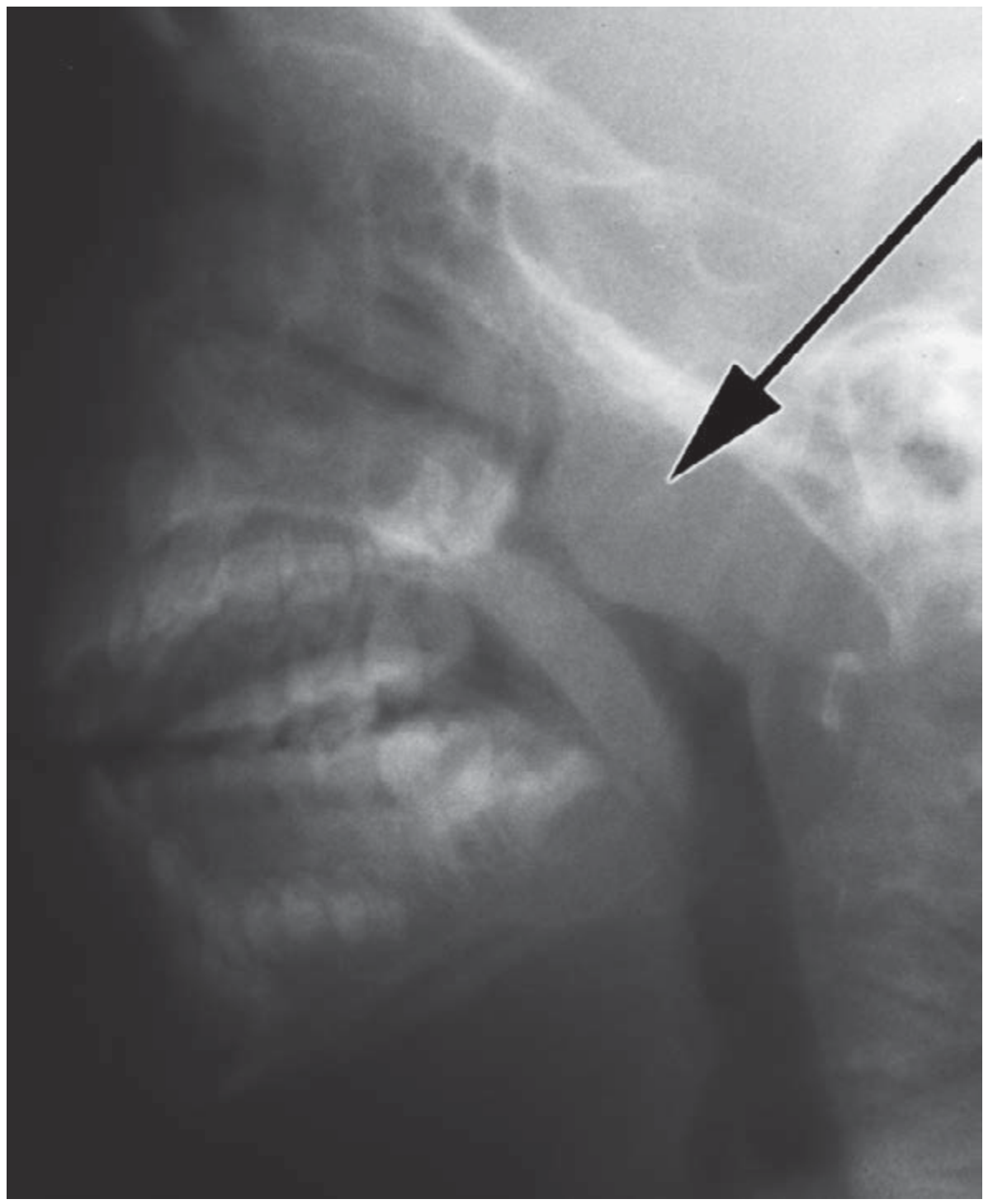
Figure 52.17 from Bailey & Love's - Plain lateral radiograph showing a large pad of adenoid tissue (arrow) in the postnasal space.
- Adenoid hypertrophy most commonly occurs between ages 4 and 10, and usually regresses at puberty.
- The size alone is NOT an indication for surgery; it is the consequence (e.g., OSA, nasal obstruction) that determines surgical need.
Role in Surgical Decision-Making
Adenoidectomy is indicated when:
- OSA associated with postnasal obstruction (most important indication)
- Recurrent/prolonged serous otitis media
- Recurrent rhinosinusitis
The A/N ratio on lateral X-ray, combined with flexible nasal endoscopy (FNE), forms the objective basis for surgical decision-making. FNE is actually considered superior for direct visualization; lateral X-ray is used when the child cannot cooperate with endoscopy.
Scott-Brown's Otorhinolaryngology (Vol 2) also references the correlation between adenoid-nasopharynx ratio and endoscopic findings (Cavlakli et al., Int J Pediatr Otorhinolaryngol, 2009), confirming the radiological measure's clinical validity.
Summary Table
| Feature | Detail |
|---|---|
| X-ray view used | Lateral soft-tissue nasopharynx |
| Numerator (A) | Maximal adenoid soft tissue depth from basiocciput line |
| Denominator (N) | Nasopharyngeal depth (hard palate to skull base) |
| Normal | < 0.6 |
| Pathological hypertrophy | > 0.73 (Elwany) |
| OSA-associated threshold | > 0.8 |
| Standard ENT texts | Bailey & Love's 28th ed., Scott-Brown's Vol 2 |
- Bailey and Love's Short Practice of Surgery 28th Edition, p. 803
- Scott-Brown's Otorhinolaryngology Head & Neck Surgery Vol 2, References (Cavlakli et al. 2009)
This is a shared conversation. Sign in to Orris to start your own chat.