
what does grade A prostrate meam
Reading File
Finding Sources
Finding Sources
Reading File
Reading File
Reading File
Here's what Grade Group (GG) 1 — or "Grade A" in common parlance — means for prostate cancer:
Prostate Cancer Grading: The Grade Group System
Prostate cancer is graded using the Gleason scoring system, which assigns a score based on how abnormal (poorly differentiated) the glandular patterns look under a microscope. Because the old Gleason scores were confusing to patients (a Gleason 6 sounds "mid-range" when it's actually the lowest assigned score), a simpler 1–5 Grade Group (GG) system was introduced:
| Grade Group | Gleason Score | What it means |
|---|---|---|
| Grade Group 1 | ≤ 6 (3+3) | Only individual, discrete, well-formed glands — lowest risk |
| Grade Group 2 | 3+4 = 7 | Predominantly well-formed glands with a lesser component of poorly formed/fused glands |
| Grade Group 3 | 4+3 = 7 | Predominantly poorly formed/fused glands with a lesser component of well-formed glands |
| Grade Group 4 | 4+4=8, 3+5, 5+3 | Only poorly formed/fused/cribriform glands, or a mix of well-formed and absent glands |
| Grade Group 5 | 9–10 | No recognizable gland formation; sheets of malignant cells |
What Grade Group 1 Specifically Means
- Gleason score ≤ 6 (typically 3+3)
- Tumor glands are well-differentiated — they look nearly normal under the microscope
- Lowest risk category: PSA < 10 ng/mL + Grade Group 1 + tumor confined to prostate = low-risk disease
- Many patients with GG1 are candidates for active surveillance (monitoring without immediate treatment) rather than surgery or radiation
- Over 90% of patients with localized, treated prostate cancer can expect to live 15+ years
Key Clinical Points
- "Grade A" is not a standard medical term — the formal term is Grade Group 1
- GG1 does not mean harmless; it still requires monitoring and follow-up
- PSA levels, tumor stage (TNM), and grade together determine the overall risk and treatment plan
- Gene panel tests (genomic testing) can further help decide whether GG1 cancers can safely be watched vs. treated
Sources: Robbins, Cotran & Kumar Pathologic Basis of Disease; Harrison's Principles of Internal Medicine 22E
how much PSA is bph and how much depicts grade 1 cancer
Finding Sources
Reading File
Reading File
Finding Sources
Finding Sources
Finding Sources
Reading File
Reading File
Here's a clear breakdown of PSA levels in BPH vs. Grade Group 1 (low-grade) prostate cancer:
The Core Problem: PSA Cannot Reliably Distinguish BPH from Cancer
PSA is organ-specific, not cancer-specific. Both BPH and prostate cancer elevate PSA through the same mechanism — disruption of normal prostatic architecture that lets PSA leak into the bloodstream. This creates a significant overlap zone, especially between 4–10 ng/mL.
PSA Ranges: What the Numbers Mean
| PSA Level | What it typically suggests | Cancer yield on biopsy (DRE negative) |
|---|---|---|
| 0–2 ng/mL | Normal / likely BPH if enlarged prostate | ~12% |
| 2–4 ng/mL | Low-level elevation — BPH common cause | 15–25% |
| 4–10 ng/mL | The "gray zone" — BPH and cancer heavily overlap | 17–32% |
| > 10 ng/mL | More suspicious for cancer | 43–65% |
Note: Even PSA < 4 ng/mL does not rule out cancer — about 15% of men with PSA < 4 and a non-suspicious DRE will have cancer on biopsy.
BPH vs. Grade Group 1 Cancer: PSA Overlap
- BPH typically produces PSA in the 4–10 ng/mL range, sometimes higher with a very large gland. BPH contributes approximately 0.3 ng/mL per gram of hyperplastic tissue.
- Grade Group 1 (low-risk) prostate cancer is defined as PSA < 10 ng/mL + GG1 (Gleason ≤6) + tumor confined to the prostate. So GG1 cancer PSA is typically in the same 4–10 range as BPH.
This is exactly why PSA alone cannot tell them apart in the gray zone.
How Clinicians Try to Separate BPH from Cancer
Since raw PSA overlaps, these refinements help:
| Tool | How it helps |
|---|---|
| % Free PSA | In BPH, more PSA is "free" (unbound). Low % free PSA (<10%) suggests cancer; high % free (>25%) suggests BPH |
| PSA density (PSAD) | PSA divided by prostate volume. PSAD > 0.15 ng/mL/cc is suspicious for cancer even within the gray zone |
| PSA velocity (PSAV) | Rise >0.75 ng/mL/year is concerning for cancer |
| PSA doubling time | Faster doubling = more suspicious |
| mpMRI | Now standard for visualizing suspicious lesions before biopsy |
| DRE | A suspicious nodule at any PSA level significantly raises cancer risk |
Key Takeaway
- BPH: PSA typically 4–10 ng/mL (rarely >10 without a very large gland); free PSA fraction is higher
- Grade Group 1 cancer: PSA < 10 ng/mL by definition for low-risk classification
- These ranges substantially overlap — a PSA of 6 ng/mL could be either. A biopsy (ideally guided by mpMRI) is required to know for certain.
Sources: Campbell Walsh Wein Urology; Harrison's Principles of Internal Medicine 22E
bph pcirs in transition zone and ca pccurs in ?
Finding Sources
Finding Sources
Reading File
Loading Image
You are correct about BPH — and here is the full picture:
Prostate Zones and Where Lesions Arise
The prostate has 4 distinct zones, each with a different disease predisposition:
| Zone | Abbreviation | Associated Pathology |
|---|---|---|
| Transition Zone (TZ) | TZ | BPH — surrounds the proximal urethra; enlargement here compresses the urethra causing obstructive symptoms |
| Peripheral Zone (PZ) | PZ | ~70–75% of prostate cancers arise here — the largest zone, located posteriorly (adjacent to rectum) |
| Central Zone (CZ) | CZ | Surrounds the ejaculatory ducts; ~5–10% of cancers arise here |
| Periurethral / Anterior fibromuscular stroma | — | Rarely involved in cancer |
Key Point: Why Peripheral Zone Cancer Matters Clinically
- The peripheral zone sits right against the rectum — this is why prostate cancer can often be felt on Digital Rectal Examination (DRE) as a hard nodule
- Because PZ cancer is posterior and peripheral, it tends to be asymptomatic early (it doesn't obstruct the urethra the way BPH does)
- BPH, by contrast, is in the central/transition zone and causes obstructive urinary symptoms (hesitancy, weak stream, retention) early on
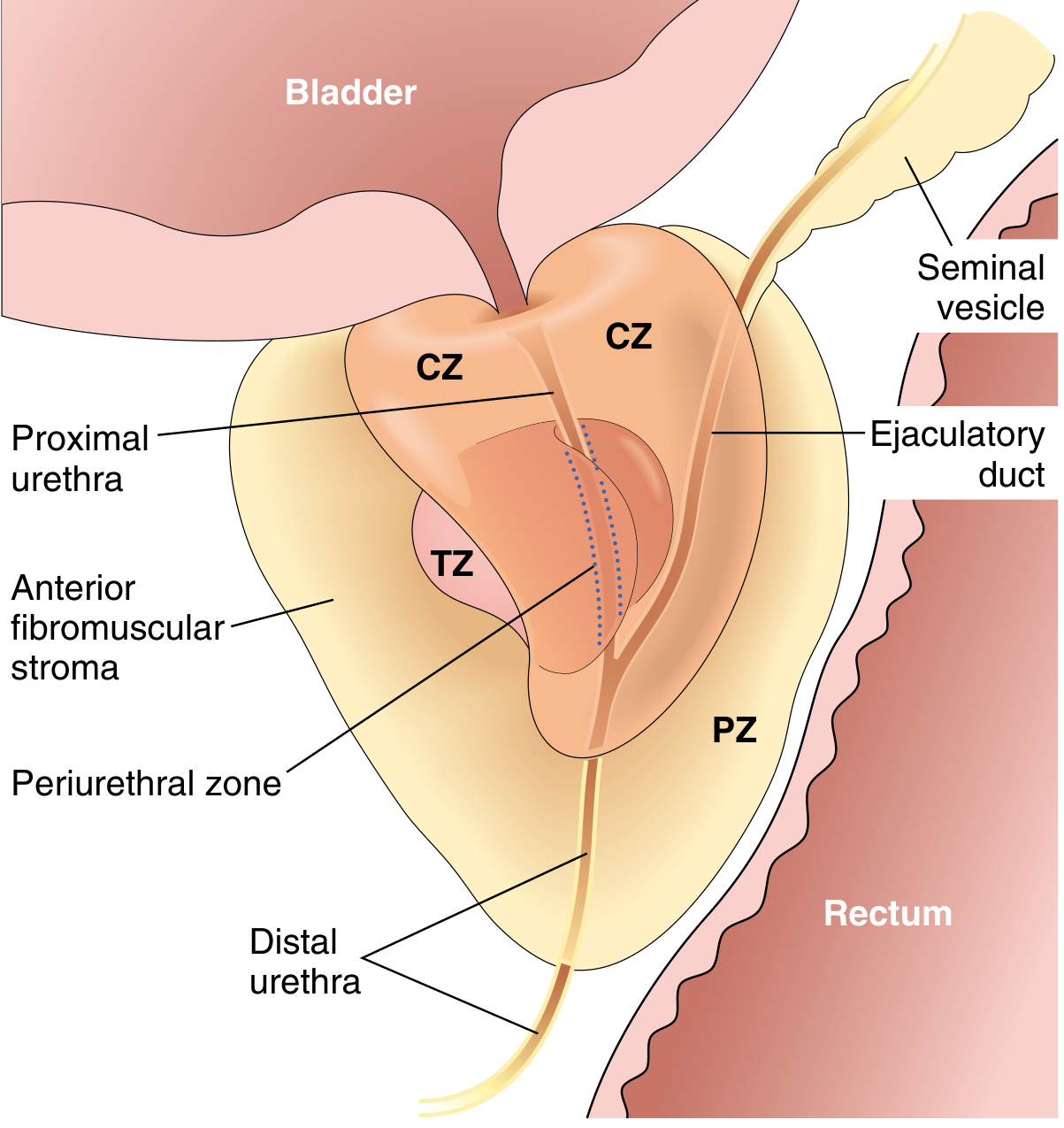
Fig: Adult prostate zones. BPH arises from the TZ (transition zone); most carcinomas arise from the PZ (peripheral zone), which is adjacent to the rectum and palpable on DRE. — Robbins, Cotran & Kumar Pathologic Basis of Disease
Simple Memory Aid
BPH = Transition Zone → obstructs urethra → urinary symptoms
Cancer = Peripheral Zone → near rectum → palpable on DRE → silent until advanced
This is a shared conversation. Sign in to Orris to start your own chat.