
Bpth 1 year make 5 marks answer for mechanical principle of centre of gravity,line of gravity
Here's a quick answer while I pull in detailed content:
Centre of Gravity (COG): The single point where the entire body weight is considered to act, regardless of body position. In anatomical position, it lies approximately at the level of S2, anterior to the sacrum.
Line of Gravity (LOG): A vertical line passing through the COG downward to the base of support. For stable posture, it must fall within the base of support.
Searching sources...
Reading File
Finding Sources
Finding Sources
Reading File
Reading File
Finding Sources
Reading File
Finding Sources
Finding Sources
Reading File
Reading File
Now I have rich textbook content. Let me fetch the key diagram image and compile the full answer.
Loading Image
Loading Image
I now have everything needed for a comprehensive, exam-ready 5-mark answer. Here it is:
Mechanical Principles of Centre of Gravity and Line of Gravity
BPTh 1st Year | 5 Marks
1. Centre of Gravity (COG)
The centre of gravity is the single theoretical point in the body through which the entire body weight is considered to act, regardless of the body's position or orientation. It represents the point at which gravitational forces on all body segments are balanced.
Location in the human body:
- In the standard anatomical position (upright standing), the COG lies just anterior to the sacral promontory, at the level of the 2nd sacral vertebra (S2).
- From the anterior view, it lies along the midsagittal plane - midway between left and right.
- The COG is not a fixed anatomical structure - it shifts with every change in posture or limb position. For example, when the arms are raised overhead or a limb is amputated, the COG changes accordingly.
Factors affecting location of COG:
- Body build (taller, heavier individuals vs children)
- Posture and body position
- Carrying external loads
- In children, the COG is relatively higher (at the level of T12) due to proportionally larger head and trunk
2. Line of Gravity (LOG)
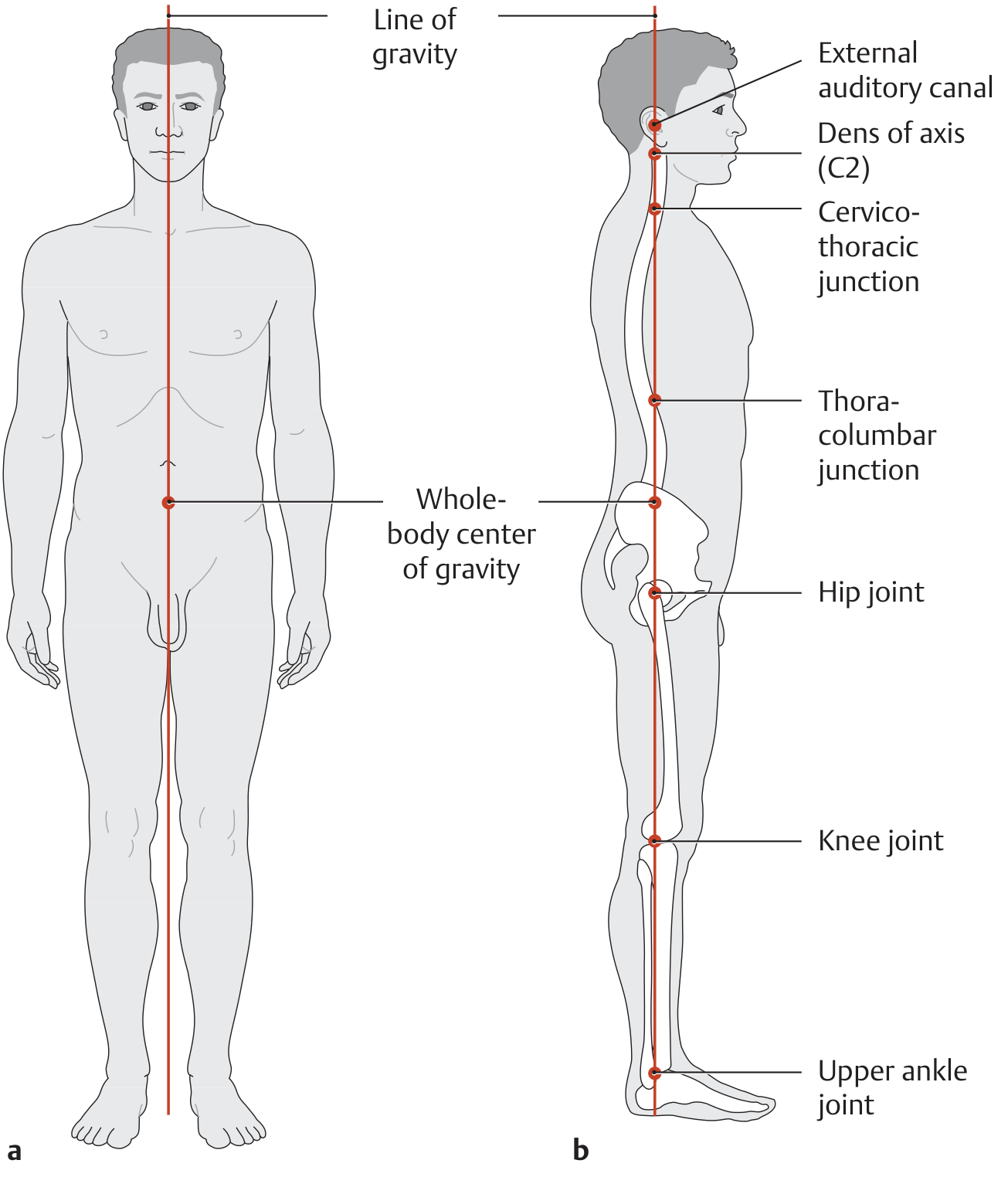
The line of gravity is an imaginary vertical line that passes downward through the COG toward the earth's center. It represents the direction in which gravitational force acts on the body.
Anatomical landmarks the LOG passes through (in normal upright stance):
| View | Landmarks |
|---|---|
| Lateral | External auditory canal → Dens of axis (C2) → Cervicothoracic junction → Thoracolumbar junction → COG (anterior to sacral promontory) → Hip joint → Knee joint → Upper ankle joint |
| Anterior | Runs vertically along the midsagittal plane through the COG |
3. Relationship Between COG, LOG, and Base of Support (BOS)
This is the most clinically important mechanical principle:
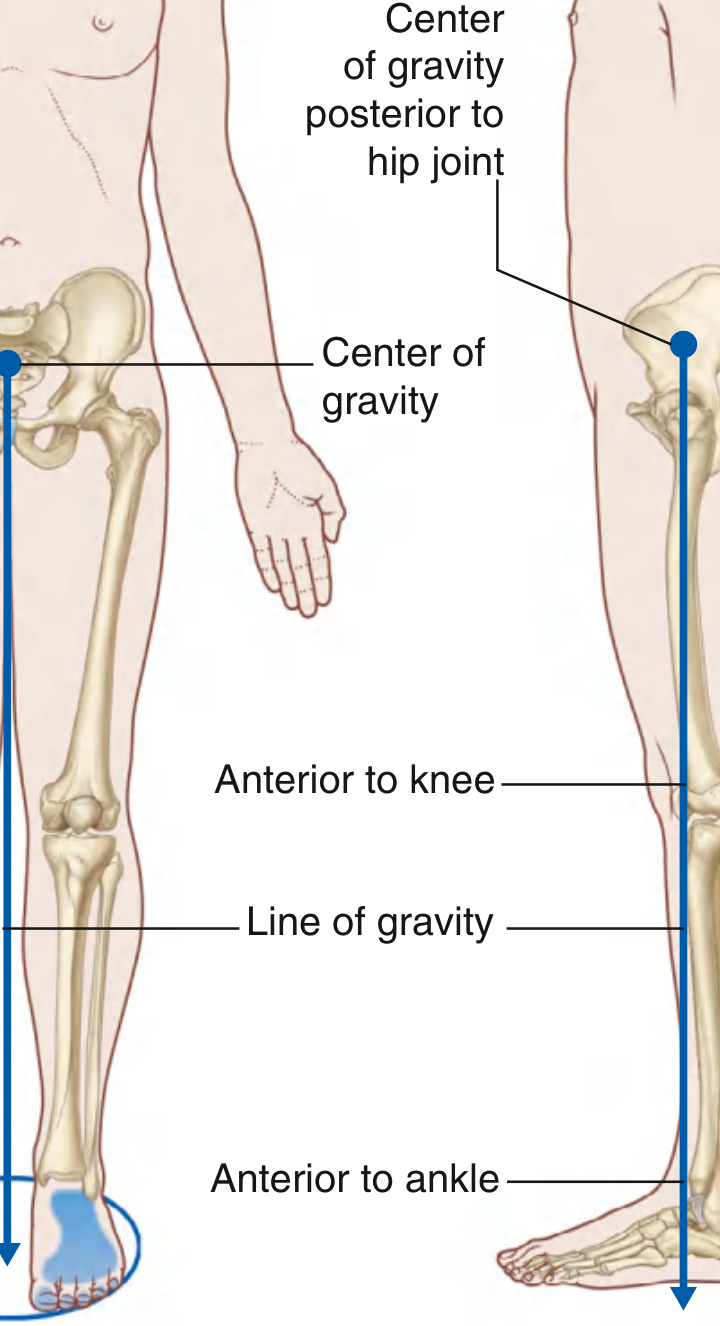
- Stability is maintained as long as the LOG falls within the base of support (the area under and between the feet in standing).
- When the LOG falls outside the BOS, the body becomes unstable and will fall unless a corrective step is taken.
- A wider BOS increases stability (e.g., standing with feet apart).
- A lower COG increases stability (e.g., squatting).
- The closer the LOG is to the center of the BOS, the greater the stability.
4. Clinical Significance
- Posture analysis: Chronic deviation of any reference point from the LOG imposes abnormal mechanical stresses on musculoskeletal elements, causing pain and deformity over time.
- Joint locking: In normal standing, the LOG passes slightly posterior to the hip and anterior to the knee and ankle, facilitating passive "locking" of these joints with minimal muscle activity - energy-efficient standing.
- Gait efficiency: During walking, the body's COG normally fluctuates only 5 cm in both vertical and lateral directions due to coordinated hip, knee, and ankle movements - minimizing energy expenditure.
- Pathological gait: In conditions like Parkinson's disease, displacement of the COG forward causes propulsive gait; in osteoporosis with kyphosis, the anterior shift of COG increases fall risk.
- Assistive devices: Use of a walking stick on the contralateral side reduces hip joint loading by shifting the LOG toward the support base.
Summary Table
| Feature | Centre of Gravity | Line of Gravity |
|---|---|---|
| Definition | Point where body weight acts | Vertical line through COG to ground |
| Location | Anterior to S2 (standing) | Along midsagittal plane |
| Fixed? | No - changes with posture | No - changes with COG |
| Clinical relevance | Stability, balance, gait | Postural alignment, joint loading |
Sources: THIEME Atlas of Anatomy - General Anatomy and Musculoskeletal System; Gray's Anatomy for Students
This is a shared conversation. Sign in to Orris to start your own chat.