
Treatment for sle
I'll read the medical library skill first, then search for SLE treatment content.
Reading File
Now I'll search the medical library and PubMed in parallel for SLE treatment.
Finding Sources
Searching PubMed
"systemic lupus erythematosus"[MeSH Terms] AND "therapy"[MeSH Terms]
Finding Sources
Searching PubMed
"lupus erythematosus, systemic"[MeSH Terms] AND "drug therapy"[MeSH Terms]
Finding Sources
Finding Sources
Good, I found a key section in Firestein & Kelley's and Goldman-Cecil. Let me read the most relevant block.
Reading File
Reading File
Let me fetch the treatment flowchart and read more of the SLE treatment section from Firestein & Kelley's.
Loading Image
Reading File
Excellent data. Let me read more on biologics and lupus nephritis treatment from the same block.
Reading File
Reading File
I now have a thorough foundation. Let me compile the full answer.
Treatment of Systemic Lupus Erythematosus (SLE)
SLE follows a relapsing-remitting course and requires a treatment strategy tailored to disease severity and organ involvement. The overarching goals are achieving remission or low disease activity (SLEDAI ≤ 4), minimizing glucocorticoid (GC) toxicity, and preventing irreversible organ damage.
Treatment Flowchart
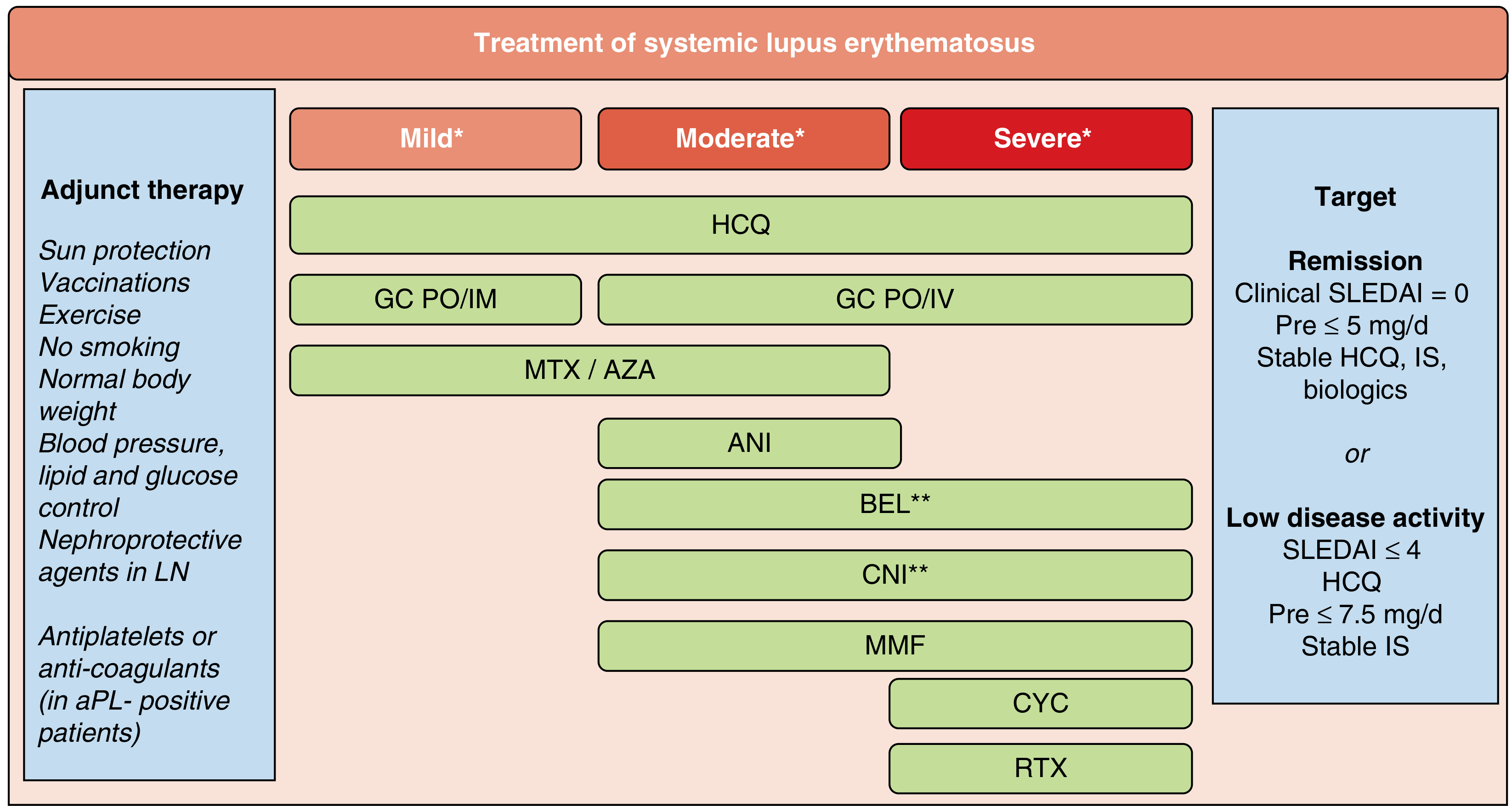
1. Hydroxychloroquine (HCQ) - Universal Backbone
Recommended for ALL SLE patients who do not have contraindications.
- Dose: Must not exceed 5 mg/kg real body weight/day (to minimize retinal toxicity)
- Ophthalmologic screening: At baseline, 5 years after starting, then annually
- Benefits: Controls skin disease, arthritis, serositis, and mild hematologic abnormalities; reduces risk of flares, end-stage renal disease, type 2 diabetes, venous thromboembolism, and cardiovascular events; improves overall SLE survival
- Mechanism: Reduces lysosomal activity, inhibits MHC class II antigen presentation, and blocks TLR7/TLR9 signaling
- Safety in pregnancy: Not teratogenic; continued during pregnancy to prevent flares
2. Mild SLE (Skin, Joints, Mucosal)
| Agent | Role |
|---|---|
| HCQ (antimalarial) | First-line; backbone |
| NSAIDs | Symptomatic relief for arthritis/serositis |
| Low-dose oral GCs (prednisone ≤ 7.5 mg/day) | Short-term control |
| Methotrexate (MTX) | Skin and joint disease, steroid-sparing |
| Azathioprine (AZA) | Steroid-sparing DMARD |
3. Moderate-to-Severe SLE
Glucocorticoids
- Oral or IV GCs are used for rapid disease control
- Goal: Taper to prednisone ≤ 5 mg/day (remission target) or ≤ 7.5 mg/day (low disease activity target)
- High-dose IV methylprednisolone "pulse" therapy (500-1000 mg/day x 3 days) for severe flares
Immunosuppressants
- Mycophenolate mofetil (MMF): 2-3 g/day; first-line for lupus nephritis (LN) and extrarenal moderate-severe SLE; comparable or superior to cyclophosphamide with better tolerability; strongly teratogenic
- Azathioprine (AZA): 2-3 mg/kg/day; used in mild-moderate disease and as maintenance; safe in pregnancy (unlike MMF)
- Methotrexate (MTX): Useful for musculoskeletal and mucocutaneous manifestations
4. Severe/Organ-Threatening SLE - Cyclophosphamide (CYC)
Used for proliferative lupus nephritis (PLN) and other severe organ involvement (CNS, vasculitis):
NIH Protocol (IV pulse CYC):
- Initial dose: 0.75 g/m² IV (reduce to 0.5 g/m² if GFR < 1/3 normal)
- Monthly pulses for 6 months (7 total pulses)
- Adjust to keep WBC nadir > 1500/mm³; max dose 1 g/m²
- Bladder protection: Vigorous hydration + mesna (20% of CYC dose) to prevent hemorrhagic cystitis
- Key toxicities: Myelosuppression, gonadal toxicity (premature ovarian failure), infections (especially herpes zoster), bladder carcinoma
5. Biologic Agents
Belimumab (anti-BAFF/BLyS monoclonal antibody)
- FDA-approved for active SLE and active lupus nephritis
- Consider when: persistent disease activity or frequent flares despite standard of care; unable to taper GCs to acceptable dose; add-on to standard therapy in LN
- Given IV or subcutaneously
Anifrolumab (anti-interferon-α/β receptor antibody)
- FDA-approved for moderate-to-severe nonrenal SLE on background standard therapy
- Targets the type I interferon pathway, which is hyperactivated in most SLE patients
Rituximab (anti-CD20 B-cell depleting antibody)
- Reserved for severe or refractory SLE - not FDA-approved for SLE but widely used off-label
- Useful in refractory LN, severe cytopenias, neuropsychiatric SLE
Obinutuzumab (next-generation anti-CD20)
- Phase 3 trials ongoing for proliferative LN; showed superior complete renal response vs. placebo in the NOBILITY phase 2 trial (35% vs. 23% at 52 weeks) - PMID 39927615
6. Lupus Nephritis - Specific Approach
| Class | Induction | Maintenance |
|---|---|---|
| Proliferative LN (III/IV) | MMF (2-3 g/day) or IV CYC | MMF or AZA for ≥ 18-24 months |
| Membranous LN (V) | MMF preferred | MMF or AZA |
| Add-on | Belimumab + MMF/CYC | Continue belimumab |
- Add voclosporin (calcineurin inhibitor, CNI) or belimumab to MMF/GC induction for enhanced renal response (approved combinations)
- HCQ continued throughout; reduces risk of end-stage renal disease even in LN
7. Antiphospholipid Syndrome (aPL-positive SLE)
- Low-dose aspirin (antiplatelet) for primary prevention
- Long-term anticoagulation (warfarin, target INR 2-3) for patients with thrombotic events
- Avoid direct oral anticoagulants (DOACs) in triple-positive aPL
8. Adjunct/Supportive Measures
- Sun protection (UV triggers flares)
- Vaccinations (especially influenza, pneumococcus, COVID-19) - avoid live vaccines on immunosuppression
- Smoking cessation, weight control, BP/lipid/glucose management
- Nephroprotective agents in LN: ACE inhibitors or ARBs to reduce proteinuria
- Calcium + vitamin D supplementation on chronic steroids
- Osteoporosis prophylaxis with bisphosphonates if on long-term GCs
Treatment Targets
| Target | Definition |
|---|---|
| Remission | Clinical SLEDAI = 0, prednisone ≤ 5 mg/day, stable HCQ/IS/biologics |
| Low disease activity (LLDAS) | SLEDAI ≤ 4, HCQ, prednisone ≤ 7.5 mg/day, stable IS |
Sources:
- Firestein & Kelley's Textbook of Rheumatology, 2-Volume Set (2022), Chapter 82
- Goldman-Cecil Medicine International Edition (2022), Chapter on Immunomodulatory Agents
- Recent RCT: Obinutuzumab in LN - Furie et al., NEJM 2025 [PMID 39927615]
This is a shared conversation. Sign in to Orris to start your own chat.