
Management of edh
I'll look up the management of EDH (Epidural Hematoma) from the medical library right away.
Reading File
Now let me search the library for EDH management content in parallel:
Finding Sources
Finding Sources
Searching PubMed
"epidural hematoma" AND management
Now let me read the most comprehensive sources in parallel:
Reading File
Reading File
Reading File
Let me read more content from the Plum and Posner text and Goldman-Cecil for detailed surgical and conservative management criteria:
Reading File
Reading File
Let me fetch the CT image of EDH and read more on spinal EDH management:
Loading Image
Reading File
I now have comprehensive information from multiple authoritative textbooks. Here is the full, detailed answer:
Management of Epidural Hematoma (EDH)
Overview
An epidural hematoma (EDH) is a neurosurgical emergency where blood collects in the potential space between the inner table of the skull and the outer (periosteal) layer of the dura mater. It occurs in approximately 2% of traumatic brain injuries and is more common in young males; it is uncommon after age 50.
CT appearance: biconvex (lens-shaped/football-shaped) hyperdense mass, typically in the temporal region.
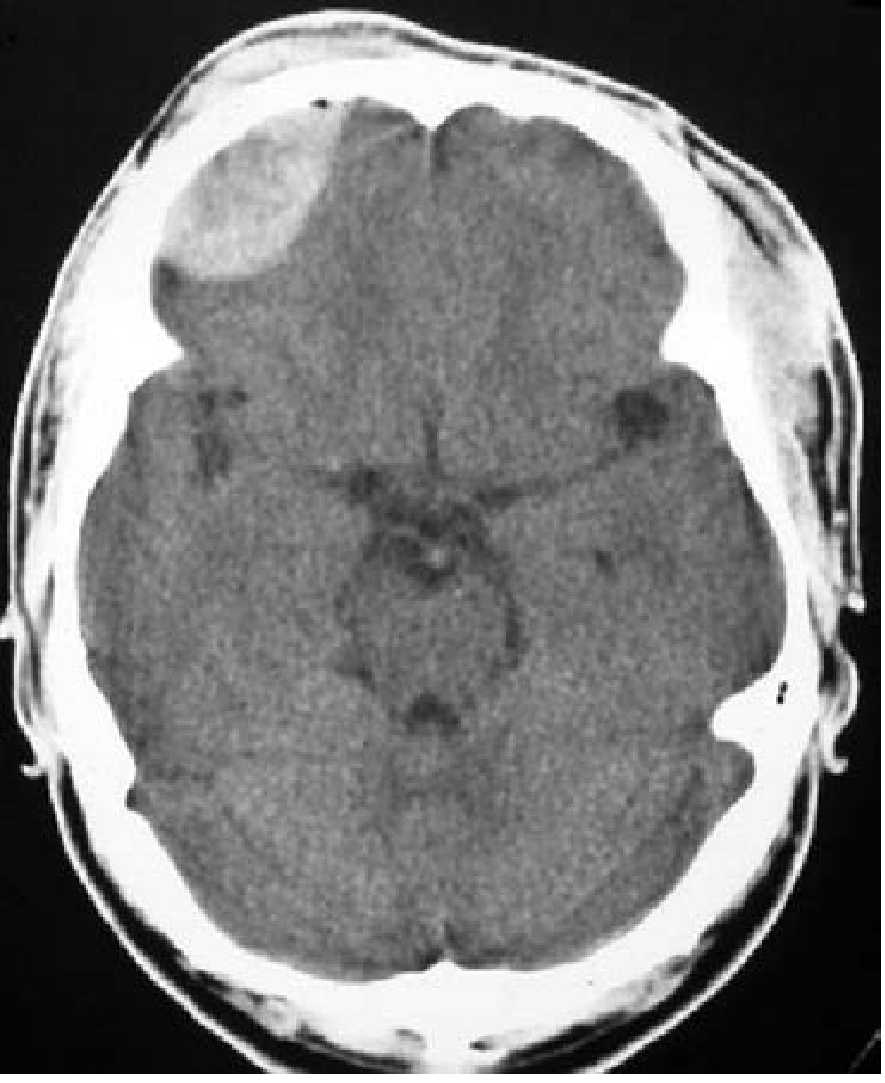
Mechanism & Etiology
- Most commonly: laceration of the middle meningeal artery by a temporal bone fracture (crossing the middle meningeal groove)
- Less commonly: tears of dural venous sinuses (parieto-occipital or posterior fossa trauma) - these bleed more slowly and may be self-limited
- High-pressure arterial bleeding means herniation can occur within hours of injury
Clinical Presentation
| Feature | Detail |
|---|---|
| Classic presentation | LOC → lucid interval → rapid neurologic deterioration |
| Frequency of classic presentation | Only 15-20% of cases |
| Most cases | Mild symptoms picked up on CT; only ~30% require surgical intervention |
| Signs of raised ICP | Vomiting, ipsilateral pupil dilation (uncal herniation), Cushing's triad (HTN + bradycardia + irregular breathing) |
| Skull fracture signs | Battle's sign (post-auricular ecchymosis), raccoon eyes (periorbital ecchymosis), hemotympanum |
Diagnosis
- Head CT (non-contrast) is the investigation of choice - shows biconvex hyperdense mass
- Check for skull fracture crossing the middle meningeal groove (bone windows on CT)
- Coronal reconstruction needed if vertex hematoma is suspected (may be missed on axial cuts)
- MRI is not required for EDH diagnosis but may be used to evaluate underlying brain contusions/edema
- Even if the initial CT is negative, careful follow-up is required as EDH development can be delayed
Management
A. Surgical Management (DEFINITIVE)
Indications for immediate surgical evacuation (craniotomy):
- EDH causing brain displacement with impaired consciousness
- Hematoma volume ≥30 mL
- Clot thickness (diameter) ≥15 mm
- Midline shift ≥5 mm
- GCS score ≤8
- Focal neurologic deficits
Key surgical principles:
- Surgery is an emergency - duration from injury to treatment is a critical determinant of prognosis
- Most patients operated on promptly recover, including ~one-third of those with a fixed dilated pupil preoperatively
- Factors affecting outcome: age, depth of coma, degree of midline shift, hematoma size
- EDH typically does not injure underlying brain parenchyma - full neurologic recovery is expected with timely evacuation
B. Conservative (Non-Surgical) Management
A non-surgical approach may be considered only if all of the following criteria are met:
| Criterion | Threshold |
|---|---|
| Hematoma volume | < 30 mL |
| Clot diameter | < 15 mm |
| Midline shift | < 5 mm |
| GCS score | > 8 |
| Neurologic examination | Non-focal |
Conservative management consists of:
- Correction of any underlying coagulopathy
- Close inpatient observation with serial neurologic examinations
- Repeat CT imaging to monitor hematoma size
- Patient and family education - return immediately if neurologic deterioration occurs
Note: Even with an apparently negative initial CT, any trauma patient with a skull fracture crossing the middle meningeal groove needs close surveillance for delayed EDH.
Management of Spinal EDH (if context includes this)
- Caused by mechanical disruption of epidural vessels by vertebral fracture fragments or dislocation
- Diagnosed on MRI: collection isointense on T1, hyperintense on T2, typically extending 2-3 vertebral segments
- Immediate surgical decompression for patients with neurologic deficits
- Conservative management (coagulopathy correction + observation) for patients without neurologic deficits
- 6-month outcomes are similar between surgical and conservatively managed groups
Prognosis
- Excellent if evacuated before herniation or neurologic deficits develop
- Unlike SDH, EDH usually does not injure underlying brain - full recovery is expected with early treatment
- Outcome worsens with delayed treatment, deep coma, bilateral fixed pupils, large hematoma, and advanced age
Sources:
- Goldman-Cecil Medicine International Edition, Chapter 368 (Treatment and Prognosis)
- Plum and Posner's Diagnosis and Treatment of Stupor and Coma, Chapter 4
- Rosen's Emergency Medicine: Concepts and Clinical Practice, Chapter 257
- Tintinalli's Emergency Medicine: A Comprehensive Study, Chapter 257
Recent evidence note (PubMed 2024-2026): A systematic review and meta-analysis (Daoud et al., 2024, PMID 38943702) specifically addressed operative vs. non-operative management of posterior fossa EDH - this is a nuanced subgroup where conservative criteria may differ from supratentorial EDH.
This is a shared conversation. Sign in to Orris to start your own chat.