
from Guyton and Hall textbook of medical physiology, 4th South Asia edition, write a 5-mark short note on Phases of Deglutition- enlist, Pharyngeal Phase-explain
Reading File
Finding Sources
Finding Sources
Reading File
Loading Image
Reading File
I now have all the content needed directly from Guyton and Hall. Here is the complete short note:
Phases of Deglutition (Swallowing)
[Guyton and Hall Textbook of Medical Physiology, 4th South Asia Edition - Chapter 64, p. 788-789]
Definition
Swallowing (deglutition) is a complicated mechanism, principally because the pharynx subserves both respiration and swallowing. The pharynx is converted for only a few seconds at a time into a tract for propulsion of food.
Phases of Deglutition (Enlisted)
Swallowing is divided into three stages:
- Voluntary Stage - initiates the swallowing process
- Pharyngeal Stage - involuntary; constitutes passage of food through the pharynx into the esophagus
- Esophageal Stage - involuntary; transports food from the esophagus to the stomach
Pharyngeal Stage - Detailed Explanation
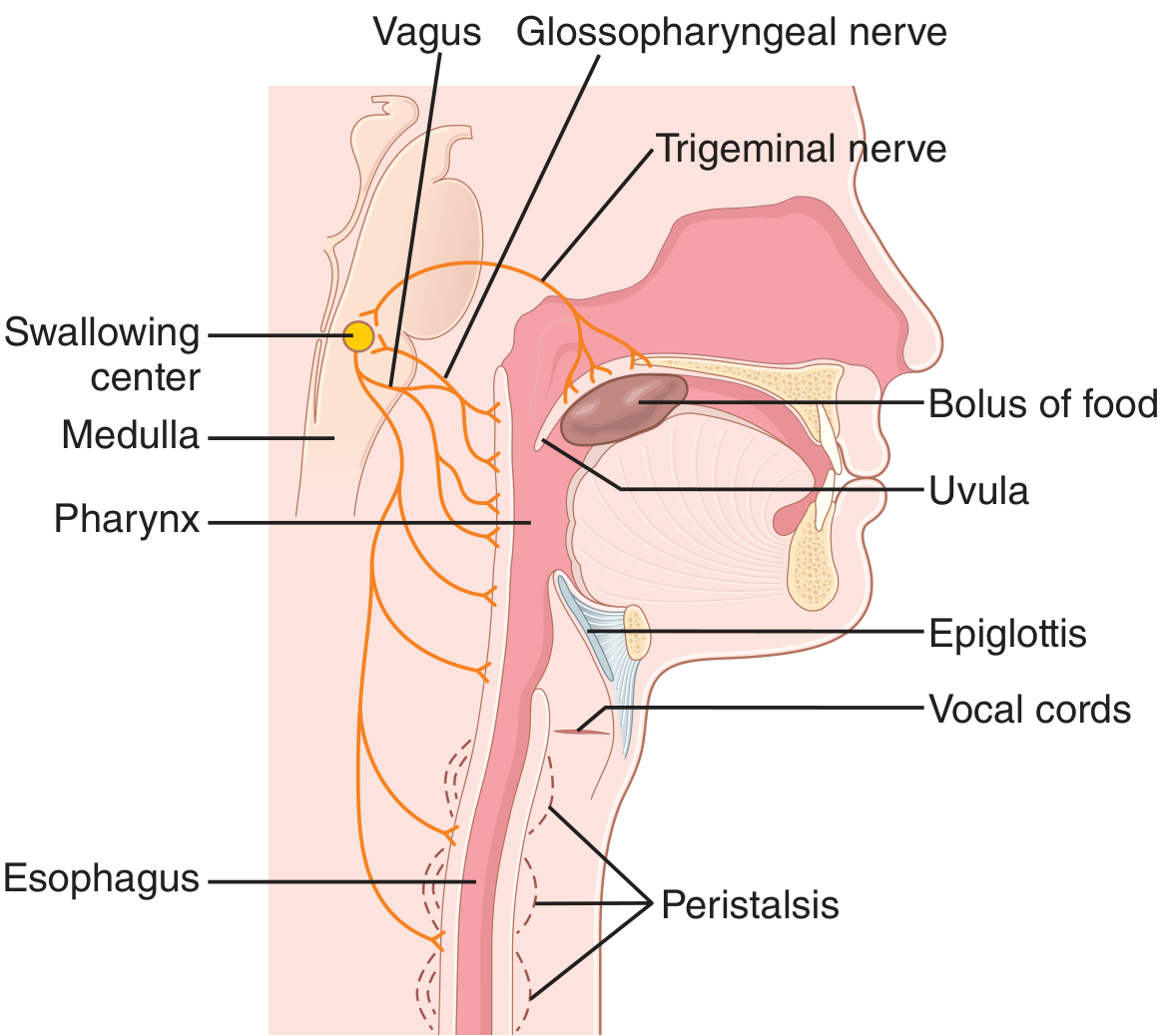
Initiation
As the bolus of food enters the posterior mouth and pharynx, it stimulates epithelial swallowing receptor areas all around the opening of the pharynx, especially on the tonsillar pillars. Impulses from these areas pass to the brain stem, initiating a series of automatic pharyngeal muscle contractions.
Sequential Events (Automatic Muscle Contractions)
1. Closure of Posterior Nares:
The soft palate is pulled upward to close the posterior nares, preventing reflux of food into the nasal cavities.
2. Formation of Sagittal Slit:
The palatopharyngeal folds on each side of the pharynx are pulled medially to approximate each other, forming a sagittal slit through which food must pass into the posterior pharynx. This acts as a selective filter - only sufficiently masticated food can pass. Because this stage lasts less than 1 second, any large object is impeded from entering the esophagus.
3. Laryngeal Protection (Airway Closure):
The vocal cords of the larynx are strongly approximated, and the larynx is pulled upward and anteriorly by the neck muscles. This stretches the epiglottis backward over the opening of the larynx, preventing food entry into the trachea.
4. Relaxation of Upper Esophageal Sphincter:
The upward movement of the larynx pulls up and enlarges the opening to the esophagus. Simultaneously, the upper esophageal sphincter (pharyngoesophageal sphincter) - the upper 3 to 4 cm of the esophageal muscular wall - relaxes, allowing food to move freely from the posterior pharynx into the upper esophagus. (Between swallows, this sphincter remains strongly contracted to prevent air entry during respiration.) The upward movement of the larynx also lifts the glottis out of the main food stream, so food mainly passes on each side of the epiglottis rather than over its surface.
5. Peristaltic Wave:
Once the larynx is raised and the pharyngoesophageal sphincter relaxes, the entire muscular wall of the pharynx contracts, beginning in the superior part and spreading downward over the middle and inferior pharyngeal areas, propelling food by peristalsis into the esophagus.
Summary of Mechanics
The trachea is closed, the esophagus is opened, and a fast peristaltic wave initiated by the nervous system of the pharynx forces the bolus of food into the upper esophagus - the entire process occurring in less than 2 seconds.
Nervous Control of the Pharyngeal Stage
-
Afferent pathway: The most sensitive areas lie in a ring around the pharyngeal opening (greatest sensitivity on tonsillar pillars). Impulses travel via the sensory portions of the trigeminal (V) and glossopharyngeal (IX) nerves into the medulla oblongata, into or closely associated with the tractus solitarius.
-
Swallowing Center: The successive stages are automatically initiated in orderly sequence by neural areas of the reticular substance of the medulla and lower pons - collectively called the deglutition (swallowing) center. The sequence and timing remain constant from one swallow to the next.
-
Efferent pathway: Motor impulses are transmitted by the 5th, 9th, 10th, and 12th cranial nerves and some superior cervical nerves.
-
Nature of reflex: The pharyngeal stage is principally a reflex act - almost always initiated by voluntary movement of food to the back of the mouth, which then excites involuntary pharyngeal sensory receptors to elicit the swallowing reflex.
Effect on Respiration
The entire pharyngeal stage occurs in less than 6 seconds, interrupting respiration for only a fraction of a usual respiratory cycle. The swallowing center specifically inhibits the respiratory center of the medulla during this time, halting respiration at any point in its cycle to allow swallowing to proceed.
Source: Guyton and Hall Textbook of Medical Physiology, 4th South Asia Edition, Chapter 64 (Propulsion and Mixing of Food in the Alimentary Tract), pp. 788-789
This is a shared conversation. Sign in to Orris to start your own chat.