
Oral antidiabetic drugs
Reading File
Now let me search the medical library for oral antidiabetic drugs content.
Finding Sources
Finding Sources
Finding Sources
Finding Sources
Finding Sources
Finding Sources
Good - I found key sources. Let me read the most comprehensive pharmacology sections.
Reading File
Reading File
Excellent - I have a huge amount of content from Lippincott Pharmacology and Ganong's. Let me read more of the Lippincott section which covers the oral antidiabetics in detail.
Reading File
Reading File
I have very rich content. Let me now fetch the key summary diagram and compile my comprehensive answer.
Loading Image
Loading Image
I now have comprehensive content from the Lippincott Pharmacology textbook. Let me compile the full answer.
Oral Antidiabetic Drugs
Oral antidiabetic (hypoglycemic) agents are used primarily in type 2 diabetes mellitus, which is characterized by insulin resistance and insufficient insulin secretion. Patients who have had diabetes for less than 5 years are most likely to respond well to oral agents. Long-standing disease may require combination therapy.
Classes of Oral Antidiabetic Agents
I. Biguanides - Metformin
Metformin is the preferred initial agent for type 2 diabetes and should be started at diagnosis.
| Property | Details |
|---|---|
| Mechanism | Reduces hepatic gluconeogenesis (primary); slows intestinal glucose absorption; improves peripheral insulin sensitivity |
| Does NOT | Stimulate insulin secretion - so very low risk of hypoglycemia alone |
| PK | Well absorbed orally; not protein bound; not metabolized; excreted unchanged in urine |
| Adverse effects | GI: diarrhea, nausea, vomiting (take with meals, titrate slowly); weight loss/appetite suppression; lactic acidosis (rare but serious) |
| Contraindications | Severe renal impairment (eGFR <30 mL/min), acute heart failure, hepatic failure - all due to lactic acidosis risk |
| Other uses | Polycystic ovary syndrome (PCOS), prediabetes prevention |
Also useful in PCOS by reducing insulin resistance. - Lippincott Illustrated Reviews: Pharmacology
II. Sulfonylureas (Insulin Secretagogues)
Examples: Tolbutamide, glipizide, glyburide (glibenclamide), glimepiride, glibenclamide (1st gen: chlorpropamide)
| Property | Details |
|---|---|
| Mechanism | Bind ATP-sensitive K⁺ channels on pancreatic B cells → close channels → membrane depolarization → Ca²⁺ influx → insulin exocytosis |
| Requirement | Some residual B cell function; ineffective in type 1 diabetes or post-pancreatectomy |
| Adverse effects | Hypoglycemia (main concern), weight gain |
| Other | Low cost; effective; second-line after metformin |
Tolbutamide and other sulfonylureas only work in patients with some remaining B cells and are ineffective after pancreatectomy or in type 1 diabetes. - Ganong's Review of Medical Physiology
III. Meglitinides (Short-acting Secretagogues)
Examples: Repaglinide, nateglinide
| Property | Details |
|---|---|
| Mechanism | Same as sulfonylureas (close K⁺-ATP channels) but short-acting - taken before meals |
| Benefit | Better postprandial glucose control with flexible dosing |
| Adverse effects | Hypoglycemia (less than sulfonylureas), weight gain |
IV. Thiazolidinediones (TZDs) - "Glitazones"
Examples: Pioglitazone, rosiglitazone
| Property | Details |
|---|---|
| Mechanism | Activate PPAR-γ (peroxisome proliferator-activated receptor gamma) in adipose tissue → increased insulin sensitivity in muscle, fat, and liver |
| Effect | Do not stimulate insulin secretion; reduce insulin resistance |
| Adverse effects | Weight gain, fluid retention/edema, increased risk of heart failure (avoid in HF), increased fracture risk |
| Pioglitazone note | Associated with bladder cancer risk (long-term use) |
V. Alpha-Glucosidase Inhibitors
Examples: Acarbose, miglitol
| Property | Details |
|---|---|
| Mechanism | Inhibit intestinal alpha-glucosidase enzymes → delay carbohydrate digestion and absorption → reduce postprandial glucose spikes |
| Adverse effects | GI disturbance: flatulence, diarrhea, abdominal cramps (very common) |
| Benefit | No hypoglycemia alone; weight neutral |
VI. DPP-4 Inhibitors ("Gliptins")
Examples: Sitagliptin, saxagliptin, alogliptin, linagliptin
| Property | Details |
|---|---|
| Mechanism | Inhibit dipeptidyl peptidase-4 (DPP-4), the enzyme that degrades incretin hormones (GLP-1, GIP) → increased GLP-1 levels → glucose-dependent insulin secretion and glucagon suppression |
| Benefit | Low hypoglycemia risk; weight neutral |
| Adverse effects | Nasopharyngitis, risk of pancreatitis (rare) |
| Cardiovascular | Generally neutral; saxagliptin associated with increased HF hospitalization |
VII. SGLT2 Inhibitors ("Gliflozins")
Examples: Empagliflozin, dapagliflozin, canagliflozin, ertugliflozin
| Property | Details |
|---|---|
| Mechanism | Inhibit sodium-glucose cotransporter 2 (SGLT2) in the proximal renal tubule → block glucose reabsorption → glucosuria |
| Benefits | Weight loss, blood pressure reduction, cardiovascular mortality reduction (empagliflozin, dapagliflozin), renal protection in CKD |
| Adverse effects | Urinary tract infections, genital mycotic infections, polyuria, rare diabetic ketoacidosis (euglycemic DKA) |
| Contraindication | eGFR <45 mL/min for most agents (reduced efficacy + safety concerns) |
VIII. Oral GLP-1 Receptor Agonist
Example: Semaglutide (oral formulation - Rybelsus)
| Property | Details |
|---|---|
| Mechanism | GLP-1 receptor agonist - glucose-dependent insulin secretion, glucagon suppression, delayed gastric emptying, satiety |
| Benefits | Weight loss, cardiovascular protection |
| Adverse effects | Nausea, vomiting, diarrhea |
Adverse Effects Summary
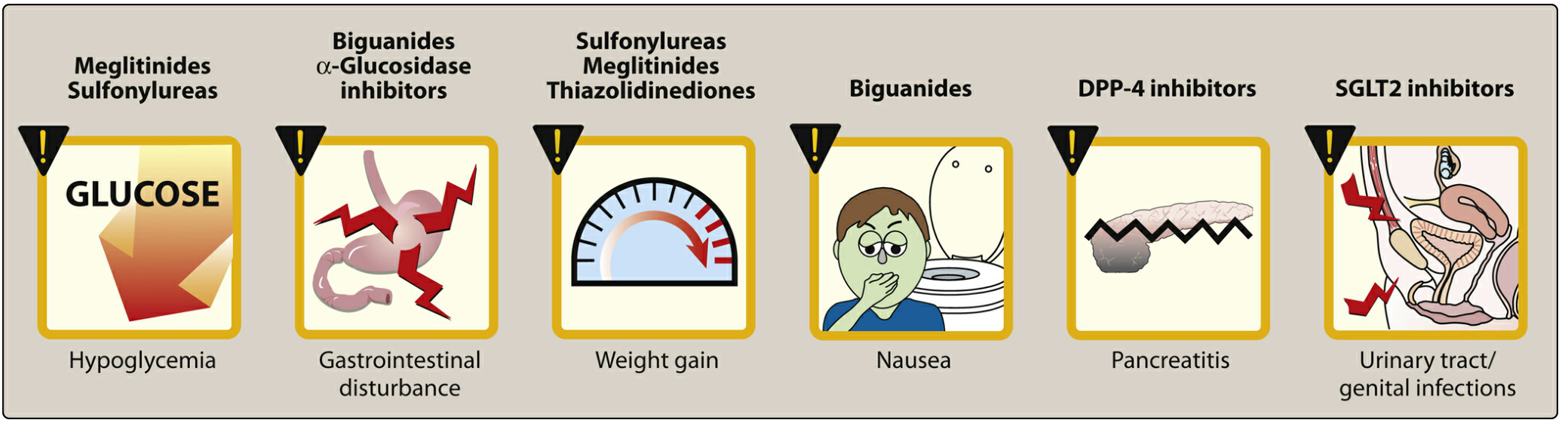
Figure: Key adverse effects by drug class - Lippincott Illustrated Reviews: Pharmacology
Treatment Algorithm for Type 2 Diabetes
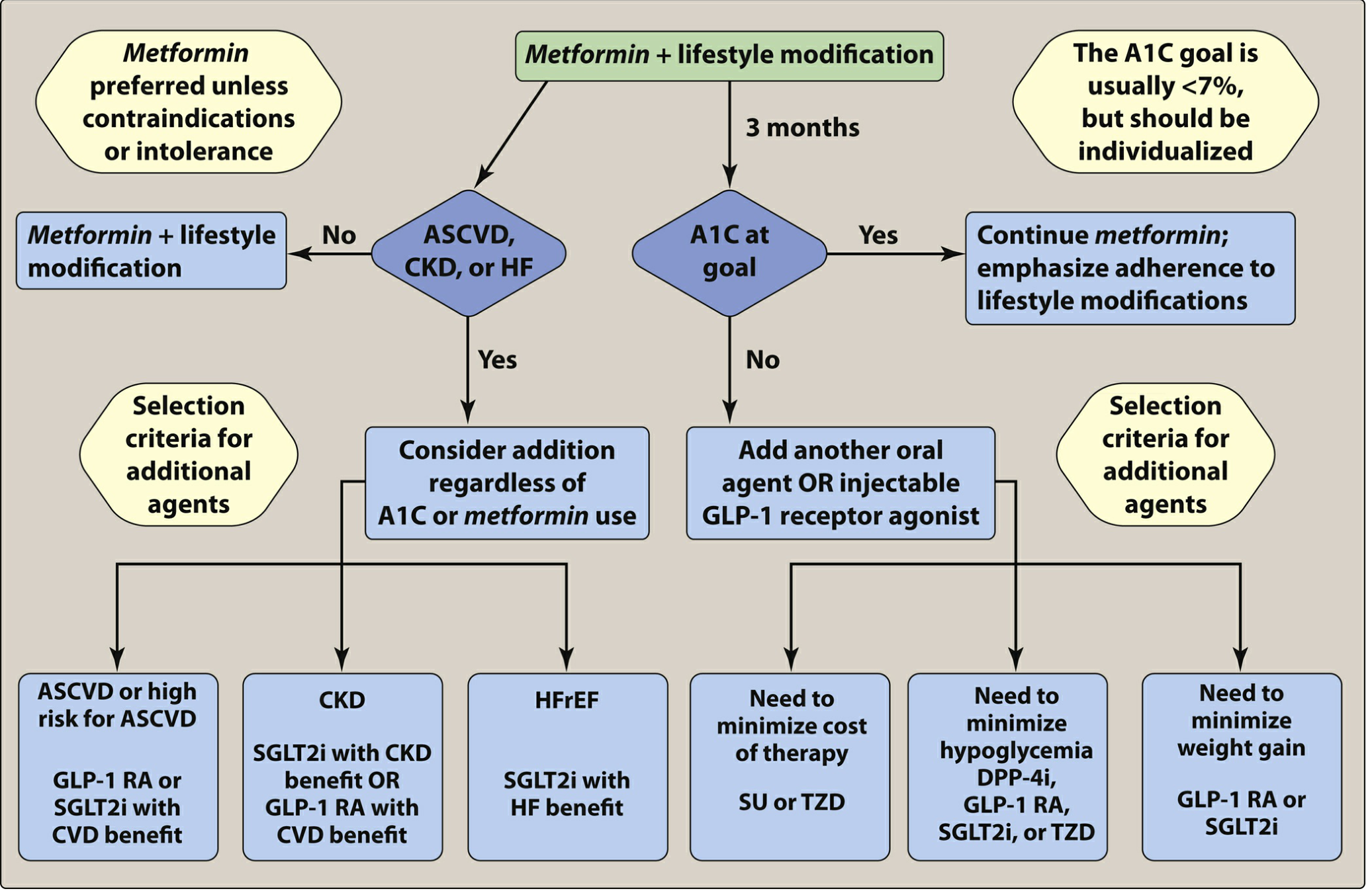
Figure: Recommendations for management of type 2 diabetes - Lippincott Illustrated Reviews: Pharmacology
Key decision points:
- Start with metformin + lifestyle (unless contraindicated)
- If A1C not at goal after 3 months, add a second agent
- If ASCVD or high CV risk: add GLP-1 RA or SGLT2i with proven CV benefit
- If CKD: add SGLT2i (renal benefit) or GLP-1 RA
- If HFrEF: add SGLT2i with heart failure benefit
- If minimizing hypoglycemia: prefer DPP-4i, GLP-1 RA, SGLT2i, or TZD
- If minimizing weight gain: prefer GLP-1 RA or SGLT2i
Quick Comparison Table
| Drug Class | MOA | Hypoglycemia | Weight | CV Benefit | Notes |
|---|---|---|---|---|---|
| Metformin | ↓ hepatic gluconeogenesis | Low | Loss | Neutral | First-line; avoid in severe renal/hepatic failure |
| Sulfonylureas | Close K⁺-ATP channels → ↑ insulin | High | Gain | Neutral | Cheap; 2nd line |
| Meglitinides | Close K⁺-ATP channels (short) | Moderate | Gain | Neutral | Pre-meal dosing |
| TZDs | PPAR-γ activation | Low | Gain | Pioglitazone neutral | Avoid in HF |
| Alpha-glucosidase inhibitors | Delay GI absorption | Low | Neutral | Neutral | Mainly postprandial |
| DPP-4 inhibitors | ↑ incretin half-life | Low | Neutral | Neutral | Well tolerated |
| SGLT2 inhibitors | ↑ renal glucose excretion | Low | Loss | Yes (CV + renal) | Genital infections |
| Oral semaglutide | GLP-1 RA | Low | Loss | Yes | Nausea common |
Sources: Lippincott Illustrated Reviews: Pharmacology; Ganong's Review of Medical Physiology, 26th Edition
Loop Diuretics
Finding Sources
Finding Sources
Finding Sources
Reading File
Reading File
Excellent content. Now let me get the pharmacology-focused content from Lippincott and look for diagrams.
Finding Sources
Reading File
Finding Sources
Finding Sources
Reading File
Reading File
Now let me get the Lippincott Pharmacology detailed section on loop diuretics for the most comprehensive pharmacology content plus a diagram.
Finding Sources
Finding Sources
Finding Sources
Reading File
I have comprehensive content from multiple authoritative sources. Now let me compile the complete answer.
Loop Diuretics
Loop diuretics are the most potent class of diuretic agents available. They act on the thick ascending limb (TAL) of the loop of Henle - the site responsible for reabsorbing approximately 25% of filtered NaCl - producing a large natriuresis and diuresis that far exceeds other diuretic classes. They are also called "high-ceiling diuretics" because their dose-response curve continues to rise at doses where other diuretics plateau.
Drugs in This Class
| Drug | Notes |
|---|---|
| Furosemide | Most widely used; variable oral bioavailability (12-112%) |
| Bumetanide | More predictable absorption than furosemide |
| Torsemide | Best oral bioavailability; longer duration; superior in chronic HF |
| Ethacrynic acid | Only non-sulfonamide loop diuretic; first choice in sulfa allergy |
Site of Action
Loop diuretics act on the apical (luminal) membrane of epithelial cells in the thick ascending limb of the loop of Henle (TALH).
The TALH is water-impermeable. Normally, the Na⁺/K⁺-ATPase on the basolateral side creates an electrochemical gradient that drives the Na⁺-K⁺-2Cl⁻ cotransporter (NKCC2) on the apical side to reabsorb Na⁺, K⁺, and Cl⁻. This concentrates the medullary interstitium and dilutes tubular fluid - essential for the kidney's concentrating/diluting ability.
Loop diuretics compete with Cl⁻ for binding to NKCC2, blocking it entirely.
Mechanism of Action
- Inhibit NKCC2 at the apical membrane of TALH → block Na⁺, K⁺, Cl⁻ reabsorption
- Large salt load passes to the distal tubule, overwhelming its reabsorptive capacity → massive natriuresis and diuresis
- Disruption of the medullary concentration gradient → impaired urinary concentrating ability even when ADH/AVP is present
- Increased Na⁺/water delivery to distal nephron → enhanced K⁺ secretion (especially with elevated aldosterone)
- Increased Ca²⁺ excretion (~30% increase in fractional excretion) - opposite to thiazides
- Increased Mg²⁺ excretion (magnesuria)
- Stimulate prostaglandin (PGE₂) synthesis → renal vasodilation (venodilation)
Furosemide's Additional Hemodynamic Effect (IV)
When given IV, furosemide acts as a venodilator within minutes - reducing right atrial pressure and pulmonary capillary wedge pressure before significant diuresis occurs. This is mediated by prostaglandin release and is blocked by indomethacin (NSAIDs). This makes IV furosemide particularly valuable in acute pulmonary edema.
Loop diuretics also transiently activate the renin-angiotensin system, causing a brief rise in systemic vascular resistance - reinforcing the importance of concurrent vasodilator therapy in acute pulmonary edema. - Braunwald's Heart Disease
Pharmacokinetics
- Highly protein-bound (mainly to albumin) → filtered load is minimal
- Gain access to tubular lumen via secretion by organic anion transporters (OAT1/OAT2) at the basolateral membrane of the proximal tubule, and by MDR1
- NSAIDs and salicylates compete for the same transporter → blunt diuretic response
- Uremic toxins (in CKD) displace loop diuretics from albumin and impede tubular secretion
| Drug | Oral Bioavailability | Metabolism | Notes |
|---|---|---|---|
| Furosemide | 12-112% (variable) | Renal (mainly) | Most affected by CKD |
| Bumetanide | ~80% (reliable) | Hepatic + renal | Less affected by CKD |
| Torsemide | ~80-90% (consistent) | Hepatic (CYP2C9) | Preferred in chronic HF and CKD; longer DOA |
| Ethacrynic acid | Good | Hepatic | Non-sulfonamide |
The consistency of torsemide absorption and its longer duration of action are features to consider for chronic HF and CKD patients. - NKF Primer on Kidney Diseases, 8e
Clinical Indications
| Indication | Notes |
|---|---|
| Acute decompensated heart failure | First-line; IV furosemide reduces filling pressures rapidly |
| Pulmonary edema | IV furosemide - both venodilation and diuresis |
| Edema - cirrhosis, nephrotic syndrome, CKD | Most effective diuretic in renal impairment (eGFR <35 mL/min) |
| Hypertension (resistant or with CKD) | Especially when thiazides fail |
| Hypercalcemia | Promote Ca²⁺ excretion; used with saline infusion |
| Hyperkalemia | Increase K⁺ excretion |
| Hyponatremia | Increase solute-free water clearance |
| Forced diuresis (drug overdose) | With fluid replacement |
Loop diuretics are the most effective agents in patients with renal insufficiency (eGFR <35 mL/min/1.73 m²). - The Washington Manual of Medical Therapeutics
Adverse Effects
| Adverse Effect | Mechanism / Notes |
|---|---|
| Hypokalemia | Increased K⁺ delivery to collecting duct + secondary hyperaldosteronism |
| Hyponatremia | Excess free water retention or aggressive diuresis |
| Hypomagnesemia | Direct magnesuria |
| Hypocalcemia | Increased Ca²⁺ excretion (opposite of thiazides) |
| Metabolic alkalosis | Loss of Cl⁻ and H⁺ with volume contraction (contraction alkalosis); secondary hyperaldosteronism |
| Hyperuricemia / Gout | Brief initial increase, then decreased uric acid excretion (compete with OAT secretion) |
| Ototoxicity | Particularly furosemide; dose-related; more common with parenteral use and in renal insufficiency; can be irreversible (ethacrynic acid has the highest risk) |
| Volume depletion / AKI | Excessive diuresis, especially in hypovolemic states |
| Hypokalemia + digoxin toxicity | Furosemide + digoxin → hypokalemia → dysrhythmias |
| Sulfonamide hypersensitivity | Furosemide, bumetanide, torsemide (all sulfonamide-based) - use ethacrynic acid if true sulfa allergy |
Drug Interactions
| Interaction | Effect |
|---|---|
| NSAIDs / Salicylates | Block OAT secretion of loop diuretics → blunted diuretic response; also inhibit renal PGE₂ |
| Aminoglycosides | Additive ototoxicity and nephrotoxicity |
| Digoxin | Hypokalemia from loop diuretics potentiates digoxin toxicity → arrhythmias |
| QT-prolonging drugs | Hypokalemia → increased arrhythmia risk |
| Lithium | Volume depletion reduces Li⁺ clearance → toxicity |
| Metolazone (thiazide-like) | Synergistic diuresis in diuretic-resistant states ("sequential nephron blockade") |
| ACE inhibitors / ARBs | Risk of first-dose hypotension |
Diuretic Resistance
Loop diuretic resistance occurs in HF, nephrotic syndrome, and CKD. The dose-response (sigmoidal) curve is shifted downward and rightward. Causes include:
- Reduced tubular secretion (NSAIDs, elevated organic acids in CKD)
- Reduced GFR limiting drug delivery
- Post-diuretic Na⁺ retention (rebound reabsorption between doses)
- Neurohormonal activation (RAS, aldosterone)
Management: increase dose, switch to IV, use torsemide (better absorption), add a thiazide/metolazone (sequential nephron blockade), restrict Na⁺ intake.
Comparison with Other Diuretic Classes
| Feature | Loop | Thiazides | K⁺-Sparing |
|---|---|---|---|
| Site | Thick ascending limb | Distal convoluted tubule | Collecting duct |
| Transporter | NKCC2 | NCC | ENaC / Aldosterone receptor |
| Potency | Highest | Moderate | Weak (used in combination) |
| Effect on Ca²⁺ | Hypocalcemia | Hypercalcemia | Neutral |
| Effect on K⁺ | Hypokalemia | Hypokalemia | Hyperkalemia |
| Use in renal failure | Yes (preferred) | Limited (poor efficacy) | Caution (hyperkalemia risk) |
| Ototoxicity | Yes | No | No |
Sources: Braunwald's Heart Disease, 2-Volume Set; NKF Primer on Kidney Diseases, 8e; Goodman & Gilman's Pharmacological Basis of Therapeutics; Barash Clinical Anesthesia, 9e; Brenner and Rector's The Kidney; The Washington Manual of Medical Therapeutics
Easy language
Loop Diuretics - Simple Language 💊
What Are Loop Diuretics?
Think of your kidneys as a giant filter that cleans your blood. Most of the salt and water that gets filtered out is reabsorbed back into the blood before urine is made.
Loop diuretics are drugs that block this reabsorption at a specific spot - the Loop of Henle (a U-shaped tube inside the kidney). Because this spot normally handles 25% of all salt reabsorption, blocking it causes a huge amount of salt and water to leave in the urine.
That's why they're also called "high-ceiling diuretics" - they are the most powerful water pills available.
The Drugs
| Drug | Remember It As |
|---|---|
| Furosemide (Lasix) | Most commonly used; unpredictable absorption by mouth |
| Bumetanide | More reliable than furosemide |
| Torsemide | Most predictable; lasts longer; best for heart failure |
| Ethacrynic acid | Only one used if patient is allergic to sulfa drugs |
How They Work - Step by Step
Imagine the loop of Henle like a salt-stealing corridor:
- Blood is filtered → salty fluid enters the kidney tubules
- Normally, a pump called NKCC2 grabs Na⁺, K⁺, and 2 Cl⁻ and pulls them back into the blood
- Loop diuretics sit in the Cl⁻ seat of this pump and block it
- Salt can't be reabsorbed → it stays in the tubule
- Water follows the salt → large volume of urine is made
Bonus effect (IV furosemide only): Within minutes of IV injection, even BEFORE urine starts flowing, furosemide causes blood vessels to relax (venodilation). This quickly lowers the pressure on the heart - very useful in pulmonary edema.
What They're Used For
| Condition | Why Loop Diuretics Help |
|---|---|
| Heart failure | Remove excess fluid; reduce swelling and breathlessness |
| Pulmonary edema (fluid in lungs) | IV furosemide acts fast - relaxes veins AND drains fluid |
| Kidney disease (CKD) | Only diuretic that works when kidneys are weak |
| Liver cirrhosis with ascites | Drain fluid from abdomen |
| Nephrotic syndrome | Reduce body swelling |
| High calcium in blood | Kidneys flush out extra calcium |
| High potassium | Kidneys excrete more potassium |
| Resistant hypertension | When other BP drugs aren't enough |
Side Effects - Easy to Remember
Think "HHOMM + Oto":
🔽 Things That Go LOW
- Potassium (hypokalemia) - most common; causes muscle weakness, cramps, heart rhythm problems
- Sodium (hyponatremia) - confusion, headache
- Magnesium (hypomagnesemia) - muscle cramps, tremors
- Calcium (hypocalcemia) - loop diuretics wash calcium OUT (opposite of thiazides)
- Blood pressure - can drop too low if too much fluid is removed
🔼 Things That Go HIGH
- Uric acid (hyperuricemia) - can trigger gout
- Blood sugar - mild effect
- Creatinine - if too much fluid is removed, kidneys may suffer (AKI)
👂 Special - Ototoxicity
- Hearing loss and tinnitus (ringing in the ears)
- Can be permanent if not caught early
- More common with: high IV doses, kidney failure, combined with aminoglycoside antibiotics
- Ethacrynic acid has the highest risk
- Always watch for this!
⚡ Metabolic Alkalosis
- Losing too much Cl⁻ and H⁺ in the urine makes the blood more alkaline
Important Drug Interactions
| Combine With | What Happens |
|---|---|
| NSAIDs (ibuprofen, etc.) | Block the diuretic effect - loop diuretics stop working properly |
| Digoxin | Low potassium from diuretic makes digoxin toxic → dangerous heart rhythms |
| Aminoglycosides (gentamicin) | Both cause hearing loss - much worse together |
| Lithium | Dehydration causes lithium to build up → toxicity |
| Metolazone (thiazide-like) | Very powerful combo for patients resistant to diuretics alone |
Why It Works in Kidney Failure (But Thiazides Don't)
- Thiazides work at the distal tubule - when kidneys are diseased, less drug reaches there → no effect
- Loop diuretics are secreted directly into the tubule by the kidney itself → they still reach their target even when kidneys are failing
- That's why loop diuretics are preferred when eGFR < 35 mL/min
Diuretic Resistance - When the Drug Stops Working
Sometimes patients stop responding to loop diuretics. This happens in severe heart failure, CKD, and nephrotic syndrome.
Why?
- Less drug reaching the kidney tubule
- Salt is reabsorbed at other parts of the tubule to compensate
- Activation of the renin-aldosterone system works against the diuretic
Solutions:
- Increase the dose or switch to IV
- Use torsemide (more reliable absorption)
- Add metolazone (blocks a different part of the tubule at the same time)
- Restrict dietary salt intake
Quick Summary Card
What: Block NKCC2 pump in the thick ascending loop of Henle Result: Massive salt and water loss in urine Best for: Heart failure, pulmonary edema, CKD with edema, hypercalcemia Main side effects: Low K⁺, low Mg²⁺, low Ca²⁺, ototoxicity (hearing loss), metabolic alkalosis, gout Watch out for: NSAIDs kill the effect; digoxin + hypokalemia = arrhythmia; gentamicin + furosemide = deafness Sulfa allergy? Use ethacrynic acid
This is a shared conversation. Sign in to Orris to start your own chat.