
Spinal cord
Reading File
The query "Spinal cord" is broad. Let me clarify what aspect you need before diving in.
Asking for Preferences
What aspect of the spinal cord are you interested in? · What level is this for?
Short bone
Finding Sources
Finding Sources
Reading File
Finding Sources
Reading File
Loading Image
Short Bone
Definition
A short bone is a type of bone classified by its shape. It is roughly cuboidal (cube-like) - approximately equal in length, width, and height. Short bones consist of a thin outer shell of compact (cortical) bone enclosing an interior of spongy (cancellous/trabecular) bone throughout, with no true medullary (marrow) cavity like that seen in long bones.
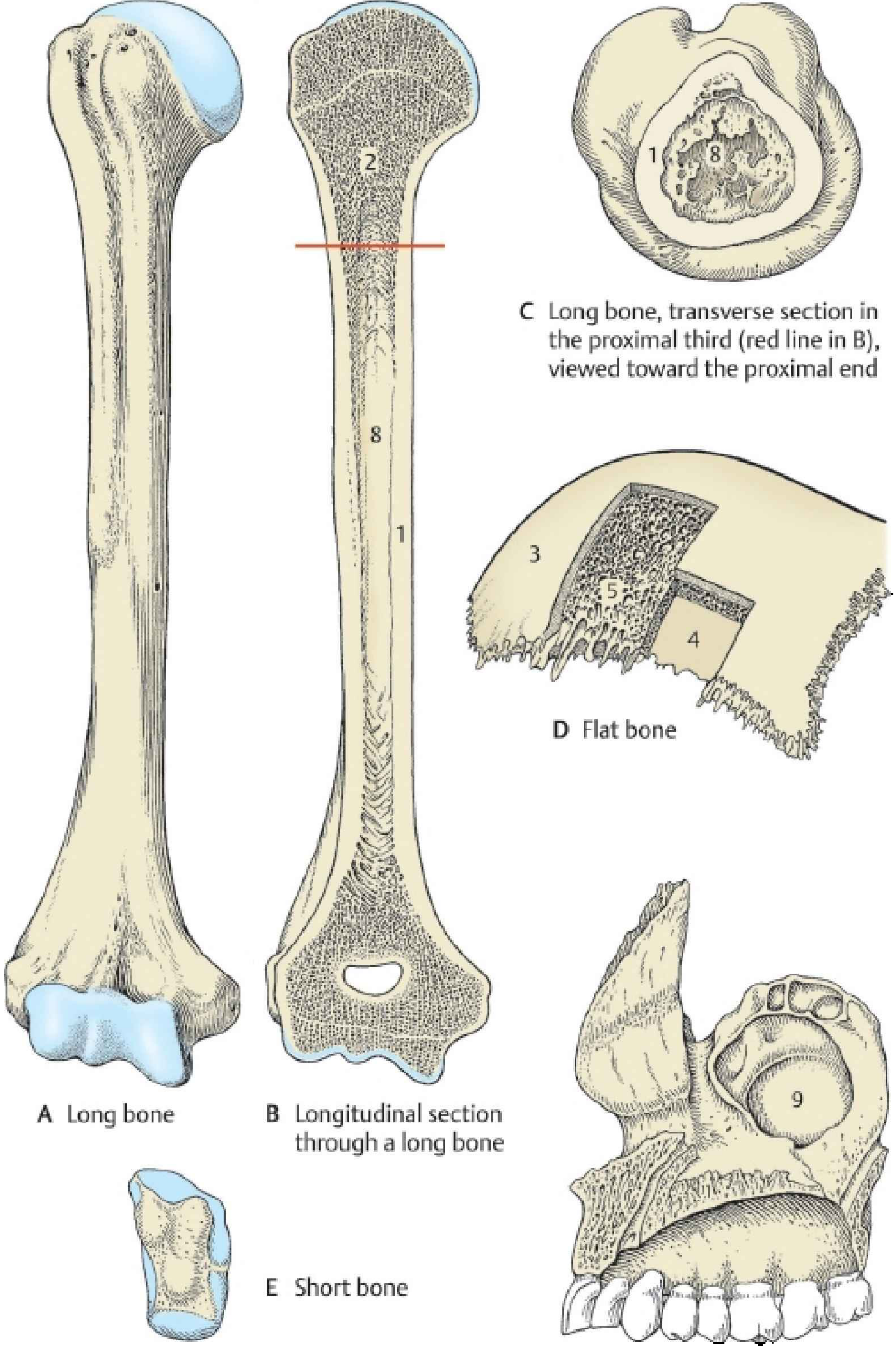
The image above (E) shows a short bone compared to long bone and flat bone types.
Examples
| Location | Bones |
|---|---|
| Wrist (carpus) | Scaphoid, lunate, triquetrum, pisiform, trapezium, trapezoid, capitate, hamate |
| Ankle (tarsus) | Calcaneus, talus, navicular, cuboid, cuneiforms |
Structure
- Outer layer: Compact (cortical) bone - dense, hard shell
- Interior: Spongy (trabecular/cancellous) bone - network of spicules enclosing red bone marrow
- No diaphysis (shaft) - unlike long bones
- Covered by periosteum except at articular surfaces, where hyaline cartilage is present
- Vascular supply: Nutrient arteries enter the bone and supply the marrow and inner compact bone; periosteal vessels supply the outer layers
Functions
Short bones are designed primarily for strength and support with limited movement. They:
- Transmit and distribute compressive forces (especially in the wrist and ankle)
- Allow gliding/sliding movements between adjacent bones
- Provide a stable base for weight-bearing and fine motor tasks
Classification in Context
Bones are classified by shape into five types:
| Type | Shape | Examples |
|---|---|---|
| Long | Tubular, length > width | Humerus, femur, tibia |
| Short | Cuboidal | Carpals, tarsals |
| Flat | Two compact plates + spongy bone between | Skull, scapula, sternum |
| Irregular | Various shapes | Vertebrae, facial bones |
| Sesamoid | Round/oval, in tendons | Patella, thumb sesamoids |
Sources: Gray's Anatomy for Students, p. 30; Color Atlas of Human Anatomy Vol. 1, p. 50
This is a shared conversation. Sign in to Orris to start your own chat.