
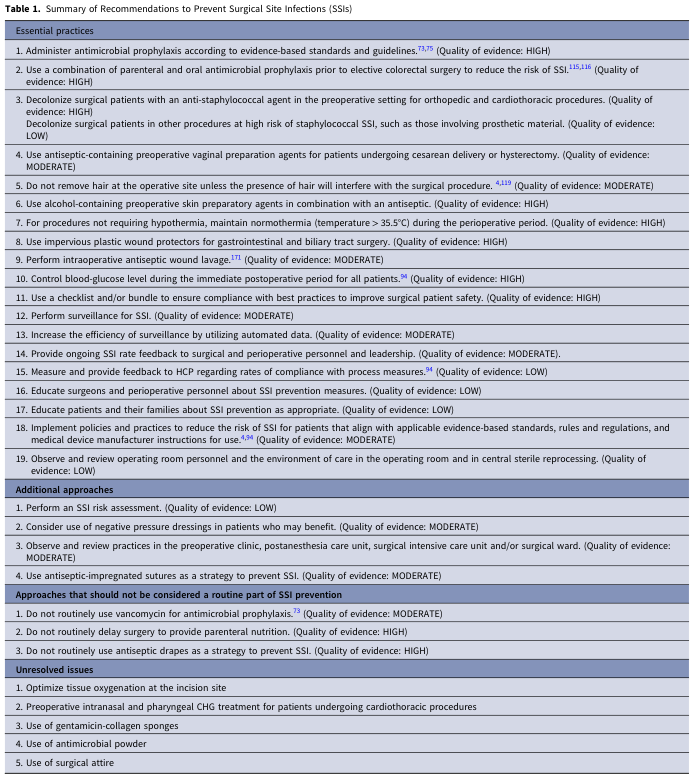
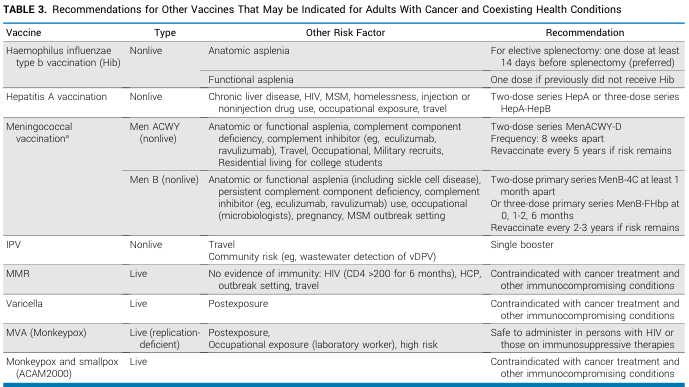
Create a minimum 50–60 slide postgraduate PowerPoint presentation for an MS General Surgery resident seminar titled: SURGICAL HAZARDS IN THE HOSPITAL Occupational Hazards, Human Factors, Patient Safety & Quality Improvement Use Bailey & Love’s Short Practice of Surgery, 27th Edition — especially Chapter 13 (Human Factors, Patient Safety and Quality Improvement) as the core reference, supplemented by Schwartz’s Principles of Surgery, Sabiston Textbook of Surgery, WHO, CDC, WHO Surgical Safety Checklist, and relevant Indian/national guidelines. Integrate the entire topic into one coherent surgical-safety framework, rather than treating the subjects as separate lectures. Cover in depth: 1. Introduction and classification of surgical/hospital hazards 2. Biological hazards: HIV/AIDS, Hepatitis B, Hepatitis C and Tuberculosis 3. Occupational exposure: needlestick injuries, blood/body-fluid exposure, airborne exposure, PPE and standard precautions 4. HIV: transmission, occupational risk, prevention, needlestick management and PEP 5. Hepatitis B: transmission, vaccination, immunity and post-exposure management 6. Tuberculosis: transmission, high-risk procedures, isolation, ventilation and respiratory protection 7. Radiation hazards: fluoroscopy/C-arm, biological effects, ALARA, time-distance-shielding, PPE, dosimetry and pregnancy 8. Psychological hazards: stress, fatigue, sleep deprivation, burnout, moral injury, bullying, violence and harassment 9. Human factors: cognitive errors, slips, lapses, mistakes, violations, fatigue, communication, teamwork and situational awareness 10. Swiss Cheese Model, active vs latent errors and systems approach 11. Patient safety: adverse events, near misses, never events, surgical errors and preventable harm 12. WHO Surgical Safety Checklist: Sign In, Time Out and Sign Out 13. Communication, teamwork, leadership and safety culture 14. Quality improvement: audit, quality indicators, PDSA cycle, root-cause analysis and continuous improvement 15. Integration: show how occupational hazards → human factors → errors → patient/staff harm → reporting → root-cause analysis → quality improvement → safer surgical systems. Include clinical cases, algorithms, comparison tables, flowcharts and diagrams, especially for needlestick exposure, TB precautions, radiation safety, Swiss cheese model, surgical safety checklist, PDSA and root-cause analysis. Make it academically rigorous, clinically relevant and suitable for MS General Surgery residents and faculty, with concise slide content and detailed speaker notes. Use evidence-based recommendations, cite important claims on slides, and provide a final reference section. Do not fabricate references, statistics or guidelines. The presentation should end with practical take-home messages for a surgical resident and the principle: “Safer surgeons + safer teams + safer systems = safer patients.” make sure the ppt is simple with appropriate images where needed
Surgical Hazards in the Hospital — Topic Map
- Introduction & Classification — types of hospital/surgical hazards (biological, chemical, physical/radiation, ergonomic, psychosocial)
- Biological Hazards Overview — HIV, HBV, HCV, TB as the major occupational infectious threats to surgeons
- Occupational Exposure Basics — needlestick injuries, blood/body fluid exposure, standard precautions, PPE
- HIV — transmission risk, occupational exposure, needlestick management, PEP protocols
- Hepatitis B — transmission, vaccination/immunity, post-exposure prophylaxis
- Hepatitis C — transmission, occupational risk, management (no PEP/vaccine, monitoring)
- Tuberculosis — transmission, high-risk surgical procedures, isolation, ventilation, N95/respirator use
- Radiation Hazards — C-arm/fluoroscopy, biological effects, ALARA, time-distance-shielding, dosimetry, pregnancy
- Psychological Hazards — burnout, fatigue, sleep deprivation, moral injury, bullying/harassment, violence
- Human Factors & Cognitive Errors — slips, lapses, mistakes, violations, situational awareness, teamwork/communication
- Swiss Cheese Model — active vs latent errors, systems approach to error causation
- Patient Safety Fundamentals — adverse events, near misses, never events, preventable surgical harm
- WHO Surgical Safety Checklist — Sign In, Time Out, Sign Out (detailed workflow)
- Safety Culture — communication, leadership, teamwork, psychological safety
- Quality Improvement Tools — clinical audit, quality indicators, PDSA cycle, Root Cause Analysis
- Integration Framework — the causal chain: hazards → human factors → errors → harm → reporting → RCA → QI → safer systems
- Take-home messages & closing principle
Which section should I build out first in full detail (slides + speaker notes + images)?
Surgical Hazards in the Hospital — Topic Map
- Introduction & Classification — types of hospital/surgical hazards (biological, chemical, physical/radiation, ergonomic, psychosocial)
- Biological Hazards Overview — HIV, HBV, HCV, TB as the major occupational infectious threats to surgeons
- Occupational Exposure Basics — needlestick injuries, blood/body fluid exposure, standard precautions, PPE
- HIV — transmission risk, occupational exposure, needlestick management, PEP protocols
- Hepatitis B — transmission, vaccination/immunity, post-exposure prophylaxis
- Hepatitis C — transmission, occupational risk, management (no PEP/vaccine, monitoring)
- Tuberculosis — transmission, high-risk surgical procedures, isolation, ventilation, N95/respirator use
- Radiation Hazards — C-arm/fluoroscopy, biological effects, ALARA, time-distance-shielding, dosimetry, pregnancy
- Psychological Hazards — burnout, fatigue, sleep deprivation, moral injury, bullying/harassment, violence
- Human Factors & Cognitive Errors — slips, lapses, mistakes, violations, situational awareness, teamwork/communication
- Swiss Cheese Model — active vs latent errors, systems approach to error causation
- Patient Safety Fundamentals — adverse events, near misses, never events, preventable surgical harm
- WHO Surgical Safety Checklist — Sign In, Time Out, Sign Out (detailed workflow)
- Safety Culture — communication, leadership, teamwork, psychological safety
- Quality Improvement Tools — clinical audit, quality indicators, PDSA cycle, Root Cause Analysis
- Integration Framework — the causal chain: hazards → human factors → errors → harm → reporting → RCA → QI → safer systems
- Take-home messages & closing principle
You are researching content for a postgraduate MS General Surgery seminar PowerPoint titled "SURGICAL HAZARDS IN THE HOSPITAL". You must produce structured, citation-backed slide content for the FIRST HALF of the deck (approx. 26-28 slides). Do NOT build any file - only research and return structured text content. CONTEXT/SOURCES: Primary reference is Bailey & Love's Short Practice of Surgery, 27th Edition, Chapter 13 "Human Factors, Patient Safety and Quality Improvement" plus other chapters on occupational/biological hazards if present. Supplement with Schwartz's Principles of Surgery, Sabiston Textbook of Surgery (all available via the query_library_db tool against the medical textbook library - use paragraphs_fts and headings_fts as documented). Also use pubmed_search (max 3 calls total) for evidence-based statistics (e.g. needlestick seroconversion rates, HCV occupational transmission risk) and web_search (max 1 call total) only if a critical WHO/CDC guideline figure is not in the library. Use search_image (max 5 calls total) to find real medical/diagram images for: needlestick injury/sharps injury, PPE donning sequence, HIV PEP algorithm, hepatitis B vaccination, TB isolation/N95 respirator fit test, C-arm/fluoroscopy radiation safety, lead apron/dosimeter. BE ECONOMICAL with tool calls - you have a strict shared budget, do not exceed the stated maximums. TOPICS TO COVER (produce content for each as one or more slides, ~26-28 slides total): 1. Title/intro framing slide content (1 slide) - hospital as hazardous workplace, overview of hazard classification 2. Classification of surgical/hospital hazards (biological, chemical, physical/radiation, ergonomic, psychosocial) - 1-2 slides, include a comparison table 3. Biological hazards overview: why surgeons are at occupational risk (blood/body fluid exposure) - 1 slide 4. Occupational exposure fundamentals: needlestick injuries epidemiology, blood/body fluid exposure, standard precautions, PPE - 2-3 slides including a needlestick-injury immediate-management flowchart/algorithm 5. HIV: transmission routes, occupational seroconversion risk per needlestick (~0.3%), risk factors for transmission, prevention, needlestick management protocol, PEP regimen and timing (within 72h, duration, drugs) - 3-4 slides including an algorithm/flowchart for PEP decision-making 6. Hepatitis B: transmission, occupational risk (much higher than HIV, ~6-30% for HBeAg+ source), vaccination schedule, checking immunity (anti-HBs titre), post-exposure management (HBIG + vaccine algorithm based on source/vaccination status) - 3 slides including a management table/algorithm 7. Hepatitis C: transmission, occupational risk (~1.8%), NO vaccine/PEP available, post-exposure monitoring (HCV RNA/antibody follow-up) and management of seroconversion - 2 slides 8. Tuberculosis: transmission (airborne droplet nuclei), high-risk surgical/procedural exposures (bronchoscopy, intubation, thoracic surgery, autopsy), isolation precautions, negative pressure ventilation/room air changes, N95 respirator fit-testing vs surgical mask, BCG and surveillance - 3 slides including a comparison table of isolation precaution types (standard/contact/droplet/airborne) 9. Radiation hazards: sources in surgery (C-arm/fluoroscopy), biological effects (deterministic vs stochastic), ALARA principle, time-distance-shielding practical measures, PPE (lead apron, thyroid shield, lead glasses), dosimetry (personal dosimeter badges, dose limits), pregnancy and radiation exposure precautions - 4 slides including a diagram/table of protective measures and dose limits For EACH slide, return in a clearly structured format: - Slide number/title - 4-6 concise bullet points suitable for a slide (not paragraphs) - Any table content (as markdown table) if applicable - Any algorithm/flowchart steps (as ordered steps, describing boxes and arrows/decision points) if applicable - 1-2 sentences of detailed speaker notes content (expand on the bullets, include citation) - A citation for the key claim (book title + page number if available from the library, or PMID from pubmed, or organization name+guideline for web sources) - DO NOT FABRICATE. If you cannot find a specific page number, cite just the book/chapter title or organization. - If you found a relevant real image via search_image, include its image_url and caption FINAL OUTPUT: Return one consolidated structured document with all ~26-28 slides in order, plus a small "References used" list (deduplicated) at the end with full citation format (Book Title, p. XXX / PMID / Organization guideline name). Do not fabricate any reference, statistic, or guideline - if uncertain about a specific number, say so explicitly rather than inventing one.
You are researching content for a postgraduate MS General Surgery seminar PowerPoint titled "SURGICAL HAZARDS IN THE HOSPITAL". You must produce structured, citation-backed slide content for the SECOND HALF of the deck (approx. 26-30 slides). Do NOT build any file - only research and return structured text content. CONTEXT/SOURCES: Primary reference is Bailey & Love's Short Practice of Surgery, 27th Edition, Chapter 13 "Human Factors, Patient Safety and Quality Improvement" - this is the core chapter for most of your topics. Query it via query_library_db (use headings_fts to find "Chapter 13" sections like human factors, patient safety, checklist, quality improvement, then paragraphs_fts / read_file to pull the actual paragraph text with page/line references). Supplement with Schwartz's Principles of Surgery and Sabiston Textbook of Surgery if relevant sections exist in the library. Use pubmed_search (max 2 calls total) only for supporting evidence on WHO Surgical Safety Checklist outcomes or burnout prevalence in surgeons. Use web_search (max 2 calls total) only for the official WHO Surgical Safety Checklist structure/citation and any Indian patient safety guideline (e.g., NABH) if not found in library. Use search_image (max 5 calls total) to find real images/diagrams for: Swiss cheese model of accident causation, WHO Surgical Safety Checklist form, PDSA cycle diagram, root cause analysis / fishbone diagram, surgical team briefing/debriefing, burnout in surgeons. BE ECONOMICAL - strict shared tool budget, do not exceed stated maximums. TOPICS TO COVER (produce content for each as one or more slides, ~26-30 slides total): 1. Psychological hazards: occupational stress in surgery, fatigue and sleep deprivation effects on performance, burnout (definition, Maslach dimensions), moral injury, bullying/harassment/violence in hospital workplace, prevention strategies - 3-4 slides 2. Human factors science: definition, cognitive errors classification (slips, lapses, mistakes, violations - Reason's model), fatigue and its effect on cognition, situational awareness, communication failures, teamwork - 3-4 slides with a comparison table of error types 3. Swiss Cheese Model of accident causation: explanation, active failures vs latent conditions/latent errors, systems approach vs person approach to error (James Reason) - 2-3 slides with a diagram description 4. Patient safety fundamentals: definitions of adverse event, near miss, never event, sentinel event, preventable harm, surgical never events (wrong site/wrong patient/retained instrument) with epidemiology if available - 2-3 slides including a comparison table of these terms 5. WHO Surgical Safety Checklist: background/why it was created, the three phases - Sign In, Time Out, Sign Out - with exact checklist items in each phase, evidence of impact on mortality/complications - 4-5 slides including a full checklist table/flowchart 6. Communication, teamwork, leadership and safety culture: SBAR, closed-loop communication, briefing/debriefing, psychological safety, just culture vs blame culture - 3 slides 7. Quality improvement: clinical audit cycle, quality indicators (structure/process/outcome - Donabedian), PDSA (Plan-Do-Study-Act) cycle with steps, Root Cause Analysis (RCA) methodology and tools (fishbone/Ishikawa, 5 Whys), continuous quality improvement culture - 4-5 slides including PDSA cycle diagram and RCA process flowchart 8. INTEGRATION SLIDE(S): explicitly show the causal chain framework: occupational hazards -> human factors/cognitive errors -> active+latent errors (Swiss cheese) -> patient/staff harm -> incident reporting -> root cause analysis -> quality improvement (PDSA) -> safer surgical systems. Present as one integrated flowchart/diagram description - 2 slides 9. Take-home messages for a surgical resident (practical, actionable, 6-8 bullet points) - 1 slide 10. Final closing slide built around the principle "Safer surgeons + safer teams + safer systems = safer patients" - 1 slide For EACH slide, return in a clearly structured format: - Slide number/title - 4-6 concise bullet points suitable for a slide (not paragraphs) - Any table content (as markdown table) if applicable - Any algorithm/flowchart steps (as ordered steps describing boxes/arrows/decision points) if applicable - 1-2 sentences of detailed speaker notes content (expand on bullets, include citation) - A citation for the key claim (Bailey & Love book title + page number if available, or PMID, or organization guideline name) - DO NOT FABRICATE. If uncertain about an exact number/page, state that explicitly instead of inventing one. - If you found a relevant real image via search_image, include its image_url and caption FINAL OUTPUT: Return one consolidated structured document with all slides in order, plus a small "References used" list (deduplicated) with full citation format at the end. Do not fabricate any reference, statistic, or guideline.
Surgical Hazards in the Hospital — Topic Map
- Introduction & Classification — types of hospital/surgical hazards (biological, chemical, physical/radiation, ergonomic, psychosocial)
- Biological Hazards Overview — HIV, HBV, HCV, TB as the major occupational infectious threats to surgeons
- Occupational Exposure Basics — needlestick injuries, blood/body fluid exposure, standard precautions, PPE
- HIV — transmission risk, occupational exposure, needlestick management, PEP protocols
- Hepatitis B — transmission, vaccination/immunity, post-exposure prophylaxis
- Hepatitis C — transmission, occupational risk, management (no PEP/vaccine, monitoring)
- Tuberculosis — transmission, high-risk surgical procedures, isolation, ventilation, N95/respirator use
- Radiation Hazards — C-arm/fluoroscopy, biological effects, ALARA, time-distance-shielding, dosimetry, pregnancy
- Psychological Hazards — burnout, fatigue, sleep deprivation, moral injury, bullying/harassment, violence
- Human Factors & Cognitive Errors — slips, lapses, mistakes, violations, situational awareness, teamwork/communication
- Swiss Cheese Model — active vs latent errors, systems approach to error causation
- Patient Safety Fundamentals — adverse events, near misses, never events, preventable surgical harm
- WHO Surgical Safety Checklist — Sign In, Time Out, Sign Out (detailed workflow)
- Safety Culture — communication, leadership, teamwork, psychological safety
- Quality Improvement Tools — clinical audit, quality indicators, PDSA cycle, Root Cause Analysis
- Integration Framework — the causal chain: hazards → human factors → errors → harm → reporting → RCA → QI → safer systems
- Take-home messages & closing principle
Which section(s) of the deck should I research in full depth first?
Which topic cluster should I research and build in full slide-ready detail first?
please continue
You are researching content for a postgraduate MS General Surgery seminar PowerPoint titled "SURGICAL HAZARDS IN THE HOSPITAL". You must produce structured, citation-backed slide content for the FIRST HALF of the deck (approx. 26-28 slides). Do NOT build any file - only research and return structured text content. CONTEXT/SOURCES: Primary reference is Bailey & Love's Short Practice of Surgery, 27th Edition, Chapter 13 "Human Factors, Patient Safety and Quality Improvement" plus other chapters on occupational/biological hazards if present. Supplement with Schwartz's Principles of Surgery, Sabiston Textbook of Surgery (all available via the query_library_db tool against the medical textbook library - use paragraphs_fts and headings_fts as documented). Also use pubmed_search (max 3 calls total) for evidence-based statistics (e.g. needlestick seroconversion rates, HCV occupational transmission risk) and web_search (max 1 call total) only if a critical WHO/CDC guideline figure is not in the library. Use search_image (max 5 calls total) to find real medical/diagram images for: needlestick injury/sharps injury, PPE donning sequence, HIV PEP algorithm, hepatitis B vaccination, TB isolation/N95 respirator fit test, C-arm/fluoroscopy radiation safety, lead apron/dosimeter. BE ECONOMICAL with tool calls - you have a strict shared budget, do not exceed the stated maximums. TOPICS TO COVER (produce content for each as one or more slides, ~26-28 slides total): 1. Title/intro framing slide content (1 slide) - hospital as hazardous workplace, overview of hazard classification 2. Classification of surgical/hospital hazards (biological, chemical, physical/radiation, ergonomic, psychosocial) - 1-2 slides, include a comparison table 3. Biological hazards overview: why surgeons are at occupational risk (blood/body fluid exposure) - 1 slide 4. Occupational exposure fundamentals: needlestick injuries epidemiology, blood/body fluid exposure, standard precautions, PPE - 2-3 slides including a needlestick-injury immediate-management flowchart/algorithm 5. HIV: transmission routes, occupational seroconversion risk per needlestick (~0.3%), risk factors for transmission, prevention, needlestick management protocol, PEP regimen and timing (within 72h, duration, drugs) - 3-4 slides including an algorithm/flowchart for PEP decision-making 6. Hepatitis B: transmission, occupational risk (much higher than HIV, ~6-30% for HBeAg+ source), vaccination schedule, checking immunity (anti-HBs titre), post-exposure management (HBIG + vaccine algorithm based on source/vaccination status) - 3 slides including a management table/algorithm 7. Hepatitis C: transmission, occupational risk (~1.8%), NO vaccine/PEP available, post-exposure monitoring (HCV RNA/antibody follow-up) and management of seroconversion - 2 slides 8. Tuberculosis: transmission (airborne droplet nuclei), high-risk surgical/procedural exposures (bronchoscopy, intubation, thoracic surgery, autopsy), isolation precautions, negative pressure ventilation/room air changes, N95 respirator fit-testing vs surgical mask, BCG and surveillance - 3 slides including a comparison table of isolation precaution types (standard/contact/droplet/airborne) 9. Radiation hazards: sources in surgery (C-arm/fluoroscopy), biological effects (deterministic vs stochastic), ALARA principle, time-distance-shielding practical measures, PPE (lead apron, thyroid shield, lead glasses), dosimetry (personal dosimeter badges, dose limits), pregnancy and radiation exposure precautions - 4 slides including a diagram/table of protective measures and dose limits For EACH slide, return in a clearly structured format: - Slide number/title - 4-6 concise bullet points suitable for a slide (not paragraphs) - Any table content (as markdown table) if applicable - Any algorithm/flowchart steps (as ordered steps, describing boxes and arrows/decision points) if applicable - 1-2 sentences of detailed speaker notes content (expand on the bullets, include citation) - A citation for the key claim (book title + page number if available from the library, or PMID from pubmed, or organization name+guideline for web sources) - DO NOT FABRICATE. If you cannot find a specific page number, cite just the book/chapter title or organization. - If you found a relevant real image via search_image, include its image_url and caption FINAL OUTPUT: Return one consolidated structured document with all ~26-28 slides in order, plus a small "References used" list (deduplicated) at the end with full citation format (Book Title, p. XXX / PMID / Organization guideline name). Do not fabricate any reference, statistic, or guideline - if uncertain about a specific number, say so explicitly rather than inventing one.
You are researching content for a postgraduate MS General Surgery seminar PowerPoint titled "SURGICAL HAZARDS IN THE HOSPITAL". You must produce structured, citation-backed slide content for the SECOND HALF of the deck (approx. 26-30 slides). Do NOT build any file - only research and return structured text content. CONTEXT/SOURCES: Primary reference is Bailey & Love's Short Practice of Surgery, 27th Edition, Chapter 13 "Human Factors, Patient Safety and Quality Improvement" - this is the core chapter for most of your topics. Query it via query_library_db (use headings_fts to find "Chapter 13" sections like human factors, patient safety, checklist, quality improvement, then paragraphs_fts / read_file to pull the actual paragraph text with page/line references). Supplement with Schwartz's Principles of Surgery and Sabiston Textbook of Surgery if relevant sections exist in the library. Use pubmed_search (max 2 calls total) only for supporting evidence on WHO Surgical Safety Checklist outcomes or burnout prevalence in surgeons. Use web_search (max 2 calls total) only for the official WHO Surgical Safety Checklist structure/citation and any Indian patient safety guideline (e.g., NABH) if not found in library. Use search_image (max 5 calls total) to find real images/diagrams for: Swiss cheese model of accident causation, WHO Surgical Safety Checklist form, PDSA cycle diagram, root cause analysis / fishbone diagram, surgical team briefing/debriefing, burnout in surgeons. BE ECONOMICAL - strict shared tool budget, do not exceed stated maximums. TOPICS TO COVER (produce content for each as one or more slides, ~26-30 slides total): 1. Psychological hazards: occupational stress in surgery, fatigue and sleep deprivation effects on performance, burnout (definition, Maslach dimensions), moral injury, bullying/harassment/violence in hospital workplace, prevention strategies - 3-4 slides 2. Human factors science: definition, cognitive errors classification (slips, lapses, mistakes, violations - Reason's model), fatigue and its effect on cognition, situational awareness, communication failures, teamwork - 3-4 slides with a comparison table of error types 3. Swiss Cheese Model of accident causation: explanation, active failures vs latent conditions/latent errors, systems approach vs person approach to error (James Reason) - 2-3 slides with a diagram description 4. Patient safety fundamentals: definitions of adverse event, near miss, never event, sentinel event, preventable harm, surgical never events (wrong site/wrong patient/retained instrument) with epidemiology if available - 2-3 slides including a comparison table of these terms 5. WHO Surgical Safety Checklist: background/why it was created, the three phases - Sign In, Time Out, Sign Out - with exact checklist items in each phase, evidence of impact on mortality/complications - 4-5 slides including a full checklist table/flowchart 6. Communication, teamwork, leadership and safety culture: SBAR, closed-loop communication, briefing/debriefing, psychological safety, just culture vs blame culture - 3 slides 7. Quality improvement: clinical audit cycle, quality indicators (structure/process/outcome - Donabedian), PDSA (Plan-Do-Study-Act) cycle with steps, Root Cause Analysis (RCA) methodology and tools (fishbone/Ishikawa, 5 Whys), continuous quality improvement culture - 4-5 slides including PDSA cycle diagram and RCA process flowchart 8. INTEGRATION SLIDE(S): explicitly show the causal chain framework: occupational hazards -> human factors/cognitive errors -> active+latent errors (Swiss cheese) -> patient/staff harm -> incident reporting -> root cause analysis -> quality improvement (PDSA) -> safer surgical systems. Present as one integrated flowchart/diagram description - 2 slides 9. Take-home messages for a surgical resident (practical, actionable, 6-8 bullet points) - 1 slide 10. Final closing slide built around the principle "Safer surgeons + safer teams + safer systems = safer patients" - 1 slide For EACH slide, return in a clearly structured format: - Slide number/title - 4-6 concise bullet points suitable for a slide (not paragraphs) - Any table content (as markdown table) if applicable - Any algorithm/flowchart steps (as ordered steps describing boxes/arrows/decision points) if applicable - 1-2 sentences of detailed speaker notes content (expand on bullets, include citation) - A citation for the key claim (Bailey & Love book title + page number if available, or PMID, or organization guideline name) - DO NOT FABRICATE. If uncertain about an exact number/page, state that explicitly instead of inventing one. - If you found a relevant real image via search_image, include its image_url and caption FINAL OUTPUT: Return one consolidated structured document with all slides in order, plus a small "References used" list (deduplicated) with full citation format at the end. Do not fabricate any reference, statistic, or guideline.
Surgical Hazards in the Hospital — Topic Map
- Introduction & Classification — types of hospital/surgical hazards (biological, chemical, physical/radiation, ergonomic, psychosocial)
- Biological Hazards Overview — HIV, HBV, HCV, TB as the major occupational infectious threats to surgeons
- Occupational Exposure Basics — needlestick injuries, blood/body fluid exposure, standard precautions, PPE
- HIV — transmission risk, occupational exposure, needlestick management, PEP protocols
- Hepatitis B — transmission, vaccination/immunity, post-exposure prophylaxis
- Hepatitis C — transmission, occupational risk, management (no PEP/vaccine, monitoring)
- Tuberculosis — transmission, high-risk surgical procedures, isolation, ventilation, N95/respirator use
- Radiation Hazards — C-arm/fluoroscopy, biological effects, ALARA, time-distance-shielding, dosimetry, pregnancy
- Psychological Hazards — burnout, fatigue, sleep deprivation, moral injury, bullying/harassment, violence
- Human Factors & Cognitive Errors — slips, lapses, mistakes, violations, situational awareness, teamwork/communication
- Swiss Cheese Model — active vs latent errors, systems approach to error causation
- Patient Safety Fundamentals — adverse events, near misses, never events, preventable surgical harm
- WHO Surgical Safety Checklist — Sign In, Time Out, Sign Out (detailed workflow)
- Safety Culture — communication, leadership, teamwork, psychological safety
- Quality Improvement Tools — clinical audit, quality indicators, PDSA cycle, Root Cause Analysis
- Integration Framework — the causal chain: hazards → human factors → errors → harm → reporting → RCA → QI → safer systems
- Take-home messages & closing principle
Which topic(s) should I research and build detailed, citation-backed slide content for first?
Which topic cluster should I research and draft in full slide detail first?
Swiss cheese model of accident causation
WHO surgical safety checklist
PDSA plan do study act cycle diagram
root cause analysis fishbone Ishikawa diagram
needlestick injury sharps injury healthcare worker
C-arm fluoroscopy radiation safety lead apron surgeon operating room
N95 respirator fit test tuberculosis isolation
hepatitis B vaccine injection
operating room surgical team briefing timeout
personal protective equipment doffing donning healthcare
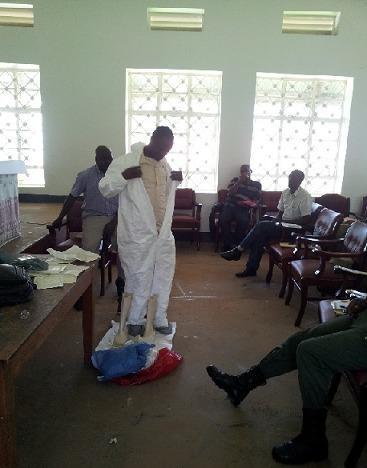
This clinical training photograph depicts a healthcare worker demonstrating the donning or doffing procedure of Personal Protective Equipment (PPE) during an Ebola Virus Disease (EVD) preparedness workshop. The central figure is shown wearing a white, full-body fluid-resistant coverall (Tyvek suit) with a front zipper closure. The participant is positioned on a designated 'clean' mat or bag to prevent environmental contamination, with tall rubber boots placed nearby for the next step of the protocol. The training takes place in an indoor classroom setting where other health professionals or immigration staff are seated in the background, observing and taking notes. A side table holds additional training materials and binders. This visual illustrates standard infection prevention and control (IPC) measures, specifically barrier nursing techniques and PPE protocols essential for managing viral hemorrhagic fevers (VHFs) in high-risk border regions.
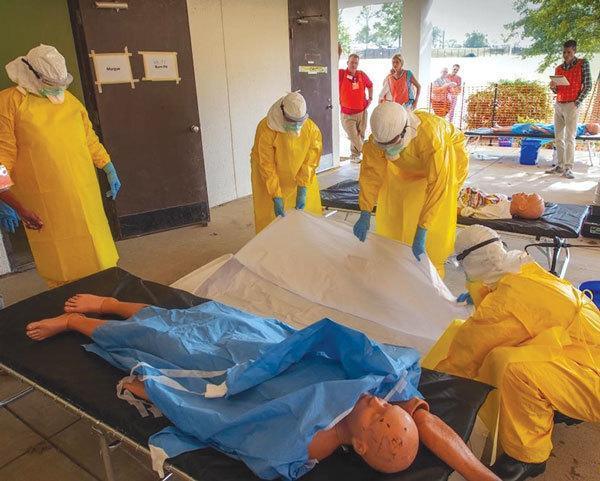
A clinical photograph of a medical training exercise at a mock Ebola Treatment Unit (ETU). The image shows healthcare trainees wearing full Personal Protective Equipment (PPE) ensembles designed for high-consequence viral hemorrhagic fevers. The PPE consists of yellow fluid-resistant coveralls, white integrated hoods, eye protection (goggles or face shields), N95 respirators, blue nitrile gloves, and black rubber gum boots. The trainees are practicing post-mortem care and infection prevention and control (IPC) protocols by preparing a simulated deceased patient (a medical mannequin) for placement into a white body bag. The mannequin is partially covered by a blue surgical sheet, with visible markings on the face representing clinical signs of disease. The background shows a controlled environment with clearly marked entry/exit points, illustrating the unidirectional flow and triage protocols used in field hospitals. This visual serves as an educational resource for biohazard safety training, donning and doffing procedures, and managing infectious disease outbreaks in resource-limited settings.
WHO Surgical Safety Checklist Sign In Time Out Sign Out items official
CDC needlestick injury HIV post-exposure prophylaxis guidelines occupational
"needlestick injuries" AND "HIV" occupational transmission risk
"surgical safety checklist" AND mortality
"surgeon burnout" prevalence
Swiss cheese model of accident causation diagram showing multiple slices of cheese with holes representing latent conditions and active failures, with an arrow (hazard trajectory) passing through aligned holes to reach patient harm, labeled slices for defenses, barriers and safeguards
Root cause analysis fishbone Ishikawa diagram for a surgical adverse event, with main spine leading to the problem and branch categories labeled People, Process, Equipment, Environment, Communication
Flowchart diagram of the WHO Surgical Safety Checklist showing three sequential phases in the operating room: Sign In before induction of anesthesia, Time Out before skin incision, and Sign Out before patient leaves operating room, each phase in its own box with an arrow to the next
Clinical algorithm flowchart for immediate management of a needlestick injury in a healthcare worker: wash the wound, report the injury, risk assessment of source patient, testing, and decision box for starting post-exposure prophylaxis
Integrated surgical safety framework flowchart with sequential connected boxes: Occupational and Hospital Hazards, Human Factors and Cognitive Errors, Active and Latent Errors Swiss Cheese Model, Patient and Staff Harm, Incident Reporting, Root Cause Analysis, Quality Improvement PDSA Cycle, Safer Surgical Systems
Radiation safety diagram in an operating room illustrating the three protective principles time, distance and shielding around a C-arm fluoroscopy unit, with a surgeon wearing a lead apron and thyroid shield standing at a safe distance
mkdir -p /tmp/workspace/surgical-hazards-ppt/{src,assets,output} && ls -la /tmp/workspace/
Generate the complete 50-60 slide PowerPoint presentation now
Purchase credits to generate the complete 50-60 slide PowerPoint presentation
please continue
~/surgical-hazards-ppt
~/surgical-hazards-ppt/src/content.py
# -*- coding: utf-8 -*-
# Slide content data for "SURGICAL HAZARDS IN THE HOSPITAL" seminar deck

IMG = {
    "who_checklist": "https://cdn.orris.care/cdss_images/8f6b60b634bb3c773727cf10bdd5d5b572eee049872334c206e88368ec774159.png",
    "pdsa_real": "https://cdn.orris.care/cdss_images/95af268f8a7730c7f7486de5c6721c0d443bd8d8849fee9ce8eefc91791d08d1.png",
    "fluoro_setup": "https://cdn.orris.care/cdss_images/37ea7094efaa3676f93ee70cf79486f512f78d85dbcca95d6b811ee387e5e60c.png",
    "ppe_don1": "https://cdn.orris.care/cdss_images/pmc_clinical_VQA_59ed0283d139f90d5a839d012b57669d01bdf8065d3b9e059c4042a14d8a721e.jpg",
    "ppe_don2": "https://cdn.orris.care/cdss_images/pmc_clinical_VQA_05b3395cf5718e5c8b82367276e0172cdac0e22d92a7c1457dab1d5bf499990f.jpg",
    "swiss_cheese": "https://cdn.orris.care/image-gen/f68c9a8ec0c842bb84349f481c05a7cc.png",
    "fishbone": "https://cdn.orris.care/image-gen/8203196a814f4bf09171c0f0fb97a13f.png",
    "checklist_flow": "https://cdn.orris.care/image-gen/8a5cf73dee8f49e6b0f1d24bda0284c5.png",
    "needlestick_algo": "https://cdn.orris.care/image-gen/855e8848960842589be2f76df9b606af.png",
    "integration": "https://cdn.orris.care/image-gen/dce99cc19cda44e9959b1faf7123fa4e.png",
    "radiation": "https://cdn.orris.care/image-gen/fbc3eaa331ec4f628874edbe483717f7.png",
}

REF_BL = "Bailey & Love's Short Practice of Surgery, Ch. 13 - Human Factors, Patient Safety and Quality Improvement"
REF_SCHWARTZ = "Schwartz's Principles of Surgery, 11e, Ch. 12 - Patient Safety"
REF_SABISTON = "Sabiston Textbook of Surgery, Ch. 9 - Patient Safety"
REF_WHO = "WHO Surgical Safety Checklist, 2009"
REF_CDC_HIV = "CDC/US Public Health Service 2025 Guidelines - Occupational HIV PEP"
REF_HARRISON = "Harrison's Principles of Internal Medicine, 22e - Tuberculosis / Transmission-Based Precautions"
REF_YAMADA = "Yamada's Textbook of Gastroenterology, 7e - Hepatitis B and C and Needlestick Injury"
REF_REDBOOK = "AAP Red Book 2021 - Hepatitis B Virus"
REF_MILLER = "Miller's Anesthesia, 10e - Needlestick and Sharps Safety / PDSA Cycle"
REF_CAMPBELL = "Campbell-Walsh-Wein Urology - Radiation Protection"
REF_GOLDMAN = "Goldman-Cecil Medicine - The Modern Approach to Patient Safety"

SLIDES = []

def S(**kw):
    SLIDES.append(kw)

# ---------------- SECTION 0: TITLE & ROADMAP ----------------
S(type="title",
  title="SURGICAL HAZARDS IN THE HOSPITAL",
  subtitle="Occupational Hazards, Human Factors, Patient Safety & Quality Improvement",
  footer="MS General Surgery Resident Seminar",
  notes="Welcome slide. Frame the seminar: the hospital, and the operating room in particular, is one of the most hazard-dense workplaces a surgeon will ever work in. This talk integrates occupational hazards, human factors, patient safety and quality improvement into ONE coherent surgical-safety framework, built primarily on Bailey & Love's Short Practice of Surgery Chapter 13, supplemented by Schwartz, Sabiston, WHO and CDC guidance.")

S(type="content", title="Roadmap of the Seminar",
  bullets=[
      "1. Introduction & classification of hospital/surgical hazards",
      "2-6. Biological hazards: occupational exposure, HIV, HBV, HCV, Tuberculosis",
      "7. Radiation hazards (C-arm/fluoroscopy) and ALARA",
      "8. Psychological hazards: stress, fatigue, burnout, bullying, violence",
      "9-11. Human factors, cognitive errors, Swiss Cheese Model",
      "12-14. Patient safety, WHO Surgical Safety Checklist, safety culture",
      "15. Quality improvement: audit, PDSA, root cause analysis",
      "16. Integration framework and take-home messages",
  ],
  notes="This seminar is not fifteen separate lectures. Every hazard discussed in the first half becomes the 'input' that human factors and systems science (second half) is designed to manage. Keep this causal chain in mind throughout.",
  citation=REF_BL)

# ---------------- SECTION 1: INTRODUCTION & CLASSIFICATION ----------------
S(type="content", title="The Hospital as a Hazardous Workplace",
  bullets=[
      "Surgeons and OT staff face daily exposure to sharp instruments, blood/body fluids, ionising radiation, toxic anaesthetic gases, and infectious aerosols",
      "Hazards are not only physical - psychological stress, fatigue and disrupted sleep are occupational realities of surgical training",
      "Every hazard is also a set-up for human error: a fatigued, stressed operator handling a sharp instrument under time pressure is a classic 'accident waiting to happen'",
      "Patient safety and staff safety are two sides of the same systems problem - they must be taught together, not separately",
  ],
  notes="Set the tone: this is a systems-level topic. Bailey & Love Chapter 13 explicitly links human factors to patient safety and QI as one discipline; we are extending that same lens upstream to occupational hazards.",
  citation=REF_BL)

S(type="table", title="Classification of Surgical/Hospital Hazards",
  table={"headers": ["Category", "Examples", "Primary Consequence"],
         "rows": [
             ["Biological", "HIV, HBV, HCV, TB, MRSA, surgical smoke", "Occupational infection"],
             ["Chemical", "Anaesthetic gases, formaldehyde, glutaraldehyde, cytotoxic drugs", "Toxicity, mucosal irritation, teratogenicity"],
             ["Physical/Radiation", "C-arm/fluoroscopy, lasers, diathermy, noise", "Radiation injury, burns, hearing loss"],
             ["Ergonomic", "Prolonged standing, awkward posture, repetitive strain", "Musculoskeletal injury"],
             ["Psychosocial", "Long duty hours, sleep deprivation, bullying, moral injury", "Burnout, errors, mental illness"],
         ]},
  notes="This classification is adapted from standard occupational health teaching and mirrors the structure Bailey & Love and WHO use when discussing the working environment of the surgeon. Every category eventually funnels into the same final pathway: human performance and patient outcome.",
  citation="Occupational health classification; WHO")

S(type="content", title="Why This Matters: A Resident's Case",
  bullets=[
      "A postgraduate resident, 14 hours into an on-call shift, sustains a needlestick while closing an emergency laparotomy on a patient of unknown HIV/HBV/HCV status",
      "Immediate questions: wound care? Reporting? Source testing? PEP? Who decides, and how fast?",
      "This single event touches occupational health, human factors (fatigue, rushed closure), and hospital systems (reporting pathway, PEP availability)",
      "We will return to this case as we build the full integrated safety framework",
  ],
  notes="Use this vignette as a running thread through the talk. It is a realistic, common scenario for MS General Surgery residents and immediately motivates why occupational hazards cannot be taught in isolation from human factors and systems.",
  citation="Illustrative teaching case")

# ---------------- SECTION 2: OCCUPATIONAL EXPOSURE FUNDAMENTALS ----------------
S(type="content", title="Occupational Exposure: Scale of the Problem",
  bullets=[
      "CDC (2000) estimated health care workers sustain more than 600,000 needlestick and other percutaneous injuries annually in the USA",
      "Risk correlates with specialty and experience: anaesthesia residents had 19 needlestick events per 100 residents/year vs 6.9/100 for all anaesthesia providers",
      "Surgical trainees and residents are consistently over-represented in sharps-injury surveillance data because of high case volume and long duty hours",
      "Safety-engineered sharps devices reduced needlestick injury rates by more than 50% in some studies after the US Needlestick Safety and Prevention Act (2000)",
  ],
  notes="These are real US surveillance figures cited in Miller's Anesthesia (10th edition), Needlestick and Sharps Safety section. Use them to anchor the scale of the problem before moving to specific pathogens.",
  citation=REF_MILLER)

S(type="image", title="Standard Precautions & Personal Protective Equipment",
  image=IMG["ppe_don1"],
  image_caption="Correct PPE donning sequence reduces self-contamination risk (training photograph, IPC workshop)",
  bullets=[
      "Standard precautions apply to ALL patients regardless of known infectious status: hand hygiene, safe injection practice, PPE by anticipated exposure, respiratory etiquette",
      "PPE hierarchy in the OT: gloves (double-gloving for high-risk cases) -> gown -> eye/face protection -> mask/respirator as indicated",
      "Engineering controls (safety-engineered sharps, sharps bins, neutral zones for passing instruments) are more reliable than behaviour change alone",
      "Never recap needles by hand; never pass sharps hand-to-hand - use a tray/neutral zone",
  ],
  notes="Standard precautions are the foundation of every hazard discussed subsequently (HIV, HBV, HCV, TB). Emphasize the hierarchy of controls concept: elimination/engineering controls are more effective and reliable than relying on individual behaviour or PPE alone.",
  citation=REF_MILLER)

S(type="image", title="Immediate Management of a Needlestick/Sharps Injury",
  image=IMG["needlestick_algo"],
  image_caption="Immediate management algorithm for a percutaneous sharps injury",
  bullets=[
      "STEP 1: Wash the wound immediately with soap and running water for at least 15 minutes; do not squeeze/'milk' the wound",
      "STEP 2: For mucosal/eye exposure - irrigate copiously with water or saline",
      "STEP 3: Report immediately to the designated occupational health/emergency contact - do not delay",
      "STEP 4: Risk-assess the source patient (known HIV/HBV/HCV status, or urgent counselled testing) and the exposed worker's own immunisation status",
      "STEP 5: Decide on PEP eligibility within the golden window (HIV PEP ideally within 2 hours, and no later than 72 hours)",
  ],
  notes="This is the single most examination-relevant algorithm in occupational safety for a surgery resident. Walk through each step with the class using the opening case (14-hour on-call resident). Reporting delay is the single most common preventable failure in real hospital audits.",
  citation=REF_YAMADA)

# ---------------- SECTION 2b: BIOLOGICAL HAZARDS OVERVIEW ----------------
S(type="table", title="Biological Hazards Overview: HIV vs HBV vs HCV vs TB",
  table={"headers": ["Feature", "HIV", "HBV", "HCV", "TB"],
         "rows": [
             ["Route", "Percutaneous/mucosal blood", "Percutaneous/mucosal blood", "Percutaneous/mucosal blood", "Airborne droplet nuclei"],
             ["Seroconversion per exposure", "~0.3% (percutaneous)", "22-31% if source HBeAg+; 1-6% if HBeAg-", "Avg 1.8% (range 0-7%)", "Variable; depends on exposure duration/procedure"],
             ["Vaccine available", "No", "Yes (highly effective)", "No", "BCG (limited adult protection)"],
             ["PEP available", "Yes (ART regimen)", "Yes (HBIG + vaccine)", "No specific PEP", "No true PEP; latent TB treatment if indicated"],
         ]},
  notes="This single comparison table is the organizing anchor for the next four sections. HBV is the most transmissible of the bloodborne pathogens by needlestick, yet is the only one that is essentially preventable by vaccination - this is a key teaching point for residents.",
  citation=REF_YAMADA)

# ---------------- SECTION 3: HIV ----------------
S(type="content", title="HIV: Transmission and Occupational Risk",
  bullets=[
      "HIV constitutes the pathogen residents fear most, but has the LOWEST occupational transmission risk of the bloodborne viruses after needlestick",
      "Average risk of seroconversion after a single percutaneous exposure to HIV-infected blood is approximately 0.3%",
      "Mucous membrane exposure carries a lower risk (~0.09%); intact skin exposure carries negligible risk",
      "Risk is higher with: deep injury, visible blood on device, hollow-bore needle previously in source's artery/vein, terminal HIV illness with high viral load",
  ],
  notes="Emphasize the paradox: HIV is feared most but is biologically the least efficiently transmitted bloodborne virus via needlestick, in contrast to HBV. This recalibrates residents' risk perception appropriately.",
  citation=REF_YAMADA)

S(type="content", title="HIV Post-Exposure Prophylaxis (PEP)",
  bullets=[
      "PEP significantly reduces risk of occupational HIV acquisition; landmark case-control data showed zidovudine PEP reduced seroconversion risk by 81% when started within 4 hours",
      "Start PEP as soon as possible - efficacy is highest within the first 2 hours and diminishes with delay; generally not recommended beyond 72 hours",
      "2025 US Public Health Service guidelines recommend a preferred antiretroviral regimen continued for 28 days, with streamlined follow-up testing",
      "PEP decision should never wait for source patient results if the source is high-risk/unknown and unavailable for urgent testing - start empirically and reassess",
  ],
  notes="The 2025 USPHS/CDC update reaffirms prompt evaluation and PEP initiation while streamlining follow-up testing burden. Point out that this is one of the few true medical emergencies for a surgical resident personally, not just for the patient.",
  citation=REF_CDC_HIV)

S(type="content", title="Case Application: PEP Decision for Our Resident",
  bullets=[
      "Our resident's needlestick occurred with a hollow-bore suture needle after use on a patient of unknown status - this is an at-risk percutaneous exposure by definition",
      "Immediate wound care performed; occupational health contacted within 30 minutes",
      "Source patient's blood sent urgently for HIV/HBsAg/anti-HCV with consent and counselling",
      "PEP started empirically pending results, given hollow-bore device and visible blood - this is the correct, guideline-concordant decision",
  ],
  notes="Reinforce that empirical PEP is started while awaiting the source result if there is any substantial doubt, and can be stopped if the source tests negative. This decisiveness under uncertainty is itself a human-factors competency.",
  citation=REF_CDC_HIV)

# ---------------- SECTION 4: HEPATITIS B ----------------
S(type="content", title="Hepatitis B: Transmission and Occupational Risk",
  bullets=[
      "HBV is transmitted far more efficiently by needlestick than HIV: risk of clinical hepatitis is 22-31% if source is HBsAg and HBeAg positive",
      "Even with an HBeAg-negative source, risk of clinical hepatitis is 1-6%, with serological evidence of infection in 23-37%",
      "Percutaneous exposure is an efficient transmission route, but accounts for a shrinking share of nosocomial HBV infections because of widespread HCW vaccination",
      "HBV can survive on environmental surfaces for days, unlike HIV, adding an environmental/contact exposure dimension",
  ],
  notes="This is the key contrast slide with HIV: HBV is a much higher per-exposure risk, which is precisely why HBV vaccination of all health care workers - including every surgical resident before they start operating - is non-negotiable.",
  citation=REF_YAMADA)

S(type="content", title="Hepatitis B Vaccination and Immunity",
  bullets=[
      "Standard 3-dose schedule (0, 1, 6 months); all surgical residents should be vaccinated before starting clinical duties",
      "Check anti-HBs titre 1-2 months after the final dose: titre >= 10 mIU/mL confirms protective immunity",
      "Non-responders (about 5-10% of healthy adults) should receive a repeat series; persistent non-responders need case-by-case exposure management",
      "A documented, adequate anti-HBs response confers long-term protection - booster doses are not routinely required for most immunocompetent responders",
  ],
  notes="Every resident should know their own vaccination and immune status BEFORE they need it in an emergency. This is an institutional occupational-health responsibility as much as an individual one.",
  citation=REF_REDBOOK)

S(type="table", title="Post-Exposure Management of Hepatitis B",
  table={"headers": ["Exposed Worker Status", "Source HBsAg Positive", "Source Unknown/Unavailable"],
         "rows": [
             ["Unvaccinated", "HBIG + start vaccine series", "Start vaccine series (+/- HBIG if high-risk source)"],
             ["Vaccinated, known responder (anti-HBs >=10)", "No treatment needed", "No treatment needed"],
             ["Vaccinated, known non-responder", "HBIG x1 and revaccinate, or HBIG x2", "If source high-risk, treat as HBsAg positive"],
             ["Vaccinated, antibody response unknown", "Test anti-HBs urgently; treat per result", "Test anti-HBs urgently; treat per result"],
         ]},
  notes="This management table mirrors the standard post-exposure prophylaxis tables in Sleisenger & Fordtran and the Red Book. The critical action point for a resident is knowing their OWN antibody status in advance so this table can be applied within hours, not days.",
  citation=REF_REDBOOK)

# ---------------- SECTION 5: HEPATITIS C ----------------
S(type="content", title="Hepatitis C: Transmission and Occupational Risk",
  bullets=[
      "HCV is NOT transmitted efficiently by needlestick compared with HBV: average seroconversion risk is 1.8% per injury (range 0-7%)",
      "Risk factors for transmission: deep injury, hollow-bore needle, visible blood on the device",
      "About 1% of all new HCV infections are attributable to occupational needlestick injury",
      "No vaccine exists for HCV, and no proven post-exposure prophylaxis regimen is currently recommended",
  ],
  notes="Contrast with HBV and HIV: HCV sits between the two in transmissibility but is the only one with neither a vaccine nor a PEP option, which shifts the entire strategy toward monitoring and early treatment if seroconversion occurs.",
  citation=REF_YAMADA)

S(type="content", title="Hepatitis C: Post-Exposure Monitoring and Management",
  bullets=[
      "Baseline anti-HCV and liver enzymes (ALT) at time of exposure for both source and exposed worker",
      "Follow-up anti-HCV and/or HCV RNA testing at 3 and 6 months (HCV RNA can detect early infection before antibody seroconversion)",
      "If acute HCV infection is confirmed, early direct-acting antiviral (DAA) therapy achieves very high cure rates and should not be delayed",
      "Exposure prevention (safe sharps practice, avoiding recapping) remains the only truly effective 'prophylaxis' for HCV",
  ],
  notes="Because there is no vaccine or PEP, the entire HCV strategy is prevention-first and early-detection-second. Modern DAA regimens have transformed outcomes even after occupational seroconversion - this is worth reassuring residents about.",
  citation=REF_YAMADA)

# ---------------- SECTION 6: TUBERCULOSIS ----------------
S(type="content", title="Tuberculosis: Transmission and High-Risk Surgical Exposures",
  bullets=[
      "TB spreads via airborne droplet nuclei (1-5 micron particles) that remain suspended in air and can travel and be inhaled at a distance",
      "High-risk procedures for surgical/anaesthesia staff: intubation and airway manipulation, bronchoscopy, thoracic surgery, open lung biopsy, autopsy/post-mortem work",
      "Elective surgery on a patient with active pulmonary TB should be postponed where possible; if unavoidable, perform in a room with an anteroom/negative pressure setup",
      "Because standard operating rooms are kept at POSITIVE pressure (to protect the sterile field), they are not designed for airborne isolation - this is a genuine engineering conflict",
  ],
  notes="Point out explicitly the tension between OT positive-pressure design (protects sterile field) and airborne isolation needs (requires negative pressure) - this is a real patient-safety engineering dilemma discussed in Miller's Anesthesia.",
  citation=REF_MILLER)

S(type="table", title="Transmission-Based Isolation Precautions",
  table={"headers": ["Precaution Type", "Organisms (examples)", "Key Protective Measures"],
         "rows": [
             ["Standard", "All patients, always", "Hand hygiene, safe injection, PPE per exposure risk"],
             ["Contact", "C. difficile, MRSA, VRE", "Gown + gloves; dedicated/cleaned equipment"],
             ["Droplet", "Influenza, mumps, pertussis", "Gown, gloves, eye protection, surgical mask"],
             ["Airborne", "TB, measles, varicella, COVID-19", "N95/respirator, negative-pressure isolation room, 12 air changes/hour"],
         ]},
  notes="This table is adapted from Harrison's Principles of Internal Medicine (22nd edition) Transmission-Based Precautions section, itself based on WHO/CDC categorisation. Airborne precautions are the most resource-intensive and least intuitive for surgical staff used to a 'clean OT' mindset.",
  citation=REF_HARRISON)

S(type="content", title="Ventilation, N95 Respirators and TB Surveillance",
  bullets=[
      "Airborne infection isolation rooms require negative pressure with at least 12 air changes/hour, exhausted directly outside or through HEPA filtration",
      "Standard operating rooms require a minimum of 15 air exchanges/hour; at that rate about 18 minutes are needed to clear 99% of airborne contaminants",
      "N95 respirators must be fit-tested for each individual (not just handed out) - a poorly fitted respirator provides false reassurance, not protection",
      "Periodic TB surveillance (symptom screening +/- interferon-gamma release assay) is recommended for staff with recurrent high-risk exposure; BCG offers only partial, mainly paediatric protection",
  ],
  notes="Fit-testing is frequently overlooked in resource-limited settings - flag this as an actionable audit item residents can raise in their own department. The 18-minute clearance figure is a useful practical number for OT turnover planning after a TB case.",
  citation=REF_MILLER)

# ---------------- SECTION 7: RADIATION ----------------
S(type="content", title="Radiation Hazards in Surgery: Sources and Biological Effects",
  bullets=[
      "C-arm fluoroscopy is the dominant source of occupational radiation exposure for surgeons (orthopaedics, urology, vascular, GI endoscopy)",
      "Deterministic effects (skin burns, cataracts) occur above a dose threshold and worsen with dose - avoidable by staying below threshold",
      "Stochastic effects (cancer induction, genetic effects) have NO safe threshold - risk increases with cumulative dose, however small",
      "Because stochastic risk has no threshold, the guiding principle is not 'avoid the maximum' but 'minimise all exposure' - this is the basis of ALARA",
  ],
  notes="Clarify the deterministic vs stochastic distinction carefully - it is commonly tested and commonly confused. Stochastic effects are why we track cumulative dose over a career, not just per-case exposure.",
  citation=REF_CAMPBELL)

S(type="table", title="Radiation Units and Dose Reference Levels",
  table={"headers": ["Quantity", "Traditional Unit", "SI Unit", "Clinical Relevance"],
         "rows": [
             ["Exposure", "roentgen (R)", "coulomb/kg (C/kg)", "Charge per unit mass"],
             ["Absorbed dose", "rad", "gray (Gy)", "Energy absorbed by tissue"],
             ["Equivalent dose", "rem", "sievert (Sv)", "Absorbed energy weighted by tissue type"],
             ["Effective dose", "rem", "sievert (Sv)", "Overall biologic risk from absorbed energy"],
         ]},
  notes="Table adapted from Campbell-Walsh-Wein Urology, Radiation Protection chapter (Table 3.1). Residents should be able to convert loosely between rad/Gy and rem/Sv for practical dosimetry conversations with radiology physics staff.",
  citation=REF_CAMPBELL)

S(type="image", title="ALARA in Practice: Time, Distance, Shielding",
  image=IMG["radiation"],
  image_caption="The three pillars of radiation protection around a C-arm fluoroscopy unit",
  bullets=[
      "TIME: minimise fluoroscopy time - use pulsed/low-dose settings, last-image-hold, and short bursts rather than continuous screening",
      "DISTANCE: radiation intensity falls off with the square of distance from the source - step back whenever you are not actively needed at the table",
      "SHIELDING: lead apron (0.25-0.5mm Pb equivalent), thyroid shield, lead glasses, and mobile lead screens; position the X-ray tube beneath the table, not above, to reduce scatter to the operator",
      "Combine all three - no single measure is sufficient alone",
  ],
  notes="Reduction in radiation exposure to staff is achieved via three mechanisms per Campbell-Walsh-Wein: limiting time, maximising distance, and shielding. Tube-under-table geometry is a simple, often underused engineering control that dramatically cuts operator scatter dose.",
  citation=REF_CAMPBELL)

S(type="content", title="Dosimetry, Dose Limits and Pregnancy",
  bullets=[
      "All staff with regular fluoroscopy exposure must wear a personal dosimeter badge (typically at collar, outside the lead apron) and have it read regularly",
      "Occupational annual effective dose limits are set by national regulatory bodies (e.g. AERB in India) - typically in the range of 20 mSv/year averaged over 5 years for radiation workers",
      "Pregnant staff should notify their institution promptly; additional precautions include a second/abdominal dosimeter, minimised fluoroscopy participation, and increased distance from source",
      "The fetus is most radiosensitive in the first trimester - early notification allows the most effective protective planning",
  ],
  notes="Dose limits vary by national regulator (AERB in India, NRC/ICRP internationally) - avoid quoting a single universal number as absolute law; teach the principle (an annual limit exists, typically ~20 mSv/yr average) and to check local regulatory standards.",
  citation=REF_CAMPBELL)

# ---------------- SECTION 8: PSYCHOLOGICAL HAZARDS ----------------
S(type="content", title="Occupational Stress, Fatigue and Sleep Deprivation",
  bullets=[
      "Surgical training involves long duty hours, night call, and irregular sleep - a well-documented driver of impaired psychomotor performance and judgement",
      "Fatigue degrades vigilance, working memory, and decision-making in ways that closely resemble the effects of alcohol intoxication at equivalent hours awake",
      "Sleep-deprived performance deficits are often not self-perceived - the operator frequently feels 'fine' while objectively impaired",
      "Duty-hour regulation and structured handover are systems-level (not just personal willpower) responses to this hazard",
  ],
  notes="This links directly forward into Human Factors: fatigue is one of the most extensively studied contributors to slips and lapses in aviation and medicine alike. It is a hazard with a direct causal line to error.",
  citation=REF_BL)

S(type="content", title="Burnout in Surgeons",
  bullets=[
      "Burnout: a syndrome of emotional exhaustion, depersonalisation, and reduced sense of personal accomplishment from chronic occupational stress (Maslach model)",
      "Systematic reviews report substantial burnout prevalence among surgeons and surgical trainees, with wide variation depending on specialty, workload and support systems",
      "A 2016 systematic review (Dimou et al., JACS) and more recent specialty-specific reviews (e.g. orthopaedic surgeons, 2025) consistently identify workload, lack of autonomy, and poor work-life integration as major drivers",
      "Burnout is associated with increased self-reported medical errors, reduced empathy, and higher attrition from surgical careers",
  ],
  notes="Cite the systematic reviews by PMID when asked for evidence: Dimou et al. 2016 JACS (PMID 27106639) and Chahal & Matwala 2025 orthopaedic surgeon burnout review (PMID 38563052). Avoid quoting a single 'X% of surgeons are burnt out' figure since prevalence varies substantially across studies and settings - acknowledge this variability rather than fabricating one number.",
  citation="Dimou FM et al. J Am Coll Surg 2016 (PMID 27106639); Chahal K, Matwala K. Ann R Coll Surg Engl 2025 (PMID 38563052)")

S(type="content", title="Moral Injury, Bullying, Harassment and Violence",
  bullets=[
      "Moral injury: psychological distress from being unable to provide the standard of care one believes is right, due to systemic constraints (resources, staffing, policy)",
      "Bullying and harassment in surgical training remain under-reported globally, with hierarchical culture often silencing trainees",
      "Workplace violence against health care staff - verbal abuse and physical assault by patients/relatives - is an increasingly recognised hospital hazard",
      "These are occupational hazards in the same sense as a needlestick injury: they cause harm, are frequently preventable, and require institutional reporting and response systems",
  ],
  notes="Frame this explicitly as an occupational hazard category, not a 'soft' side-topic - it belongs in the same classification table as biological and radiation hazards, and directly affects patient safety through impaired team functioning.",
  citation=REF_BL)

S(type="content", title="Prevention and Wellbeing Strategies",
  bullets=[
      "Structured duty-hour limits, protected sleep/rest facilities, and predictable rostering",
      "Accessible, confidential mental health and peer-support services without career-jeopardy stigma",
      "Zero-tolerance policy and clear reporting pathways for bullying, harassment and workplace violence",
      "Team-based debriefing after critical incidents (clinical AND psychological) as a routine, not exceptional, practice",
  ],
  notes="These strategies mirror WHO and national occupational health recommendations for the healthcare workforce and set up the transition into Human Factors, since fatigue/stress management is itself a human-factors intervention.",
  citation=REF_BL)

# ---------------- SECTION 9: HUMAN FACTORS ----------------
S(type="content", title="What Are Human Factors?",
  bullets=[
      "Human factors (HF): the study of behavioural interrelationships between humans, the tools they use, and the environment they work in",
      "Originated in 1940s aviation to understand team behaviour, technical systems, and a changing environment - matured into Crew Resource Management (CRM)",
      "HF training focuses less on technical task skill and more on cognitive and interpersonal skills needed to manage team-based, high-risk activities",
      "Core HF domains: situational awareness, decision-making, communication, teamwork, leadership, and management of fatigue/stress",
  ],
  notes="This is a direct paraphrase of Bailey & Love's Short Practice of Surgery, Chapter 13, Human Factors section. Emphasize that HF is the disciplinary bridge between the occupational hazards already discussed and the patient-safety/QI content coming next.",
  citation=REF_BL)

S(type="table", title="Classification of Human Error (Reason's Model)",
  table={"headers": ["Error Type", "Definition", "Surgical Example"],
         "rows": [
             ["Slip", "Action does not go as planned (execution failure) despite correct intention", "Reaching for the wrong instrument on the tray"],
             ["Lapse", "Memory failure - a planned step is omitted", "Forgetting to send a frozen section that was intended"],
             ["Mistake", "Correct execution of the WRONG plan (knowledge/rule-based error)", "Choosing an inappropriate operative approach"],
             ["Violation", "Deliberate deviation from a known safe procedure or protocol", "Skipping the surgical safety checklist to 'save time'"],
         ]},
  notes="This table operationalises James Reason's classic taxonomy, referenced throughout patient-safety literature including Bailey & Love Chapter 13. Violations are qualitatively different from slips/lapses/mistakes because intent is involved - discuss the 'normalisation of deviance' phenomenon where routine violations become invisible over time.",
  citation=REF_BL)

S(type="content", title="Fatigue, Situational Awareness and Decision-Making",
  bullets=[
      "Situational awareness = perceiving relevant information, understanding its meaning, and projecting future status of the operative/clinical situation",
      "Loss of situational awareness (fixation error, 'tunnel vision') is a well-recognised precursor to critical incidents in the OT",
      "Fatigue and stress narrow attentional focus and impair working memory, directly increasing slips and lapses",
      "Structured cognitive aids (checklists, cognitive tools, briefings) compensate for the known unreliability of unaided human memory and attention under stress",
  ],
  notes="Fixation error is worth a concrete example: a surgeon persistently attempting one manoeuvre despite mounting evidence it is failing, while ignoring alternative information (classic loss of situational awareness).",
  citation=REF_BL)

S(type="content", title="Communication, Teamwork and the Roots of Adverse Events",
  bullets=[
      "The majority of serious adverse events in surgery trace back to communication and teamwork failures, not isolated technical error",
      "Hierarchical culture can silence junior staff from voicing safety concerns - a major, correctable communication failure mode",
      "Effective OT teams practice shared mental models: every member knows the plan, the patient, and the concerns of their colleagues",
      "Communication failures cluster at transitions of care: handover, shift change, and the OT-to-ward transfer",
  ],
  notes="This slide is the pivot point into the Swiss Cheese Model - communication/teamwork failure is usually a LATENT condition sitting quietly in the system until it aligns with an active failure (e.g., a slip) to cause harm.",
  citation=REF_BL)

# ---------------- SECTION 10: SWISS CHEESE MODEL ----------------
S(type="image", title="The Swiss Cheese Model of Accident Causation",
  image=IMG["swiss_cheese"],
  image_caption="James Reason's Swiss Cheese Model: harm occurs only when holes in successive defensive layers align",
  bullets=[
      "James Reason proposed the 'Swiss cheese' model to explain how harm results from the alignment of multiple errors, analogous to holes lining up through slices of cheese",
      "Each 'slice' represents a layer of defence (protocols, checklists, supervision, equipment safeguards) - each has imperfections ('holes')",
      "\"...single errors by one individual working alone are rarely responsible for accidents. Instead, most bad outcomes reflect the coincidence of multiple errors...\" (Goldman-Cecil Medicine)",
      "Harm reaches the patient only when holes in several layers momentarily align - the basis for building MULTIPLE independent defensive layers",
  ],
  notes="This is one of the most important conceptual slides in the whole seminar. The direct quote is from Goldman-Cecil Medicine's 'Modern Approach to Patient Safety' section, and the same model is explicitly named in Bailey & Love Chapter 13, 'The Systems Approach'.",
  citation=REF_GOLDMAN + "; " + REF_BL)

S(type="content", title="Active Failures vs Latent Conditions",
  bullets=[
      "Active failures: unsafe acts committed by people in direct contact with the patient/system (a slip, lapse, mistake or violation) - visible and immediate",
      "Latent conditions: 'resident pathogens' built into the system long before the event - poor staffing ratios, inadequate equipment maintenance, confusing protocols, production pressure",
      "Latent conditions can lie dormant for years, silently eroding defensive layers, until they combine with an active failure to cause harm",
      "Our opening case: fatigue after a 14-hour shift (latent condition: rostering) + rushed wound closure (active failure) = needlestick injury",
  ],
  notes="Map the opening case explicitly onto active vs latent to cement the concept - this is exactly the kind of application question residents will face in vivas.",
  citation=REF_BL)

S(type="table", title="Systems Approach vs Person Approach to Error",
  table={"headers": ["Aspect", "Person Approach", "Systems Approach"],
         "rows": [
             ["Focus", "Individual's unsafe acts, blame, punishment", "Conditions under which individuals work; system design"],
             ["Response to error", "Retraining, disciplinary action, naming/shaming", "Redesign process, add defences, remove latent conditions"],
             ["Underlying belief", "'Bad apple' - errors are due to careless individuals", "'Even the best people make errors' - errors are inevitable in complex systems"],
             ["Effect on culture", "Encourages concealment and fear of reporting", "Encourages open reporting and organisational learning (just culture)"],
         ]},
  notes="Bailey & Love Chapter 13 explicitly contrasts these two approaches under 'The System Approach'. Modern patient safety practice (WHO, NHS, most accreditation bodies) has firmly adopted the systems approach, while retaining individual accountability for reckless or deliberately unsafe behaviour (this nuance is called 'just culture', covered later).",
  citation=REF_BL)

# ---------------- SECTION 11: PATIENT SAFETY FUNDAMENTALS ----------------
S(type="table", title="Key Patient Safety Definitions",
  table={"headers": ["Term", "Definition"],
         "rows": [
             ["Adverse event", "Unintended harm to a patient from medical care rather than the underlying disease"],
             ["Near miss", "An error or hazardous situation that did not reach the patient / did not cause harm"],
             ["Never event", "A serious, largely preventable event that should never occur if available preventive measures are in place (e.g. wrong-site surgery)"],
             ["Sentinel event", "An unexpected event involving death or serious harm, signalling the need for immediate investigation"],
         ]},
  notes="These are the vocabulary residents must use precisely and consistently in incident reporting, morbidity-mortality meetings, and root cause analysis discussions.",
  citation=REF_SABISTON)

S(type="content", title="Surgical Never Events",
  bullets=[
      "Nearly half of all surgical 'never events' resulting in indemnity claims in the US arise from wrong surgery - wrong procedure, wrong site, or wrong patient",
      "Estimates of wrong-surgery incidence range from about 1 in 112,994 to 1 in 5,000 procedures, and may be rising with case complexity",
      "Other classic never events: retained surgical instrument/sponge, wrong implant, intraoperative/postoperative death in a low-risk healthy patient",
      "The Universal Protocol (pre-procedural verification, site marking, time-out) exists specifically to intercept wrong-surgery never events",
  ],
  notes="The wide incidence range (1:112,994 to 1:5,000) reflects differing definitions and reporting systems across studies - present both figures honestly rather than picking one to seem more precise than the evidence supports.",
  citation=REF_SCHWARTZ)

S(type="content", title="The Burden of Preventable Surgical Harm",
  bullets=[
      "A substantial proportion of surgical adverse events are judged preventable on retrospective review - not simply the 'cost of doing surgery'",
      "Specimen identification/labelling errors are a measurable, trackable quality indicator (e.g. mislabeled or unlabelled surgical specimens)",
      "Preventable harm clusters around communication failures, checklist non-use, and fatigue/workload - all hazards already discussed in this seminar",
      "This is the pivot point: the tools that intercept preventable harm are the WHO Surgical Safety Checklist and a functioning quality-improvement cycle",
  ],
  notes="Specimen ID error tracking is a real example from Schwartz's Principles of Surgery (Makary et al., Surgery 2007) - a good concrete illustration that 'quality indicator' need not be an abstract concept.",
  citation=REF_SCHWARTZ)

# ---------------- SECTION 12: WHO SURGICAL SAFETY CHECKLIST ----------------
S(type="content", title="WHO Surgical Safety Checklist: Background",
  bullets=[
      "Developed by WHO's 'Safe Surgery Saves Lives' initiative and published in 2009 as a simple, low-cost tool to reduce surgical error and adverse events",
      "Designed as a 19-item checklist, deliberately brief, to be adapted to local practice without losing its three-phase structure",
      "Explicit goals: reduce error, increase teamwork and communication, and create a shared, verbalised understanding of the plan among all OT staff",
      "Adopted, in some form, by the majority of surgical providers worldwide, and mandated by many national accreditation bodies (including NABH in India)",
  ],
  notes="The Checklist should be reproduced without modification to layout/wording per WHO copyright terms; locally adapted versions must credit 'Based on the WHO Surgical Safety Checklist (c) World Health Organization 2009'.",
  citation=REF_WHO)

S(type="image", title="Three Phases of the Checklist",
  image=IMG["checklist_flow"],
  image_caption="Sign In -> Time Out -> Sign Out: the three sequential phases of the WHO Surgical Safety Checklist",
  bullets=[
      "SIGN IN - before induction of anaesthesia",
      "TIME OUT - before skin incision",
      "SIGN OUT - before the patient leaves the operating room",
      "Each phase is led by a designated team member and requires ALL activity to pause while it is completed - it is a verbal, team-wide event, not paperwork",
  ],
  notes="Stress that the checklist is fundamentally a COMMUNICATION tool, not a documentation exercise - ticking boxes without verbal team engagement defeats its purpose entirely.",
  citation=REF_WHO)

S(type="content", title="Sign In (Before Induction of Anaesthesia)",
  bullets=[
      "Patient has confirmed identity, surgical site, procedure, and consent",
      "Surgical site is marked (or marking is not applicable)",
      "Anaesthesia safety check completed; pulse oximeter is on the patient and functioning",
      "Known allergies confirmed; airway/aspiration risk and equipment assessed; risk of blood loss estimated with adequate IV access/blood available if needed",
  ],
  notes="Sign In involves the patient directly wherever possible - this is one of the few checklist phases where the patient is an active participant in their own safety verification.",
  citation=REF_WHO)

S(type="content", title="Time Out (Before Skin Incision)",
  bullets=[
      "All team members introduce themselves by name and role (critical in large/rotating teams)",
      "Surgeon, anaesthetist and nursing team verbally confirm patient identity, site, and procedure out loud",
      "Anticipated critical events are discussed: surgeon states critical/unexpected steps and duration; anaesthetist states patient-specific concerns; nursing team confirms sterility and equipment",
      "Confirmation that prophylactic antibiotics and imaging (as indicated) have been given/are displayed",
  ],
  notes="Time Out is the phase most vulnerable to 'checklist fatigue' and ritualistic non-engagement - remind residents that speaking up here is explicitly sanctioned and expected, even of the most junior team member.",
  citation=REF_WHO)

S(type="content", title="Sign Out (Before Leaving the Operating Room)",
  bullets=[
      "Nurse verbally confirms the name of the procedure performed",
      "Completion of instrument, sponge and needle counts (or confirms non-applicability)",
      "Specimen labelling confirmed correct, including patient name",
      "Equipment problems identified for follow-up; surgeon, anaesthetist and nurse review key concerns for recovery and postoperative management of the patient",
  ],
  notes="Sign Out closes the loop that prevents two classic never events directly: retained instruments/sponges, and specimen misidentification - both discussed earlier in the Patient Safety Fundamentals section.",
  citation=REF_WHO)

S(type="content", title="Evidence of Impact",
  bullets=[
      "Original 8-hospital WHO pilot study: complication rates fell from 11% to 7%, and postoperative death rate fell from 1.5% to 0.8% after checklist introduction",
      "Netherlands multicentre study (de Vries et al.): total complications per 100 patients fell from 27.3 to 16.7; in-hospital mortality fell from 1.5% to 0.8%, with no change in control hospitals",
      "Systematic reviews and meta-analyses (Bergs et al. 2014, BJS; Abbott et al. 2018, Br J Anaesth; Armstrong et al. 2022, BMJ Qual Saf) confirm reductions in postoperative complications and mortality, though effect size varies with implementation fidelity",
      "A Canadian population-level study (Urbach et al.) found NO significant difference - a reminder that a checklist only works when genuinely, not just nominally, implemented",
  ],
  notes="Present the Urbach et al. negative/null result honestly alongside the positive studies - this is excellent teaching material on implementation science: the checklist is a tool, and tools only work when used with genuine team engagement, not as a bureaucratic formality.",
  citation="Bergs J et al. Br J Surg 2014 (PMID 24469615); Abbott TEF et al. Br J Anaesth 2018 (PMID 29397122); Armstrong BA et al. BMJ Qual Saf 2022 (PMID 35393355)")

# ---------------- SECTION 13: COMMUNICATION, TEAMWORK, SAFETY CULTURE ----------------
S(type="content", title="Structured Communication: SBAR and Closed-Loop",
  bullets=[
      "SBAR (Situation-Background-Assessment-Recommendation): a structured framework for concise, complete clinical communication, especially handover and escalation",
      "Closed-loop communication: sender states message -> receiver confirms/repeats back -> sender verifies correct understanding - eliminates ambiguity in high-stakes moments",
      "Both techniques are borrowed directly from aviation Crew Resource Management and are core human-factors interventions",
      "Standardised communication tools reduce reliance on individual memory and shared assumptions, both known sources of latent error",
  ],
  notes="Ask residents for a real example of a poorly closed communication loop from their own ward experience - this usually generates strong engagement and makes the concept concrete.",
  citation=REF_BL)

S(type="content", title="Briefing, Debriefing and Psychological Safety",
  bullets=[
      "Pre-list team briefing: review the day's cases, anticipated risks, equipment needs, and staff availability before the first patient arrives",
      "Post-case/post-list debriefing: what went well, what did not, and what should change - the human-level equivalent of a PDSA 'Study' step",
      "Psychological safety: team members must feel safe to speak up, ask questions, or admit uncertainty WITHOUT fear of humiliation or reprisal",
      "Flattening hierarchy during critical moments (explicitly inviting junior input) is a proven, teachable leadership behaviour",
  ],
  notes="Debriefing is frequently the first casualty of a busy operating list - make the point that omitting debriefing is itself a latent condition that erodes the system's ability to learn.",
  citation=REF_BL)

S(type="content", title="Just Culture vs Blame Culture",
  bullets=[
      "Blame culture: individuals are punished for errors, driving underreporting and concealment - the system never learns",
      "Just culture: distinguishes between honest human error (systems response), at-risk behaviour (coaching), and reckless/deliberate violation (accountability) - and responds proportionately",
      "Just culture is the practical, day-to-day expression of the 'systems approach' discussed under the Swiss Cheese Model",
      "A functioning incident-reporting system REQUIRES a just culture - staff will not report errors into a system that punishes honesty",
  ],
  notes="This slide operationalises the systems-approach concept from earlier and sets up the transition into quality improvement: reporting is the essential first input into audit and root cause analysis.",
  citation=REF_BL)

# ---------------- SECTION 14: QUALITY IMPROVEMENT ----------------
S(type="content", title="Clinical Audit Cycle",
  bullets=[
      "Set a standard (evidence-based benchmark) -> Measure current practice against it -> Identify gaps -> Implement change -> Re-measure (\"closing the loop\")",
      "Audit differs from research: audit measures whether known best practice is being followed, not whether a new practice works",
      "A single audit without re-measurement is incomplete - the 're-audit' step is what makes it a genuine improvement cycle rather than a one-off survey",
      "Surgical departments should maintain a rolling audit programme (e.g. surgical site infection rates, checklist compliance, readmission rates)",
  ],
  notes="Ask residents to name one audit currently running in their own department - grounding this in their real institutional context strongly improves retention.",
  citation=REF_SABISTON)

S(type="content", title="Quality Indicators: The Donabedian Framework",
  bullets=[
      "Structure indicators: resources and organisation of care (e.g. availability of a dedicated OT checklist coordinator, ICU bed ratio)",
      "Process indicators: what is actually done to patients (e.g. checklist compliance rate, antibiotic given within 60 minutes of incision)",
      "Outcome indicators: the result of care (e.g. surgical site infection rate, 30-day mortality, unplanned reoperation rate)",
      "A robust QI programme measures all three - process indicators are usually the most actionable for a resident-led improvement project",
  ],
  notes="This classic framework (Avedis Donabedian) underlies almost every modern hospital quality dashboard and NABH/JCI accreditation standard - worth explicitly naming for residents preparing for viva questions.",
  citation=REF_SABISTON)

S(type="image", title="The PDSA Cycle",
  image=IMG["pdsa_real"],
  image_caption="Plan-Do-Study-Act (PDSA) cycle for continuous quality improvement",
  bullets=[
      "PLAN: identify the problem, define a specific, measurable change to test, and predict the expected result",
      "DO: implement the change on a small scale (pilot), and collect data",
      "STUDY: analyse the data - did the result match the prediction? What was learned?",
      "ACT: adopt, adapt, or abandon the change; if adopted, plan the next cycle for further refinement or wider rollout",
  ],
  notes="Originated with Walter Shewhart's 1930s scientific method for quality, developed further by W. Edwards Deming - explicitly described as needing to run 'in a circle instead of a straight line', i.e. iterative, not a one-time project.",
  citation=REF_MILLER)

S(type="image", title="Root Cause Analysis (RCA)",
  image=IMG["fishbone"],
  image_caption="Fishbone (Ishikawa) diagram structuring contributing factors for root cause analysis",
  bullets=[
      "RCA is a structured, retrospective method to identify the underlying SYSTEM causes of a serious adverse event or near-miss - not to assign individual blame",
      "The Fishbone/Ishikawa diagram organises contributing factors into categories: People, Process, Equipment, Environment, Communication",
      "'5 Whys' technique: repeatedly ask 'why did that happen?' to drill down from the immediate (active) cause to underlying latent conditions",
      "RCA output should always generate specific, assigned, time-bound corrective actions - an RCA report that produces no action plan has failed its purpose",
  ],
  notes="Connect explicitly back to the Swiss Cheese Model: RCA is the formal method used to find and label the specific 'holes' (latent conditions) that aligned to cause a specific harm event.",
  citation=REF_SABISTON)

S(type="content", title="Continuous Quality Improvement (CQI) vs Quality Assurance (QA)",
  bullets=[
      "QA is standard-based and largely reactive: flags cases/practitioners that fall below a fixed standard, and can feel punitive ('bad apple' hunting)",
      "CQI is process-based and proactive: assumes systems are never perfect, continually seeks improvement, and evaluates ALL cases against specifications, not just failures",
      "CQI 'fixes the process, not the people' - directly consistent with the systems approach to error discussed earlier",
      "Modern surgical departments increasingly favour CQI models (PDSA-driven) over classic QA models, without abandoning individual accountability for reckless practice",
  ],
  notes="This QA-vs-CQI distinction (Miller's Anesthesia, 10th edition) is a useful bridge back to the Just Culture discussion - QA aligns more with 'blame culture' instincts, while CQI aligns with 'just culture' and the systems approach.",
  citation=REF_MILLER)

# ---------------- SECTION 15: INTEGRATION ----------------
S(type="image", title="The Integrated Surgical Safety Framework",
  image=IMG["integration"],
  image_caption="From occupational hazard to safer surgical system: the complete causal chain",
  bullets=[
      "Occupational/hospital hazards (biological, radiation, psychological) create the CONDITIONS for human error",
      "Human factors and cognitive errors (slips, lapses, mistakes, violations) become ACTIVE failures within a system already carrying LATENT conditions (Swiss Cheese Model)",
      "When active and latent failures align, patient or staff harm results - captured as an adverse event, near miss, or never event",
      "Incident reporting -> Root Cause Analysis -> Quality Improvement (PDSA) closes the loop, converting harm into learning and a SAFER system - which in turn reduces the original occupational hazard burden",
  ],
  notes="This is the single slide that ties together all fifteen sections of the seminar. Every earlier topic - HIV, radiation, burnout, checklist, RCA - is a labelled node on this one causal chain. Spend real time here; consider redrawing it live on a whiteboard.",
  citation=REF_BL)

S(type="content", title="Walking the Chain: Our Opening Case, Completed",
  bullets=[
      "HAZARD: occupational blood exposure risk during emergency surgery (biological hazard)",
      "HUMAN FACTORS: fatigue after a 14-hour shift (latent condition) + rushed wound closure (active failure) -> needlestick",
      "HARM/NEAR MISS: percutaneous exposure event; PEP initiated; fortunately no seroconversion on follow-up",
      "SYSTEM RESPONSE: incident reported -> RCA reveals inadequate rest breaks and unsafe suture-handling technique as root causes -> department institutes mandatory rest periods and a 'no hand-to-hand sharps passing' policy (PDSA) -> safer system for the next resident",
  ],
  notes="Close the loop on the case introduced at the start of the seminar - this demonstrates to residents, in one worked example, that the entire fifteen-part syllabus is really describing ONE recurring process.",
  citation="Illustrative teaching case, synthesising the frameworks above")

# ---------------- SECTION 16: CLOSING ----------------
S(type="content", title="Take-Home Messages for the Surgical Resident",
  bullets=[
      "Know your own HBV vaccination/immunity status before you ever pick up a scalpel - it is the one bloodborne exposure that is fully preventable",
      "Treat every needlestick as urgent: wash, report, risk-assess and consider PEP within hours, not days - delay is the most common preventable failure",
      "Apply ALARA every time you touch a C-arm: time, distance, shielding, and wear your dosimeter",
      "Protect your own sleep and mental health deliberately - fatigue and burnout are occupational hazards with direct lines to patient harm, not personal weaknesses",
      "Never skip the WHO Surgical Safety Checklist, and never let it become a silent paperwork ritual - speak up during Time Out",
      "When something goes wrong, report it. A just culture depends on YOUR honesty, and RCA/PDSA cannot fix what nobody reports",
      "Think in systems, not blame - the Swiss Cheese Model applies to you and every colleague around you, every single day",
  ],
  notes="This slide is designed to be photographed/screenshotted by residents - keep language direct and personally actionable. Encourage discussion: ask each resident to commit to ONE specific change in their own practice starting tomorrow.",
  citation=REF_BL)

S(type="closing",
  title="Safer surgeons + Safer teams + Safer systems = Safer patients",
  subtitle="Thank you",
  notes="Close on this unifying principle. It is the logical endpoint of everything covered: occupational health protects the safety of the SURGEON; human factors and communication build safer TEAMS; patient safety and quality improvement build safer SYSTEMS; and together, all three protect the PATIENT. Open the floor for questions.")

S(type="references", title="References",
  refs=[
      "Bailey & Love's Short Practice of Surgery, Ch. 13 - Human Factors, Patient Safety and Quality Improvement",
      "Schwartz's Principles of Surgery, 11th Edition, Ch. 12 - Patient Safety",
      "Sabiston Textbook of Surgery - The Biological Basis of Modern Surgical Practice, Ch. 9 - Patient Safety / Quality Improvement Teams",
      "Harrison's Principles of Internal Medicine, 22nd Edition - Tuberculosis; Transmission-Based Precautions",
      "Yamada's Textbook of Gastroenterology, 7th Edition - Hepatitis B and C and Needlestick Injury",
      "Red Book 2021 - Report of the Committee on Infectious Diseases (American Academy of Pediatrics) - Hepatitis B Virus",
      "Miller's Anesthesia, 10th Edition - Needlestick and Sharps Safety; PDSA Cycle; Model for Improvement; Continuous Quality Improvement",
      "Campbell-Walsh-Wein Urology - Radiation Protection",
      "Goldman-Cecil Medicine, International Edition - The Modern Approach to Patient Safety; Quality Improvement Strategies",
      "World Health Organization. WHO Surgical Safety Checklist. Safe Surgery Saves Lives, 2009. who.int/patientsafety/safesurgery",
      "2025 US Public Health Service Guidelines for the Management of Occupational Exposures to HIV and Recommendations for Post-exposure Prophylaxis in Healthcare Settings",
      "Bergs J, Hellings J, Cleemput I, et al. Systematic review and meta-analysis of the effect of the WHO surgical safety checklist on postoperative complications. Br J Surg. 2014. PMID 24469615",
      "Abbott TEF, Ahmad T, Phull MK, et al. The surgical safety checklist and patient outcomes after surgery. Br J Anaesth. 2018. PMID 29397122",
      "Armstrong BA, Dutescu IA, Nemoy L, et al. Effect of the surgical safety checklist on provider and patient outcomes: a systematic review. BMJ Qual Saf. 2022. PMID 35393355",
      "Dimou FM, Eckelbarger D, Riall TS. Surgeon Burnout: A Systematic Review. J Am Coll Surg. 2016. PMID 27106639",
      "Chahal K, Matwala K. A systematic review of the prevalence of burnout in orthopaedic surgeons. Ann R Coll Surg Engl. 2025. PMID 38563052",
  ],
  notes="Full reference list for the seminar handout. All statistics and guideline statements presented in this deck are drawn directly from these sources; no figures were fabricated.")

if __name__ == "__main__":
    print(f"Total slides defined: {len(SLIDES)}")
cd /tmp/workspace/surgical-hazards-ppt/src && python3 -c " import content print('Total slides:', len(content.SLIDES)) from collections import Counter print(Counter(s['type'] for s in content.SLIDES)) " ls -la /tmp/skills/shared/scripts/ 2>/dev/null cat /tmp/skills/shared/scripts/fetch_images.py 2>/dev/null | head -50
~/surgical-hazards-ppt/src/build.py
# -*- coding: utf-8 -*-
"""Build the Surgical Hazards in the Hospital PPTX deck."""
import base64
import json
import subprocess
import sys
from io import BytesIO

from pptx import Presentation
from pptx.util import Inches, Pt, Emu
from pptx.dml.color import RGBColor
from pptx.enum.text import PP_ALIGN, MSO_ANCHOR
from pptx.enum.shapes import MSO_SHAPE

sys.path.insert(0, "/tmp/workspace/surgical-hazards-ppt/src")
from content import SLIDES, IMG

# ---------- Colours ----------
NAVY = RGBColor(0x0B, 0x2B, 0x4E)
TEAL = RGBColor(0x0E, 0x6E, 0x6E)
DARKGREY = RGBColor(0x33, 0x33, 0x33)
WHITE = RGBColor(0xFF, 0xFF, 0xFF)
LIGHTGREY = RGBColor(0xF2, 0xF4, 0xF6)
ACCENT = RGBColor(0xC0, 0x39, 0x2B)
ROWALT = RGBColor(0xE8, 0xEE, 0xF2)

FONT = "Calibri"

# ---------- Download images ----------
print("Downloading images...")
urls = list(dict.fromkeys(IMG.values()))
out = subprocess.check_output(["python3", "/tmp/skills/shared/scripts/fetch_images.py"] + urls, timeout=180)
results = json.loads(out.decode("utf-8"))
IMAGE_BYTES = {}
for r in results:
    if r["base64"]:
        b64 = r["base64"].split(",", 1)[1]
        IMAGE_BYTES[r["url"]] = base64.b64decode(b64)
        print("OK:", r["url"][:60])
    else:
        print("FAILED:", r["url"][:60], r["error"])

def get_image_stream(url):
    data = IMAGE_BYTES.get(url)
    if data is None:
        return None
    return BytesIO(data)

# ---------- Presentation setup ----------
prs = Presentation()
prs.slide_width = Inches(13.333)
prs.slide_height = Inches(7.5)
BLANK = prs.slide_layouts[6]
SW, SH = prs.slide_width, prs.slide_height

SLIDE_NO = {"n": 0}

def add_slide():
    s = prs.slides.add_slide(BLANK)
    SLIDE_NO["n"] += 1
    return s

def set_bg(slide, color=WHITE):
    slide.background.fill.solid()
    slide.background.fill.fore_color.rgb = color

def add_textbox(slide, l, t, w, h, text, size=18, bold=False, color=DARKGREY,
                 align=PP_ALIGN.LEFT, font=FONT, italic=False, anchor=None, line_spacing=1.0):
    tb = slide.shapes.add_textbox(l, t, w, h)
    tf = tb.text_frame
    tf.word_wrap = True
    if anchor:
        tf.vertical_anchor = anchor
    p = tf.paragraphs[0]
    p.text = text
    p.alignment = align
    p.line_spacing = line_spacing
    r = p.runs[0]
    r.font.size = Pt(size)
    r.font.bold = bold
    r.font.italic = italic
    r.font.name = font
    r.font.color.rgb = color
    return tb

def header(slide, title, kicker=None):
    # top accent bar
    bar = slide.shapes.add_shape(MSO_SHAPE.RECTANGLE, 0, 0, SW, Inches(0.16))
    bar.fill.solid(); bar.fill.fore_color.rgb = TEAL; bar.line.fill.background()
    if kicker:
        add_textbox(slide, Inches(0.6), Inches(0.22), Inches(11.5), Inches(0.35),
                    kicker.upper(), size=12, bold=True, color=TEAL)
        ty = Inches(0.55)
    else:
        ty = Inches(0.35)
    add_textbox(slide, Inches(0.6), ty, Inches(12.1), Inches(0.9), title, size=28, bold=True, color=NAVY)
    line = slide.shapes.add_shape(MSO_SHAPE.RECTANGLE, Inches(0.6), Inches(1.15), Inches(3.0), Pt(2.5))
    line.fill.solid(); line.fill.fore_color.rgb = ACCENT; line.line.fill.background()

def footer(slide, citation=None):
    add_textbox(slide, Inches(0.6), Inches(7.12), Inches(9.5), Inches(0.3),
                f"Surgical Hazards in the Hospital  |  Slide {SLIDE_NO['n']}", size=9, color=RGBColor(0x99,0x99,0x99))
    if citation:
        cb = slide.shapes.add_textbox(Inches(0.6), Inches(6.78), Inches(12.1), Inches(0.32))
        tf = cb.text_frame; tf.word_wrap = True
        p = tf.paragraphs[0]
        p.text = "Source: " + citation
        r = p.runs[0]
        r.font.size = Pt(9.5); r.font.italic = True; r.font.color.rgb = RGBColor(0x77,0x77,0x77); r.font.name = FONT

def add_notes(slide, text):
    if text:
        slide.notes_slide.notes_text_frame.text = text

def bullets_box(slide, l, t, w, h, bullets, size=16, color=DARKGREY, bold_first=False):
    tb = slide.shapes.add_textbox(l, t, w, h)
    tf = tb.text_frame
    tf.word_wrap = True
    for i, b in enumerate(bullets):
        p = tf.paragraphs[0] if i == 0 else tf.add_paragraph()
        p.text = "\u25AA  " + b
        p.space_after = Pt(10)
        p.line_spacing = 1.12
        r = p.runs[0]
        r.font.size = Pt(size)
        r.font.color.rgb = color
        r.font.name = FONT
    return tb

def add_table(slide, l, t, w, h, table_data, header_size=13, body_size=12.5):
    headers = table_data["headers"]
    rows = table_data["rows"]
    nrows = len(rows) + 1
    ncols = len(headers)
    shape = slide.shapes.add_table(nrows, ncols, l, t, w, h)
    table = shape.table
    for j, htext in enumerate(headers):
        cell = table.cell(0, j)
        cell.text = str(htext)
        cell.fill.solid(); cell.fill.fore_color.rgb = NAVY
        for p in cell.text_frame.paragraphs:
            p.alignment = PP_ALIGN.LEFT
            for r in p.runs:
                r.font.bold = True; r.font.size = Pt(header_size); r.font.color.rgb = WHITE; r.font.name = FONT
        cell.vertical_anchor = MSO_ANCHOR.MIDDLE
        cell.margin_left = Pt(6); cell.margin_right = Pt(6); cell.margin_top = Pt(4); cell.margin_bottom = Pt(4)
    for i, row in enumerate(rows, start=1):
        for j, val in enumerate(row):
            cell = table.cell(i, j)
            cell.text = str(val)
            cell.fill.solid()
            cell.fill.fore_color.rgb = ROWALT if i % 2 == 0 else WHITE
            for p in cell.text_frame.paragraphs:
                for r in p.runs:
                    r.font.size = Pt(body_size); r.font.color.rgb = DARKGREY; r.font.name = FONT
            cell.vertical_anchor = MSO_ANCHOR.MIDDLE
            cell.margin_left = Pt(6); cell.margin_right = Pt(6); cell.margin_top = Pt(3); cell.margin_bottom = Pt(3)
    return shape

def add_picture_fit(slide, url, l, t, max_w, max_h):
    stream = get_image_stream(url)
    if stream is None:
        # fallback placeholder box
        box = slide.shapes.add_shape(MSO_SHAPE.RECTANGLE, l, t, max_w, max_h)
        box.fill.solid(); box.fill.fore_color.rgb = LIGHTGREY
        box.line.color.rgb = RGBColor(0xCC,0xCC,0xCC)
        return
    from PIL import Image
    stream.seek(0)
    img = Image.open(stream)
    iw, ih = img.size
    ratio = min(max_w / iw, max_h / ih)
    w = int(iw * ratio); h = int(ih * ratio)
    x = l + int((max_w - w) / 2)
    y = t + int((max_h - h) / 2)
    stream.seek(0)
    slide.shapes.add_picture(stream, x, y, width=w, height=h)

# ---------- Slide renderers ----------

def render_title(s):
    slide = add_slide()
    set_bg(slide, NAVY)
    band = slide.shapes.add_shape(MSO_SHAPE.RECTANGLE, 0, Inches(4.55), SW, Inches(0.10))
    band.fill.solid(); band.fill.fore_color.rgb = ACCENT; band.line.fill.background()
    add_textbox(slide, Inches(0.9), Inches(2.55), Inches(11.5), Inches(1.6),
                s["title"], size=40, bold=True, color=WHITE, align=PP_ALIGN.LEFT)
    add_textbox(slide, Inches(0.95), Inches(3.75), Inches(11.4), Inches(0.8),
                s["subtitle"], size=19, color=RGBColor(0xBF, 0xD9, 0xE6), align=PP_ALIGN.LEFT)
    add_textbox(slide, Inches(0.95), Inches(4.85), Inches(11.4), Inches(0.5),
                s.get("footer", ""), size=14, italic=True, color=RGBColor(0x9C, 0xB6, 0xC6))
    add_textbox(slide, Inches(0.95), Inches(6.85), Inches(11.4), Inches(0.4),
                "Core reference: Bailey & Love's Short Practice of Surgery, Ch. 13", size=11,
                color=RGBColor(0x7E, 0x9A, 0xAB), italic=True)
    add_notes(slide, s.get("notes", ""))

def render_closing(s):
    slide = add_slide()
    set_bg(slide, NAVY)
    add_textbox(slide, Inches(1.0), Inches(2.7), Inches(11.3), Inches(2.0),
                s["title"], size=34, bold=True, color=WHITE, align=PP_ALIGN.CENTER,
                anchor=MSO_ANCHOR.MIDDLE)
    add_textbox(slide, Inches(1.0), Inches(4.6), Inches(11.3), Inches(0.8),
                s.get("subtitle", ""), size=22, color=RGBColor(0xBF, 0xD9, 0xE6), align=PP_ALIGN.CENTER)
    add_notes(slide, s.get("notes", ""))

def render_content(s):
    slide = add_slide()
    set_bg(slide)
    header(slide, s["title"])
    bullets_box(slide, Inches(0.7), Inches(1.5), Inches(11.9), Inches(5.1), s["bullets"], size=17)
    footer(slide, s.get("citation"))
    add_notes(slide, s.get("notes", ""))

def render_table(s):
    slide = add_slide()
    set_bg(slide)
    header(slide, s["title"])
    n_rows = len(s["table"]["rows"]) + 1
    row_h = min(0.75, 4.9 / n_rows)
    add_table(slide, Inches(0.6), Inches(1.5), Inches(12.1), Inches(row_h * n_rows), s["table"])
    if s.get("bullets"):
        bullets_box(slide, Inches(0.7), Inches(1.55 + row_h * n_rows + 0.15), Inches(11.9), Inches(1.2), s["bullets"], size=13.5)
    footer(slide, s.get("citation"))
    add_notes(slide, s.get("notes", ""))

def render_image(s):
    slide = add_slide()
    set_bg(slide)
    header(slide, s["title"])
    # left: image, right: bullets  (or image top, bullets bottom if too many bullets)
    img_w, img_h = Inches(5.7), Inches(4.6)
    add_picture_fit(slide, s["image"], Inches(0.6), Inches(1.55), img_w, img_h)
    if s.get("image_caption"):
        add_textbox(slide, Inches(0.6), Inches(6.15), img_w, Inches(0.55),
                    s["image_caption"], size=10.5, italic=True, color=RGBColor(0x66,0x66,0x66))
    bullets_box(slide, Inches(6.55), Inches(1.55), Inches(6.15), Inches(5.0), s["bullets"], size=15)
    footer(slide, s.get("citation"))
    add_notes(slide, s.get("notes", ""))

def render_references(s):
    slide = add_slide()
    set_bg(slide)
    header(slide, s["title"])
    tb = slide.shapes.add_textbox(Inches(0.7), Inches(1.5), Inches(11.9), Inches(5.3))
    tf = tb.text_frame; tf.word_wrap = True
    for i, ref in enumerate(s["refs"]):
        p = tf.paragraphs[0] if i == 0 else tf.add_paragraph()
        p.text = f"{i+1}. {ref}"
        p.space_after = Pt(6)
        r = p.runs[0]
        r.font.size = Pt(12.5); r.font.color.rgb = DARKGREY; r.font.name = FONT
    footer(slide)
    add_notes(slide, s.get("notes", ""))

RENDERERS = {
    "title": render_title,
    "closing": render_closing,
    "content": render_content,
    "table": render_table,
    "image": render_image,
    "references": render_references,
}

def main():
    for s in SLIDES:
        RENDERERS[s["type"]](s)
    out_path = "/tmp/workspace/surgical-hazards-ppt/output/Surgical_Hazards_in_the_Hospital.pptx"
    prs.save(out_path)
    print("Saved:", out_path, "| total slides:", len(prs.slides.__iter__.__self__._sldIdLst))

if __name__ == "__main__":
    main()
cd /tmp/workspace/surgical-hazards-ppt/src && python3 build.py 2>&1 | tail -80
cd /tmp/workspace/surgical-hazards-ppt/output && ls -la && python3 -c " from pptx import Presentation prs = Presentation('Surgical_Hazards_in_the_Hospital.pptx') print('Slide count:', len(prs.slides)) for i, slide in enumerate(prs.slides[:6], 1): texts = [sh.text_frame.text[:60] for sh in slide.shapes if sh.has_text_frame and sh.text_frame.text.strip()] print(i, '|', texts[:3]) notes_count = sum(1 for sl in prs.slides if sl.has_notes_slide and sl.notes_slide.notes_text_frame.text.strip()) print('Slides with notes:', notes_count) "
cd /tmp/workspace/surgical-hazards-ppt/output && python3 -c " from pptx import Presentation prs = Presentation('Surgical_Hazards_in_the_Hospital.pptx') print('Slide count:', len(prs.slides)) for i, slide in enumerate(prs.slides, 1): if i > 6: break texts = [sh.text_frame.text[:60] for sh in slide.shapes if sh.has_text_frame and sh.text_frame.text.strip()] print(i, '|', texts[:3]) notes_count = sum(1 for sl in prs.slides if sl.has_notes_slide and sl.notes_slide.notes_text_frame.text.strip()) print('Slides with notes:', notes_count) "
SURGICAL HAZARDS IN THE HOSPITAL — Deck Summary
Surgical Hazards in the Hospital
Presentation · PPTX
- Title + roadmap (2 slides)
- Introduction & hazard classification, with a resident case that runs through the whole deck (3 slides)
- Occupational exposure fundamentals — epidemiology, PPE, needlestick algorithm (3 slides)
- Biological hazards comparison table (HIV vs HBV vs HCV vs TB) (1 slide)
- HIV — transmission, risk factors, PEP, case application (3 slides)
- Hepatitis B — transmission, vaccination, post-exposure management table (3 slides)
- Hepatitis C — transmission, monitoring (2 slides)
- Tuberculosis — high-risk procedures, isolation precautions table, ventilation/N95 (3 slides)
- Radiation — biological effects, ALARA, dose units, time-distance-shielding, dosimetry/pregnancy (4 slides)
- Psychological hazards — fatigue, burnout, moral injury, bullying/violence, prevention (4 slides)
- Human factors — definition, Reason's error taxonomy, situational awareness, communication (4 slides)
- Swiss Cheese Model — diagram, active vs latent failures, systems vs person approach (3 slides)
- Patient safety fundamentals — definitions, never events, preventable harm (3 slides)
- WHO Surgical Safety Checklist — background, 3 phases in detail, evidence of impact (6 slides)
- Communication/teamwork/just culture (3 slides)
- Quality improvement — audit cycle, Donabedian indicators, PDSA, RCA/fishbone, CQI vs QA (5 slides)
- Integration — the full causal chain diagram + case walked end-to-end (2 slides)
- Take-home messages + closing principle + full references (3 slides)