
Types of incisions in autopsy
The main autopsy incisions are the Y-incision (standard), I-incision (straight midline), and T-incision, plus specialized approaches for the neck and skull. Let me pull the full details from the medical library.
Searching sources...
Reading File
Finding Sources
Finding Sources
Good results. Now let me read the detailed content from the two most relevant forensic medicine textbooks.
Reading File
Reading File
Excellent content found. Let me also fetch the diagram image and check for additional incision details (skull, neck) from the same textbook.
Loading Image
Reading File
Reading File
I now have all the information needed for a thorough answer. Let me also quickly check for the skull/scalp incision details.
Finding Sources
Reading File
Reading File
Reading File
I now have comprehensive information from two authoritative forensic medicine textbooks. Here is the complete answer:
Types of Incisions in Autopsy
Autopsy incisions are divided into primary (trunk) incisions and head/scalp incisions. The choice depends on the nature of the case, findings present, and the pathologist's preference.
Primary (Trunk) Incisions
There are three standard types used to open the chest, abdomen, and pelvis:
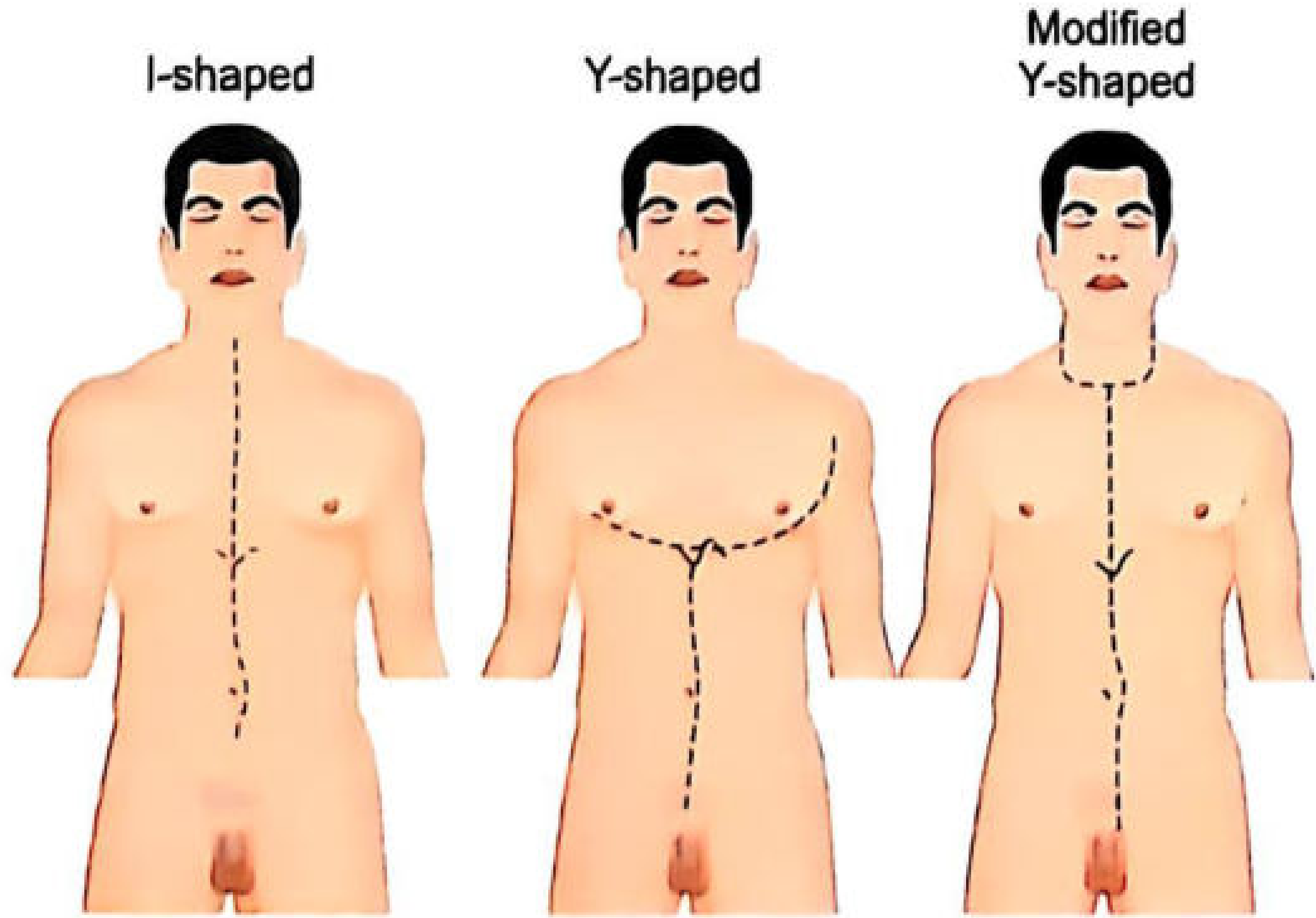
Fig: Primary skin incisions in autopsy (I-shaped, Y-shaped, Modified Y-shaped)
1. "I"-shaped Incision (T-shaped / Midline Incision)
- Also called the straight or "T"-shaped incision in some texts
- Runs in the midline from the chin straight down to the symphysis pubis, passing either to the left or right of the umbilicus
- The umbilicus is deliberately avoided because its dense fibrous tissue is difficult to penetrate with a needle when the body is stitched after autopsy
- Simplest of the three; used when neck examination is also required
2. "Y"-shaped Incision
- The most commonly used incision
- Starts from a point close to the acromial process on both sides
- Two arms extend diagonally downward, below the breast (below the mammary line), converging at the xiphoid process
- From the xiphoid, a single midline incision continues downward to the symphysis pubis (passing either side of the umbilicus)
- Provides excellent exposure of the chest and abdomen
- Preferred in adult male autopsies
3. Modified "Y"-shaped Incision
- A midline incision is made from the suprasternal notch down to the symphysis pubis
- From the suprasternal notch, two arms extend over the clavicle to its center on both sides, then pass upward over the neck behind the ear to the mastoid process
- Preferred in females to preserve cosmetic appearance of the chest, and in cases where the neck structures need to be examined without a separate neck dissection
- Also preferred in children
Note: The incision must be modified according to the special conditions of each case. For example, in cases of stab wounds of the chest or abdomen, the standard incision must be altered to avoid disturbing such wounds before they are documented.
Scalp Incision (Head Examination)
- A coronal (intermastoidal) incision is made in the scalp
- It starts from the mastoid process behind one ear, carried over the vertex of the scalp to the back of the opposite ear
- The incision penetrates to the periosteum
- The scalp is reflected: anteriorly to the superciliary ridges, posteriorly to just below the occipital protuberance
- This creates two flaps (anterior and posterior) that expose the entire skull cap
- After reflecting the scalp, the skull cap is removed using a V-shaped saw-line running horizontally from the center of the forehead to the base of the mastoid process on both sides and then backwards/upwards to above the external occipital protuberance
Skull Cap Removal
- The temporal and masseter muscles are cut on either side
- The saw-line is made in a slightly V-shaped direction so the cap fits back precisely (important for cosmetic restoration)
- Average skull thickness is 3-5 mm; stop sawing when resistance decreases to avoid cutting the meninges
- A chisel and hammer are NOT used to loosen the skull, as heavy hammering may cause false fractures
Infant Head (Special Technique - Baar's Method)
- The Rokitansky technique is used for infant autopsies
- An incision is made into the anterior fontanelle at its posterior margin, ~5 mm from the midline
- The parietal bone is cut longitudinally parallel to the sagittal suture up to the lambdoid suture
- Bilateral parietotemporal flaps are turned outward to examine the brain
Special Situations
| Situation | Modification |
|---|---|
| Stab wounds to trunk | Incision altered to avoid wound sites |
| Female body | Modified Y preferred (cosmetic) |
| Suspected neck injury | I-shaped preferred (includes neck dissection) |
| Infants | Baar's method for skull; Rokitansky technique overall |
| Suspected cranial injury | Open skull only after draining blood by opening heart first |
Sources:
- The Essentials of Forensic Medicine and Toxicology, 36th edition (2026), Chapter 5 - External/Skin Incisions & Examination of the Head
- P C Dikshit Textbook of Forensic Medicine and Toxicology, Chapter 8 - Internal Examination
This is a shared conversation. Sign in to Orris to start your own chat.