
Free radicle theory of aging
The free radical theory of aging (Harman, 1956) proposes that aging results from cumulative oxidative damage to cells caused by reactive oxygen species (ROS) - byproducts of normal metabolism. ROS damage DNA, proteins, and lipid membranes, leading to cellular dysfunction over time. Mitochondria are both the main source of ROS and a primary target of damage.
Searching sources...
Reading File
Searching the Web
free radical theory of aging oxidative stress current evidence
Searching PubMed
"free radical" AND aging
Now let me search the medical library for detailed textbook content on this topic.
Finding Sources
Finding Sources
Excellent - multiple textbook sources found. Let me read the key sections from Medical Physiology and Harper's Biochemistry in parallel.
Reading File
Reading File
Let me also read the Harrison's section and fetch the key diagram from Harper's.
Reading File
Reading File
I now have comprehensive textbook content from multiple authoritative sources. Let me also fetch the ROS diagram from Harper's for visual clarity.
Loading Image
Reading File
I now have rich, multi-source textbook content and a key diagram. Here is the full, synthesized answer:
Free Radical Theory of Aging
1. Historical Origin
The free radical theory of aging was first proposed by Denham Harman in 1954-1956. Harman was inspired by two observations: (1) the rate-of-living theory, which held that lifespan is inversely proportional to metabolic rate (and thus oxygen consumption), and (2) the finding by Rebeca Gerschman that the toxic effects of hyperbaric oxygen and ionizing radiation shared a common mechanism - oxygen free radicals. Harman extended this in the 1970s to specifically implicate mitochondrial ROS production.
- Medical Physiology (Boron & Boulpaep), p. 1816
- Harper's Illustrated Biochemistry 32e, p. 732
2. Core Postulate
Free radicals are highly reactive chemical entities containing one or more unpaired outer orbital electrons. The theory proposes that aging is the cumulative result of biomolecular damage inflicted by the continual and inescapable production of reactive oxygen species (ROS) during normal cellular respiration. Since all animals respire, this damage is universal and inevitable.
Key ROS involved:
| Species | Formula | Origin |
|---|---|---|
| Superoxide radical | O2•- | Electron leakage from ETC |
| Hydrogen peroxide | H2O2 | Dismutation of O2•- by SOD |
| Hydroxyl radical | •OH | Fenton reaction (H2O2 + Fe2+) |
| Peroxynitrite | ONOO- | O2•- + nitric oxide |
3. Primary Source: The Mitochondria
The dominant natural source of cellular ROS is the leakage of electrons from the mitochondrial electron transport chain (ETC), primarily at Complexes I and III. A small percentage (estimated 1-2%) of electrons "escape" and react directly with O2 to form superoxide rather than passing through the full chain to reduce O2 to water.
This sets up a vicious cycle:
Initial ROS production → Mitochondrial DNA (mtDNA) damage → Impaired ETC components → Increased electron leakage → More ROS → Further mtDNA mutations → ...
Critically, the mitochondrial genome lacks the repair enzymes present in the nucleus (no mismatch repair, nucleotide excision repair, or double-strand break repair systems). Mutations therefore accumulate permanently and compound over time. Age-related changes in mitochondria include increased electron leakage, decreased ATP production (especially impaired Complex IV activity), mitochondrial swelling, and disrupted cristae.
- Harper's Illustrated Biochemistry 32e, p. 732-733
- Harrison's Principles of Internal Medicine 22e
4. Molecular Targets of ROS Damage
The diagram below (from Harper's Biochemistry) illustrates the three major classes of biomolecular damage:
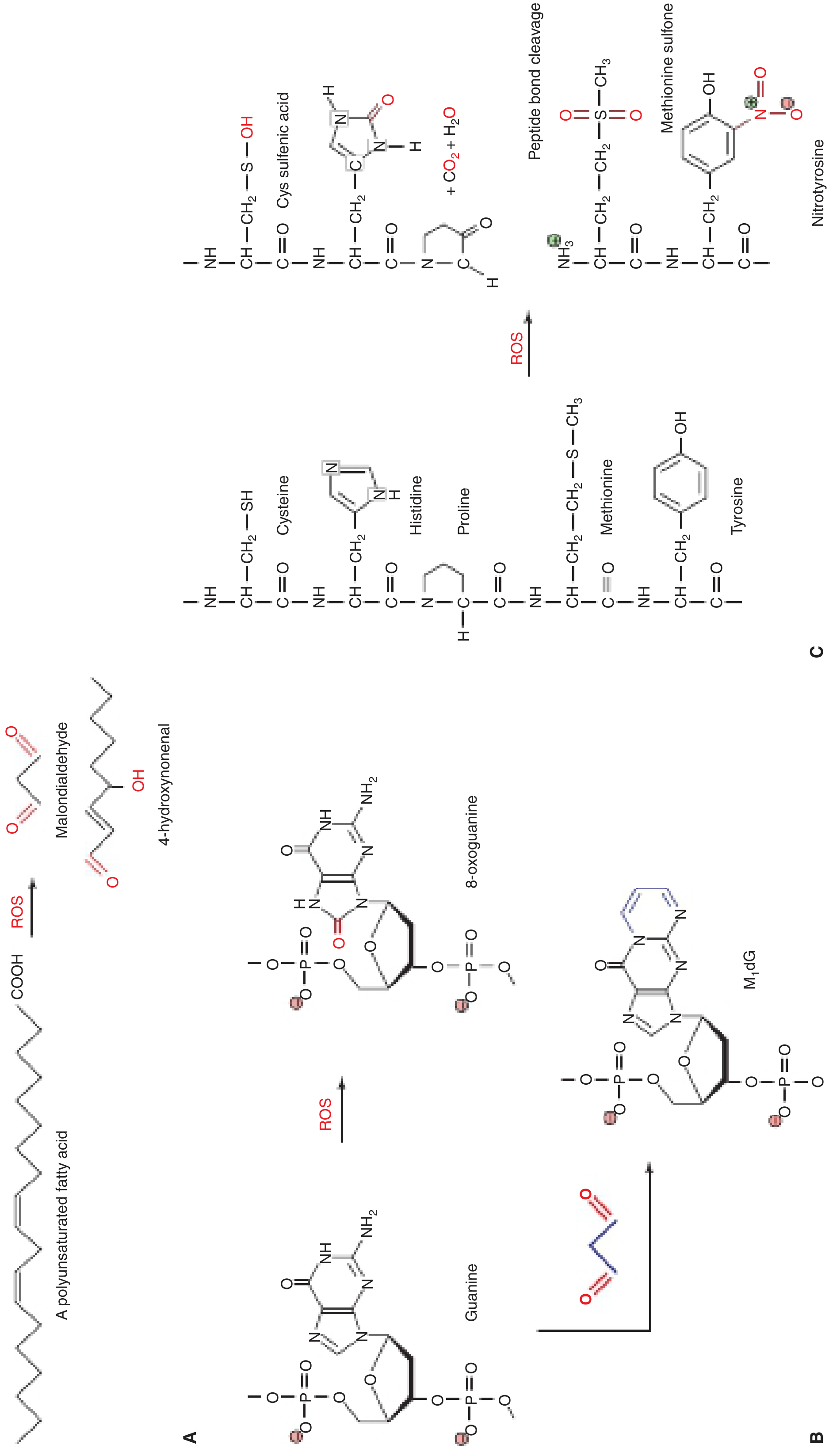
A. Lipid peroxidation
- ROS attack polyunsaturated fatty acids in membrane phospholipids
- Chain reaction produces reactive aldehydes: malondialdehyde (MDA) and 4-hydroxynonenal (4-HNE)
- Results in membrane fluidity loss, impaired receptor/transporter function
B. DNA oxidation
- The guanine base is particularly vulnerable
- Key oxidized product: 8-oxo-deoxyguanosine (8-oxodG) - a biomarker of oxidative DNA damage that accumulates with age
- 8-oxodG causes G:C → T:A transversion mutations if not repaired
C. Protein oxidation
-
ROS cause oxidation of amino acid side chains (Cys → cysteine sulfenic acid; Met → methionine sulfone)
-
Peptide bond cleavage and nitration (Tyr → nitrotyrosine)
-
Affects residues particularly important in catalysis and regulation (Cys, His, Met, Pro, Tyr)
-
Long-lived proteins like collagen, elastin, and lens crystallins accumulate damage over decades, explaining loss of vascular elasticity, joint stiffness, and cataract formation
-
Harper's Illustrated Biochemistry 32e, p. 732-733, 2876-2878
5. Antioxidant Defense Systems
Cells have enzymatic and non-enzymatic defenses against ROS:
Enzymatic:
- Superoxide dismutase (SOD): O2•- → H2O2 (cytosolic Cu/Zn-SOD; mitochondrial Mn-SOD)
- Catalase: H2O2 → H2O + O2
- Glutathione peroxidase: H2O2 + 2 GSH → H2O + GSSG
Note: SOD generates H2O2 as a byproduct, which can still produce the highly reactive hydroxyl radical via the Fenton reaction if not eliminated by catalase or glutathione peroxidase.
Non-enzymatic:
- Vitamins C and E (ascorbic acid and tocopherol)
- Glutathione (GSH)
- Carotenoids, flavonoids
- Alpha-lipoic acid (may reduce skin aging from free radical damage)
6. Evolution: The Mitochondrial Theory of Aging
Harman's original theory evolved into the Mitochondrial Theory of Aging, emphasizing:
- mtDNA mutations accumulate with age (mitochondria cannot repair their own genome)
- Declining NAD(H) levels with age impair ETC function
- Mitochondria's central role in apoptosis means damaged mitochondria can trigger programmed cell death, driving tissue degeneration
As noted in the Frontiers update (2020), recent studies show age-related mtDNA mutations are predominantly transition mutations (A↔G, C↔T) - the hallmark of mitochondrial polymerase-γ errors - rather than transversion mutations expected from direct oxidative damage, which complicates simple causation.
7. Relationship to Other Aging Theories
The free radical / oxidative stress theory connects with several broader hallmarks of aging (Lopez-Otin et al.):
| Theory | Relationship to Free Radical Theory |
|---|---|
| Somatic mutation theory | ROS are a major driver of somatic DNA mutations |
| Glycation / AGE formation | Glyoxidation = oxidative glycation; ROS promote crosslink formation |
| Telomere shortening | Oxidative damage accelerates telomere attrition |
| Cellular senescence | ROS trigger senescence via the INK4/ARF pathway; SASP produces inflammatory cytokines |
| Caloric restriction (CR) | CR reduces ROS production; works partly via AMPK, sirtuins, mTOR pathways |
8. Limitations and Current Status
Despite its elegance, the theory has faced challenges:
- Antioxidant supplementation (vitamins C, E) has been largely ineffective at delaying aging in clinical trials, and sometimes harmful
- Genetically engineered mice with overexpressed or deficient antioxidant enzymes do not consistently show the predicted changes in lifespan
- Long-lived organisms sometimes have higher ROS levels (the hormesis concept - low-level ROS as signaling molecules)
- ROS are now recognized to play essential physiological signaling roles (redox signaling, immune function), not just damaging ones
As Harrison's (22e) states: "Antioxidants have been investigated as a method to delay age-related oxidative stress but have been ineffective in delaying aging." The most effective anti-aging interventions (caloric restriction, metformin, rapamycin, senolytics) act on mitochondrial biogenesis, AMPK, mTOR, and sirtuin pathways rather than directly scavenging ROS.
In summary, the free radical theory of aging remains an important conceptual framework, particularly the mitochondrial variant, but is now understood as one of several interconnected mechanisms - not a single, sufficient explanation for the aging process.
Sources:
- Medical Physiology (Boron & Boulpaep), p. 1816 - Free-Radical Theory of Aging
- Harper's Illustrated Biochemistry 32e, pp. 732-733 - Mitochondrial Theory of Aging
- Harrison's Principles of Internal Medicine 22e - Mitochondrial Dysfunction in Aging
- Basic Medical Biochemistry (Lieberman & Peet) 6e - Protein damage and aging
Make it short and easy to understand
Free Radical Theory of Aging - Simple Version
The Big Idea
Your body runs on oxygen. But as cells use oxygen to make energy, they accidentally create harmful byproducts called free radicals (also called ROS - reactive oxygen species). These free radicals damage your cells over time, and that damage = aging.
What is a Free Radical?
Think of atoms as needing electrons in pairs - like a couple. A free radical is an atom missing one electron from a pair. It becomes desperate and aggressive, stealing electrons from nearby healthy molecules and damaging them in the process.
Where Do They Come From?
Mostly from your mitochondria (the powerhouse of the cell). Every time mitochondria burn fuel to make energy (ATP), a small number of electrons "escape" and hit oxygen molecules, creating free radicals. This happens 24/7, just from being alive.
What Do They Damage?
| Target | Damage | Result |
|---|---|---|
| DNA | Breaks and mutations | Cancer, cell dysfunction |
| Proteins | Distort their shape | Cataracts, stiff joints |
| Cell membranes (lipids) | Destroy membrane structure | Cells lose function |
The Vicious Cycle
Mitochondria leak free radicals
        ↓
Free radicals damage mitochondrial DNA
        ↓
Damaged mitochondria leak MORE free radicals
        ↓
More damage... → aging accelerates
Mitochondria can't repair their own DNA, so the damage builds up permanently.
The Body's Defense
Your body fights back with antioxidants:
- Enzymes: SOD, Catalase, Glutathione peroxidase
- From food: Vitamin C, Vitamin E, Beta-carotene
As you age, these defenses weaken, so damage outpaces repair.
Why Antioxidant Supplements Don't Work Well
Taking antioxidant pills sounds logical, but trials show they don't significantly slow aging. Turns out, small amounts of free radicals are actually useful as signaling molecules - completely wiping them out causes other problems.
One-Line Summary
You age because your mitochondria slowly damage your own cells with the byproducts of making energy, and this damage adds up faster than your body can repair it.
This is a shared conversation. Sign in to Orris to start your own chat.