
How to manage penile injury.
penile fracture hematoma eggplant deformity
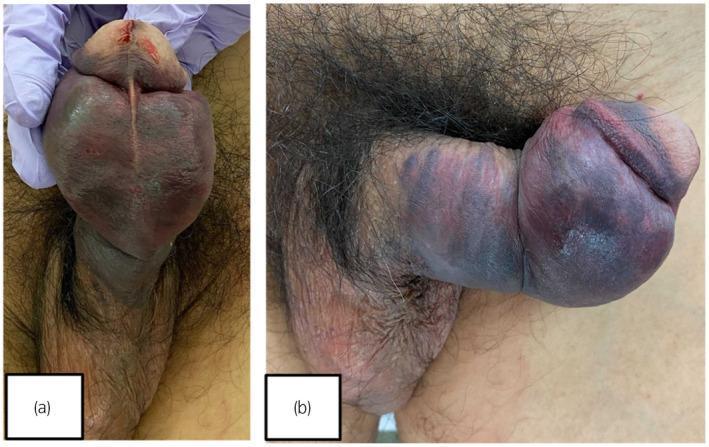
Two clinical photographs (a and b) show a male pelvis and genitalia demonstrating classic signs of penile fracture. The penis exhibits a characteristic 'eggplant deformity,' characterized by gross swelling, distortion, and a large subcutaneous hematoma. The skin of the penile shaft and glans is markedly discolored with deep purple and blue ecchymosis, extending from the distal ventral surface to the proximal shaft. Figure (a) provides a ventral view showing maximal tumescence and hematoma concentration at the distal shaft, while figure (b) provides a lateral view highlighting the circumferential nature of the swelling and the involvement of the glans. Hemorrhage is also visible at the external urethral orifice, suggesting a concomitant urethral injury. This visual presentation is indicative of a rupture of the tunica albuginea, often occurring during high-impact trauma to the erect penis. The images serve as an educational tool for identifying emergency urological conditions requiring immediate surgical intervention to preserve erectile and urinary function.
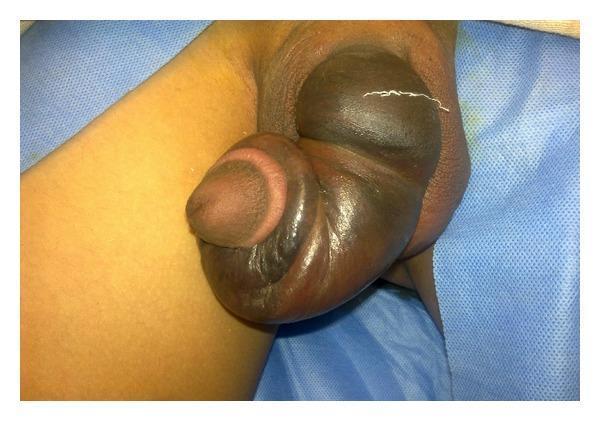
This clinical photograph displays a classic presentation of a penile fracture, a urological emergency. The image shows the male external genitalia, specifically the penis, which exhibits significant diffuse edema and deep violaceous to near-black ecchymosis, characteristic of the 'eggplant deformity.' This extensive hematoma is concentrated at the base and extends throughout the shaft due to the rupture of the tunica albuginea and subsequent extravasation of blood into the subcutaneous tissues. There is a prominent lateral angulation or bending of the penile shaft, deviating away from the side of the corporal rupture. The visual evidence of rapid detumescence, severe swelling, and focal deformity provides a high-fidelity example of traumatic penile injury commonly associated with vigorous sexual activity or blunt trauma during erection. This educational material is intended for clinical recognition of acute genital trauma and differentiating it from more localized skin lesions.
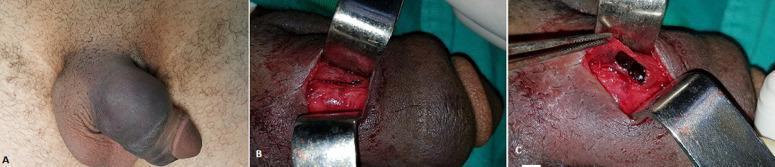
This composite of three clinical and intraoperative photographs illustrates a penile fracture resulting from blunt trauma. Image A shows a clinical photograph of the external genitalia exhibiting the classic 'eggplant deformity,' characterized by significant edema, ecchymosis, and deep purple discoloration of the penile shaft due to subcutaneous hematoma. Images B and C are intraoperative photographs taken during surgical exploration. Image B displays a longitudinal tear or rupture in the tunica albuginea of the right corpus cavernosum, exposed via a surgical incision and maintained with metallic retractors. Image C demonstrates the evacuation of a localized hematoma and the associated inflammatory response of the underlying cavernous tissue. This sequence is representative of the diagnostic presentation and surgical management of urological emergencies involving traumatic rupture of the tunica albuginea.
Management of Penile Injury
1. Penile Fracture (Rupture of Tunica Albuginea)
- Audible "popping" or cracking sound at the moment of injury
- Immediate pain and rapid detumescence
- Swelling and ecchymosis - the classic "eggplant deformity"
- Palpable defect in the tunica albuginea
- Urethral injury is associated in ~20% of cases
- Immediate surgical exploration and repair - nonoperative management has no place in managing this injury; delayed or conservative treatment leads to penile curvature, abscess, missed urethral injury, and fibrosis
- Approach via a circumcising incision - allows inspection of the entire length of both corporal bodies and the urethra
- The corporal laceration is closed with absorbable sutures
- If urethral injury is present, it is repaired primarily over a Foley catheter
- Early repair results in low complication rates and preserves erectile function; curvature occurs in <5% with prompt repair vs. significantly higher rates with conservative management
2. Penetrating Penile Injury (Gunshot/Stab Wounds)
- Uncommon outside of wartime settings
- ~8% have injuries to adjacent organs
- Urethral injury occurs in ~50% of cases - RUG must be performed before exploration if possible
- Associated scrotal/testicular injury must be assessed
- Debridement and primary repair for most injuries - good functional outcomes expected
- Close-range shotgun injuries are the exception - massive tissue destruction requires debridement, allow the wound to "declare itself," then staged reconstruction
- Corporal injuries: closed with buried absorbable sutures
- Urethral injuries: closed primarily in watertight fashion over a Foley catheter
- Superficial lacerations (superficial to Buck fascia): debridement and primary closure
3. Penile Amputation
- Expeditious replantation is the treatment of choice - most psychotic patients respond well to psychiatric rehabilitation and will not repeat
- The penis is remarkably resistant to cold ischemia - successful replantation has been achieved up to 24 hours post-amputation
- Preservation: Wrap in saline-soaked gauze → place in a sterile plastic bag → immerse bag in ice slush (increases ischemic tolerance)
- Two-layer closure of the urethra over a catheter (stabilizes the repair)
- Reapproximation of the tunica albuginea of corporal bodies in watertight fashion
- Microvascular anastomosis of the deep dorsal artery and dorsal vein
- Microsurgical neurorrhaphy of the dorsal sensory nerves
- Subcutaneous tissues and skin closed in layers
- Foley catheter left for 3 weeks
- Even without microvascular reanastomosis, replantation often yields satisfactory results
4. Skin Avulsion / Degloving
- Scrotum: Can often be closed primarily even with up to 60% skin loss (due to elasticity)
- If primary closure not possible: testes placed in anterior subcutaneous thigh pouches for delayed reconstruction
- Penile shaft: Reconstruct with split-thickness skin grafts (STSGs) - meshed grafts should be avoided on the penis due to contracture risk and poor cosmesis
- Excise residual subcoronal skin before grafting to prevent circumferential lymphedema
- Contaminated wounds: debride, dress with moist saline gauze, then graft once clean
5. Penile Strangulation
- The ring must be cut off with a ring cutter - do not attempt forceful removal as this worsens injury
- Assess for urethral and vascular compromise
6. Blunt Trauma / Contusion
- Most penile blunt trauma in children arises from circumcision complications, hair tourniquet, toilet seat injuries, motor vehicle accidents, animal bites, and burns
- Grade I-II injuries (contusion, Buck fascia laceration): conservative management with close follow-up
- Hair tourniquet: Conservative management with catheter drainage if urethral involvement; surgical repair if conservative management fails
7. AAST Organ Injury Scale (Summary)
| Grade | Description |
|---|---|
| I | Cutaneous laceration or contusion |
| II | Buck fascia laceration without tissue loss |
| III | Cutaneous avulsion, glans/meatus laceration, or cavernosal/urethral defect <2 cm |
| IV | Partial penectomy, or cavernosal/urethral defect >2 cm |
| V | Total penectomy |
Key Management Principles
| Injury Type | Key Management |
|---|---|
| Penile fracture | Immediate surgical repair (circumcising incision); no conservative management |
| Penetrating/GSW | RUG first, debridement + primary repair; staged for shotgun |
| Amputation | Ice slush preservation + microsurgical replantation ASAP |
| Avulsion/degloving | STSG reconstruction; thigh pouches for testes |
| Strangulation | Ring cutter removal |
| Urethral injury (any) | Repair over Foley catheter; RUG to diagnose |