


86388.jpg
86389.jpg
National program of above disease
I can see from the table of contents that this is a Community Medicine / PSM (Preventive & Social Medicine) book covering National Health Programmes. The images show topics including NTEP (National Tuberculosis Elimination Programme), NACP (HIV/AIDS), NVBDCP (vector-borne diseases), Leprosy, Polio, and more.
To give you the most relevant answer, I need to clarify which disease's national program you're asking about.
Asking for Preferences
Which disease's national program do you want covered?
Searching sources...
Let me pull all the relevant national programme content from the medical library simultaneously.
Reading File
Now let me search for all national programmes simultaneously:
Finding Sources
Finding Sources
Finding Sources
Finding Sources
Finding Sources
Finding Sources
Finding Sources
Finding Sources
The library doesn't have a dedicated Community Medicine / PSM textbook with Indian national programmes. Let me use my knowledge base combined with a web search to provide a comprehensive answer on all four programmes.
Searching the Web
NTEP NACP NVBDCP NLEP India national health programme key points 2024
Here is a comprehensive, exam-focused summary of all the major National Health Programmes shown in your textbook's table of contents:
National Health Programmes of India
1. NTEP - National Tuberculosis Elimination Programme
Launched: 1962 as NTP → 1997 as RNTCP → 2020 renamed NTEP
Goal: Eliminate TB by 2025 (5 years ahead of global SDG target of 2030)
Under: MoHFW; implemented through NHM
Key Features
| Parameter | Details |
|---|---|
| Target | <1 case per lakh population by 2025 |
| Strategy | DOTS (Directly Observed Treatment, Short-course) |
| Case finding | Passive + Active case finding (ACF) |
| Diagnosis | CBNAAT/Truenat (molecular tests) preferred over sputum smear |
| Treatment | 2HRZE/4HR (Category I); 2HRZES/1HRZE/5HRE (Cat II retired) |
| Drug supply | Nikshay portal for online tracking |
NTEP Organisation
- National level: Central TB Division (CTD), Ministry of Health
- State level: State TB Officer (STO)
- District level: District TB Officer (DTO)
- Peripheral: TB Unit (TU) covers ~5 lakh population; DMC (Designated Microscopy Centre)
NTEP Key Indicators
- Notification rate (CNR - Case Notification Rate)
- Treatment Success Rate (TSR): Target >90%
- CDR (Case Detection Rate): Target >90%
NTEP Incentives (Nikshay Poshan Yojana)
- Patient: ₹500/month for nutrition during treatment
- Informant/provider: ₹500 on notification; ₹500 on treatment initiation
- Private provider: additional ₹500 on treatment completion
DR-TB (Drug Resistant TB)
- MDR-TB treated with longer regimens (9-month BPaL or 18-24 month regimens)
- DST (Drug Susceptibility Testing) mandatory for all diagnosed TB cases
2. NACP - National AIDS Control Programme
Launched: 1992 (Phase I) → Currently in Phase V
Under: NACO (National AIDS Control Organisation)
Goal: End AIDS by 2030 (90-90-90 targets)
90-90-90 Targets (UNAIDS)
- 90% of HIV+ persons diagnosed
- 90% of diagnosed on ART
- 90% of those on ART virally suppressed
NACP Organisation
- National: NACO
- State: SACS (State AIDS Control Society)
- District: DAPCU (District AIDS Prevention and Control Unit)
- Field: ICTCs (Integrated Counselling and Testing Centres), ART Centres, Link ART Centres (LAC)
Diagnosis & Screening
- ICTC - voluntary HIV testing; free & confidential
- PPTCT - Prevention of Parent to Child Transmission (earlier PPTMCT)
- Testing strategy: Three ELISA tests (A, B, C kits); all three reactive = HIV positive
- Rapid tests now widely used
Treatment (ART)
- First line: TDF + 3TC + DTG (Tenofovir + Lamivudine + Dolutegravir) - updated
- Free ART provided at ART Centres
- CD4 count + Viral Load monitoring
- ART initiated regardless of CD4 count (Test and Treat policy)
Prevention Strategies
- TI (Targeted Interventions): for HRGs - FSW, MSM, IDU, transgenders
- Condom promotion
- NSP (Needle Syringe Programme) for IDU
- OST (Opioid Substitution Therapy): Buprenorphine/methadone for IDU
- PEP (Post Exposure Prophylaxis): within 72 hours
- PrEP (Pre-Exposure Prophylaxis): for high-risk individuals
Key Indicators
- HIV prevalence among ANC attendees (sentinel surveillance)
- ART coverage, Viral suppression rate, MTCT rate
3. NVBDCP - National Vector Borne Disease Control Programme
Launched: 2003-04 (merged NMEP + NFCP + KCF)
Under: Directorate of NVBDCP, MoHFW
Diseases covered: Malaria, Dengue, Chikungunya, Filaria (LF), Kala-Azar (VL), Japanese Encephalitis (JE)
A. MALARIA
Elimination target: <1 case per 1000 at-risk population per year by 2027; zero indigenous cases by 2030
Diagnosis
- Microscopy (gold standard) - thick + thin smear
- RDT (Rapid Diagnostic Test) - for remote areas
- PCR - for mixed/doubtful cases
Treatment
| Species | Drug |
|---|---|
| P. vivax | Chloroquine 25 mg/kg over 3 days + Primaquine 0.25 mg/kg × 14 days |
| P. falciparum (uncomplicated) | ACT (Artesunate + SP) + Primaquine single dose |
| Severe malaria | IV Artesunate (preferred) / IV Quinine |
Key Indicators
- API (Annual Parasite Incidence): Cases per 1000 population/year
- ABER (Annual Blood Examination Rate): ≥10% mandatory
- SPR (Slide Positivity Rate): Positive slides / slides examined × 100
- ASFR (Annual Falciparum Incidence)
- SFR (Slide Falciparum Rate)
Vector Control
- IRS (Indoor Residual Spraying) - DDT, Malathion, Synthetic pyrethroids
- LLIN (Long Lasting Insecticidal Nets)
- Larval control (biological - Gambusia/Bacillus thuringiensis; environmental)
B. LYMPHATIC FILARIASIS (LF)
Elimination target: Microfilaria rate <1% & Disease burden <1% by 2027
Strategies
- MDA (Mass Drug Administration): DEC 6 mg/kg + Albendazole 400mg annually (now Triple Drug Therapy = DEC + Albendazole + Ivermectin in some states)
- Transmission Assessment Survey (TAS) for stopping MDA
- Morbidity management - hydrocele surgery, lymphoedema management (MMDP)
C. KALA-AZAR (Visceral Leishmaniasis)
Elimination target: <1 case per 10,000 population at block PHC level
Endemic: Bihar, Jharkhand, West Bengal, UP (eastern districts)
Treatment
- First line: Liposomal Amphotericin B (single dose 10 mg/kg IV) - replaced Miltefosine as first line
- Alternative: Miltefosine (oral)
- Vector control: IRS with DDT/Synthetic pyrethroid; elimination of sandfly breeding
D. DENGUE
- No specific antiviral; supportive management
- NS1 antigen (days 1-5), IgM ELISA (after day 5)
- WHO Dengue Warning Signs: Abdominal pain, persistent vomiting, bleeding, plasma leakage
- Vector control: elimination of Aedes aegypti breeding (container habitats)
E. JAPANESE ENCEPHALITIS (JE)
- Vaccination is cornerstone - SA 14-14-2 live attenuated vaccine, 2 doses
- Part of UIP in endemic districts (UP, Bihar, Assam, WB)
- Vector: Culex tritaeniorhynchus; reservoir: Pigs, Ardeid birds
4. NLEP - National Leprosy Eradication Programme
Launched: 1983
Goal: Eliminate leprosy (< 1 case per 10,000 population) - achieved at national level in 2005
Current goal: Zero leprosy transmission (interruption of transmission) - NSP 2023-2027
Classification (WHO)
| Type | Bacillary load | Patches | Treatment |
|---|---|---|---|
| Pauci-bacillary (PB) | Smear negative | 1-5 patches | MB-MDT × 6 months |
| Multi-bacillary (MB) | Smear positive | >5 patches | MB-MDT × 12 months |
MDT Regimen
PB-MDT (6 months):
- Monthly supervised: Rifampicin 600mg + Dapsone 100mg
- Daily unsupervised: Dapsone 100mg
MB-MDT (12 months):
- Monthly supervised: Rifampicin 600mg + Clofazimine 300mg + Dapsone 100mg
- Daily unsupervised: Clofazimine 50mg + Dapsone 100mg
NLEP Organisation
- National: Central Leprosy Division (CLD)
- State: State Leprosy Officer (SLO)
- District: District Leprosy Officer (DLO)
- Vertical programme integrated into general health services
Key Indicators
- PR (Prevalence Rate): Cases per 10,000 population (target <1)
- NCDR (New Case Detection Rate)
- Proportion with Grade 2 Disability (marker of late detection)
- Child proportion among new cases (marker of active transmission)
Special Programmes under NLEP
- LCDC (Leprosy Case Detection Campaign): house-to-house survey
- ABSULS: ASHA-Based Surveillance for Leprosy Suspects
- SDR-PEP (Single Dose Rifampicin - Post Exposure Prophylaxis): 600mg to contacts of PB/MB patients to prevent new cases
5. NATIONAL LEPROSY ERADICATION vs. ELIMINATION vs. CONTROL
| Term | Definition |
|---|---|
| Control | Reducing disease to locally acceptable level |
| Elimination | Reducing incidence to very low level (<1/10,000) |
| Eradication | Permanent global reduction to zero |
Quick Comparison Table
| Programme | Full Name | Launched | Under | Target Year |
|---|---|---|---|---|
| NTEP | National TB Elimination Programme | 1962/2020 | CTD, MoHFW | 2025 |
| NACP | National AIDS Control Programme | 1992 | NACO | 2030 |
| NVBDCP | National Vector Borne Disease Control Programme | 2003 | NVBDCP Directorate | 2030 |
| NLEP | National Leprosy Eradication Programme | 1983 | CLD, MoHFW | 2027 (NSP) |
Exam Tips:
- NTEP target = 2025 (most asked); NACP = 2030
- API, ABER, SPR are malaria-specific indicators
- Nikshay = TB online notification portal; Nikshay Poshan Yojana = ₹500/month nutritional support
- MDT for leprosy = free through all government health facilities
- Triple Drug MDA (DEC + Albendazole + Ivermectin) is the new addition for filariasis in selected states
- NACP's "Test and Treat" = ART started regardless of CD4 count
- SDR-PEP for leprosy contacts is a recent and frequently tested update
Lepra reaction
Lepra reactions are acute inflammatory episodes that occur in leprosy patients, representing immunological events that can cause sudden nerve damage and disability. There are two main types: Type 1 (Reversal Reaction) driven by cell-mediated immunity, and Type 2 (Erythema Nodosum Leprosum - ENL) driven by immune complex deposition.
Searching sources...
Reading File
Finding Sources
Finding Sources
Finding Sources
Excellent - found the dedicated section in Park's PSM and also content in Goldman-Cecil and Dermatology. Let me read all relevant sections now in parallel:
Reading File
Reading File
Reading File
Reading File
Reading File
I have rich content from Park's PSM and Goldman-Cecil. Let me also fetch the clinical images for visual clarity:
Loading Image
Finding Sources
I now have comprehensive content from Park's PSM, Goldman-Cecil, and Fitzpatrick's. Here is the complete, exam-ready answer:
Lepra Reactions
Lepra reactions are acute or subacute immunologically mediated episodes of inflammation that occur in the course of leprosy, affecting the skin and peripheral nerves. Unless promptly treated, they cause permanent nerve damage, deformity, and disability. They can occur before, during, or after completion of MDT.
- Park's Textbook of Preventive and Social Medicine, p. 2445
- Goldman-Cecil Medicine, p. 3277
There are TWO Types:
| Feature | Type 1 - Reversal Reaction (RR) | Type 2 - Erythema Nodosum Leprosum (ENL) |
|---|---|---|
| Immunology | Delayed hypersensitivity (Type IV) - cell-mediated | Antigen-antibody (immune complex - Type III) |
| Leprosy type | PB + MB; borderline spectrum (BT, BB, BL) | MB only - BL and LL |
| Skin | Pre-existing lesions become red, swollen, warm, tender; new lesions may appear | New sub-cutaneous nodules (1-2 cm), red, tender, bilateral - ENL nodules; original patches unchanged |
| Nodule character | Plaques/patches become inflamed | Evanescent nodules - appear in crops, subside in days, recurrent/episodic; "better felt than seen" |
| Nerve involvement | Common, severe, acute neuritis - close to skin lesion; sudden pain + loss of function | Less common/severe than Type 1 |
| Systemic symptoms | Not common | Fever, malaise, joint pain, red eyes |
| Other organs | Not affected | Eyes (iritis/iridocyclitis), testes (epididymo-orchitis), kidneys (nephritis), lymphadenopathy, hepatosplenomegaly |
| Severity | Can cause nerve abscess; ulceration in severe cases | Can become pustular, bullous, necrotic (erythema nodosum necroticans) |
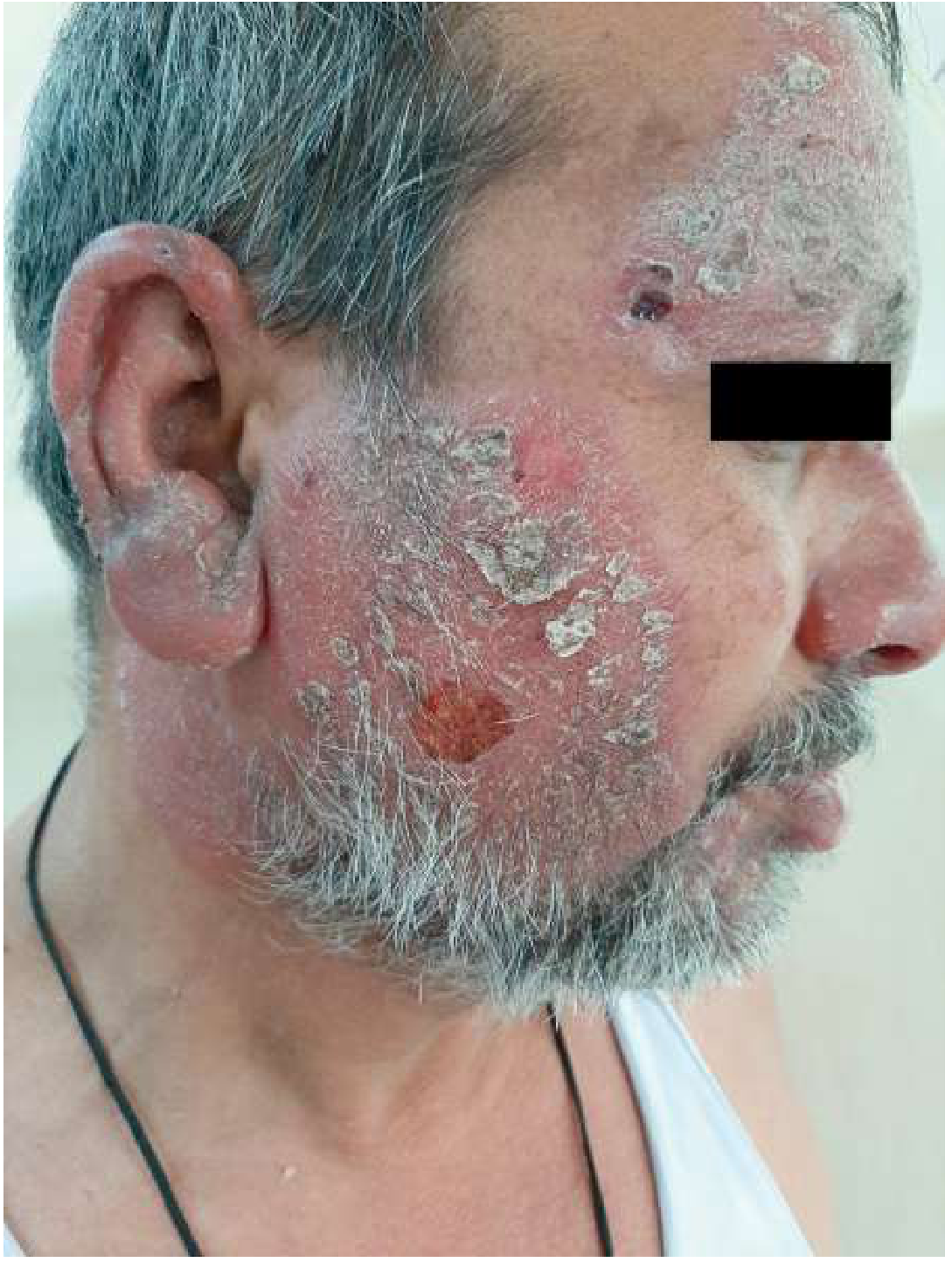
Type 1 - Reversal Reaction (RR)
Mechanism: Sudden upregulation of cell-mediated immunity (CMI) against M. leprae antigens, causing a "shift up" in the leprosy spectrum toward tuberculoid end.
Clinical Features
- Pre-existing skin patches suddenly become erythematous, edematous, warm, painful
- New patches may appear on previously normal skin
- Rapid swelling and severe pain in one or more peripheral nerves (neuritis)
- Oedema of hands, feet, or face
- Lagophthalmos and corneal anaesthesia due to facial nerve neuritis
- In severe cases: nerve abscesses, ulceration of plaques
Signs of SEVERE Reversal Reaction (treat with steroids)
- Loss of nerve function (sensory or motor)
- Pain/tenderness in any nerve
- Silent neuritis / Quiet nerve paralysis (nerve damage without symptoms - important exam point)
- Red, swollen patch on the face or overlying a major nerve trunk
- Skin lesion becomes ulcerated
- Marked oedema of hands, feet, or face
Type 2 - Erythema Nodosum Leprosum (ENL)
Mechanism: Immune complex (antigen-antibody) mediated, seen in bacillary-rich LL and BL types due to massive antigen load.
Clinical Features
- Crops of evanescent, pink-red, tender subcutaneous nodules - appear on face, arms, legs bilaterally
- Individual lesion evolves: pink/red → bluish/brownish (24-48 hrs) → dark → desquamates (1 week)
- Nodules are recurrent and episodic
- Fever, malaise, generalized aching
- Neuritis (most common extracutaneous feature)
- Can become vesicular, pustular, bullous, or necrotic (Erythema Nodosum Necroticans)
Systemic Involvement in ENL
| Organ | Manifestation |
|---|---|
| Eyes | Iritis, iridocyclitis |
| Testes | Epididymo-orchitis |
| Kidneys | Proteinuria, nephritis, nephrotic syndrome |
| Joints | Arthritis, synovitis, dactylitis |
| Lymph nodes | Lymphadenopathy |
| Liver/Spleen | Hepatosplenomegaly |
| Muscles | Myositis |
| Larynx | Laryngitis |
Lucio Phenomenon (Type 3 / Special Reaction)
- Seen in untreated diffuse lepromatous leprosy (non-nodular type)
- Common in Mexico and Central America
- Presents as necrotizing vasculitis - hemorrhagic infarcts in skin
- More severe than ENL; high mortality
Treatment of Lepra Reactions
Key rule: Do NOT stop MDT during lepra reaction. Continue and complete MDT.
Mild Reactions
- Type 1 mild: NSAIDs (aspirin), analgesics, rest, splinting of affected nerve
- Type 2 mild (ENL): Aspirin/analgesics
Severe Reactions - Prednisolone Regimen
| Week | Prednisolone dose |
|---|---|
| Weeks 1-2 | 40 mg/day |
| Weeks 3-4 | 30 mg/day |
| Weeks 5-6 | 20 mg/day |
| Weeks 7-8 | 15 mg/day |
| Weeks 9-10 | 10 mg/day |
| Weeks 11-12 | 5 mg/day |
For neuritis: extend treatment with prednisolone from 20 mg onwards for 4 more weeks (total prolonged course)
Clofazimine in ENL (Type 2 only)
- Added to prednisolone for severe/recurrent ENL
- Dosing: 100 mg TDS × 4 weeks → 100 mg BD × 4 weeks → 100 mg OD × 4 weeks
- Takes 4-6 weeks to show effect; must NOT be used as sole agent for severe ENL
- Helps reduce/wean corticosteroid dependence
- Total duration: not to exceed 12 months
Thalidomide
- First-line for moderate-to-severe ENL (cutaneous manifestations)
- Approved use: 100-400 mg/day
- Contraindicated in pregnancy (teratogenic - phocomelia)
- Reduces TNF-alpha
Prednisolone Use - Pre-treatment Checklist
Before starting steroids, check for and treat:
- Peptic ulcer / epigastric pain
- Fungal infections
- Scabies
- Worm infestations
- Uncontrolled diabetes / hypertension
- Active TB (steroids cause reactivation)
Precipitating Factors for Lepra Reactions
- Starting MDT
- Pregnancy and post-partum period
- Intercurrent infections
- Vaccination
- Emotional stress
- Physical trauma
Quick Exam Summary
| Point | Type 1 (RR) | Type 2 (ENL) |
|---|---|---|
| Immunology | Type IV (CMI) | Type III (Immune complex) |
| Leprosy spectrum | BT, BB, BL (borderline) | BL, LL only |
| Skin | Old lesions inflamed | New nodules (evanescent) |
| Nerve damage | Severe, sudden | Less severe |
| Systemic | Absent | Fever, multi-organ |
| Treatment | Prednisolone | Prednisolone + Clofazimine; Thalidomide |
| Most feared complication | Sudden nerve paralysis | Iritis, orchitis, renal damage |
Exam pearls:
- "Silent neuritis / Quiet nerve paralysis" = Type 1 RR - nerve damage without any symptoms (most missed, most dangerous)
- ENL nodules = "evanescent" - appear and disappear quickly; "better felt than seen"
- Thalidomide = drug of choice for ENL but absolutely contraindicated in pregnancy
- Never stop MDT during any lepra reaction
- Clofazimine has anti-inflammatory role in ENL (apart from anti-leprosy role in MDT)
This is a shared conversation. Sign in to Orris to start your own chat.