
Parts of corpus callosum
The corpus callosum has 4 main parts (from anterior to posterior): rostrum, genu, body (trunk), and splenium.
Searching sources...
Reading File
Searching Images
corpus callosum parts anatomy diagram
Finding Sources
Finding Sources
Reading File
Reading File
Reading File
Now let me fetch the diagram image from Kaplan & Sadock's that shows the parts:
Reading File
Reading File
Loading Image
Here is a complete, textbook-sourced overview of the parts of the corpus callosum.
Parts of the Corpus Callosum
The corpus callosum is the largest fiber bundle in the brain, containing roughly 300 million axons that interconnect the two cerebral hemispheres. It is divided into 4 main parts (anterior to posterior):
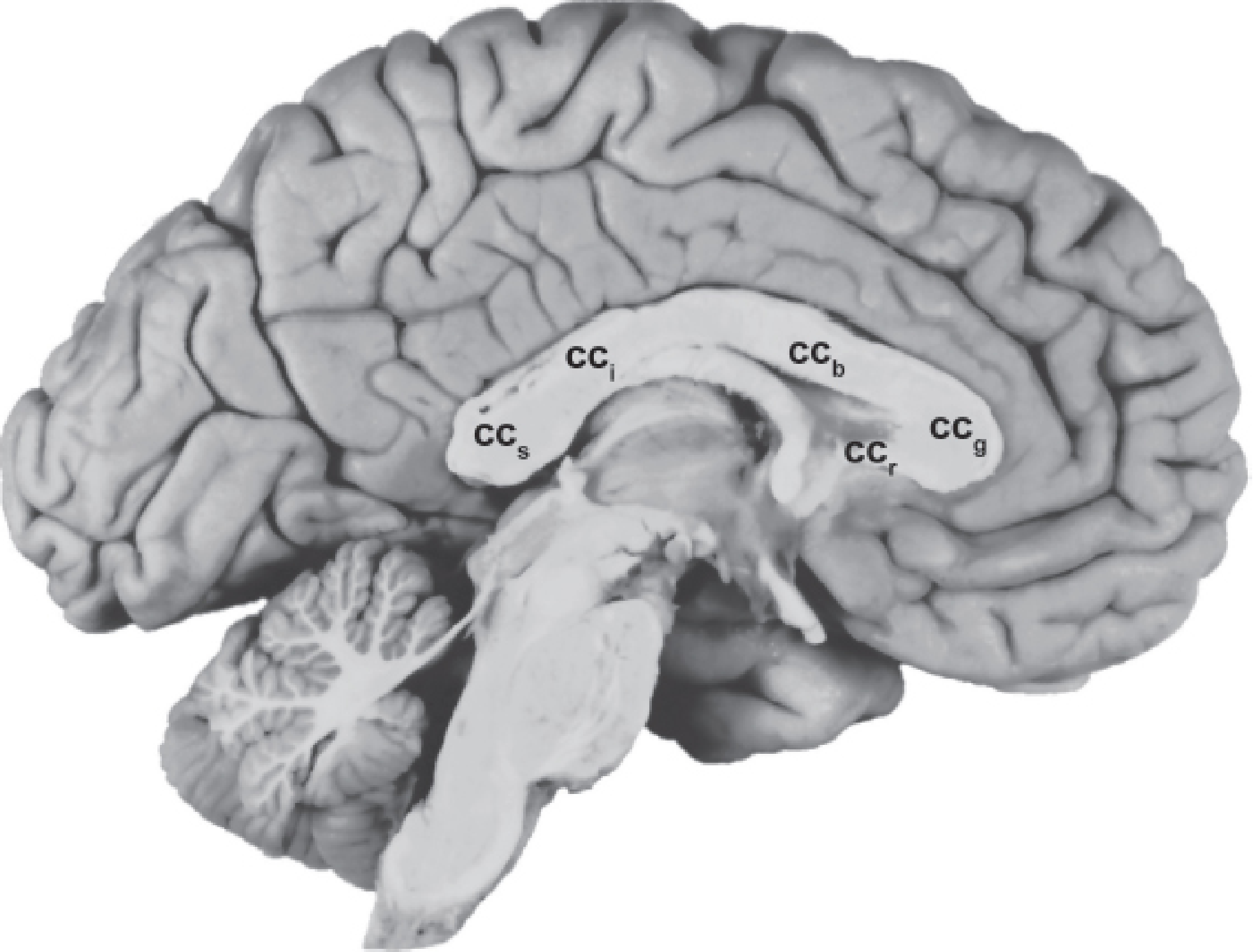
1. Rostrum (CC_r)
- The most anterior-inferior portion, projecting backward from the genu
- Thin and hook-like, it forms the inferior bend of the structure
- Connects orbitofrontal cortex regions between hemispheres
2. Genu (CC_g)
- The anterior knee (genu = Latin for "knee")
- Curves anteriorly and dorsally from the rostrum
- Fibers from the genu form the forceps minor, connecting the prefrontal cortices
- Carries higher-order cognitive information from the prefrontal cortex
3. Body (Trunk) (CC_b)
- The largest and longest part, running in the mid-sagittal plane
- Connects the motor, somatosensory, auditory, and association cortices
- Carries predominantly visual, auditory, and somatosensory information
4. Splenium (CC_s)
- The enlarged, rounded posterior end - the thickest part
- Fibers form the forceps major, connecting the occipital cortices
- Carries higher-order sensory and parietal/temporal cortex connections
- Last part to develop embryologically
The Isthmus (CC_i)
- A narrow constriction between the body and the splenium
- Sometimes listed as a 5th subdivision (especially in neuroimaging/neuropsychiatry texts)
- Carries connections between the temporal and parietal cortices
Fiber Projections Summary
| Part | Cortex Connected | Information Carried |
|---|---|---|
| Rostrum | Orbitofrontal | Limbic/prefrontal |
| Genu | Prefrontal | Higher-order cognition |
| Body | Motor, somatosensory, auditory | Motor, sensory, auditory |
| Isthmus | Posterior parietal, superior temporal | Somatosensory, auditory |
| Splenium | Occipital, posterior temporal, parietal | Visual, higher-order sensory |
Embryological Development
The corpus callosum develops between 7 and 20 weeks' gestation. Development proceeds from the posterior genu and anterior body first, then the anterior genu and rostrum, and finally the splenium (all parts present by ~20 weeks). This order is important clinically: agenesis affecting the genu/body but sparing the splenium suggests acquired destruction rather than developmental failure.
Sources: Kaplan & Sadock's Comprehensive Textbook of Psychiatry (FIGURE 1.2-13); Grainger & Allison's Diagnostic Radiology; Gray's Anatomy for Students
This is a shared conversation. Sign in to Orris to start your own chat.