
Ozone therapy in orthopaedics 10 marks pg answer with flow chart and images
"ozone therapy" AND "orthopaedic" OR "musculoskeletal"
ozone therapy orthopaedics mechanism applications clinical evidence 2024
https://pmc.ncbi.nlm.nih.gov/articles/PMC11290204
"ozone therapy" AND ("disc herniation" OR "knee osteoarthritis" OR "low back pain")
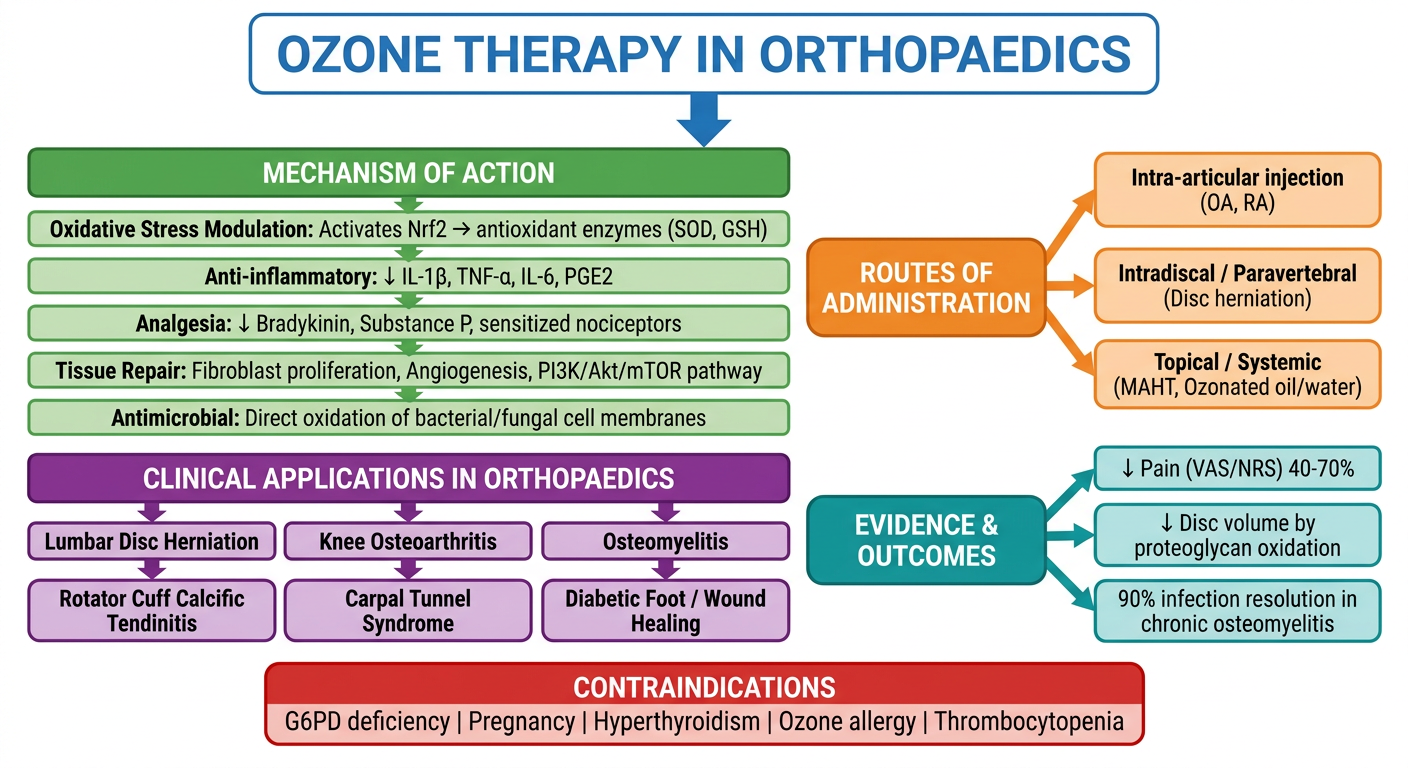
Medical flowchart titled "Ozone Therapy in Orthopaedics" with clean clinical diagram style on white background. Show these connected sections with arrows and boxes: TOP: "OZONE THERAPY IN ORTHOPAEDICS" (large title box, blue) SECTION 1 - "MECHANISM OF ACTION" (green box) with 5 sub-boxes below connected by arrows: - "Oxidative Stress Modulation: Activates Nrf2 → antioxidant enzymes (SOD, GSH)" - "Anti-inflammatory: ↓ IL-1β, TNF-α, IL-6, PGE2" - "Analgesia: ↓ Bradykinin, Substance P, sensitized nociceptors" - "Tissue Repair: Fibroblast proliferation, Angiogenesis, PI3K/Akt/mTOR pathway" - "Antimicrobial: Direct oxidation of bacterial/fungal cell membranes" SECTION 2 - "ROUTES OF ADMINISTRATION" (orange box) with 3 branches: - "Intra-articular injection (OA, RA)" - "Intradiscal / Paravertebral (Disc herniation)" - "Topical / Systemic (MAHT, Ozonated oil/water)" SECTION 3 - "CLINICAL APPLICATIONS IN ORTHOPAEDICS" (purple box) with 6 sub-boxes: - "Lumbar Disc Herniation" - "Knee Osteoarthritis" - "Osteomyelitis" - "Rotator Cuff Calcific Tendinitis" - "Carpal Tunnel Syndrome" - "Diabetic Foot / Wound Healing" SECTION 4 - "EVIDENCE & OUTCOMES" (teal box) with arrows pointing to: - "↓ Pain (VAS/NRS) 40-70%" - "↓ Disc volume by proteoglycan oxidation" - "90% infection resolution in chronic osteomyelitis" BOTTOM: "CONTRAINDICATIONS" (red box): "G6PD deficiency | Pregnancy | Hyperthyroidism | Ozone allergy | Thrombocytopenia" Use clean sans-serif font, color-coded boxes, directional arrows, professional medical infographic style.
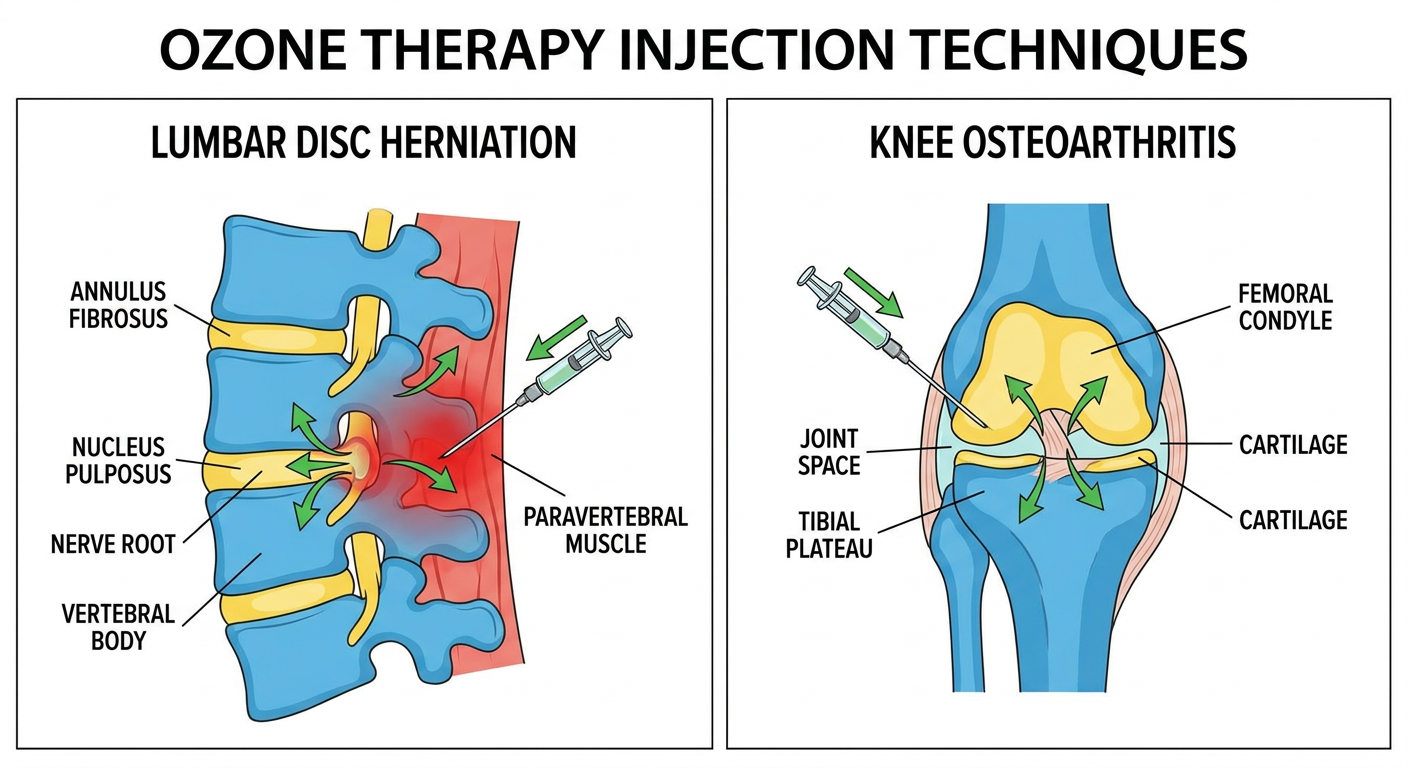
Professional medical illustration showing ozone therapy injection technique for lumbar disc herniation and knee osteoarthritis. Left panel: cross-section of lumbar spine showing needle placement for intradiscal and paravertebral ozone injection, with labeled anatomy (nucleus pulposus, annulus fibrosus, nerve root, vertebral body). Right panel: cross-section of knee joint showing intra-articular ozone injection, with labeled structures (femoral condyle, tibial plateau, joint space, cartilage). Color-coded with blue for bone, yellow for cartilage, red for inflamed tissue, and green arrows showing ozone gas distribution. Medical textbook style, clean white background, professional anatomical diagram.
PMID: 40452464
PMID: 38854278
OZONE THERAPY IN ORTHOPAEDICS
FLOWCHART
INJECTION TECHNIQUE ILLUSTRATION
INTRODUCTION
MECHANISM OF ACTION
1. Oxidative Stress Modulation (Hormesis Principle)
- Ozone reacts with polyunsaturated fatty acids in cell membranes to form Reactive Oxygen Species (ROS) and Lipid Ozonation Products (LOPs)
- At controlled doses, ROS activate the Nrf2 transcription factor, upregulating antioxidant enzymes: Superoxide Dismutase (SOD), Catalase (CAT), Glutathione Peroxidase (GPx)
- This "hormetic" oxidative stimulus paradoxically reduces net oxidative damage
2. Anti-inflammatory Effects
- Downregulates pro-inflammatory cytokines: IL-1β, TNF-α, IL-6, PGE₂
- Inhibits NF-κB signaling pathway
- Reduces matrix metalloproteinases (MMPs) responsible for cartilage degradation in OA
- In disc disease: reduces phospholipase A₂ activity on nerve roots
3. Analgesic Mechanism
- Inhibits bradykinin, substance P, and sensitized nociceptors
- Reduces perineural edema around compressed nerve roots
- For disc herniation: dehydration and shrinkage of nucleus pulposus by oxidation of proteoglycans (which are highly hydrophilic), reducing disc volume and nerve compression
4. Tissue Repair and Regeneration
- Stimulates fibroblast migration and proliferation
- Promotes angiogenesis via VEGF upregulation
- Activates PI3K/Akt/mTOR pathway for epithelial-mesenchymal transition
- Enhances oxygen delivery to hypoxic ischemic tissues
5. Antimicrobial Action
- Direct oxidation of bacterial, fungal, and viral cell membranes
- Effective against biofilm-forming organisms in osteomyelitis
ROUTES OF ADMINISTRATION
| Route | Concentration | Application |
|---|---|---|
| Intra-articular injection | 20-30 mcg/mL, 5-20 mL | Knee OA, RA, TMJ |
| Intradiscal injection | 27-30 mcg/mL, 3-5 mL | Lumbar/cervical disc herniation |
| Paravertebral / Epidural | 20-25 mcg/mL | Low back pain, radiculopathy |
| Intramuscular | 10-20 mcg/mL | Tendinopathies, muscle injuries |
| Major Autohemotherapy (MAHT) | 200-300 mL blood + ozone | Systemic; avascular necrosis, osteomyelitis |
| Topical (ozonated oil/water) | Direct application | Wound healing, diabetic foot ulcers |
CLINICAL APPLICATIONS IN ORTHOPAEDICS
1. Lumbar Disc Herniation
- Most studied application of ozone in orthopaedics
- Ozone injected intradiscally ± paravertebrally under CT/fluoroscopy guidance
- Oxidizes nucleus pulposus proteoglycans → disc dehydration → volume reduction → nerve root decompression
- Reduces inflammatory mediators around nerve roots
- Evidence: Multiple systematic reviews show significant VAS reduction; Kumar et al. 2024 systematic review of prospective studies shows consistent pain reduction with low complication rates
- Success rate: 70-80% in appropriately selected patients; avoids surgery in majority
2. Knee Osteoarthritis
- Intra-articular ozone injections (3-5 sessions, weekly)
- Reduces synovial inflammation, inhibits chondrocyte apoptosis
- Restores cellular redox equilibrium in cartilage
- Often combined with hyaluronic acid (HA) for synergistic effect: combination superior to either alone (Giombini RCT)
- Evidence: Farì et al. (J Back Musculoskelet Rehabil, 2025) - systematic review of 5 RCTs: OOT significantly reduces pain and improves joint mobility; effects outlast corticosteroids; fewer side effects
3. Cervical Disc Herniation
- Percutaneous intradiscal ozone nucleolysis under fluoroscopic guidance
- Evidence: Ghatge et al. (Cureus, 2024) meta-analysis of 5 studies: standardized mean difference in VAS = 2.78 (95% CI 1.48-4.07, p<0.0001). Minimally invasive alternative to surgery.
4. Osteomyelitis (Chronic)
- MAHT and local ozone irrigation used as adjunct to antibiotics
- Effective against antibiotic-resistant biofilms
- Studies report 90% infection resolution in antibiotic-resistant chronic osteomyelitis cases
- Particularly useful in diabetic osteomyelitis
5. Avascular Necrosis (AVN)
- Improves microcirculatory disturbances in bone
- Adjunctive role alongside core decompression
- Reduces ischemia-reperfusion injury
6. Rotator Cuff Calcific Tendinitis
- Perineural/peritendinous ozone injections
- Reduces calcium deposit inflammation and facilitates resorption
- Used when ultrasound-guided needling is insufficient
7. Diabetic Foot Ulcers and Chronic Wounds
- Topical ozone (ozonated oil, ozonated water bagging) and MAHT
- Reduces wound size, promotes angiogenesis and fibroblast proliferation
- Reduces infection load
- Speeds epithelialization by up to 40% in complex wound cases
8. Carpal Tunnel Syndrome
- Perineural ozone injection around median nerve
- Reduces perineural inflammation and fibrosis
- Evidence limited to case series but shows improvement in nerve conduction
9. Sports Medicine
- Hamstring injuries, ligament sprains, Achilles tendinopathy
- Reduces inflammation, improves perfusion, accelerates return-to-play
- Achilles tendinopathy RCT: ozone injections reduced pain scores by 40% vs 20% in placebo group at 6 weeks
EVIDENCE SUMMARY
| Condition | Level of Evidence | Key Finding |
|---|---|---|
| Lumbar disc herniation | Multiple SRs | 70-80% success, VAS ↓ significantly |
| Knee OA | SR of 5 RCTs (2025) | Pain ↓, function ↑, fewer SE vs corticosteroids |
| Cervical disc herniation | Meta-analysis (2024) | SMD 2.78 in VAS improvement |
| Chronic osteomyelitis | Case series + reviews | 90% infection resolution |
| Diabetic foot wounds | RCTs + animal studies | 40% faster epithelialization |
ADVANTAGES OVER CONVENTIONAL TREATMENTS
- Minimally invasive - day-care procedure, no general anesthesia
- Multi-modal action - analgesic + anti-inflammatory + regenerative simultaneously
- No systemic toxicity at therapeutic doses
- Cost-effective compared to surgery or biologics (PRP, stem cells)
- Avoids or delays surgery in disc disease and OA
- No drug interactions
- Can be combined with HA, PRP, corticosteroids for synergistic effects
CONTRAINDICATIONS
| Absolute | Relative |
|---|---|
| G6PD deficiency (hemolysis risk) | Pregnancy |
| Known ozone hypersensitivity | Uncontrolled hyperthyroidism |
| Thrombocytopenia | Active bleeding disorders |
| Intravenous route (gas embolism) | Recent steroid injection at same site |
| Severe cardiopulmonary disease | Immunocompromised states |
COMPLICATIONS
- Local: Transient pain flare, local bruising, gas leak (if technique error)
- Neurological: Rare - spinal cord injury if intrathecal inadvertent injection
- Pulmonary embolism: Only if intravenous route used (strictly avoided)
- Infection: Rare if sterile technique followed
- Overall complication rate is < 0.1% with proper technique
LIMITATIONS AND FUTURE DIRECTIONS
- Lack of FDA approval in the USA (widely used in Europe, Latin America, Asia)
- No standardized international dosing protocols
- Need for more high-quality long-term RCTs
- Mechanism of action not fully elucidated at molecular level
- Operator-dependent outcomes
- Future: Ozone + stem cells/exosomes (preconditioning), precision dosing by oxidative stress biomarkers
KEY POINTS FOR EXAM
- Ozone acts by hormetic oxidative stress - controlled ROS generation activating antioxidant pathways
- In disc herniation: proteoglycan oxidation → disc shrinkage → nerve decompression
- In OA: reduces IL-1β, TNF-α, MMP → chondroprotection
- Gold standard contraindication: G6PD deficiency
- Most common orthopaedic use: Lumbar disc herniation and Knee OA
- Concentration used: 10-40 mcg/mL (O₂:O₃ mixture, 95-99% O₂)
- MAHT = Major Autohemotherapy (200-300 mL blood withdrawn, ozonated, reinfused)
- Jeyaraman M et al. Ozone therapy in musculoskeletal medicine: a comprehensive review. Eur J Med Res. 2024;29:398
- Farì G et al. The effects of oxygen-ozone therapy in knee osteoarthritis: A systematic review. J Back Musculoskelet Rehabil. 2025. PMID: 40452464
- Ghatge SB et al. Ozone Disc Nucleolysis for Cervical Intervertebral Disc Herniation: A Systematic Review and Meta-Analysis. Cureus. 2024. PMID: 38854278
- Ozone therapy for knee OA: literature visualization analysis. PMC11918477