
Anterior pituitary hormones pharmacology 2nd year bpt
Reading File
The anterior pituitary secretes 6 main hormones: GH, TSH, ACTH, FSH, LH, and prolactin. Their pharmacological uses include growth hormone deficiency treatment (somatropin), infertility management (gonadotropins), Cushing's testing (metyrapone/ketoconazole), and hypothyroidism diagnosis (TSH). Analogs and antagonists of these are widely used clinically.
Searching sources...
Finding Sources
Finding Sources
I found excellent pharmacology sources. Let me read the key sections now in parallel.
Reading File
Reading File
Excellent content found. Let me read more from both books to get full details on GH, TSH, FSH/LH, and prolactin sections.
Reading File
Reading File
Reading File
Reading File
Reading File
Reading File
Reading File
Reading File
Now let me get the FSH/LH/gonadotropins and prolactin sections, and fetch the key diagrams:
Reading File
Reading File
Loading Image
I now have comprehensive content from both Lippincott Pharmacology and Katzung's Pharmacology. Let me compile the full, well-structured answer for a 2nd year BPT student.
Anterior Pituitary Hormones - Pharmacology (2nd Year BPT)
Source: Lippincott Illustrated Reviews: Pharmacology & Katzung's Basic and Clinical Pharmacology, 16th Ed.
Overview
The pituitary gland is the "master gland." Its anterior lobe secretes 6 key hormones, all under hypothalamic control via the hypophyseal portal system. Releasing/inhibiting hormones from the hypothalamus reach the anterior pituitary and trigger synthesis and secretion of target hormones.
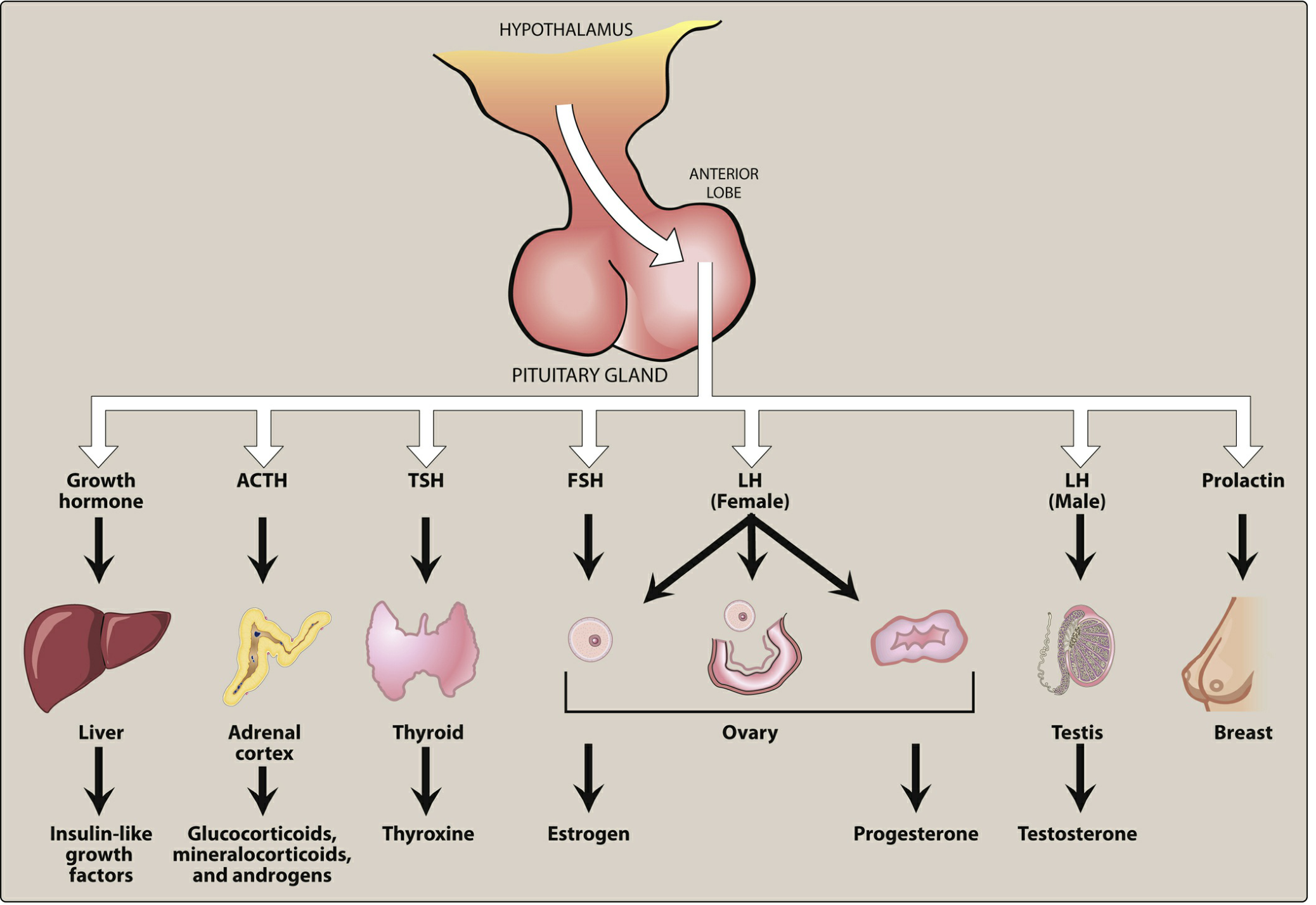
Important note on administration: All pituitary hormones are peptides/glycoproteins, so they are destroyed by gut proteolytic enzymes. They must be given IM, subcutaneously (SC), or intranasally - NOT orally.
Receptor Classification (Katzung)
| Hormone Group | Receptor Type |
|---|---|
| GH, Prolactin | JAK/STAT superfamily |
| TSH, FSH, LH | G protein-coupled receptors (share α subunit; differ in β subunit) |
| ACTH | G protein-coupled receptor (melanocortin 2 receptor) |
1. ACTH (Adrenocorticotropic Hormone / Corticotropin)
Hypothalamic control: CRH (corticotropin-releasing hormone) stimulates; cortisol provides negative feedback.
Precursor: Proopiomelanocortin (POMC) - also gives rise to α-MSH and β-endorphin.
Release pattern: Pulsatile with diurnal rhythm - highest in early morning, lowest late evening. Stress increases it.
Mechanism of Action
ACTH binds G protein-coupled receptors on the adrenal cortex → activates adenylyl cyclase → stimulates the rate-limiting step: cholesterol → pregnenolone → synthesis and release of glucocorticoids, mineralocorticoids, and adrenal androgens.
Therapeutic Uses
- Diagnosis of adrenal insufficiency: differentiates primary (Addison disease - adrenal atrophy) from secondary (pituitary ACTH failure)
- Cosyntropin (synthetic human ACTH, preferred over animal extract) used for the cosyntropin stimulation test
- CRH used to distinguish Cushing disease from ectopic ACTH syndrome
- Infantile spasms, multiple sclerosis, resistant epilepsy
Adverse Effects
Similar to glucocorticoids: hypertension, peripheral edema, hypokalemia, emotional disturbances, bone loss, increased infection risk.
2. Growth Hormone (GH / Somatotropin)
Hypothalamic control:
- GHRH (growth hormone-releasing hormone) → stimulates GH
- Somatostatin (SST) → inhibits GH
- GH and IGF-1 → negative feedback on both GHRH and somatostatin
Release: Pulsatile; highest during deep sleep. Decreases with age.
Mechanism of Action
- Direct effects: on liver, muscle, adipose tissue
- Indirect effects: via IGF-1 and IGF-2 (somatomedins) produced in the liver → promote bone growth, cell proliferation, protein synthesis
- GH receptors activate the JAK2/STAT5 pathway
Therapeutic Preparation
Somatropin = recombinant human GH (rhGH), made by recombinant DNA technology. Given SC or IM daily.
Clinical Uses (Approved)
| Condition | Details |
|---|---|
| GH deficiency in children | Pituitary dwarfism - achieves near-normal adult height if started early |
| GH deficiency in adults | Reduces obesity, increases muscle mass, improves bone density |
| Turner syndrome | Short stature in girls |
| Noonan syndrome | Growth failure |
| Prader-Willi syndrome | Decreases body fat, increases lean mass |
| Chronic renal insufficiency (pre-transplant) | Growth failure |
| Idiopathic short stature (ISS) | Height ≥2.25 SD below normal; adds ~4-7 cm to adult height |
| AIDS wasting | Anabolic effect |
| Short bowel syndrome | Improves intestinal absorption |
Adverse Effects
- Injection site pain, edema, arthralgias, myalgias, nausea
- Hyperglycemia (GH is diabetogenic)
- Pseudotumor cerebri, slipped capital femoral epiphysis, scoliosis progression in children
- Carpal tunnel syndrome in adults
- Increases CYP450 enzyme activity (drug interactions)
Contraindications
- Closed epiphyses (no point in treatment)
- Diabetic retinopathy
- Obese Prader-Willi patients with sleep apnea (risk of asphyxiation)
- Active malignancy
GH Excess - Acromegaly Treatment
- Somatostatin analogs: Octreotide, Lanreotide - inhibit GH release; used every 4 weeks (depot); also used for carcinoid tumors and bleeding esophageal varices
- GH receptor antagonist: Pegvisomant - blocks GH signaling
- Adverse effects of octreotide: bradycardia, diarrhea, gallstones (delayed gallbladder emptying), steatorrhea
3. TSH (Thyroid-Stimulating Hormone / Thyrotropin)
Hypothalamic control: TRH stimulates; T3/T4 provide negative feedback.
Structure: Glycoprotein dimer; shares α-subunit with FSH and LH; unique β-subunit confers specificity.
Mechanism of Action
TSH binds G protein-coupled receptors on thyroid follicular cells → stimulates:
- Iodide uptake
- Thyroglobulin synthesis
- T3 and T4 synthesis and release
Pharmacological Use
- Thyrotropin alfa (recombinant TSH): Used in patients post-thyroid surgery for carcinoma to stimulate radioactive iodine (131I) uptake for detecting cancer recurrence and measuring serum thyroglobulin - without stopping levothyroxine therapy
Drugs Affecting Thyroid (Related to TSH Axis)
- Thioamides (propylthiouracil/PTU, methimazole): Inhibit iodination of tyrosines and coupling → reduce T3/T4 synthesis
- PTU also blocks peripheral T4→T3 conversion
- Methimazole preferred (once daily, fewer ADRs); PTU preferred in 1st trimester pregnancy
- ADRs: rash, agranulocytosis, hepatotoxicity
- Radioactive iodine (131I): Destroys thyroid follicular cells; causes hypothyroidism requiring levothyroxine
- Iodide (high dose - Wolff-Chaikoff effect): Transiently inhibits thyroid hormone synthesis and release; used pre-surgery and in thyroid storm
4. FSH & LH (Gonadotropins)
Hypothalamic control: GnRH (pulsatile) stimulates both FSH and LH. Continuous GnRH suppresses them.
Structure: Both are glycoprotein dimers sharing the α-subunit; distinct β-subunits.
Actions:
- FSH: stimulates ovarian follicle maturation (female) and spermatogenesis (male)
- LH: triggers ovulation, stimulates progesterone (female) and testosterone (male)
Gonadotropin Preparations
| Drug | Source | Content | Use |
|---|---|---|---|
| Menotropins (hMG) | Urine of postmenopausal women | FSH + LH | Infertility |
| Urofollitropin | Urine of postmenopausal women | FSH only | Infertility |
| Follitropin alfa / beta | Recombinant DNA | FSH only | Infertility |
| hCG (human chorionic gonadotropin) | Urine of pregnant women | LH-like activity | Trigger ovulation; treat cryptorchidism |
| Choriogonadotropin alfa | Recombinant DNA | LH-like | ART protocols |
Infertility protocol: Inject hMG or FSH for 5-12 days → follicular growth → then hCG injection → ovulation
Adverse effects: Ovarian hyperstimulation syndrome (OHSS - potentially life threatening), ovarian enlargement, multiple pregnancies.
5. GnRH and Its Analogs (Hypothalamic - controls FSH & LH)
GnRH Agonist Analogs (Continuous use = suppression)
Leuprolide, Goserelin, Nafarelin
- Paradox: Continuous use downregulates GnRH receptors → suppresses FSH/LH → reduces gonadal steroids
- Uses:
- Prostate cancer (medical castration)
- Endometriosis
- Precocious puberty (children)
- Suppress LH surge in ART protocols
- Uterine fibroids
- Adverse effects:
- Women: hot flashes, sweating, diminished libido, depression, ovarian cysts
- Men: initial testosterone flare → bone pain; then hot flashes, edema, gynecomastia, diminished libido
- Contraindicated in pregnancy and breastfeeding
GnRH Antagonists (Immediate suppression)
Cetrorelix, Ganirelix
- Block GnRH receptors directly → no initial flare
- Used in ART protocols to prevent premature LH surge
6. Prolactin (PRL)
Hypothalamic control: Dopamine (from hypothalamus) tonically inhibits prolactin. TRH stimulates it. There is no specific prolactin-releasing hormone - dopamine acts as the main brake.
Physiological Roles
- Stimulates and maintains lactation
- Decreases sexual drive and reproductive function (inhibits GnRH)
Pharmacological Relevance
Hyperprolactinemia is the main clinical concern:
- Caused by: pituitary adenoma (prolactinoma), drugs that block dopamine (antipsychotics, metoclopramide), primary hypothyroidism (high TRH stimulates prolactin)
- Effects: amenorrhea, galactorrhea, infertility, loss of libido
Treatment of Hyperprolactinemia: Dopamine Agonists
| Drug | Notes |
|---|---|
| Bromocriptine | Ergot alkaloid; D2 agonist; shrinks prolactinomas; 1st choice; also used in Parkinson's, acromegaly |
| Cabergoline | Longer acting; better tolerated; preferred over bromocriptine for prolactinoma |
ADRs of dopamine agonists: Nausea, vomiting, postural hypotension, headache; cardiac valvular changes with long-term use (cabergoline).
Summary Table
| Hormone | Hypothalamic Control | Receptor | Key Drug | Key Use |
|---|---|---|---|---|
| ACTH | CRH (+), Cortisol (-) | GPCR (MC2R) | Cosyntropin | Diagnose adrenal insufficiency |
| GH | GHRH (+), SST (-) | JAK/STAT | Somatropin | GH deficiency, short stature |
| TSH | TRH (+), T3/T4 (-) | GPCR | Thyrotropin alfa | Post-thyroid cancer surveillance |
| FSH/LH | GnRH (pulsatile +) | GPCR | Menotropins, hCG | Infertility, ART |
| Prolactin | Dopamine (-), TRH (+) | JAK/STAT | Bromocriptine, Cabergoline | Hyperprolactinemia, prolactinoma |
Key Pharmacological Concept:
- Pulsatile GnRH → stimulates FSH/LH (physiological)
- Continuous GnRH agonist → suppresses FSH/LH (pharmacological)
- Dopamine agonists → suppress prolactin (used for prolactinomas)
- Somatostatin analogs → suppress GH (used for acromegaly)
Sources: Lippincott Illustrated Reviews: Pharmacology, Chapter 23; Katzung's Basic and Clinical Pharmacology 16th Ed., Chapter 37
This is a shared conversation. Sign in to Orris to start your own chat.