
Macrolide antibiotics
Reading File
Macrolide antibiotics are a class of antibiotics that inhibit bacterial protein synthesis by binding to the 50S ribosomal subunit. Key members include erythromycin, azithromycin, clarithromycin, and roxithromycin. They are used for respiratory tract infections, atypical pneumonia, STIs, and as penicillin alternatives.
Searching sources...
Finding Sources
Finding Sources
Searching PubMed
"macrolide" AND "clinical"
Good results. Let me now read the most comprehensive pharmacology sections - from Goodman & Gilman and Harrison's, plus the Katzung section.
Reading File
Reading File
Finding Sources
Excellent. Now let me read the core Goodman & Gilman macrolide section and Lippincott section for comprehensive pharmacology details.
Reading File
Reading File
Let me read more of the Goodman & Gilman macrolide section (truncated) and the Lippincott macrolide-specific section.
Reading File
Reading File
Let me get the rest of the Lippincott pharmacokinetics/therapeutic uses section and fetch the spectrum diagram.
Reading File
Loading Image
Reading File
I now have comprehensive material from Goodman & Gilman and Lippincott. Let me read the remaining G&G section on ADME and therapeutic uses.
Reading File
I now have all the key information needed. Let me also fetch the mechanism of action diagram.
Loading Image
I now have all the information needed for a comprehensive answer. Here is the complete reference on macrolide antibiotics:
Macrolide Antibiotics
Structure
Macrolide antibiotics are defined by a large macrocyclic lactone ring to which one or more deoxy sugars are attached. Ring sizes vary by agent:
- 14-membered ring: erythromycin, clarithromycin
- 15-membered ring: azithromycin (technically an "azalide" - the ring contains a methyl-substituted nitrogen atom)
Clarithromycin differs from erythromycin only by methylation of the hydroxyl group at position 6. Azithromycin differs by insertion of a nitrogen atom into the lactone ring. Both structural modifications improve acid stability, tissue penetration, and spectrum of activity compared to erythromycin. - Goodman & Gilman's Pharmacological Basis of Therapeutics, p. 1202
Mechanism of Action
Macrolides are primarily bacteriostatic (bactericidal at high concentrations). They bind reversibly to the 23S rRNA of the 50S ribosomal subunit, blocking bacterial protein synthesis.
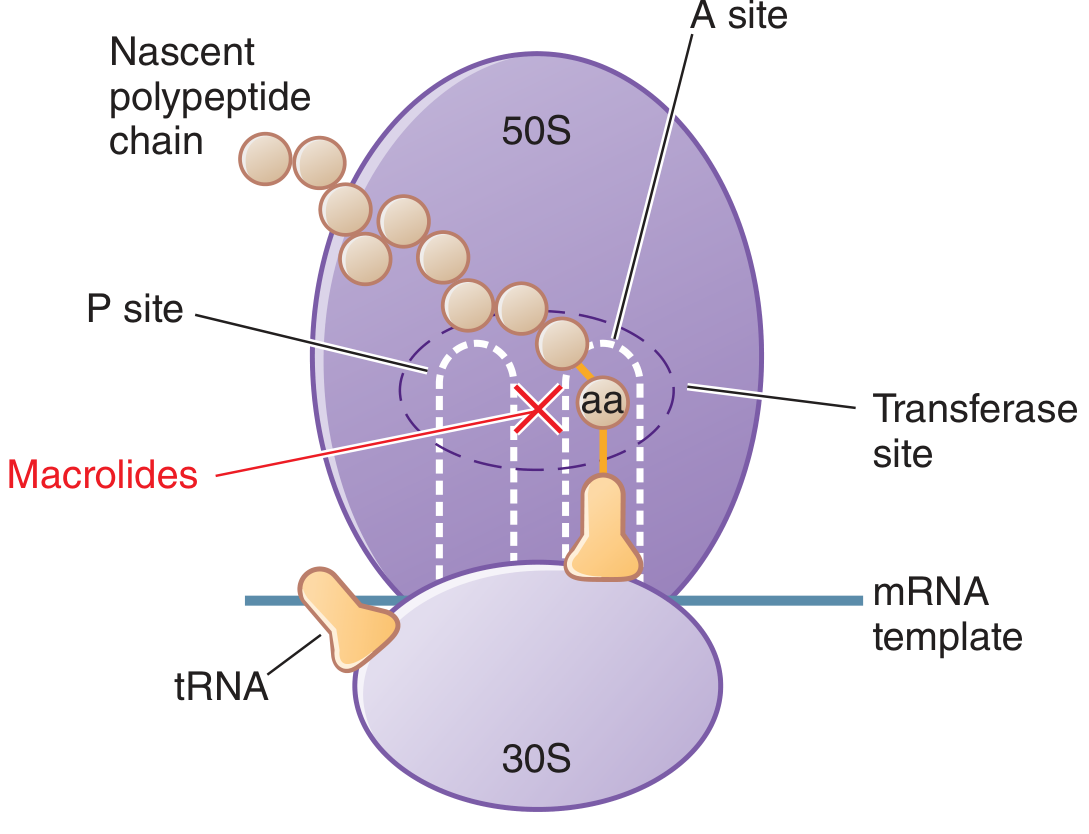
The primary effect is inhibition of the translocation step: the newly synthesized peptidyl-tRNA fails to move from the A site to the P (donor) site. Alternatively, macrolides may cause a conformational change that interferes with both transpeptidation and translocation. - Goodman & Gilman's, p. 1202
Their binding site overlaps with that of clindamycin and chloramphenicol, so these agents can competitively displace each other.
Members of the Class
| Drug | Ring Size | Key Feature |
|---|---|---|
| Erythromycin | 14-membered | Original agent (1952); acid labile |
| Clarithromycin | 14-membered | Acid stable; active metabolite (14-OH); twice daily |
| Azithromycin | 15-membered (azalide) | Longest half-life; once daily; least CYP3A4 interaction |
| Fidaxomicin | Macrocyclic | Non-absorbed; C. difficile only |
| Telithromycin | Ketolide | Active vs. macrolide-resistant strains; withdrawn in US due to hepatotoxicity |
Antimicrobial Spectrum
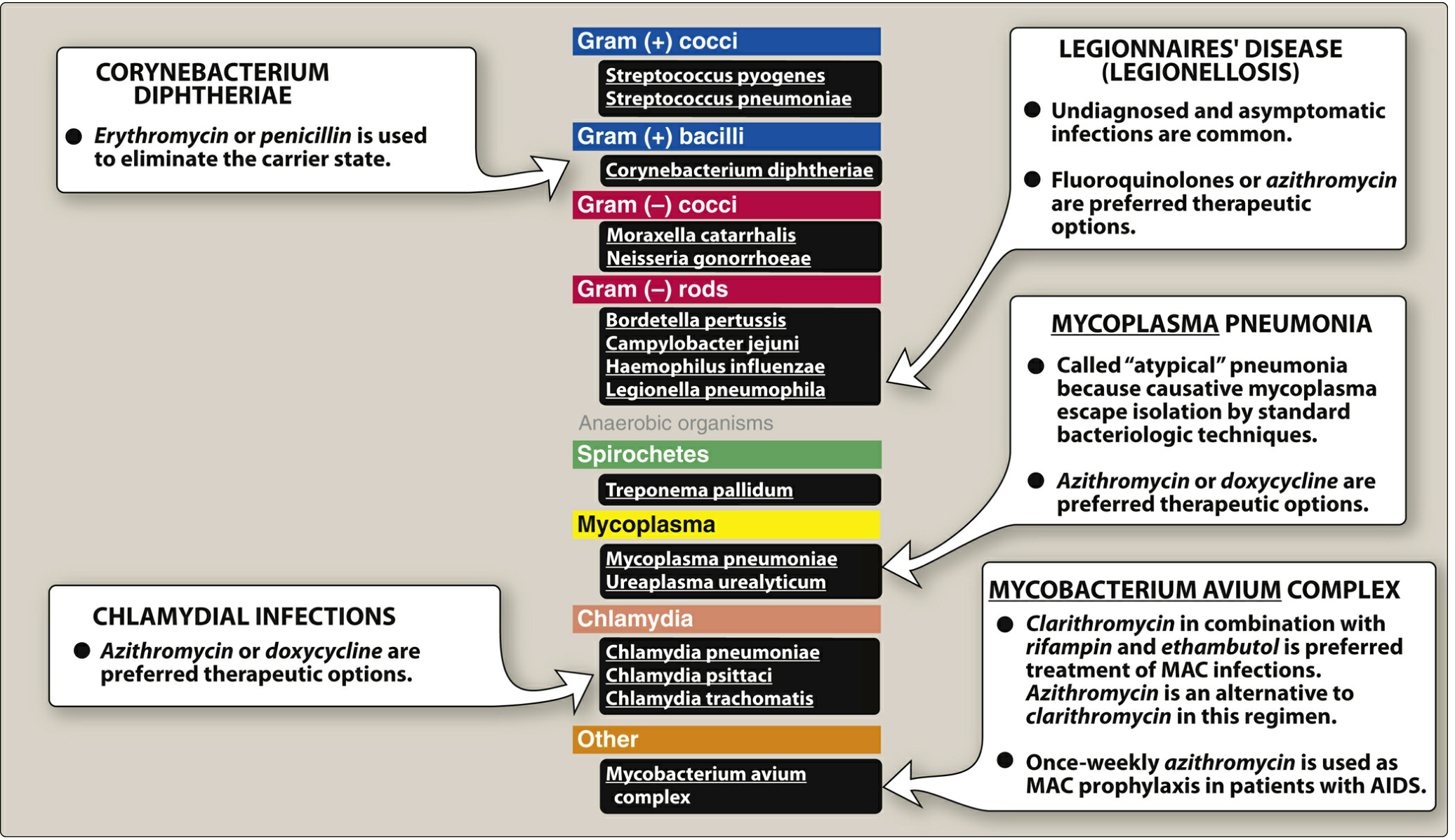
Gram-positive organisms:
- Streptococcus pneumoniae, S. pyogenes, Corynebacterium diphtheriae, Listeria monocytogenes, Clostridium perfringens
Gram-negative organisms:
- Moraxella catarrhalis, Neisseria gonorrhoeae, Bordetella pertussis, Campylobacter jejuni
- H. influenzae: azithromycin > erythromycin > clarithromycin
Atypical/intracellular organisms (key indication):
- Mycoplasma pneumoniae, Chlamydia spp., Legionella pneumophila, Ureaplasma
Mycobacteria:
- Clarithromycin: Mycobacterium avium complex (MAC), M. leprae
- Azithromycin: MAC prophylaxis in AIDS (once-weekly)
Other:
- H. pylori (clarithromycin - component of triple therapy)
- Toxoplasma, Cryptosporidium, Plasmodium spp. (azithromycin/clarithromycin)
- Lippincott Illustrated Reviews Pharmacology, pp. 998-999; Goodman & Gilman's, pp. 1202-1203
Resistance Mechanisms
Four main mechanisms (Lippincott, p. 999):
- Inability to take up the antibiotic (reduced permeability in gram-negatives)
- Active efflux pumps - mef gene (M phenotype); low-level resistance, common in S. pneumoniae
- Ribosomal methylation - erm gene encodes a methylase that methylates adenine in 23S rRNA of the 50S subunit (MLS phenotype: cross-resistance to macrolides, lincosamides, and streptogramin B); high-level resistance
- Erythromycin esterases - plasmid-encoded; gram-negative Enterobacteriaceae
Cross-resistance: strains resistant to erythromycin are usually also resistant to clarithromycin and azithromycin. - Tietz Textbook of Laboratory Medicine; Harrison's Principles of Internal Medicine 22e
Pharmacokinetics
| Property | Erythromycin | Clarithromycin | Azithromycin |
|---|---|---|---|
| Acid stability | Unstable (enteric-coated or esterified formulations required) | Stable | Stable |
| Food effect | Reduces absorption | Increases absorption (XR form) | Reduces absorption |
| Bioavailability | Variable | ~50-55% | ~30-40% |
| Half-life | Short | 3-7 h | 40-68 h (tissue sequestration) |
| Active metabolite | - | 14-hydroxyclarithromycin (t1/2 5-9 h) | - |
| Tissue distribution | Good | Good (including middle ear) | Extremely high (phagocyte accumulation); does NOT penetrate CSF or brain well |
| Elimination | Hepatic/biliary | Renal (20-40% unchanged); dose adjust if CrCl <30 mL/min | Biliary (only 12% urine) |
| IV available | Yes | No | Yes |
The prolonged half-life of azithromycin (up to 68 h) arises from extensive tissue sequestration and allows once-daily (or once-weekly for MAC prophylaxis) dosing. - Goodman & Gilman's, pp. 1202-1203
Therapeutic Uses
- Community-acquired pneumonia (atypical and typical): first-line agents
- Whooping cough (Bordetella pertussis): most effective in the catarrhal phase - Sherris Medical Microbiology
- Chlamydial infections (urogenital, respiratory): azithromycin or doxycycline preferred
- H. pylori eradication: clarithromycin + amoxicillin + PPI (triple therapy)
- MAC treatment and prophylaxis: clarithromycin-based regimens; azithromycin alternative
- Legionnaires disease: azithromycin or fluoroquinolones
- Corynebacterium diphtheriae carrier state: erythromycin or penicillin
- Skin and soft tissue infections: alternative in penicillin-allergic patients
- Prokinetic agent: erythromycin mimics motilin, used in diabetic gastroparesis (250-500 mg doses cause GI smooth muscle contraction) - Goodman & Gilman's, p. 1685
Adverse Effects
GI effects (most common, especially erythromycin):
- Nausea, vomiting, abdominal cramps - partly due to motilin receptor agonism
- Higher doses can produce spastic small bowel contractions, impairing transit
Cardiac toxicity:
- QT prolongation and ventricular tachyarrhythmias (including torsades de pointes) with erythromycin, clarithromycin, and azithromycin
- A large cohort study found a small but statistically significant increase in sudden cardiac death risk with azithromycin vs. no antibiotic or amoxicillin
- Risk heightened by concurrent antiarrhythmics or other QTc-prolonging drugs - Goodman & Gilman's, p. 1204
Hepatotoxicity:
- Cholestatic hepatitis most commonly with erythromycin estolate (after 10-20 days of use)
- Characterized by nausea, vomiting, cramps -> jaundice, fever, eosinophilia, elevated transaminases
- Lower risk with clarithromycin and azithromycin
Ototoxicity:
- Auditory impairment and tinnitus, especially at higher doses
Allergic reactions:
- Fever, eosinophilia, skin rash (uncommon; resolve after stopping drug)
Drug Interactions (CYP3A4)
This is a clinically important class effect:
-
Erythromycin and clarithromycin: potent CYP3A4 inhibitors - significantly increase levels of carbamazepine, cyclosporine, digoxin, ergot alkaloids, theophylline, triazolam, valproate, warfarin, statins, and calcium channel blockers
-
Azithromycin: much weaker CYP3A4 inhibitor - far fewer interactions, preferred when co-prescribing with CYP3A4-metabolized drugs
-
Erythromycin and some derivatives are metabolized by CYP3A4 to metabolites that complex the cytochrome P450 heme iron, rendering it catalytically inactive
-
Rifampin (CYP inducer) reduces clarithromycin concentrations
-
Goodman & Gilman's, pp. 1204-1205; Katzung's Basic and Clinical Pharmacology 16e
Recent Evidence
Recent systematic reviews highlight an evolving role for macrolides:
- A 2024 systematic review and meta-analysis (PMID 39326270) confirmed the efficacy of long-term macrolide therapy (primarily azithromycin) in reducing exacerbations and improving lung function in non-cystic fibrosis bronchiectasis
- A 2026 network meta-analysis (PMID 41534709) evaluated anti-inflammatory therapies in bronchiectasis, positioning macrolides among the most effective agents
- A 2025 meta-analysis (PMID 39383346) on macrolide-resistant Mycoplasma pneumoniae in children found tetracyclines (doxycycline) superior to macrolides when resistance is present - an important clinical consideration given rising macrolide-resistant M. pneumoniae prevalence globally
This is a shared conversation. Sign in to Orris to start your own chat.