
Explain hypothyroidism
hypothyroidism clinical features symptoms signs
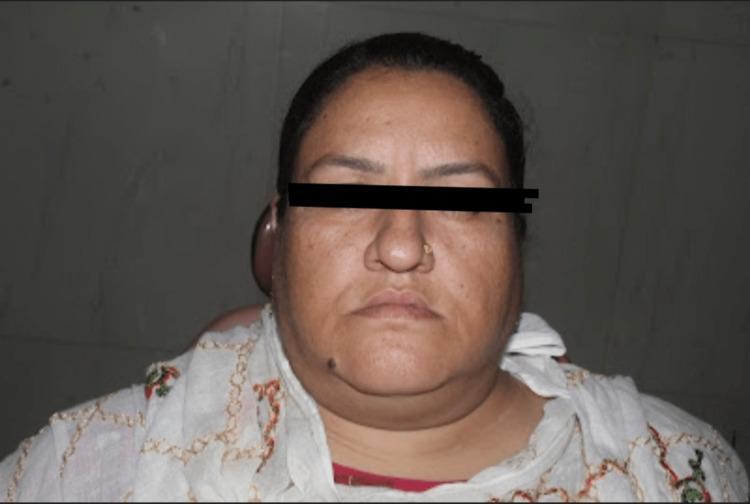
This clinical photograph shows a front-view extraoral assessment of a 38-year-old female patient exhibiting classic signs of facial myxedema and weight gain associated with uncontrolled hypothyroidism. The facial contour is noticeably rounded, presenting a 'moon face' appearance with generalized fullness and obscuration of the underlying bony jawline and malar landmarks. Key visible features include bilateral periorbital puffiness, prominent soft tissue swelling in the cheeks (buccal fat pad region), and increased subcutaneous adipose tissue in the submental and cervical areas, leading to a less defined neck-to-jaw transition. The skin appears somewhat thickened with diffuse hyperpigmentation, particularly across the malar regions. These findings are characteristic clinical manifestations of thyroid dysfunction, reflecting the systemic metabolic effects and mucopolysaccharide deposition in dermal tissues. This visual material serves as an educational reference for identifying secondary systemic symptoms during a dental or general medical examination, specifically in patients with comorbid diabetes mellitus and hypothyroidism.
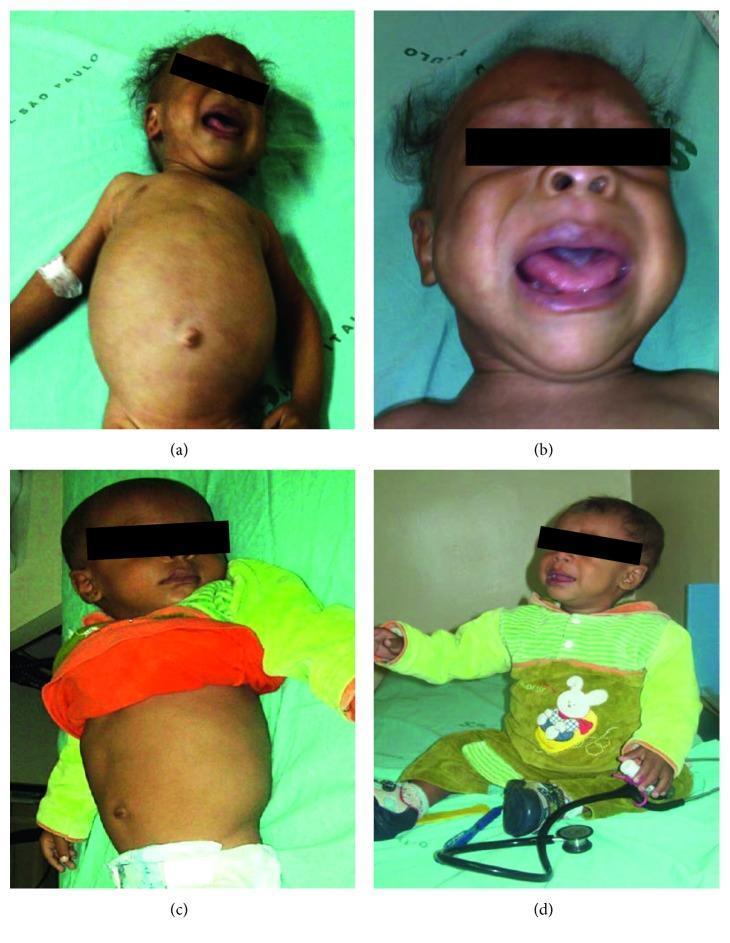
A series of four clinical photographs (a–d) documenting the progression of a pediatric patient with primary congenital hypothyroidism before and after treatment. Images (a) and (b) represent the patient at admission, exhibiting classic symptoms of untreated hypothyroidism: severe abdominal distension (pseudo-obstruction secondary to constipation), an umbilical hernia, generalized myxedema, and visible irritability. Facial features in (b) show macroglossia (enlarged tongue), rarefied eyebrows, and brittle, sparse hair. Images (c) and (d) depict the same patient six months after initiating levothyroxine sodium replacement therapy. These images demonstrate significant clinical improvement, including the complete resolution of abdominal distension (c) and achievement of developmental milestones, such as sitting without support (d). The comparison illustrates the systemic effects of thyroid hormone deficiency on metabolism, gastrointestinal motility, and neurodevelopmental progress in infants, as well as the efficacy of hormonal replacement.
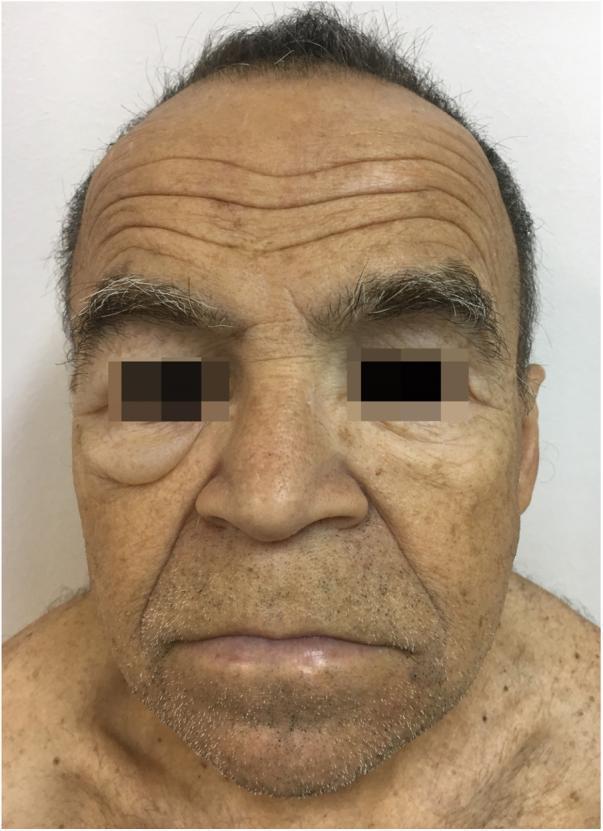
A clinical photograph displaying the frontal view of a 58-year-old male exhibiting classic signs of myxedematous facies associated with primary hypothyroidism. Notable features include bilateral periorbital edema, most pronounced in the right lower eyelid, which appears as a soft, fluid-filled swelling. The patient presents with generalized facial puffiness, particularly around the mid-face and jawline, contributing to a characteristic 'moon-like' facial contour. The skin demonstrates a yellowish, pale tonality (pallor) and a dry texture consistent with xeroderma. Additional visible findings include deep forehead wrinkling, significant skin laxity in the lower facial region, and sparse lateral eyebrows. This image serves as a clinical illustration of the cutaneous and soft tissue manifestations of severe thyroid hormone deficiency, illustrating the accumulation of glycosaminoglycans in the dermis.
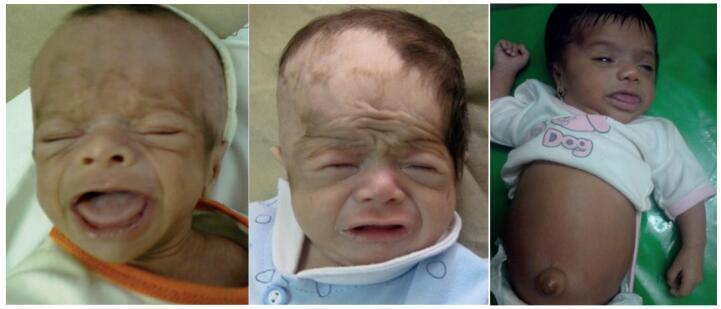
This clinical photograph displays a three-panel series of infants illustrating classic physical manifestations of untreated congenital primary hypothyroidism at three months of age. The first two panels focus on facial features, showing coarse facial features, puffy eyelids (periorbital edema), and a characteristic 'myxedematous' facies. Notably, the infants exhibit a flat nasal bridge, macroglossia (an enlarged, protruding tongue), and thickened skin with prominent forehead wrinkling. The third panel shows an infant with a markedly distended abdomen and a prominent umbilical hernia, another hallmark sign of the condition. Additional visible indicators include sparse hair and an overall lethargic or dull appearance. These images serve as a pedagogical example of the clinical progression of hypothyroidism in infants who missed neonatal screening, highlighting the multisystemic physical signs that accompany developmental delay and metabolic insufficiency in early infancy.
"hypothyroidism"[MeSH Terms] AND "diagnosis" AND "treatment"
Hypothyroidism
Definition
- Textbook of Family Medicine 9e
- Sabiston Textbook of Surgery
Pathophysiology & the HPT Axis
- The hypothalamus releases TRH → stimulates anterior pituitary to release TSH → TSH stimulates thyroid follicular cells to synthesize and secrete T4 and T3
- T3/T4 exert negative feedback on both the hypothalamus and pituitary
- In primary hypothyroidism (>95% of cases), the defect is at the thyroid gland level: TSH rises due to loss of negative feedback
- In secondary hypothyroidism (rare), pituitary TSH secretion fails; in tertiary (very rare), hypothalamic TRH is deficient - both give low/normal TSH with low T4
- Costanzo Physiology 7th Edition; Sabiston Textbook of Surgery
Causes
| Category | Examples |
|---|---|
| Autoimmune (most common in iodine-replete regions) | Hashimoto thyroiditis (chronic lymphocytic thyroiditis) - anti-TPO and anti-thyroglobulin antibodies destroy thyroid stroma |
| Dietary | Iodine deficiency (most common worldwide) |
| Iatrogenic | Thyroidectomy, radioactive iodine (RAI) treatment, head/neck radiation |
| Drug-induced | Lithium (overt hypothyroidism in 14-17% of users; subclinical in 19-55%), amiodarone |
| Congenital | Cretinism - absent/dysgenetic gland, enzymatic defects |
| Transient | Postpartum thyroiditis, subacute thyroiditis, sporadic thyroiditis |
| Central | Pituitary failure (secondary), hypothalamic failure (tertiary) |
- Rosen's Emergency Medicine; Textbook of Family Medicine 9e; Sabiston Textbook of Surgery
Clinical Features
Symptoms & Signs
| System | Features |
|---|---|
| General | Fatigue, lethargy, weight gain, cold intolerance |
| Cardiovascular | Bradycardia, decreased cardiac output, pericardial effusion, diastolic hypertension |
| Skin | Dry, coarse skin; non-pitting edema (myxedema due to glycosaminoglycan deposition); hair loss; sparse lateral eyebrows |
| Neurological | Mental slowness, depression, memory impairment, carpal tunnel syndrome, peripheral neuropathy |
| GI | Constipation, ileus |
| Reproductive | Menorrhagia, anovulation, infertility |
| Metabolic | Hypercholesterolemia, hyponatremia |
| Respiratory | Hypoventilation, obstructive sleep apnoea |
| Eyes | Periorbital puffiness, drooping eyelids |
| Paediatric | Growth retardation; if congenital/perinatal: irreversible intellectual disability (cretinism), macroglossia, umbilical hernia |
- Sabiston Textbook of Surgery; Costanzo Physiology 7th Edition
Diagnosis
- TSH is the single most sensitive screening test for primary hypothyroidism. TSH >4.12 mIU/L raises suspicion; TSH >10 mIU/L with low free T4 = overt primary hypothyroidism
- Free T4 (fT4): low in overt hypothyroidism; normal in subclinical hypothyroidism
- TPO antibodies: confirm autoimmune (Hashimoto) etiology
- Central hypothyroidism: low/normal TSH + low fT4 - fT4 is the monitoring parameter (TSH is unreliable)
- TSH should be rechecked every 6-8 weeks after starting treatment until stable, then annually
- Sabiston Textbook of Surgery; Scott-Brown's Otorhinolaryngology
| Pattern | Diagnosis |
|---|---|
| TSH high, fT4 low | Overt primary hypothyroidism |
| TSH high, fT4 normal | Subclinical hypothyroidism |
| TSH low/normal, fT4 low | Central (secondary/tertiary) hypothyroidism |
Treatment
Levothyroxine (LT4) - First-Line
- LT4 (synthetic T4) is the preferred first-line therapy. The body's peripheral deiodinases convert T4 to active T3 in tissues
- Adult replacement dose: 1.6 µg/kg/day orally
- Starting dose for subclinical/mild disease: typically 50-75 µg/day
- Take at bedtime or 60 minutes before breakfast for optimal absorption
- Treatment is indicated for: all overt hypothyroidism; subclinical hypothyroidism with TSH >10 mIU/L; symptomatic subclinical hypothyroidism with TSH 5.1-10 mIU/L
- Monitoring: TSH every 6-8 weeks until stable, then annually; target TSH within normal range (typically 1-4 mIU/L)
- Rosen's Emergency Medicine; Textbook of Family Medicine 9e
Combination T4 + T3 / Other Options
- Multiple RCTs have not shown superiority of LT4 + liothyronine (LT3) combination over LT4 monotherapy for most patients
- Can be tried in patients with persistent symptoms on adequate LT4 monotherapy (maintaining TSH >1.0 mIU/L to avoid iatrogenic hyperthyroidism)
- LT3 monotherapy and desiccated thyroid extract (DTE) have limited supportive evidence; not recommended as routine first-line therapy
- Sabiston Textbook of Surgery
Subclinical Hypothyroidism
- TSH >10 mIU/L: treat
- TSH 5-10 mIU/L: treat if symptomatic, or if pregnant, or if anti-TPO positive with progressive rise in TSH
Myxedema Coma
- Altered consciousness / coma
- Hypothermia
- Bradycardia, hypotension, shock
- Hypoventilation, respiratory failure
- Hyponatremia
- Cardiomegaly, pericardial effusion, ascites
- Airway protection and ventilatory support
- IV thyroid hormone: LT4 200-400 µg IV loading dose (lower for elderly, CAD, arrhythmia), then 1.6 µg/kg/day
- Hydrocortisone 100 mg IV q8h - given empirically for possible concomitant adrenal insufficiency before thyroid hormone (to prevent precipitating adrenal crisis)
- Fluid resuscitation (normal saline; avoid hypotonic fluids)
- Passive rewarming
- Treat the precipitating cause
- Rosen's Emergency Medicine
Special Situations
Recent Evidence
| Feature | Detail |
|---|---|
| Most common cause (developed world) | Hashimoto thyroiditis |
| Most common cause (worldwide) | Iodine deficiency |
| Best screening test | Serum TSH |
| First-line treatment | Levothyroxine (T4) 1.6 µg/kg/day |
| Monitoring | TSH (primary); fT4 (central hypothyroidism) |
| Emergency form | Myxedema coma - IV T4 + hydrocortisone |