
Pathogenesis flow chart for NO releaser for hypertension drug
A detailed medical pathogenesis flowchart titled "Mechanism of Action: NO (Nitric Oxide) Releasers in Hypertension" showing the following step-by-step pathway: Top section - Drug Sources box: "NO-RELEASING DRUGS FOR HYPERTENSION" Three drugs listed in colored boxes: Nitroglycerin (NTG) [blue], Sodium Nitroprusside (SNP) [red], Isosorbide Dinitrate/Mononitrate (ISDN/ISMN) [green], Hydralazine [purple] Arrow down to: Step 1 box: "DRUG METABOLISM / BIOACTIVATION" - Organic nitrates (NTG, ISDN): enzymatic bioactivation via mitochondrial ALDH2 - Sodium Nitroprusside: spontaneous decomposition in RBCs → releases CN⁻ + NO - Hydralazine: antioxidant → prevents NO breakdown by reactive oxygen species Arrow down to: Step 2 box: "NITRIC OXIDE (NO) RELEASE" NO = endogenous vasodilator (EDRF - Endothelium-Derived Relaxing Factor) Half-life < 5 seconds Arrow down to: Step 3 box: "NO DIFFUSES INTO VASCULAR SMOOTH MUSCLE CELLS" Arrow down to: Step 4 box: "ACTIVATION OF SOLUBLE GUANYLATE CYCLASE (sGC)" NO binds to heme group of sGC → conformational change → enzyme activation Arrow down to: Step 5 box: "↑ cGMP PRODUCTION" GTP → cGMP (catalyzed by activated sGC) Arrow down to: Step 6 box: "ACTIVATION OF PROTEIN KINASE G (PKG / cGMP-dependent protein kinase)" Arrow down to: Step 7 box: "MYOSIN LIGHT CHAIN DEPHOSPHORYLATION" PKG phosphorylates MLCK (inactivates it) → Dephosphorylation of myosin light chains Also: ↓ intracellular Ca²⁺ (SR reuptake + Ca²⁺ channel inhibition) Arrow down to: Step 8 box (green): "VASCULAR SMOOTH MUSCLE RELAXATION" Arterioles + Veins dilate Arrow down splitting into two: Left box (yellow): "VENODILATION (↓ Preload)" - ↓ Venous return - ↓ LVEDP - ↓ Cardiac work Right box (orange): "ARTERIOLAR DILATION (↓ Afterload)" - ↓ SVR (Systemic Vascular Resistance) - ↓ Peripheral resistance Both boxes arrow down to final box (red/bold): "↓ BLOOD PRESSURE (Antihypertensive Effect)" Side note box for Cyanide Toxicity (SNP): "SNP Toxicity: CN⁻ binds cytochrome oxidase → inhibits oxidative phosphorylation → Lactic acidosis + Tachyphylaxis" Clean medical diagram style, white background, professional flowchart with colored boxes and clear arrows, well-labeled, suitable for pharmacology teaching
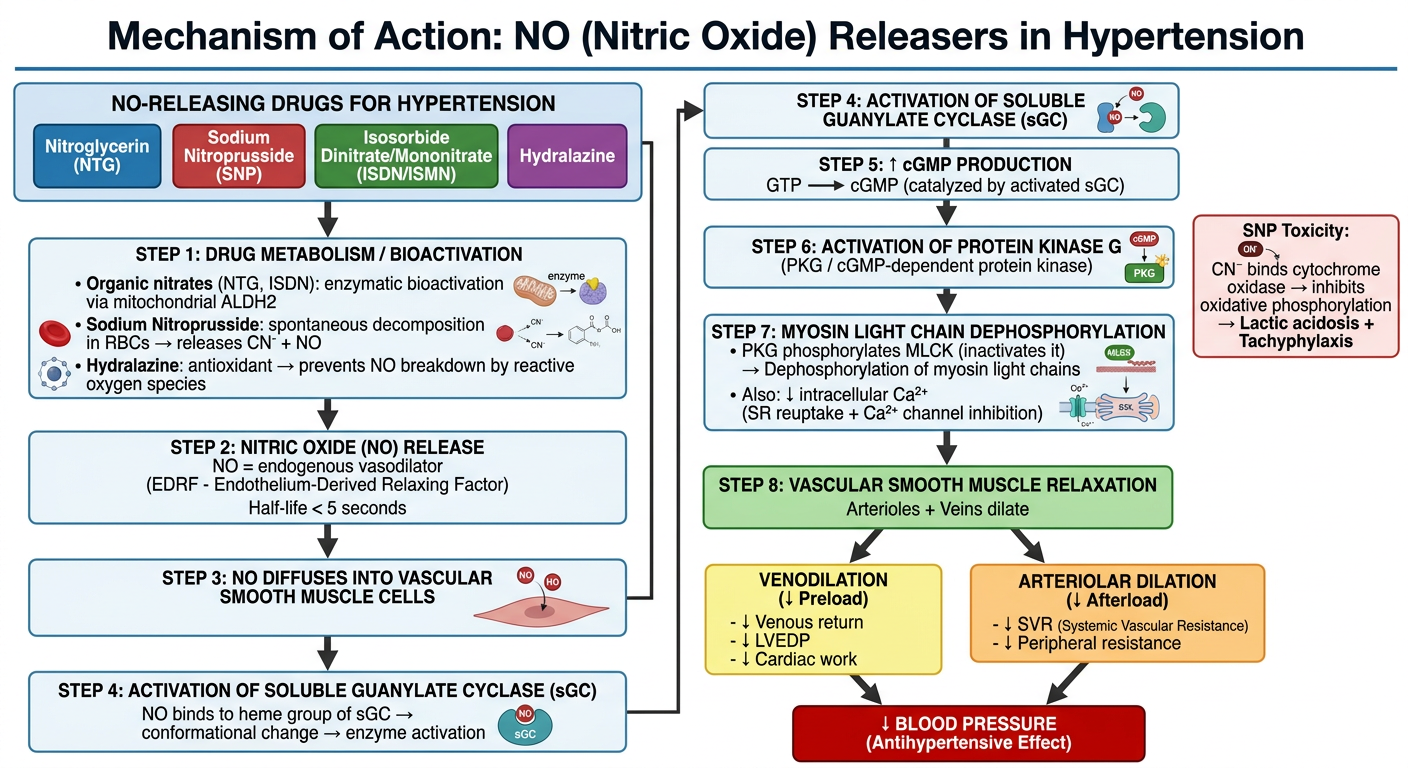
Mechanism of Action: NO Releasers in Hypertension
The Key Drugs
| Drug | Class | Route | Primary Vascular Effect |
|---|---|---|---|
| Nitroglycerin (NTG) | Organic nitrate | IV / sublingual | Venous > Arterial |
| Isosorbide dinitrate/mononitrate | Organic nitrate | Oral | Venous > Arterial |
| Sodium Nitroprusside (SNP) | Inorganic nitrate | IV only | Arterial = Venous (balanced) |
| Hydralazine | Antioxidant/indirect NO enhancer | Oral / IV | Arterial (afterload reduction) |
Pathogenesis Flow
- Organic nitrates (NTG, ISDN): require enzymatic bioactivation via mitochondrial aldehyde dehydrogenase 2 (ALDH2) - this is why tolerance (tachyphylaxis) develops with prolonged use.
- Sodium Nitroprusside: undergoes spontaneous decomposition in red blood cells - the ferrous (Fe²⁺) ion of oxyhemoglobin donates an electron, releasing 5 CN⁻ ions + the active nitroso (N=O) group.
- Hydralazine: acts as an antioxidant - inhibits NADPH oxidases, preventing breakdown of endogenous NO by reactive oxygen species (ROS).
- Stimulates Ca²⁺ reuptake into the sarcoplasmic reticulum
- Inhibits voltage-gated Ca²⁺ channels
- Net result: ↓ intracellular free Ca²⁺
| Venodilation (↓ Preload) | Arteriolar Dilation (↓ Afterload) |
|---|---|
| ↓ Venous return | ↓ SVR (systemic vascular resistance) |
| ↓ Left ventricular end-diastolic pressure | ↓ Peripheral resistance |
| ↓ Cardiac work/O₂ demand | ↓ Aortic impedance |
Important Side Note: SNP Cyanide Toxicity
For nitroprusside
A detailed, clean medical pharmacology flowchart titled "SODIUM NITROPRUSSIDE (SNP) - Mechanism of Action & Pathogenesis" on a white background. The chart has two parallel vertical tracks side by side, connected by arrows. LEFT TRACK (blue theme) - titled "THERAPEUTIC PATHWAY": Box 1 (dark blue, top): "SODIUM NITROPRUSSIDE (SNP)" Chemical: [Fe(CN)5NO]2- complex | IV infusion: 0.5-10 mcg/kg/min | Must protect from light (photodegradation) Arrow down to Box 2 (blue): "ENTERS RED BLOOD CELLS" Fe2+ of oxyhemoglobin donates an electron to SNP (nonenzymatic) Result: Unstable SNP radical + Methemoglobin (Hb Fe3+) Arrow down to Box 3 (blue): "SPONTANEOUS DECOMPOSITION" SNP radical → releases: • NO (nitroso group - active moiety) • 5 CN- ions (cyanide - toxic moiety) Arrow down with NO branch continuing: Box 4 (teal): "NO DIFFUSES INTO VASCULAR SMOOTH MUSCLE CELLS" Half-life of NO < 5 seconds Arrow down to Box 5 (teal): "ACTIVATES SOLUBLE GUANYLATE CYCLASE (sGC)" NO binds to heme (Fe2+) of sGC → enzyme activation Arrow down to Box 6 (teal): "GTP → cGMP ↑↑" Cyclic GMP production increases Arrow down to Box 7 (teal): "ACTIVATES PROTEIN KINASE G (PKG)" cGMP-dependent protein kinase Arrow down to Box 8 (teal): "↓ Intracellular Ca2+ + Myosin light chain dephosphorylation" MLCK inactivation → smooth muscle relaxation Arrow down to Box 9 (green, large): "BALANCED VASODILATION" Arteries = Veins (equal dilation) ↓ Preload (venodilation) + ↓ Afterload (arteriodilation) Arrow down to Box 10 (green, bold): "↓ BLOOD PRESSURE" Rapid onset 1-2 min | Duration: 1-10 min after stopping RIGHT TRACK (red/orange theme) - titled "CYANIDE TOXICITY PATHWAY": Box A (orange): "5 CN- IONS RELEASED" Three possible fates (three branches): Branch 1 (yellow): CN- + Methemoglobin → Cyanmethemoglobin (SAFE - harmless) Branch 2 (green): CN- + Thiosulfate →(Rhodanese enzyme, liver/kidney, Vitamin B12)→ Thiocyanate → Renal excretion (SAFE) Note: Risk if renal failure - thiocyanate accumulates Branch 3 (red, danger): CN- + Cytochrome oxidase → INHIBITS oxidative phosphorylation → CYANIDE TOXICITY Red box: "CYANIDE TOXICITY SIGNS:" • Metabolic acidosis (lactic acidosis) • Cardiac arrhythmias • ↑ Venous O2 content (cells cannot use O2) • Tachyphylaxis (resistance to BP effect) • Risk: dose >500 mcg/kg/day OR >2 mcg/kg/min for >1 hour Treatment box (purple): "TREATMENT OF CN- TOXICITY:" • 100% O2 (mechanical ventilation) • Sodium thiosulfate 150 mg/kg (sulfur donor) • 3% Sodium nitrite 5 mg/kg (creates methemoglobin) • Hydroxocobalamin → forms cyanocobalamin (Vit B12) - renal excretion • Methylene blue (for methemoglobinemia) Bottom center connecting box (gray): "ORGAN EFFECTS OF SNP:" Brain: ↑ CBF, ↑ ICP (cerebral vasodilation, abolishes autoregulation) Heart: Reflex tachycardia, ↑ contractility, coronary steal Lung: Inhibits HPV → V/Q mismatch, ↓ PaO2 Kidney: ↓ RBF if excessive hypotension Clean professional style, all boxes have rounded corners, color-coded arrows (blue for therapeutic, red for toxic pathway), bold headings, medical textbook quality, suitable for pharmacology exam study
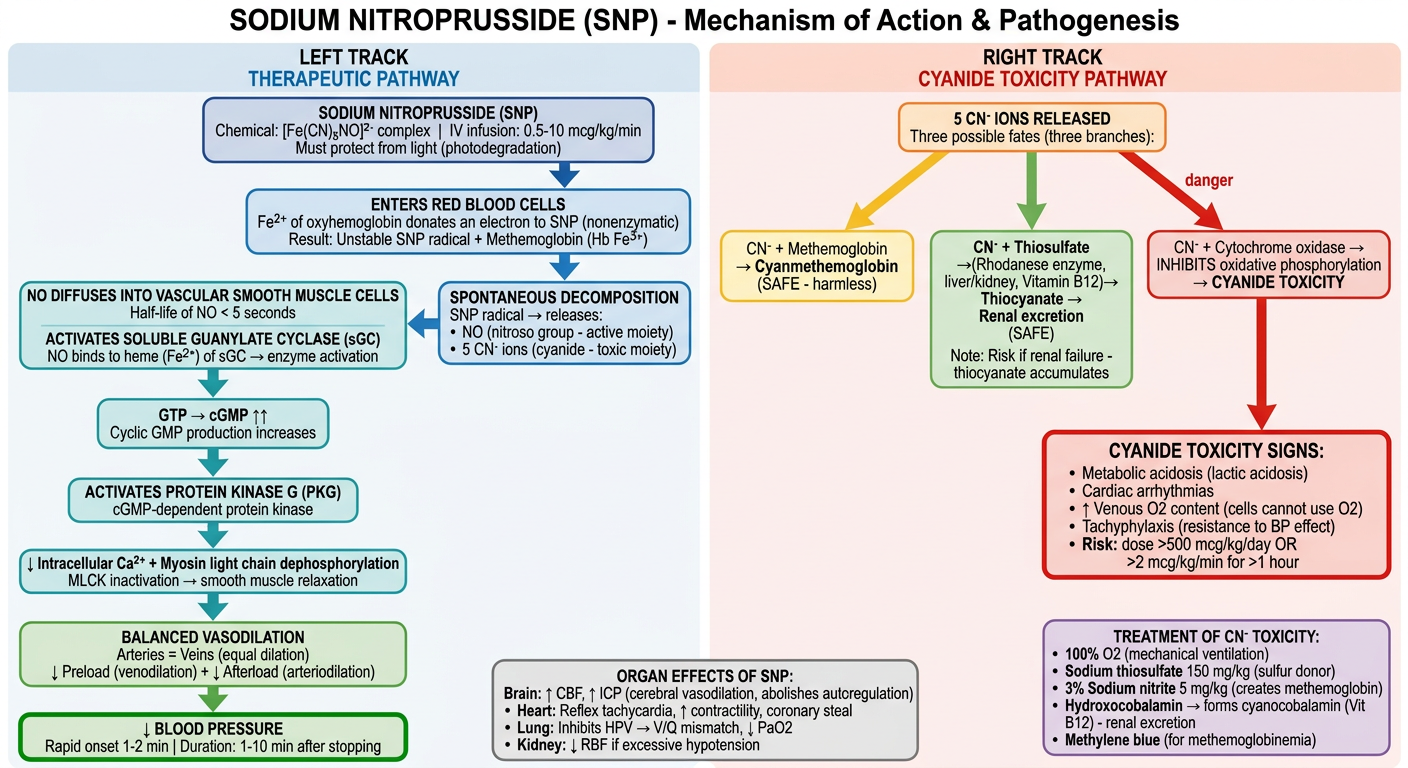
Sodium Nitroprusside (SNP) - Full Pathogenesis
Chemical Identity
THERAPEUTIC PATHWAY (Left Track)
- Dose: 0.5-10 mcg/kg/min by IV infusion
- Must be protected from light (photodegradation)
- Onset: 1-2 minutes; duration: 1-10 minutes after stopping
SNP + OxyHb → Unstable SNP radical + Methemoglobin (Hb Fe³⁺)
- NO (active nitroso moiety) → therapeutic effect
- 5 CN⁻ ions → toxic moiety
- ↓ Preload (venodilation)
- ↓ Afterload (arteriodilation)
- ↓ SVR → ↓ Blood Pressure
CYANIDE TOXICITY PATHWAY (Right Track - from the 5 CN⁻ ions)
| Fate | Reaction | Outcome |
|---|---|---|
| 1 | CN⁻ + Methemoglobin | → Cyanmethemoglobin (safe) |
| 2 | CN⁻ + Thiosulfate →(Rhodanese + Vit B₁₂)→ | Thiocyanate → renal excretion (safe) |
| 3 | CN⁻ + Cytochrome oxidase | → CYANIDE TOXICITY ⚠️ |
- Metabolic (lactic) acidosis - cells cannot use O₂
- Cardiac arrhythmias
- ↑ Venous O₂ content (O₂ not extracted by tissues)
- Tachyphylaxis - first clinical warning sign (resistance to hypotensive effect)
- Risk threshold: cumulative dose >500 mcg/kg/day OR infusion >2 mcg/kg/min for >1 hour
| Agent | Mechanism |
|---|---|
| 100% O₂ | Maximize O₂ availability |
| Sodium thiosulfate 150 mg/kg | Sulfur donor → rhodanese converts CN⁻ → thiocyanate |
| 3% Sodium nitrite 5 mg/kg | Creates methemoglobin (alternative CN⁻ binder) |
| Hydroxocobalamin | CN⁻ → cyanocobalamin (Vit B₁₂) → renal excretion |
| Methylene blue | Treats excessive methemoglobinemia |
Organ-Specific Effects
| Organ | Effect | Mechanism |
|---|---|---|
| Blood vessels | Balanced arterial + venous dilation | NO/cGMP pathway |
| Heart | Reflex tachycardia, ↑ contractility; may cause coronary steal | Baroreceptor reflex; arteriolar dilation |
| Brain | ↑ CBF, ↑ ICP, abolishes cerebral autoregulation | Cerebral vessel dilation |
| Lungs | Inhibits HPV → V/Q mismatch → ↓ PaO₂ | Pulmonary vasodilation |
| Kidney | Thiocyanate accumulation if renal failure | Slow renal clearance of thiocyanate |