
Orthosis
Reading File
The query "Orthosis" is broad. Let me clarify before researching.
Asking for Preferences
What aspect of orthosis are you looking for?
Finding Sources
Searching the Web
orthosis definition types classification overview rehabilitation
Reading File
Searching Images
orthosis types overview ankle foot knee spinal
Now let me read the main orthoses section from Miller's:
Reading File
Reading File
Reading File
I now have comprehensive content. Let me also fetch the spine orthoses section that was cut off:
Reading File
I now have all the information needed for a comprehensive overview. Here is the full answer:
Orthosis — Definition & Types Overview
Definition
An orthosis is an externally applied device used to modify the structural or functional characteristics of the neuromusculoskeletal system. Its primary function is control of motion of certain body segments.
Orthoses are used to:
- Protect long bones or unstable joints
- Support flexible deformities
- Substitute for a functional task
- Prevent deformities, improve alignment, or off-load a body part
They may be static (no movement permitted), static-progressive (holds joint at end range to improve passive ROM), or dynamic (allows or assists motion).
Key principle: Orthoses are not indicated for fixed or spastic deformities that cannot be easily controlled manually.
Naming follows a standard convention based on the joints controlled (e.g., ankle-foot orthosis = AFO, short-leg brace).
Classification by Region
🦶 Foot Orthoses (FO)
Used to align and support the foot; prevent, correct, or accommodate deformities:
| Type | Function |
|---|---|
| Rigid | Limit joint motion; stabilize flexible deformities |
| Semirigid | Partial support + shock absorption |
| Soft | Best shock absorption; accommodate fixed/neuropathic/dysvascular deformities |
Shoe modifications are commonly combined with FOs:
- Extra-depth shoes with high toe box → diabetic feet, claw deformities
- SACH heels → shock absorption at initial loading
- Rocker sole → reduces bending forces (metatarsalgia, hallux rigidus)
- Medial heel out-flare → severe flatfoot
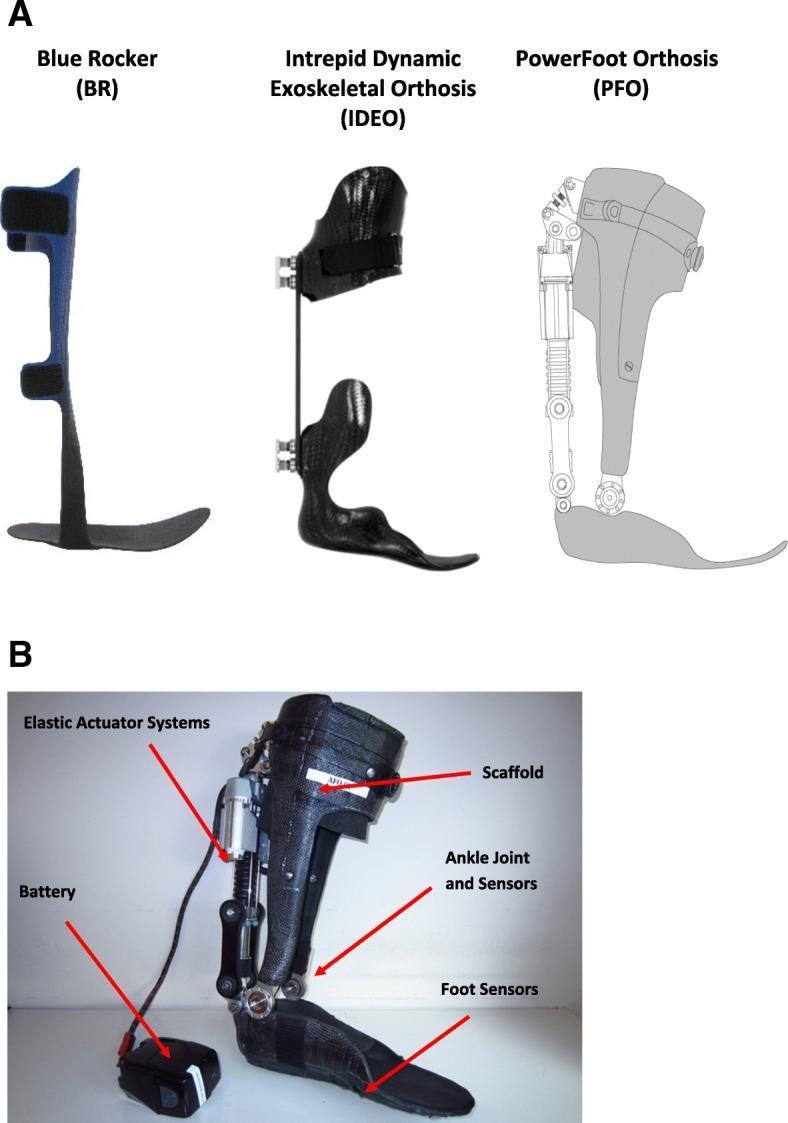
🦵 Ankle-Foot Orthosis (AFO)
The most commonly prescribed lower-limb orthosis. Controls the ankle joint.
- Fabricated from metal bars attached to shoe or thermoplastic elastomer (TPE)
- May be rigid (prevent all motion) or articulated (free or spring-assisted motion)
- Common indications: footdrop, plantar spasticity, spinal cord injury, hindfoot fusions
- Trimlines (full/anterior, intermediate, posterior) control the degree of mediolateral support
- Articulating AFOs permit motion through a mechanical ankle joint
🦿 Knee-Ankle-Foot Orthosis (KAFO)
Extends from upper thigh to foot. Controls an unstable knee joint.
- Provides mediolateral stability with controlled flexion/extension
- Stability achieved via various knee locks
- Subset: knee orthoses alone — for knee OA pain, patellar instability, ACL-deficient knee, post-op rehab
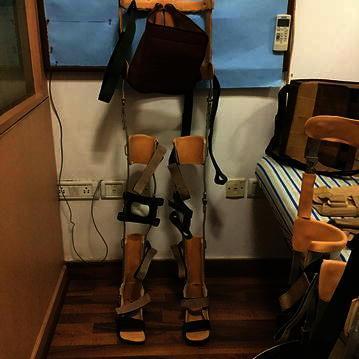
🦼 Hip-Knee-Ankle-Foot Orthosis (HKAFO)
Provides hip and pelvic stability.
- Rarely used in paraplegic adults due to cumbersome nature and high effort requirement
- Experimentally combined with implanted electrodes + functional electrical stimulation
- In children with upper lumbar myelomeningocele: reciprocating gait orthoses (RGOs) are modified HKAFOs used for therapeutic upright activity
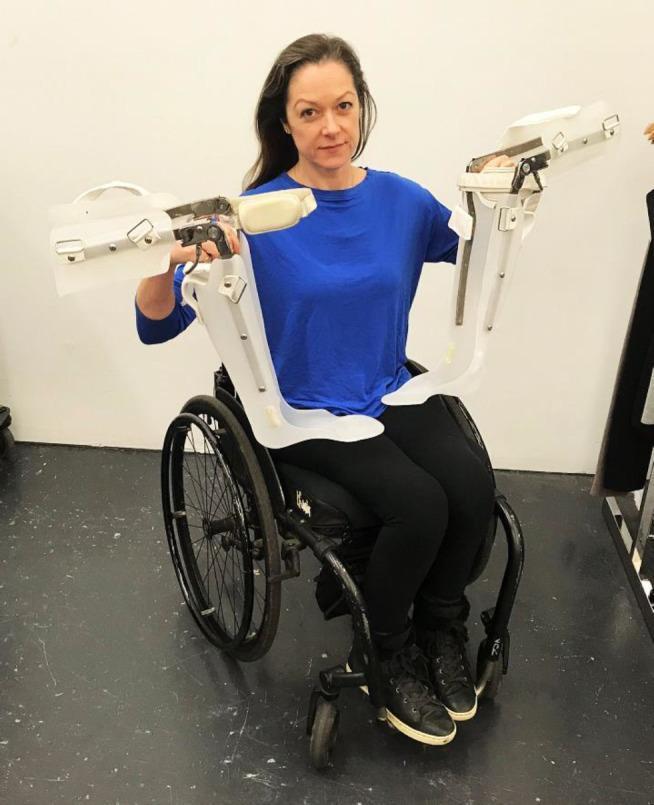
💪 Upper Limb Orthoses
Elbow Orthosis:
- Hinged: minimum stability for ligament instability
- Dynamic spring-loaded: flexion/extension contractures
- Elbow strap: lateral epicondylitis
- Long arm splint at 45° flexion: cubital tunnel syndrome
Wrist-Hand Orthosis (WHO):
- Most common use: postoperative care after injury or reconstructive surgery
- Can be static, static-progressive, or dynamic
- Opponens splint: prepositioning the thumb (impairs tactile sensation)
- Wrist-driven hand orthosis: lower cervical quadriplegia (C6–C7) — body-powered via tenodesis or motor-driven
🦴 Fracture Braces
- Valuable for isolated fractures of the tibia and fibula
- Prefabricated versions for simple foot/ankle fractures, ankle sprains, and hand injuries
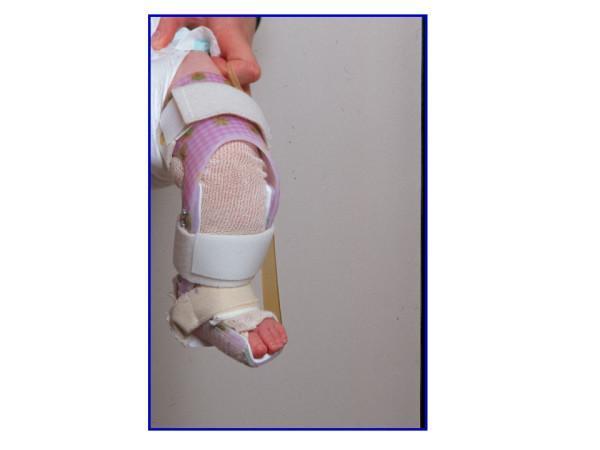
👶 Pediatric Orthoses
- Pavlik harness: mainstay for early treatment of developmental dysplasia of the hip (DDH)
- Dynamic containment orthoses: Perthes disease
- Dynamic KAFOs: commonly used in children to control motion without total immobilization
🏥 Spine Orthoses
Cervical spine:
- Range from simple soft collars → posted orthoses (shoulder/chin purchase) → halo vest (maximum stability via skull pin fixation)
Thoracolumbar spine:
- Mechanically stabilize the back via three-point pressure mechanism and increased body cavity pressure
- Three-point orthoses control motion through lever arm length
Summary Table
| Acronym | Full Name | Primary Indication |
|---|---|---|
| FO | Foot Orthosis | Flatfoot, neuropathic foot, deformity |
| AFO | Ankle-Foot Orthosis | Footdrop, spasticity, SCI |
| KAFO | Knee-Ankle-Foot Orthosis | Knee instability, paralysis |
| HKAFO | Hip-Knee-Ankle-Foot Orthosis | Paraplegia, myelomeningocele |
| WHO | Wrist-Hand Orthosis | Quadriplegia, post-op hand |
| SO | Spinal Orthosis | Cervical/thoracolumbar instability, pain |
Sources: Miller's Review of Orthopaedics, 9th Edition; PM&R KnowledgeNow — Lower Limb Orthotics
This is a shared conversation. Sign in to Orris to start your own chat.