
AI-guided Early-Onset Neonatal Sepsis Prediction
Reading File
Early-onset neonatal sepsis (EONS) occurs in the first 72 hours of life and carries significant morbidity and mortality. AI-guided prediction tools - most notably the Kaiser Permanente Neonatal Early-Onset Sepsis Calculator - use maternal and clinical risk factors to stratify risk and reduce unnecessary antibiotic use.
Searching sources...
Finding Sources
Searching PubMed
"neonatal sepsis" AND "early onset" AND "prediction" AND "artificial intelligence"
Searching the Web
AI machine learning early-onset neonatal sepsis prediction 2025 2026
Finding Sources
Searching PubMed
"early-onset sepsis" AND neonatal AND calculator
Reading Article
PMID: 42403824
Reading File
Reading Article
PMID: 39314183
Reading Article
PMID: 39417838
Finding Sources
Searching PubMed
"early-onset sepsis" AND neonatal AND "machine learning" OR "deep learning"
Searching Images
neonatal early onset sepsis risk stratification flowchart calculator
Reading File
Searching PubMed
neonatal sepsis prediction model biomarkers machine learning
Searching Images
neonatal sepsis GBS group B streptococcus newborn infection signs
Loading Image
Reading Article
PMID: 41290495
Reading Article
PMID: 39472236
I now have comprehensive data to deliver a thorough, well-sourced answer. Here is the full synthesis:
AI-Guided Early-Onset Neonatal Sepsis (EONS) Prediction
1. What Is Early-Onset Neonatal Sepsis?
Early-onset neonatal sepsis (EONS) is defined as culture-proven or clinically suspected sepsis occurring within the first 72 hours (some definitions extend to 7 days) of life. It is the most common cause of neonatal cardiorespiratory distress and carries significant morbidity and mortality, particularly in premature neonates.
Key features distinguishing EONS:
- Onset: First 7 days of life (majority within 24 hours; median onset ~6 hours)
- Acquisition: Ascending from maternal genitourinary tract or hematogenous/transplacental spread
- Clinical course: Tends to be fulminant and rapidly progressive
- Incidence: ~0.3-2 per 1,000 live births in the US (culture-proven)
- Pathogens: Group B Streptococcus (GBS) and Escherichia coli account for the majority; also Listeria monocytogenes, Klebsiella spp., Haemophilus influenzae
Clinical signs (non-specific and easily confused with other neonatal conditions):
- Temperature instability (fever ≥38°C or hypothermia <36.5°C)
- CNS dysfunction: lethargy, irritability, seizures
- Respiratory distress: apnea, tachypnea, grunting
- Feeding disturbances: vomiting, poor feeding, gastric distention
- Jaundice and skin rashes
- Tintinalli's Emergency Medicine, p. 2463-2491
2. The Diagnostic Problem - Why AI Matters
Traditional EONS management is caught in a fundamental tension: the risk of missing true sepsis (mortality ~3% in term neonates) versus the harm of over-treating with antibiotics (antimicrobial resistance, microbiome disruption, NEC risk). Currently:
- Blood culture (reference standard) has a 48-72 hour turnaround
- Culture-negative sepsis is common (inflated by antenatal antibiotic exposure in mothers)
- Conventional biomarkers (CRP, procalcitonin, lactate) are time-dependent - they rise too slowly to guide immediate decisions
- Of 7-13% of neonates screened for sepsis, only 3-8% have culture-proven disease - meaning antibiotic over-use is pervasive
AI offers the prospect of earlier, more accurate risk stratification using data already available at birth - maternal factors, physiological monitoring, and genomics.
3. The Kaiser Permanente EOS Calculator - The Foundation Model
The most widely validated and implemented AI-derived prediction tool is the Neonatal Early-Onset Sepsis Calculator (https://neonatalsepsiscalculator.kaiserpermanente.org/), developed by Kaiser Permanente.
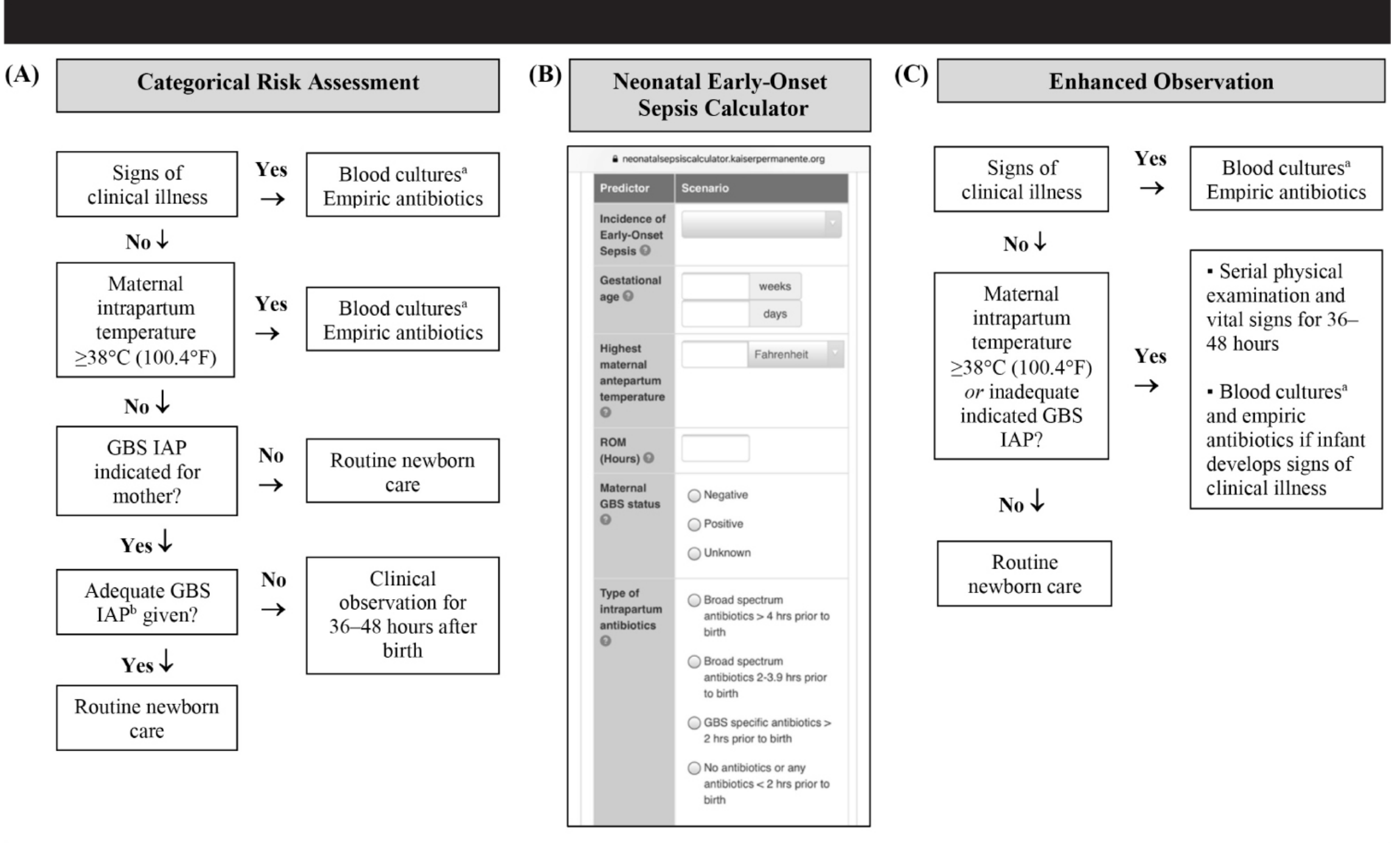
From: Red Book 2021, AAP Committee on Infectious Diseases - reproduced with permission from Kaiser Permanente Division of Research
How It Works
The calculator uses multivariate Bayesian logistic regression combining:
| Input Variable | Why It Matters |
|---|---|
| Gestational age (weeks + days) | Prematurity amplifies risk |
| Highest maternal antepartum temperature | Intrapartum fever is a strong GBS/EOS predictor |
| Rupture of membranes duration (hours) | Prolonged ROM >18 hrs increases colonization risk |
| Maternal GBS status (positive/negative/unknown) | Direct pathogen exposure risk |
| Type of intrapartum antibiotics (GBS-specific >2 hrs / broad spectrum / none) | Prophylaxis effectiveness |
| Infant's clinical status at birth | Well-appearing vs. equivocal vs. clinical illness |
The calculator outputs a posterior probability (e.g., 0.2/1,000 births) and recommends one of three actions:
- Routine newborn care - observe, no labs
- Enhanced observation - serial exam and vital signs for 36-48 hours
- Blood cultures + empiric antibiotics - immediate evaluation
Performance (2024 Update - PMID 39314183)
A 2024 multicenter update using 412,595 infants born 2010-2020 at 14 hospitals found:
- Original model sensitivity: 0.76 (95% CI 0.63-0.85)
- Updated model sensitivity: 0.80 (95% CI 0.68-0.89)
- Empiric antibiotic rate: 3.5% (original) vs. 3.7% (updated)
- For each additional case identified by the updated model, ~158 additional infants would receive antibiotics - illustrating the sensitivity-antibiotic stewardship tradeoff
- Red Book 2021, pp. 2899-2912; Kuzniewicz et al., Pediatrics 2024
Three Risk Assessment Approaches (AAP Framework)
The AAP recognizes three strategies (illustrated in the figure above):
A. Categorical Risk Assessment - Uses threshold values (e.g., any GBS positivity, any maternal fever) to trigger evaluation. Simple but includes many low-risk neonates unnecessarily.
B. Multivariate Risk Assessment (EOS Calculator) - Quantitative, individual-level prediction using the Kaiser tool. Prospectively validated in large cohorts. Recommended for term and late preterm (≥35 weeks) infants.
C. Enhanced Clinical Observation - Risk stratification based entirely on the newborn's clinical condition at birth. A well-appearing term infant has 60-70% lower risk of EOD. Can be used standalone or layered with categorical/multivariate assessment.
4. Emerging AI Approaches Beyond the Calculator
A. Machine Learning / Ensemble Models for EONS
The 2026 systematic review by Ndubuisi et al. (PMID 42403824, 44 studies included) found:
- Ensemble tree-based classifiers (CatBoost, XGBoost) for EONS report AUROCs exceeding 0.95 in retrospective cohorts
- These models integrate electronic health record (EHR) data: maternal labs, vitals, delivery records, fetal monitoring data
- Most studies are retrospective, single-center, and lack external validation - limiting confidence in real-world generalizability
B. Continuous Physiological Monitoring (HeRO Monitor) - For LONS/NICU
The HeRO (Heart Rate Observation) monitor uses heart rate characteristics (HRC) analysis - detecting reduced variability and transient decelerations - as an early warning system. Performance benchmarks:
- AUROCs 0.81-0.90 for sepsis prediction
- Early warning signals emerge 6-12 hours before clinical deterioration
- A prospective RCT demonstrated a 22% relative reduction in mortality - the strongest clinical outcome evidence for any sepsis AI tool to date
C. Genomic Signatures - The Frontier
A 2024 study (An et al., EBioMedicine, PMID 39472236) identified a 4-gene blood expression signature (HSPH1, BORA, NCAPG2, PRIM1) predictive of EONS:
- 720 full-term neonates in The Gambia
- Signature identified at birth, before any clinical signs appeared
- Neonates who developed EOS already had ~1,000 differentially expressed genes at birth vs. healthy controls
- Training AUC = 0.94 (sensitivity 0.93, specificity 0.92)
- Validation AUC = 0.72 (sensitivity 0.83, specificity 0.83)
This is a conceptual leap - moving from risk factors to pre-symptomatic biological prediction, though it remains a research tool far from bedside implementation.
D. AI for Sepsis Biomarker Integration (2026 Perspective)
Per Kainth & Agarwal (Sem Fetal Neonatal Med, 2026), AI models in neonatal sepsis currently serve three roles:
- Risk prediction - before or at birth (EOS Calculator, genomic signatures)
- Diagnosis support - integrating biomarkers + clinical data to classify probability of infection
- Individualized treatment - predicting pathogen type, antibiotic susceptibility, duration of therapy
5. Risk Factors Driving AI Models
| Category | Key Risk Factors |
|---|---|
| Maternal | GBS colonization, intrapartum fever ≥38°C, prolonged ROM >18 hrs, chorioamnionitis |
| Obstetric | Inadequate GBS IAP (<4 hrs before delivery), preterm labor, fetal distress |
| Neonatal | Prematurity (especially <35 weeks), low birth weight, male sex |
| Clinical presentation | Respiratory distress, temperature instability, lethargy at birth |
6. Biomarkers Used in AI Models
| Biomarker | Role | Limitation |
|---|---|---|
| CRP | Serial monitoring; rises 6-8 hrs after onset | Not useful for immediate decision |
| Procalcitonin | Peaks 12-24 hrs; good for stopping antibiotics | Physiologically elevated in all neonates Day 1-2 |
| Lactate | Sign of poor perfusion; prognostic | Not diagnostic; requires clinical context |
| WBC / I:T ratio | Classic sepsis screen | Poor sensitivity and specificity |
| IL-6, IL-8 | Early rise; high sensitivity | Not widely available |
| Gene expression | 4-gene signature; pre-symptomatic detection | Research stage only |
7. Limitations and Controversies
The Swiss guideline exception: The 2024 Swiss National Guideline (PMID 39417838) does not recommend the EOS Calculator for their population, because their observed antibiotic exposure rate is already below 3% - at which point the calculator offers no net reduction in antibiotic use. This is an important reminder that population-specific baseline rates matter in implementing any prediction tool.
General AI limitations (as synthesized across the 2026 reviews):
- Most models are derived from high-income country (HIC) populations - LMIC performance may differ substantially
- Retrospective, single-center designs dominate
- Lack of external validation
- Sepsis definition heterogeneity across studies
- No regulatory-approved AI EONS tool beyond the probabilistic calculator
- Explainability (XAI) remains limited - "black box" models resist clinical adoption
- Ethical concerns: bias, equity, data privacy
8. Current Clinical Recommendations (AAP / 2024 Evidence)
For infants ≥35 weeks' gestation:
- Use the EOS Calculator as the primary risk stratification tool (or enhanced observation approach)
- Empiric antibiotics only if the calculator outputs a recommendation, plus clinical illness
- Stop antibiotics within 24-36 hours if blood culture shows no pathogen growth at adequate volume
- Lumbar puncture before antibiotics in highest-risk or critically ill infants
- Adequate GBS IAP = penicillin G, ampicillin, or cefazolin given ≥4 hours before delivery
For infants <35 weeks' gestation:
- Heightened suspicion regardless of calculator output
- Any unexplained prematurity with risk factors carries inherently higher EOS risk
Summary
AI-guided EONS prediction has evolved from early categorical approaches to sophisticated multivariate tools (the Kaiser EOS Calculator), ensemble ML models (XGBoost/CatBoost with AUROCs >0.95 in research settings), physiological monitoring systems (HeRO, with proven mortality reduction in LONS), and genomic pre-symptomatic signatures. The Kaiser Calculator remains the only prospectively validated, widely implemented tool at bedside, with a 2024 multicenter update confirming its utility across 400,000+ births. The frontier involves integrating EHR data, transcriptomics, and continuous monitoring into unified decision-support systems - but external validation, equity, and explainability remain the central challenges before any of these next-generation models translate into routine care.
Key References:
- Kuzniewicz et al. 2024 - EOS Calculator Update (PMID 39314183)
- Ndubuisi et al. 2026 - AI for Neonatal Sepsis Review (PMID 42403824)
- Kainth & Agarwal 2026 - AI in Neonatal Sepsis (PMID 41290495)
- An et al. 2024 - Gene Expression Signature for EOS (PMID 39472236)
- Swiss EOS Guideline 2024 (PMID 39417838)
- Red Book 2021, AAP - pp. 1099-1103
- Tintinalli's Emergency Medicine - pp. 2461-2494
This is a shared conversation. Sign in to Orris to start your own chat.