
Discuss layers of skin and draw a labeled diagram of layers of skin with their functions 10 mark question
Reading File
Finding Sources
Finding Sources
Good results from multiple authoritative textbooks. Let me read the detailed content from the best sources simultaneously.
Reading File
Reading File
Reading File
Excellent content. Now let me get the detailed layers of epidermis (strata) and dermis sub-layers, plus search for a skin diagram image.
Finding Sources
Searching Images
layers of skin epidermis dermis hypodermis labeled diagram histology
The first image is exactly what's needed. Let me fetch it and also read the detailed epidermal layers from the histology textbook.
Loading Image
Reading File
Reading File
I now have all the content needed for a comprehensive 10-mark answer. Let me also quickly get the dermis sub-layers (papillary + reticular) detail.
Reading File
I now have all the content needed for a thorough 10-mark answer. Let me compile the full response.
Layers of the Skin — 10 Mark Answer
Labeled Diagram
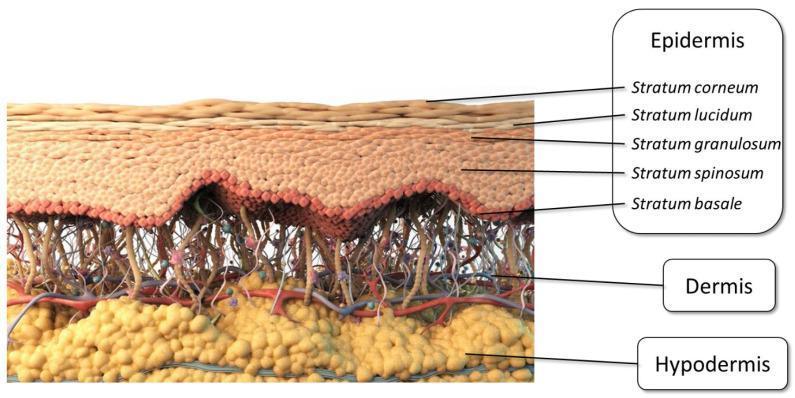
Introduction
The skin (integument) is the largest organ of the body, accounting for 15–20% of total body weight and presenting 1.5–2 m² of surface to the external environment. It is divided into three primary layers:
- Epidermis (outermost)
- Dermis (middle)
- Hypodermis / Subcutaneous tissue (deepest)
1. EPIDERMIS
The epidermis is a keratinized stratified squamous epithelium of ectodermal origin. It is avascular and receives nutrients by diffusion from dermal capillaries.
It is further subdivided into five strata (from deepest to most superficial):
(i) Stratum Basale (Germinativum)
- Single layer of cuboidal to low columnar cells resting on the basement membrane
- Contains mitotically active stem cells (keratinocytes) that continuously renew the epidermis — hence called "stratum germinativum"
- Also contains melanocytes (secrete melanin for UV protection) and Merkel cells (mechanoreception/touch)
- Cells are connected to the basement membrane by hemidesmosomes and to each other by desmosomes
- Function: Cell renewal and proliferation; melanin synthesis for UV protection
(ii) Stratum Spinosum (Prickle Cell Layer)
- Several layers of polyhedral cells with prominent spiny/prickle-like processes (actually desmosomal connections — an artifact of preparation)
- Rich in tonofilaments (keratin intermediate filaments)
- Contains Langerhans cells — dendritic antigen-presenting cells involved in immune surveillance
- Function: Mechanical strength; immune surveillance
(iii) Stratum Granulosum (Granular Layer)
- 3–5 layers of flattened cells packed with keratohyalin granules (precursors to keratin)
- Also contains lamellar bodies (Odland bodies) that secrete lipids forming the water-impermeable barrier
- Nuclei and organelles begin to degenerate here (onset of keratinization)
- Function: Initiates keratinization; forms the permeability/water barrier
(iv) Stratum Lucidum
- A thin, translucent/clear band found only in thick skin (palms and soles)
- Composed of dead, densely packed cells filled with eleidin (a precursor to keratin)
- Considered a subdivision of the stratum corneum
- Function: Additional protection in areas of high friction
(v) Stratum Corneum (Horny Layer)
- The outermost layer, composed of 15–20+ layers of dead, anucleate, flattened corneocytes filled with hard keratin
- Cells are continuously shed (desquamation) and replaced from below
- The extracellular space is filled with lipids forming a "brick-and-mortar" waterproof barrier
- Function: Primary barrier — protects against physical, chemical, and microbial agents; prevents transepidermal water loss
Key cells of the epidermis: Keratinocytes (80%), Melanocytes (UV protection), Langerhans cells (immune), Merkel cells (touch sensation)
2. DERMIS
The dermis is a layer of dense irregular connective tissue of mesodermal origin that supports and nourishes the epidermis. It contains collagen, elastic fibers, blood vessels, lymphatics, nerves, and skin appendages (hair follicles, sweat glands, sebaceous glands).
At the dermal-epidermal junction, projections called dermal papillae interdigitate with epidermal ridges (rete ridges), increasing surface area for adhesion and nutrient diffusion.
The dermis has two sublayers:
(i) Papillary Layer
- Thin, superficial zone of loose connective tissue (types I and III collagen)
- Contains fibroblasts, mast cells, dendritic cells, and leukocytes
- Houses Meissner's corpuscles (fine touch receptors) in dermal papillae
- Anchoring fibrils of type VII collagen bind it to the basement membrane
- Function: Structural support to epidermis; houses superficial sensory receptors; nutritive capillary loops
(ii) Reticular Layer
- Thicker, deeper zone of dense irregular connective tissue (mainly type I collagen bundles)
- Contains a network of elastic fibers (provide skin elasticity and resilience)
- Houses Pacinian corpuscles (deep pressure receptors), hair follicles, sweat and sebaceous glands
- Rich in proteoglycans (dermatan sulfate)
- Contains two vascular plexuses:
- Subpapillary plexus (between papillary and reticular layers)
- Deep plexus (at dermis-hypodermis junction)
- Arteriovenous anastomoses regulate thermoregulation
- Function: Mechanical strength and elasticity; thermoregulation; houses appendages and sensory receptors
3. HYPODERMIS (Subcutaneous Tissue)
- Located below the dermis; corresponds to the superficial fascia of gross anatomy
- Composed of loose connective tissue with lobules of adipocytes (fat cells) separated by fibrous septa
- NOT part of the skin strictly, but closely associated
- Contains larger blood vessels, lymphatics, and nerves
- Functions:
- Insulation — thermal regulation
- Energy storage — fat depot
- Mechanical cushion — protection against trauma
- Attachment — binds skin loosely to underlying muscles and bones
Summary Table
| Layer | Sub-layer | Composition | Key Function |
|---|---|---|---|
| Epidermis | Stratum basale | Mitotic keratinocytes, melanocytes | Cell renewal, UV protection |
| Stratum spinosum | Polyhedral cells, Langerhans cells | Strength, immune surveillance | |
| Stratum granulosum | Keratohyalin granules | Keratinization, water barrier | |
| Stratum lucidum | Eleidin-filled cells (thick skin only) | Extra protection | |
| Stratum corneum | Dead corneocytes, keratin | Primary physical/chemical barrier | |
| Dermis | Papillary layer | Loose CT, capillaries, Meissner's corpuscles | Nutrition, fine touch |
| Reticular layer | Dense CT, collagen, elastic fibers | Elasticity, strength, thermoregulation | |
| Hypodermis | — | Adipose tissue, loose CT | Insulation, energy storage, cushioning |
Overall Functions of Skin
- Barrier — protects against physical, chemical, and microbial agents
- UV protection — melanin in epidermis absorbs/blocks UV radiation
- Immunologic — Langerhans cells process and present antigens
- Thermoregulation — dermal vasculature and sweat glands regulate heat
- Sensory — various mechanoreceptors (Meissner's, Pacinian, Merkel cells, free nerve endings)
- Metabolic — synthesis of vitamin D₃ via UV action on precursors
- Excretion — sweat glands excrete water, salts, urea
- Absorption — lipid-soluble substances (e.g., steroid hormones, nicotine patches) can be absorbed transdermally
Sources: Histology: A Text and Atlas with Correlated Cell and Molecular Biology; Junqueira's Basic Histology: Text and Atlas, 17e; Fitzpatrick's Dermatology
This is a shared conversation. Sign in to Orris to start your own chat.