
I have a seminar on Bronchopulmonary Segments. What questions can the teacher possibly ask on this?
Reading File
Finding Sources
Searching the Web
bronchopulmonary segments anatomy seminar exam questions
Reading File
Reading File
Finding Sources
Reading File
Finding Sources
Finding Sources
Loading Image
Finding Sources
Reading File
Reading File
I now have comprehensive information from multiple authoritative textbooks. Let me compile the full answer.
Bronchopulmonary Segments — Likely Seminar Questions
Here is a thorough breakdown of every angle a teacher is likely to probe, drawn from Gray's Anatomy for Students, the Color Atlas of Human Anatomy (Vol. 2), Fishman's Pulmonary Diseases, and Barash's Clinical Anesthesia.
1. Definition & Basic Concept
Q: Define a bronchopulmonary segment.
A bronchopulmonary segment is the area of lung supplied by a segmental (tertiary) bronchus and its accompanying branch of the pulmonary artery. It is shaped like an irregular cone (or pyramid), with the apex pointing toward the hilum and the base projected peripherally onto the lung surface. — Gray's Anatomy for Students, p. 210
Q: Why is a bronchopulmonary segment called the "smallest functionally independent unit" of the lung?
It is the smallest region that can be isolated and surgically removed without affecting adjacent segments — because each segment has its own bronchus and arterial supply. — Gray's Anatomy for Students, p. 210
2. Blood Supply & Venous Drainage
Q: What is the arterial supply to a bronchopulmonary segment? What about venous drainage?
- Artery: A branch of the pulmonary artery runs intrasegmentally alongside the segmental bronchus (bronchoarterial unit).
- Vein: Tributaries of the pulmonary vein run intersegmentally — they travel in the connective tissue between segments, along the segment boundaries, demarcating segment borders before converging into the large pulmonary veins at the hilum. — Color Atlas, p. 214
Q: Why is the venous drainage clinically significant?
Because pulmonary veins are intersegmental, they cannot be used to identify individual segment boundaries the way bronchi and arteries can. This matters during segmental resection.
3. Number of Segments — Right vs. Left
Q: How many bronchopulmonary segments are there in each lung? Name them.
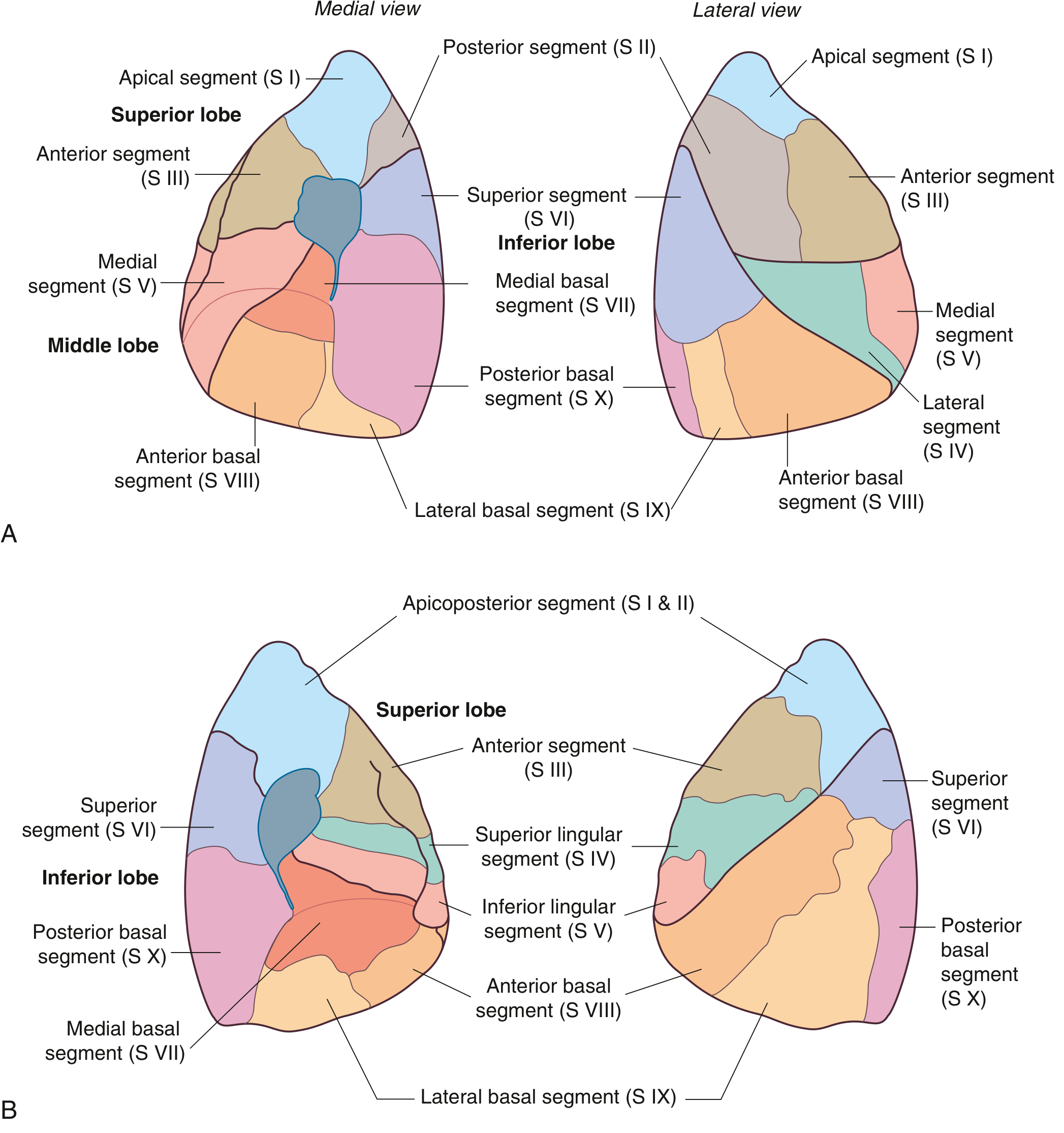
| Lobe | Right Lung | Left Lung |
|---|---|---|
| Upper/Superior lobe | Apical (S I), Posterior (S II), Anterior (S III) | Apicoposterior (S I+II fused), Anterior (S III) |
| Middle lobe / Lingula | Lateral (S IV), Medial (S V) | Superior lingular (S IV), Inferior lingular (S V) |
| Lower/Inferior lobe | Superior (S VI), Medial basal (S VII), Anterior basal (S VIII), Lateral basal (S IX), Posterior basal (S X) | Superior (S VI), Anteromedial basal (S VII+VIII fused), Lateral basal (S IX), Posterior basal (S X) |
- Right lung: 10 segments
- Left lung: 8–9 segments (S I & II fuse → apicoposterior; S VII & VIII often fuse → anteromedial basal; no separate middle lobe — replaced by the lingula)
Q: Which segments are absent or fused in the left lung, and why?
Segments I and II fuse into the apicoposterior segment. Segments VII and VIII often fuse into the anteromedial basal segment. This is because the left lung is smaller, displaced by the heart, leaving less room. The medial basal segment (S VII) is absent as a discrete segment in the left lung. — Fishman's Pulmonary Diseases, p. 54
4. Bronchial Tree — Hierarchy
Q: Trace the bronchial tree from the trachea to a segmental bronchus.
Trachea → Main (primary) bronchi → Lobar (secondary) bronchi → Segmental (tertiary) bronchi → segmental bronchopulmonary unit
Q: How far from the carina do the lobar bronchi branch off on each side?
- Right superior lobar bronchus: ~1–2.5 cm from the carina
- Right middle and inferior lobar bronchi: ~5 cm from the carina
- Left main bronchus (both lobar bronchi): ~5 cm from the carina — Color Atlas, p. 213
Q: How many segmental bronchi arise on each side?
- Right: 10 segmental bronchi
- Left: 9 segmental bronchi (S I & II share a common trunk)
5. Lobar Divisions
Q: How many lobes does each lung have, and what separates them?
- Right lung: 3 lobes (superior, middle, inferior) — separated by the oblique fissure (inferior from superior+middle) and horizontal fissure (superior from middle)
- Left lung: 2 lobes (superior, inferior) — separated by the oblique fissure only. The lingula is NOT a separate lobe; it is part of the left superior lobe.
6. The Lingula
Q: What is the lingula and what is its anatomical equivalent on the right?
The lingula is a tongue-shaped projection of the left upper lobe, supplied by the superior lobar bronchus of the left lung. It contains the superior and inferior lingular segments (S IV & V). Its functional equivalent on the right is the middle lobe (also S IV & V). — Fishman's, p. 54
7. Lobules vs. Segments
Q: Distinguish between a bronchopulmonary segment and a pulmonary lobule.
| Feature | Bronchopulmonary Segment | Pulmonary Lobule |
|---|---|---|
| Supplied by | Segmental (tertiary) bronchus | Bronchiole |
| Size | Large (pyramid-shaped, visible on surface) | Small polygonal unit, 0.5–3 cm |
| Relationship | Made of many lobules | Subunit of a segment |
| Location | Throughout lung | Mainly on the surface |
| Borders visible? | Not directly visible | Yes — marked by connective tissue septa (often pigmented) |
— Color Atlas, pp. 214–215
8. Clinical Significance
Q: Why are bronchopulmonary segments surgically important?
Because each segment is an independent bronchoarterial unit, it can be individually resected (segmentectomy) without compromising adjacent tissue — important in tuberculosis, bronchiectasis, carcinoid, or small lung cancers. — Histology: A Text and Atlas, p. 4561
Q: In a patient with aspiration pneumonia lying supine, which segment is most likely affected? Why?
The superior (apical) segment of the lower lobe (S VI), and the posterior segment of the upper lobe (S II), because gravity directs aspirated material posteriorly when supine. On the right, the most common site is the apical and posterior segments of the right upper lobe (also relevant for TB reactivation).
Q: Which bronchopulmonary segment is the most common site of tuberculosis reactivation?
The apical and posterior segments of the right upper lobe (S I & S II), and the apicoposterior segment of the left upper lobe (S I+II). These apical zones are well-aerated with high oxygen tension, favoring Mycobacterium tuberculosis growth. — Murray & Nadel's Respiratory Medicine
Q: What is the relevance of the intersegmental course of pulmonary veins during surgery?
The intersegmental position of pulmonary veins makes them reliable landmarks for identifying and preserving adjacent segments during segmentectomy.
9. Relationship to the Hilum
Q: Describe the arrangement of structures at the hilum of the right lung.
From anterior to posterior at the right hilum: right pulmonary vein (superior) → pulmonary artery → bronchus. The right pulmonary artery passes anterior to the right main bronchus and posterior to the ascending aorta and SVC. — Gray's Anatomy for Students
10. Imaging / Radiology Correlates
Q: How are bronchopulmonary segments identified on a chest X-ray or CT?
The segments are identified by the distribution of their supplying segmental bronchi and pulmonary arteries as seen on CT. Each segment appears as a roughly pyramidal region of lung parenchyma. Segment numbering (S I–X) correlates with lobar bronchus origin and is used in reporting CT findings. — Grainger & Allison's Diagnostic Radiology
Quick-Reference Memory Aid
| Lobe (Right) | Segments |
|---|---|
| Upper | Apical, Posterior, Anterior → "APA" |
| Middle | Lateral, Medial → "LM" |
| Lower | Superior, Medial basal, Anterior basal, Lateral basal, Posterior basal → "SMALP" |
| Lobe (Left) | Segments |
|---|---|
| Upper | ApicoPosterior, Anterior → "PA" |
| Lingula | Superior lingular, Inferior lingular |
| Lower | Superior, Anteromedial basal, Lateral basal, Posterior basal → "SALP" |
Sources: Gray's Anatomy for Students (p. 208–211) · Color Atlas of Human Anatomy Vol. 2 (pp. 213–216) · Fishman's Pulmonary Diseases (p. 54) · Barash's Clinical Anesthesia, Table 15-1 · Murray & Nadel's Respiratory Medicine
This is a shared conversation. Sign in to Orris to start your own chat.