
• • • • • • Define Glycogenesis and Glycogenolysis. Write the reactions of Glycogenesis and Glycogenolysis in the Liver.
Reading File
Now let me search the medical library for glycogenesis and glycogenolysis content in parallel.
Finding Sources
Finding Sources
Excellent results. Now let me read the key sections in parallel - Lippincott (most detailed biochemistry) and Harper's:
Reading File
Reading File
I now have rich content from Lippincott and Harper's. Let me also fetch the key diagrams and read more of the Lippincott glycogenolysis section:
Reading File
Reading File
I now have comprehensive content from both Lippincott and Harper's. Let me also fetch the key diagrams to include:
Loading Image
Loading Image
Loading Image
I now have everything needed for a comprehensive, well-illustrated answer. Let me compose the full response.
Glycogenesis and Glycogenolysis
Definitions
Glycogenesis is the process of synthesizing glycogen from glucose molecules. It occurs primarily in the liver and skeletal muscle, takes place in the cytosol, and is an anabolic pathway that requires energy in the form of ATP and UTP. Liver glycogen stores fluctuate with feeding and fasting - they increase in the well-fed state and are depleted during starvation.
Glycogenolysis is the process of breaking down stored glycogen to release glucose. It is NOT the reversal of glycogenesis; it is a completely separate degradative pathway using a distinct set of cytosolic enzymes. The primary product is glucose 1-phosphate from α(1→4) bonds, plus free glucose released from branch points.
In the liver specifically, glycogenolysis is important for maintaining blood glucose during fasting, because the liver (unlike muscle) contains glucose-6-phosphatase, enabling it to export free glucose into the bloodstream.
GLYCOGENESIS - Reactions in the Liver
Glycogenesis proceeds through the following sequential steps:
Step 1: Phosphorylation of Glucose
In the liver, glucose is phosphorylated by glucokinase (hexokinase IV):
Glucose + ATP ──glucokinase──► Glucose 6-phosphate + ADP
- Glucokinase (not hexokinase I) is used in the liver because it has a high Km for glucose and is not inhibited by its product, making it suited for buffering postprandial glucose.
Step 2: Isomerization to Glucose 1-Phosphate
Phosphoglucomutase converts glucose 6-phosphate to glucose 1-phosphate. This is a reversible reaction with glucose 1,6-bisphosphate as an obligatory intermediate:
Glucose 6-phosphate  ──phosphoglucomutase──►  Glucose 1-phosphate
                     (via Glucose 1,6-bisphosphate)
Step 3: Formation of UDP-Glucose (Activated Glucose)
UDP-glucose pyrophosphorylase (UDPGlc pyrophosphorylase) catalyzes the reaction of glucose 1-phosphate with UTP to form UDP-glucose, the active donor of glucosyl units:
Glucose 1-phosphate + UTP  ──UDP-glucose pyrophosphorylase──►  UDP-Glucose + PPi

PPi  ──pyrophosphatase──►  2 Pi   (drives the reaction forward)
- The hydrolysis of PPi by pyrophosphatase is exergonic and makes this reaction essentially irreversible, ensuring UDP-glucose production.
Step 4: Priming (Glycogenin)
Glycogen synthase cannot initiate a chain from free glucose - it needs a primer. The protein glycogenin (a 37-kDa homodimeric protein, a self-glucosylating enzyme) provides the primer:
- Glycogenin autoglucosylates its own Tyr-194 residue with the first glucose from UDP-glucose.
- It then catalyzes the transfer of at least 7 more glucose residues in α(1→4) linkage, building a short oligosaccharide primer (~8 residues).
- Glycogenin remains embedded at the core of the glycogen granule.
Glycogenin-Tyr-OH + UDP-Glucose  ──glycogenin (autoglucosylation)──►
                    Glycogenin-Tyr-O-[Glc]₈ + 8 UDP
Step 5: Chain Elongation by Glycogen Synthase
Glycogen synthase (the key regulated enzyme of glycogenesis) elongates the chain by adding glucosyl units from UDP-glucose to the non-reducing end in α(1→4) linkage:
UDP-Glucose + [Glycogen]ₙ ──glycogen synthase──► [Glycogen]ₙ₊₁ + UDP
- Chain elongation continues at the non-reducing, outer ends of all branches simultaneously.
- Glycogen synthase only forms α(1→4) bonds; it cannot form branch points.
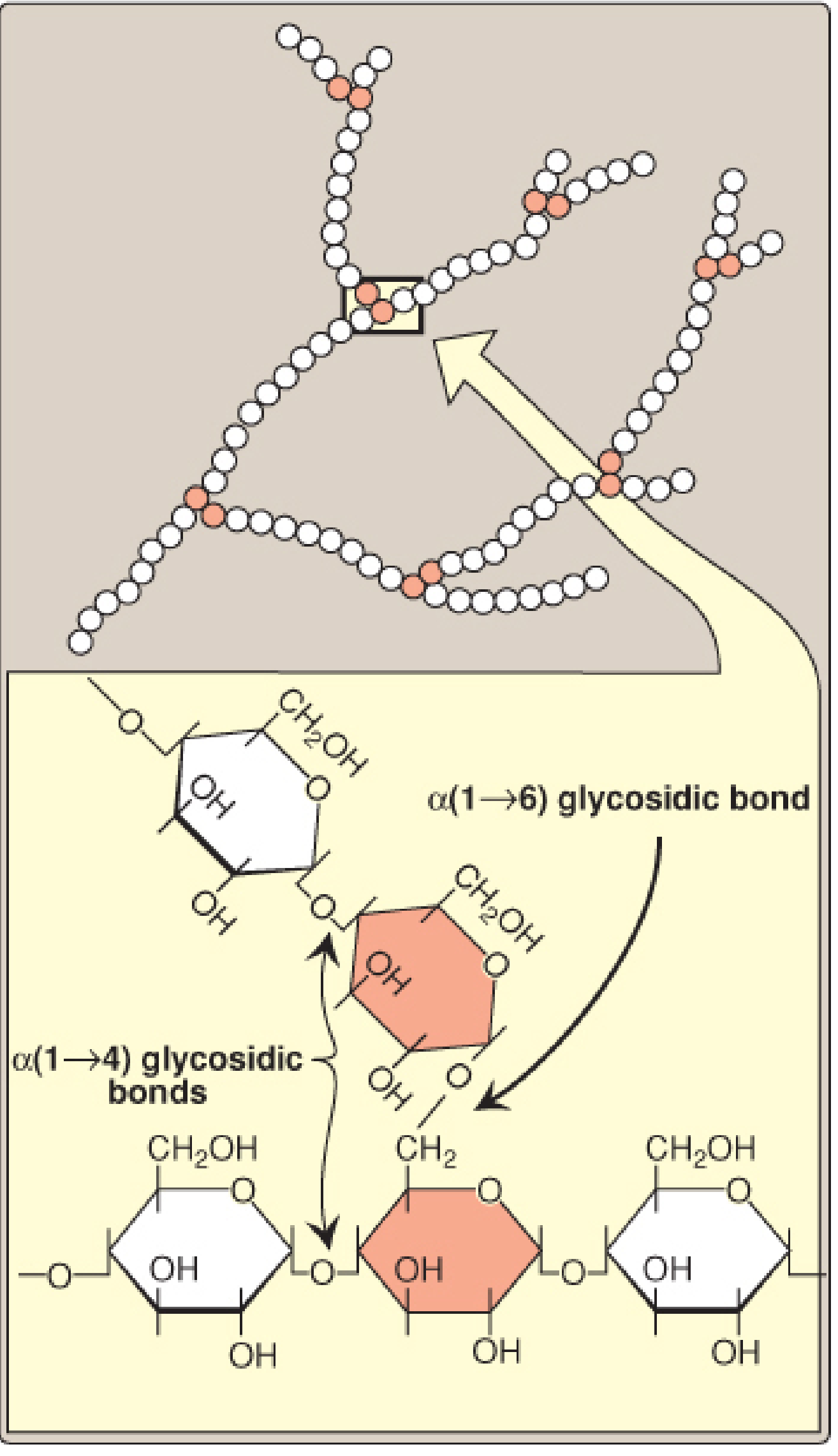
Step 6: Branching
Once a chain reaches at least 11 glucosyl residues, the branching enzyme (amylo-α(1→4)→α(1→6)-transglucosylase) transfers a block of at least 6 terminal glucosyl residues from the non-reducing end of a chain to a neighboring chain, forming an α(1→6) glycosidic bond - this creates a new branch point:
[Linear α(1→4) chain ≥11 residues]
     ──branching enzyme──►
[Shortened chain] + [New branch joined via α(1→6) bond]
- Branching increases the solubility of glycogen and creates more non-reducing ends for faster simultaneous synthesis and degradation.
Summary of Glycogenesis (Net):
Glucose → Glucose 6-P → Glucose 1-P → UDP-Glucose → Glycogen (with branching) Energy cost: 1 ATP (hexokinase) + 1 UTP (UDP-glucose synthesis) = 2 high-energy phosphate bonds per glucose incorporated
GLYCOGENOLYSIS - Reactions in the Liver
Glycogenolysis proceeds through the following sequential steps:
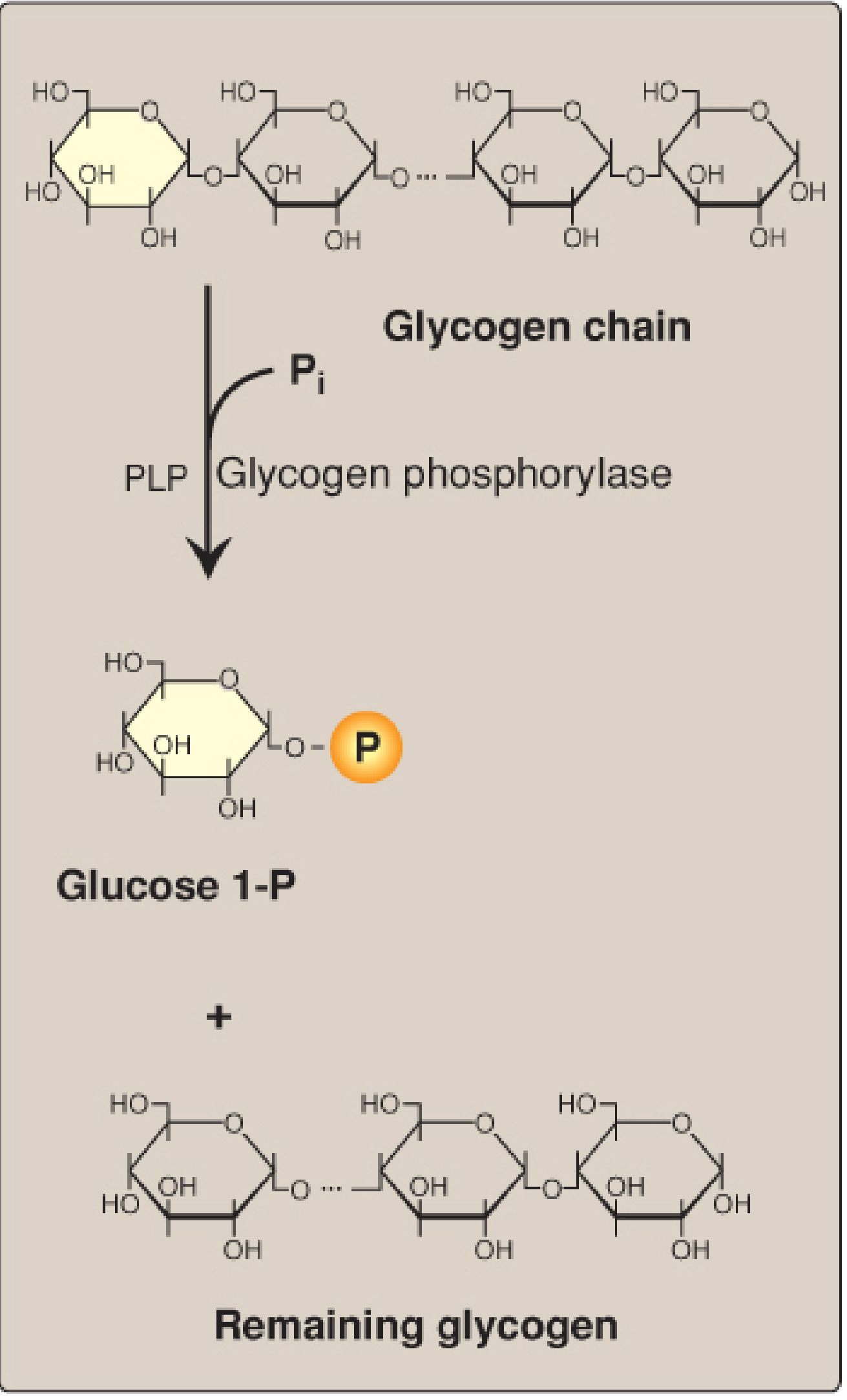
Step 1: Chain Shortening by Glycogen Phosphorylase
Glycogen phosphorylase (rate-limiting enzyme of glycogenolysis) cleaves successive α(1→4) bonds from the non-reducing ends by phosphorolysis (using inorganic phosphate Pi, not water):
[Glycogen]ₙ + Pi ──glycogen phosphorylase (PLP)──► Glucose 1-phosphate + [Glycogen]ₙ₋₁
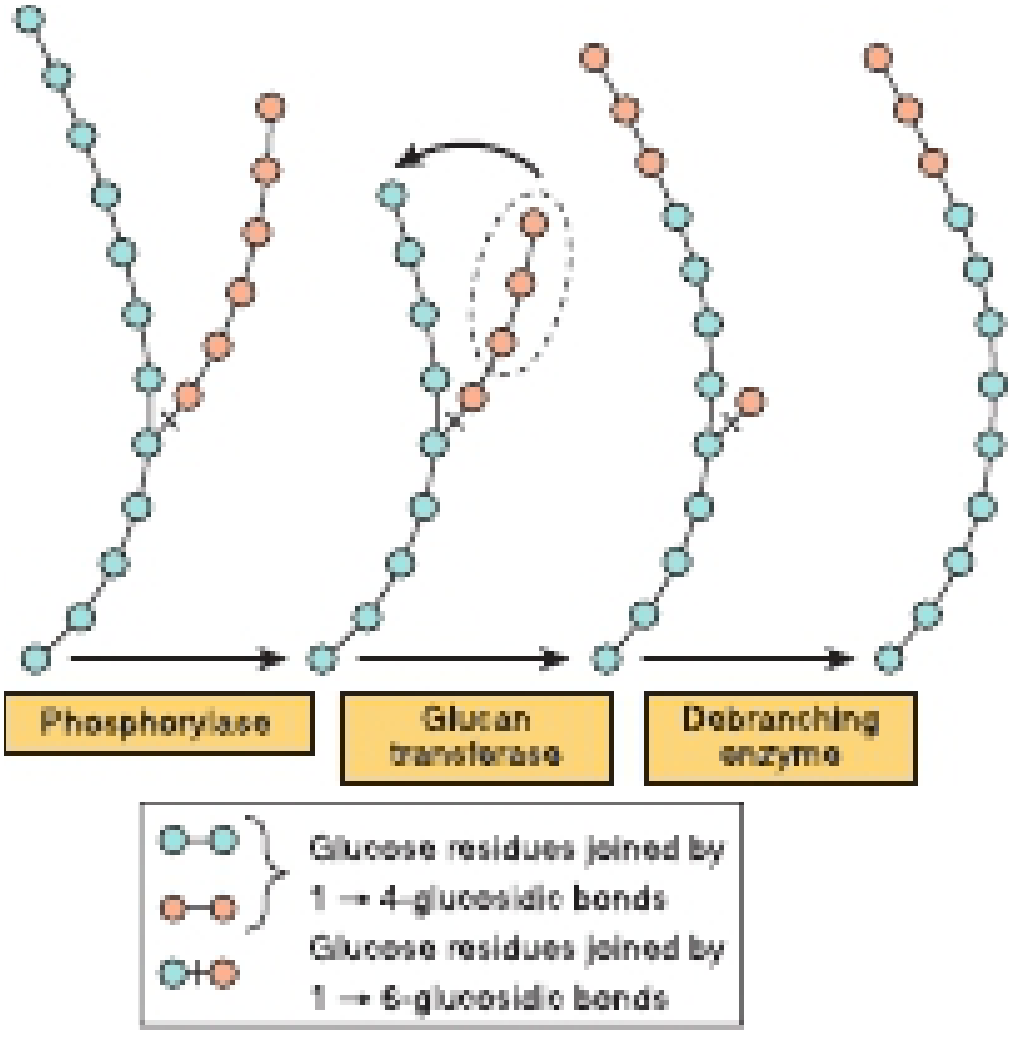
- This reaction proceeds sequentially until 4 glucosyl residues remain on each chain at a branch point - this stump is called a limit dextrin.
- Phosphorylase requires pyridoxal phosphate (PLP) (vitamin B6 derivative) as a coenzyme. Unlike in amino acid metabolism, the phosphate group (not the aldehyde) of PLP is catalytically active here.
- Phosphorylase cannot degrade past a branch point - the limit dextrin must be processed by the debranching enzyme.
Step 2: Debranching (Bifunctional Debranching Enzyme)
When phosphorylase stalls at the limit dextrin (4 residues remain at a branch), the debranching enzyme - a single bifunctional protein with two catalytic activities - acts:
Activity 1 - Oligo-α(1→4)→α(1→4)-glucantransferase (4:4 transferase):
Transfers the outer 3 of the 4 remaining glucosyl residues from the branch to the non-reducing end of a neighboring chain via a new α(1→4) bond:
Limit dextrin ──4:4-glucantransferase──► [3 residues transferred to neighboring chain] + 1 glucosyl residue remaining at α(1→6) branch
Activity 2 - Amylo-α(1→6)-glucosidase (debranching):
Hydrolyzes (with water, not phosphorolysis) the remaining single glucosyl residue at the α(1→6) branch point, releasing free glucose (not glucose 1-phosphate):
α(1→6)-linked glucose residue + H₂O ──amylo-α(1→6)-glucosidase──► Free Glucose + [Unbranched glycogen chain]
- This free glucose is the only glucose produced in glycogenolysis that is not phosphorylated.
- After debranching, phosphorylase can continue degrading the now-linear chain.
Step 3: Conversion of Glucose 1-Phosphate to Glucose 6-Phosphate
Phosphoglucomutase (same enzyme as in glycogenesis, acting in reverse) converts glucose 1-phosphate to glucose 6-phosphate:
Glucose 1-phosphate ──phosphoglucomutase──► Glucose 6-phosphate
Step 4: Liver-Specific Step - Dephosphorylation by Glucose-6-Phosphatase
This step occurs ONLY in the liver (and kidney), NOT in muscle. Glucose-6-phosphatase (located in the lumen of the smooth endoplasmic reticulum) hydrolyzes glucose 6-phosphate to free glucose:
Glucose 6-phosphate + H₂O ──glucose-6-phosphatase (ER lumen)──► Glucose + Pi
- The free glucose is then exported from the hepatocyte into the portal circulation, raising blood glucose.
- Glucose-6-phosphate must first be transported into the ER lumen by a specific transporter (SLC37A4). Defects in this transporter cause von Gierke disease type Ib.
- In muscle, glucose 6-phosphate cannot be dephosphorylated, so it enters glycolysis directly for local energy use - muscle cannot release free glucose into the blood.
Summary Comparison Table
| Feature | Glycogenesis | Glycogenolysis |
|---|---|---|
| Direction | Glucose → Glycogen | Glycogen → Glucose |
| Location | Cytosol | Cytosol (G-6-Pase in ER) |
| Key enzyme | Glycogen synthase | Glycogen phosphorylase |
| Bond formed/cleaved | α(1→4) by synthase; α(1→6) by branching enzyme | α(1→4) by phosphorylase; α(1→6) by debranching enzyme |
| Activated glucose donor | UDP-glucose | N/A (uses Pi) |
| Products | Glycogen | Glucose 1-P (mainly) + free glucose (from branches) |
| Liver-specific step | Glucokinase phosphorylates glucose | Glucose-6-phosphatase releases free glucose to blood |
| Energy | Requires ATP + UTP | Releases glucose 1-phosphate (no net ATP cost) |
| Coenzyme | - | PLP (vitamin B6) for phosphorylase |
| Regulation | Stimulated by insulin | Stimulated by glucagon, epinephrine |
Sources: Biochemistry (Lippincott Illustrated Reviews), 8th ed., Chapter 11 | Harper's Illustrated Biochemistry, 32nd ed., Chapter 18
This is a shared conversation. Sign in to Orris to start your own chat.