
Hypertension university mein puche to 15 marks me to usme kon kon se diagrams bana sakte hai
Hypertension ke 15-mark university question mein kaunse diagrams draw kar sakte hain - yeh batata hoon. Pehle quick answer:
Quick Answer: Hypertension ke 15-mark question mein typically ye diagrams draw kar sakte hain: RAAS pathway, JNC classification table, pathophysiology flowchart, baroreceptor reflex, aur antihypertensive drugs ka mechanism diagram.
Searching sources...
Reading File
Finding Sources
Finding Sources
Finding Sources
Reading File
Finding Sources
Reading File
Reading File
Reading File
Ab main kuch key diagrams ke images bhi fetch karta hoon jo textbook mein hain:
Loading Image
Loading Image
Ab main ek aur important RAAS diagram bhi fetch karta hoon aur classification table bhi dekhta hoon:
Finding Sources
Finding Sources
Reading File
Loading Image
Reading File
Ab mere paas saari information hai. Ab main ek comprehensive answer deta hoon.
Hypertension - 15 Marks University Question ke liye Diagrams
15-mark question mein typically 3-4 diagrams draw karne chahiye. Neeche har diagram explain kiya gaya hai - kya draw karna hai, points ke saath.
DIAGRAM 1 - RAAS Pathway (MOST IMPORTANT - 4 marks value)
(Yeh diagram ZAROOR banana - sabse zyada marks milte hain)
Iske andar yeh flow banana hai:
Liver → Angiotensinogen
           ↓ (Renin - kidney se)
       Angiotensin I
           ↓ (ACE - lung capillaries mein)
       Angiotensin II
        ↙           ↘
Adrenal cortex    Direct vasoconstriction
(Aldosterone)           ↓
     ↓              BP ↑ (peripheral resistance ↑)
Na+ & H2O retention
     ↓
Blood volume ↑
     ↓
BP ↑
Yeh exact diagram Robbins Pathology (Fig 11.4) aur Katzung Pharmacology dono mein hai:
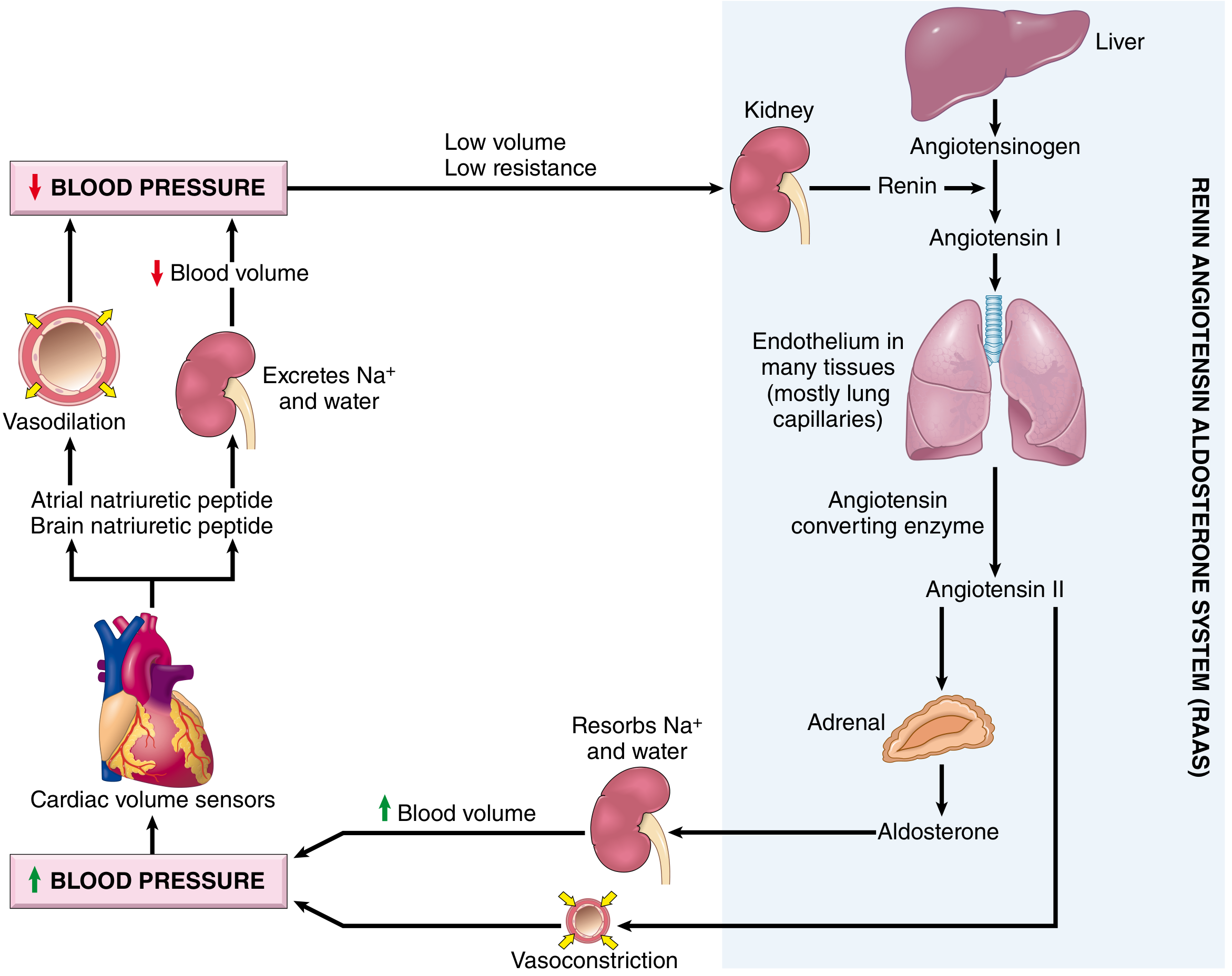
Labeling zaroor karo: Liver, Kidney (renin), Lung (ACE), Adrenal, Vasoconstriction, Na+ retention
DIAGRAM 2 - Sites of Action of Antihypertensive Drugs (4 marks value)
Katzung Pharmacology ka yeh classic diagram hai - body ke alag alag sites pe drugs ka action dikhata hai:
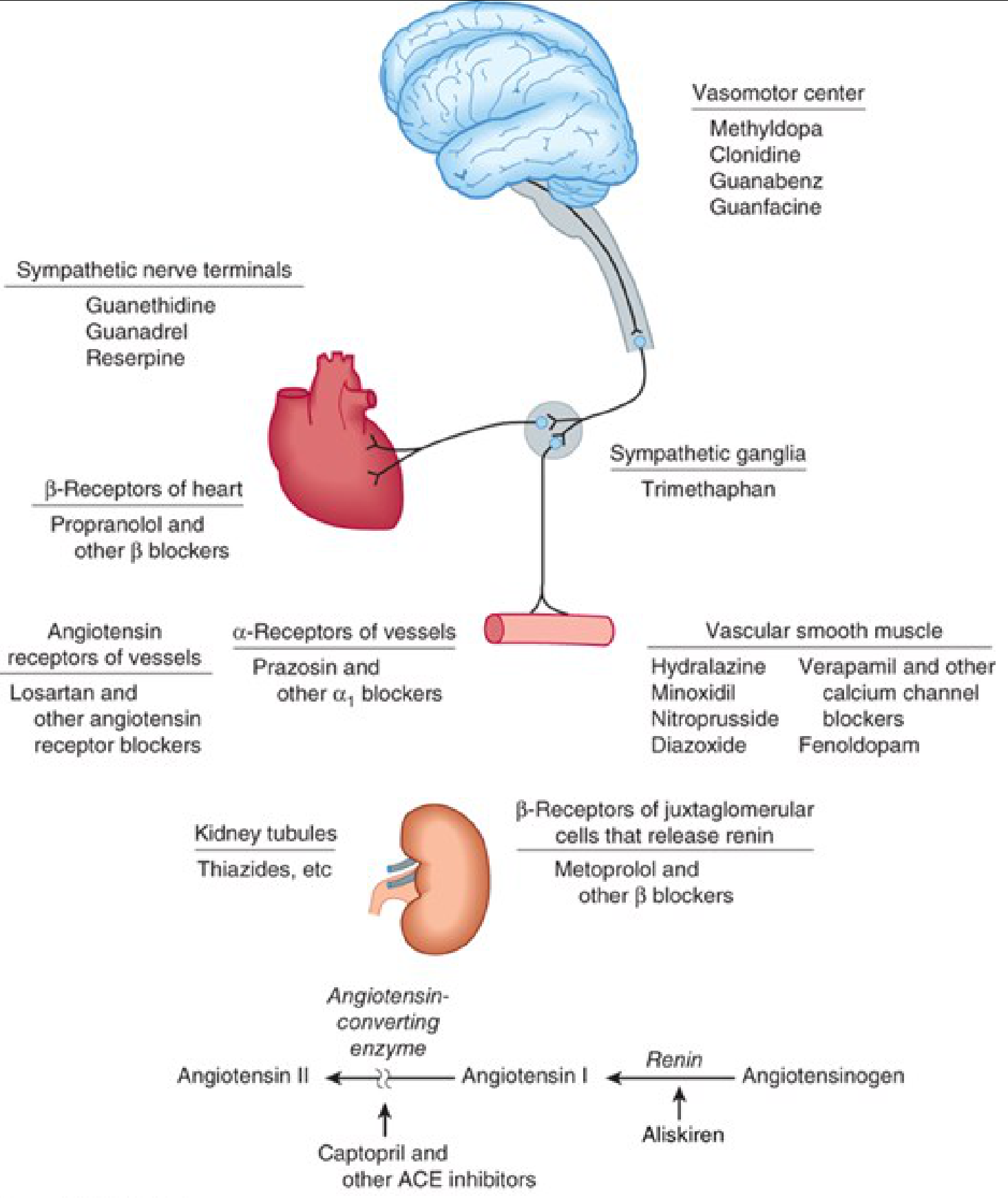
Diagram mein yeh label karo:
| Site | Drugs |
|---|---|
| Vasomotor center (brain) | Methyldopa, Clonidine |
| Sympathetic ganglia | Trimethaphan |
| Sympathetic nerve terminal | Guanethidine, Reserpine |
| β-receptors of heart | Propranolol, Beta-blockers |
| α1-receptors of vessels | Prazosin |
| Vascular smooth muscle | Hydralazine, CCBs (Verapamil) |
| Kidney tubules | Thiazides |
| β-receptors of JGA (renin) | Metoprolol |
| Angiotensin II receptor | Losartan (ARBs) |
| ACE | Captopril (ACE inhibitors) |
DIAGRAM 3 - Baroreceptor Reflex Arc (3 marks value)
Yeh diagram Katzung mein Fig 11-2 hai - blood pressure regulation ka nervous control dikhata hai:
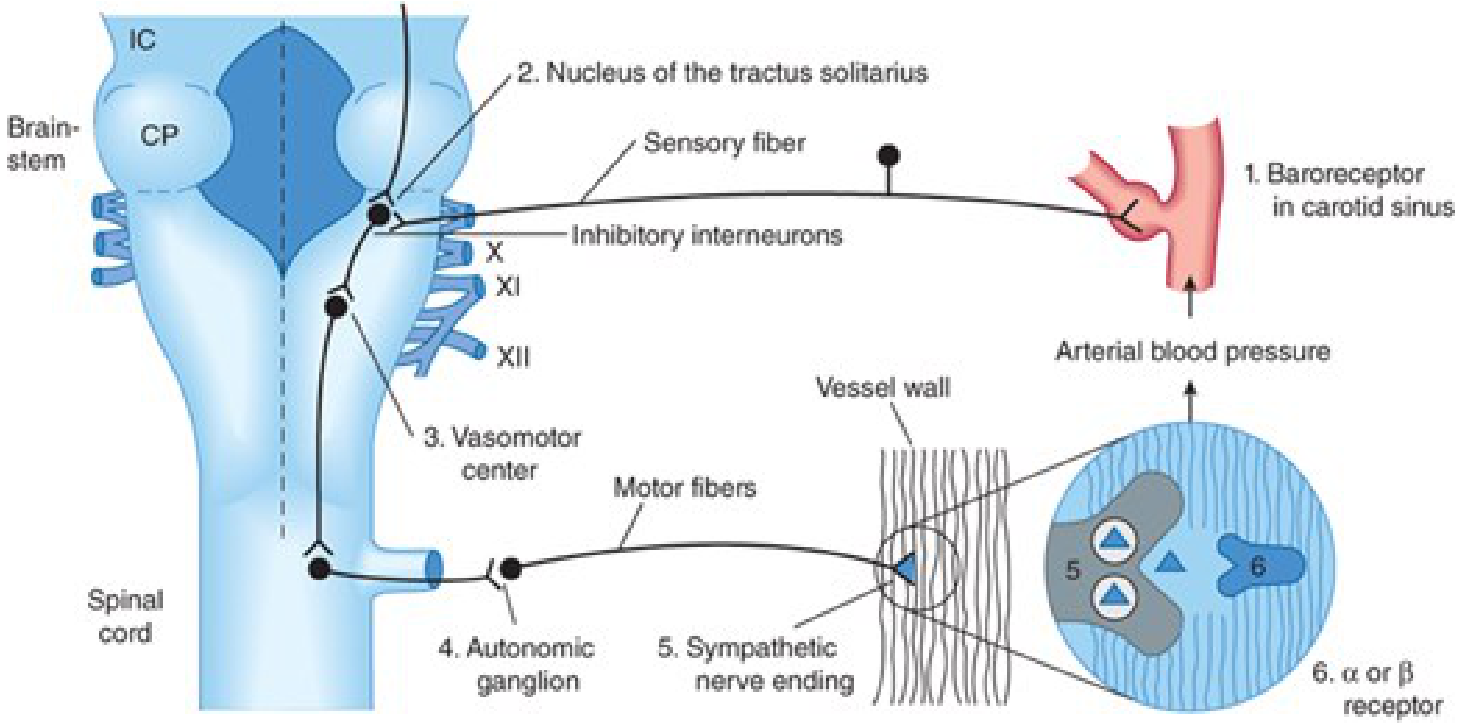
Flow draw karo:
Carotid sinus baroreceptors (↑BP sensed)
     ↓ Sensory fiber
Nucleus tractus solitarius (brainstem)
     ↓ Inhibitory interneurons
Vasomotor center
     ↓ ↓ Sympathetic discharge
Autonomic ganglion
     ↓ Motor fibers
Sympathetic nerve endings → α/β receptors
     → Vasodilation + ↓ HR → BP normalizes
DIAGRAM 4 - Classification / Staging Table (2 marks - easy marks)
JNC 8 / ACC/AHA classification ka simple table banana hai:
| Category | Systolic (mmHg) | Diastolic (mmHg) |
|---|---|---|
| Normal | < 120 | AND < 80 |
| Elevated | 120-129 | AND < 80 |
| Stage 1 HTN | 130-139 | OR 80-89 |
| Stage 2 HTN | ≥ 140 | OR ≥ 90 |
| Hypertensive Crisis | > 180 | AND/OR > 120 |
DIAGRAM 5 - Pathophysiology Flowchart (2 marks - agar time ho)
Primary Causes                Secondary Causes
(Essential HTN >90%)          (Renovascular, Endocrine)
         ↓                           ↓
↑ Cardiac Output + ↑ TPR (Total Peripheral Resistance)
         ↓
     BP = CO × TPR ↑
         ↓
Target Organ Damage:
├── Heart → LVH, IHD, Heart failure
├── Brain → Stroke, Hypertensive encephalopathy
├── Kidney → Nephrosclerosis, CKD
├── Eye → Hypertensive retinopathy
└── Arteries → Atherosclerosis, Aortic dissection
Exam Strategy - 15 Marks Answer Structure
| Section | Marks | Kya likho |
|---|---|---|
| Definition + Types | 2 | Essential vs Secondary |
| Classification Table | 2 | JNC/ACC-AHA staging |
| Pathophysiology + RAAS Diagram | 4 | Flowchart + RAAS |
| Antihypertensive Drugs + Sites Diagram | 4 | Classification + mechanism diagram |
| Baroreceptor diagram / Complications | 3 | Reflex arc OR target organ damage flowchart |
Pro Tips:
- Diagrams ke saath labels aur arrows clearly likho - ek label missing = marks cut
- Har diagram ke neeche "Fig:" ke saath ek line title likho
- RAAS aur drug sites diagram - dono milake banao agar ek hi page mein fit ho, warna alag alag
- BP formula BP = CO × TPR zaroor likho - examiner notice karta hai
Sources: Katzung Basic & Clinical Pharmacology, 16th Ed | Robbins & Cotran Pathologic Basis of Disease | Fuster and Hurst's The Heart, 15th Ed
And same question but shock
Shock ke 15-mark university question mein kaunse diagrams draw kar sakte hain - batata hoon. Quick answer pehle:
Quick Answer: Shock ke 15-mark question mein: Types of shock classification diagram, Pathophysiology flowchart (↓CO → compensatory mechanisms), Stages of shock table, Distributive shock mein vasodilation diagram, aur Compensatory mechanisms (SNS + RAAS + ADH) ka flowchart banana chahiye.
Searching sources...
Finding Sources
Finding Sources
Finding Sources
Finding Sources
Reading File
Reading File
Reading File
Finding Sources
Finding Sources
Finding Sources
Reading File
Finding Sources
Finding Sources
Finding Sources
Reading File
Excellent! Ab mere paas Harrison's se saara data hai. Ab main complete answer deta hoon:
Shock - 15 Marks University Question ke liye Diagrams
DIAGRAM 1 - Classification of Shock (MOST IMPORTANT - 4 marks)
Yeh mind-map ya branching diagram banana hai:
                        SHOCK
                   (↓ O2 delivery)
         _______________↓________________
        |          |          |          |
  DISTRIBUTIVE  CARDIOGENIC  HYPOVOLEMIC  OBSTRUCTIVE
        |          |          |          |
  Septic shock    MI         Hemorrhage  Tension PTX
  Anaphylaxis    Arrhythmia  GI bleed    Cardiac tamponade
  Neurogenic     Myocarditis Burns       Pulmonary embolism
  Burn shock     Valvular    DKA         Aortic dissection
  Adrenal crisis             Diarrhea
Note: Yeh Harrison's Principles Table 314-1 ka classification hai (22nd Ed, 2025).
DIAGRAM 2 - Hemodynamic Profile Table (EXAMINER FAVOURITE - 3 marks)
Harrison's ka yeh Table 314-2 - is ek table se 3 marks pakke - examiner ko bahut pasand hai:
| Type of Shock | CVP | PCWP | Cardiac Output | SVR |
|---|---|---|---|---|
| Distributive | ↓ | ↓ | ↑ | ↓ |
| Cardiogenic | ↑ | ↑ | ↓ | ↑ |
| Obstructive | ↑ | ↓/↑ | ↓ | ↑ |
| Hypovolemic | ↓ | ↓ | ↓ | ↑ |
(CVP = Central Venous Pressure; PCWP = Pulmonary Capillary Wedge Pressure; SVR = Systemic Vascular Resistance)
Trick to remember: Distributive shock mein CO upar jaata hai (akela) - baaki sab mein CO neeche jaata hai. SVR distributive mein sirf neeche - baaki sab mein upar.
DIAGRAM 3 - Pathophysiology / O2 Delivery Flowchart (3 marks)
Harrison's ke anusaar:
DO2 = CO × CaO2
       |         |
   HR × SV   Hb × 1.34 × SaO2
    |
Preload/Contractility/Afterload

          ↓ DO2  (any cause)
               ↓
    Aerobic → Anaerobic metabolism
               ↓
    Pyruvate → LACTATE (↑ lactate = marker of shock)
               ↓
    ATP ↓  →  Na+/K+ ATPase fails
               ↓
    Cell swelling → Ca2+ influx → Phospholipases activate
               ↓
    Cellular death → Organ dysfunction
               ↓
    MODS (Multi-Organ Dysfunction Syndrome)
DIAGRAM 4 - Stages of Shock (3 marks)
Yeh progression diagram banana hai - Harrison's se:
STAGE 1: COMPENSATED SHOCK (Preshock)
├── Body compensates: ↑HR, ↑SVR, ↑ADH, ↑RAAS
├── No overt organ dysfunction
├── Mild ↑ Lactate only
└── REVERSIBLE with treatment

         ↓ (if untreated)

STAGE 2: DECOMPENSATED SHOCK (True Shock)
├── Compensatory mechanisms overwhelmed
├── Hypotension (SBP <90 or MAP <65 mmHg)
├── Signs: oliguria, AMS, cold peripheries
└── STILL REVERSIBLE with aggressive treatment

         ↓ (if untreated)

STAGE 3: IRREVERSIBLE SHOCK
├── Permanent organ dysfunction
├── MODS develops
├── Death despite treatment
└── NOT reversible
DIAGRAM 5 - Compensatory Mechanisms in Shock (2 marks - bonus diagram)
↓ BP / ↓ CO  (any shock type)
        ↓
   3 Compensatory Systems activate:

   1. Sympathetic NS:
      ↑ Heart rate + ↑ Contractility + Vasoconstriction (↑SVR)

   2. RAAS:
      ↓ Renal perfusion → ↑ Renin → ↑ Ang II → ↑ Aldosterone
      → Na+ & H2O retention → ↑ Blood volume

   3. ADH (Vasopressin):
      Released from posterior pituitary
      → Water retention → ↑ Blood volume + Vasoconstriction

   Result: Attempt to restore MAP and tissue perfusion
Exam Strategy - 15 Marks Answer Structure
| Section | Marks | Kya likho |
|---|---|---|
| Definition + Formula | 1 | DO2 = CO × CaO2; Shock = ↓ DO2 |
| Classification diagram | 3 | 4 types + examples |
| Hemodynamic Profile Table | 3 | CVP/PCWP/CO/SVR for each type |
| Pathophysiology flowchart | 3 | Anaerobic → lactate → cell death |
| Stages of shock | 3 | Compensated → Decompensated → Irreversible |
| Compensatory mechanisms | 2 | SNS + RAAS + ADH |
Key formulas examiner dekhna chahta hai:
DO2 = CO × CaO2CO = HR × SVMAP = DBP + 1/3(SBP - DBP)→ Shock mein MAP < 65 mmHgLactate > 2 mmol/L= tissue hypoperfusion
Top Tips:
- Distributive shock mein CO ↑ hota hai - yeh unique point diagram mein circle karke highlight karo
- Septic shock = Distributive + Lactate > 2 + vasopressor required (newest Sepsis-3 definition)
- Hemodynamic table ZAROOR banana - bahut marks milte hain aur easy bhi hai
- Stages diagram ke saath clinical features likho (oliguria, altered sensorium, cold extremities)
Sources: Harrison's Principles of Internal Medicine 22nd Ed (2025) | Miller's Anesthesia 10th Ed | Fuster & Hurst's The Heart 15th Ed
This is a shared conversation. Sign in to Orris to start your own chat.