
from Guyton and Hall Textbook of Medical Physiology (4th South Asia Edition) write a proper 5 mark note on tetany
Reading File
Finding Sources
Finding Sources
Reading File
Tetany (Guyton and Hall, 4th South Asia Edition)
Definition
Tetany refers to a state of increased neuromuscular excitability characterized by spontaneous, repetitive discharge of nerve impulses leading to sustained ("tetanic") contraction of skeletal muscles. It is the hallmark manifestation of hypocalcemia.
Mechanism
- Calcium ions normally stabilize neuronal membranes by reducing their permeability to sodium.
- When extracellular fluid calcium concentration falls below normal, neuronal membrane permeability to Na⁺ increases, making it much easier to generate an action potential.
- When plasma calcium falls to about 50% below normal, peripheral nerve fibers become so excitable that they discharge spontaneously, sending trains of impulses to skeletal muscle and producing tetanic contraction.
- Hypocalcemia can also increase excitability of the brain, occasionally precipitating seizures.
Calcium levels at which tetany occurs
- Normal plasma calcium: ~9.4 mg/dL.
- Tetany develops when calcium falls to about 6 mg/dL (only ~35% below normal).
- Levels around 4 mg/dL are usually lethal (tetanic spasm of respiratory muscles causing death).
Clinical feature - Carpopedal spasm
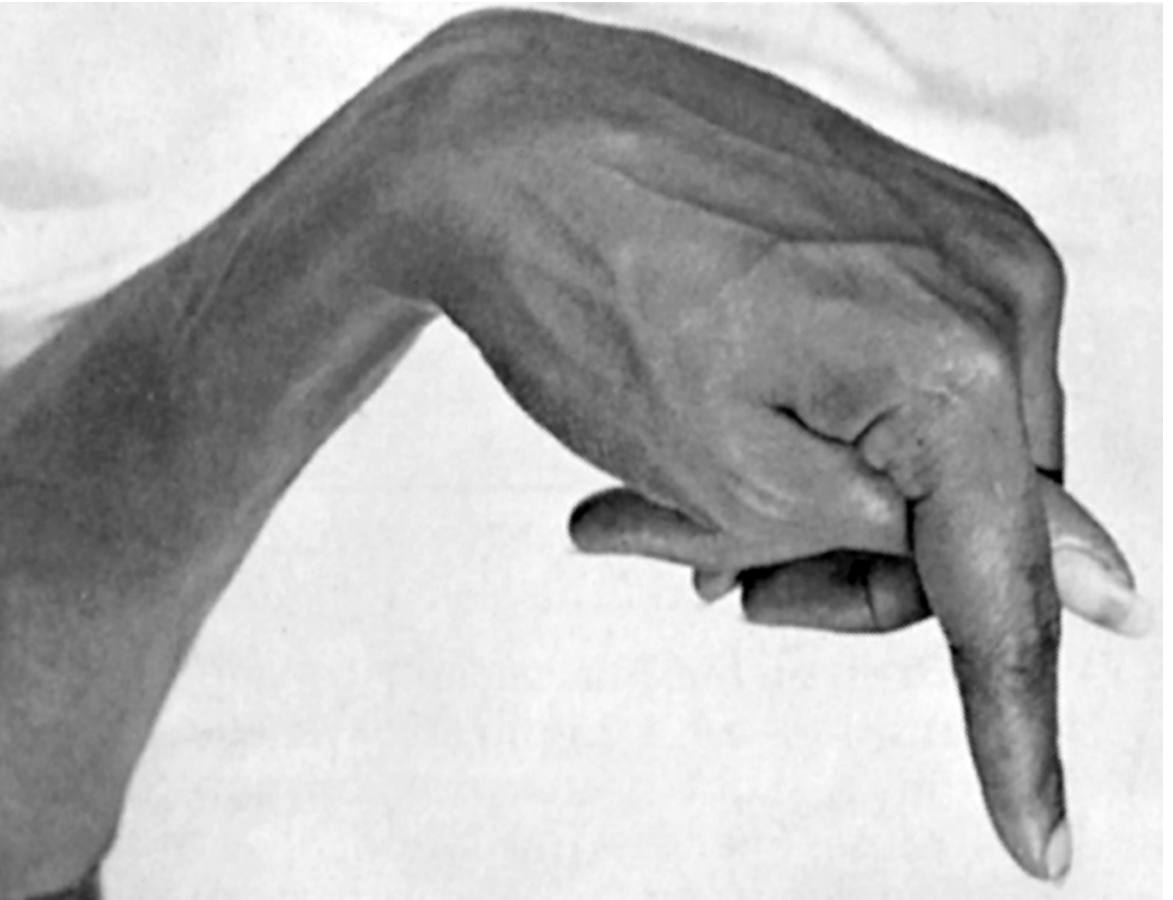
- The earliest and most characteristic sign is tetany of the hand, called carpopedal spasm - flexion at the wrist and metacarpophalangeal joints with extension of the fingers - which typically appears before tetany develops elsewhere in the body.
- In children, severe hypocalcemia (blood calcium below 7 mg/dL) can cause fatal tetanic respiratory spasm unless calcium is administered promptly.
Clinical correlation / management (supplementary)
-
Common causes: hypoparathyroidism, vitamin D deficiency (rickets/osteomalacia), acute pancreatitis, respiratory alkalosis (hyperventilation lowers ionized calcium).
-
Treatment of acute tetany: IV calcium gluconate to rapidly raise ionized calcium and relieve neuromuscular excitability.
-
Guyton and Hall Textbook of Medical Physiology, "Nonbone Physiological Effects of Altered Calcium and Phosphate Concentrations in the Body Fluids," p. 3258-3262
-
Guyton and Hall Textbook of Medical Physiology, "Rickets Caused by Vitamin D Deficiency," p. 3782-3787
This is a shared conversation. Sign in to Orris to start your own chat.