
Migration of keratin layer self cleansing property of ear
Reading File
Finding Sources
Finding Sources
Searching the Web
keratin migration ear canal self-cleansing mechanism
Finding Sources
Reading Web Page
https://entokey.com/tympanic-membrane-wound-healing-and-epit…
Searching PubMed
epithelial migration external auditory canal keratin
Reading File
Reading File
Finding Sources
Reading File
Finding Sources
Finding Sources
Searching Images
epithelial migration ear canal tympanic membrane diagram
Loading Image
Finding Sources
Now I have enough material from the textbooks, web sources, and literature to compose a thorough answer.
Keratin Migration & the Self-Cleansing Property of the Ear
What Is It?
The external auditory canal (EAC) and tympanic membrane (TM) possess a remarkable, unique biological property called lateral epithelial (keratin) migration — a built-in self-cleansing mechanism that keeps the canal free of debris, dead skin, and cerumen. It was first described by Burnett (1877) and later confirmed by multiple investigators including Litton (1963) and Alberti (1964).
Origin of Migration
Keratinocyte progenitor cells are located at the umbo (centre of the TM) and along the handle of the malleus. These cells proliferate and migrate outward in a radial, centrifugal pattern:
- Starts at the umbo → spreads centripetally across the pars tensa
- Moves onto the bony EAC wall
- Travels laterally along the canal floor and walls
- Ends at the bony-cartilaginous junction, where desquamation (shedding) occurs
This creates a conveyor belt of skin cells moving from deep to superficial, carrying debris, cerumen, and dead keratin outward.
- Cummings Otolaryngology, p. 2654
Rate and Pattern
| Parameter | Detail |
|---|---|
| Speed | 70–131 microns/day (some diurnal variation) |
| Plane of migration | Between stratum basale/spinosum and the basement membrane |
| Slower quadrants | Anterior and inferior TM quadrants |
| Terminal zone | Bony-cartilaginous junction of the EAC |
Migration occurs via a plane of separation between superficial cells sliding over deeper ones. The stratum basale and stratum spinosum show intercellular spaces, cytoplasmic processes, and fewer desmosomes — facilitating this gliding.
Molecular Mechanisms
The migration depends on finely coordinated changes in cell adhesion:
- Hemidesmosomes (linking keratin filaments to the basement membrane) must be disassembled to allow keratinocyte movement
- Key adhesion molecules involved: selectins, desmocoilin, F-actin, fibronectin, integrin β-1, cadherin-6
- α3β1 and α6β4 integrins maintain the directional trajectory of migration
- Reduction in intercellular adhesion between layers permits the sliding movement
Clinical Significance: When Migration Fails
The self-cleansing mechanism is the net result of coordinated keratin maturation + lateral cell migration. Two major pathologies arise when this goes wrong:
1. Keratosis Obturans
- Cause: Faulty epithelial migration of TM and EAC skin (Corbridge et al., 1996); possibly also excessive epithelial cell production
- Result: Dense circumferential keratin plug obstructing the entire medial EAC
- Features: Bilateral, affects ages 30–60, severe otalgia, conductive hearing loss, bony canal widening ("automatousectomy" cavity)
- Treatment: Atraumatic microscopic cleaning; lifelong debridements may be needed
- Cummings Otolaryngology, p. 2655 | K.J. Lee's Essential Otolaryngology, p. 472
2. EAC Cholesteatoma (External Canal Cholesteatoma)
- Focal disorder (inferoposterior bony canal), distinct from keratosis obturans
- Keratin accumulation with osteitis and bone necrosis
- Associated with canal skin ulceration; squamous epithelium invades bone
- Treatment: Debris removal + topical agents; surgery (fascial graft) for refractory cases
3. Normal Aging
- Epithelial migration slows with age, reducing the self-cleansing efficiency → increased cerumen impaction risk
- Fitzpatrick's Dermatology, p. 24
Endoscopic Evidence of Migration
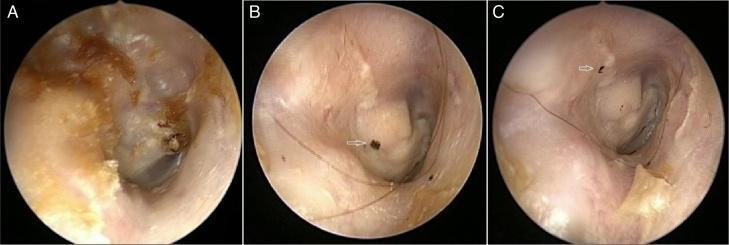
The image below (from a clinical study tracking ink-dot markers in the EAC) visually demonstrates lateral epithelial migration — ink placed on the TM (Panel B, white arrow) migrates posterosuperiorly along the canal wall (Panel C), confirming the directional conveyor-belt pattern:
Summary
The ear's self-cleansing property is driven by lateral keratin (epithelial) migration — a unique, directional outward movement of the skin layer of the TM and EAC, originating at the umbo, running at ~70–131 µm/day, and terminating in desquamation at the bony-cartilaginous junction. It is coordinated by integrin-mediated keratinocyte adhesion changes and serves as the primary mechanism preventing accumulation of dead skin and cerumen. Disruption of this process leads to keratosis obturans or EAC cholesteatoma.
Key sources:
- Cummings Otolaryngology Head and Neck Surgery, Chapter 138
- K.J. Lee's Essential Otolaryngology, Chapter on External Ear Canal
- Fitzpatrick's Dermatology, External Otitis section
- Corbridge RJ et al., Am J Otolaryngol 17:411–414, 1996 (epithelial migration in keratosis obturans)
- Revadi G et al., Otol Neurotol 2011 [PMID: 21307812] (migration in normal vs pathologic ears)
This is a shared conversation. Sign in to Orris to start your own chat.