
Detail about rheumatoid arthritis correlation with ayurvedreate image
Reading File
Now let me search the medical library and web simultaneously for RA and Ayurveda correlation.
Finding Sources
Searching the Web
rheumatoid arthritis Ayurveda correlation Amavata treatment
Searching PubMed
"rheumatoid arthritis" AND "Ayurveda"
Now let me get the RA content from the textbook and generate the image simultaneously.
Reading File
Generating Image
Rheumatoid Arthritis and Ayurveda correlation infographic showing: on the left side modern medicine view with inflamed synovial joints, autoimmune mechanism with T-cells and cytokines; on the right side Ayurvedic view with Amavata concept, Ama toxin accumulation in joints, Vata-Kapha dosha imbalance, and Agni (digestive fire) impairment; center bridge showing parallel pathophysiology; bottom section showing Ayurvedic treatments: Panchakarma, herbal remedies (Ashwagandha, Shallaki, Guggulu), and dietary guidelines
Now let me get the RA content from the textbook and generate the image simultaneously.Here is a detailed overview of Rheumatoid Arthritis (RA) and its correlation with Ayurveda, along with the infographic:
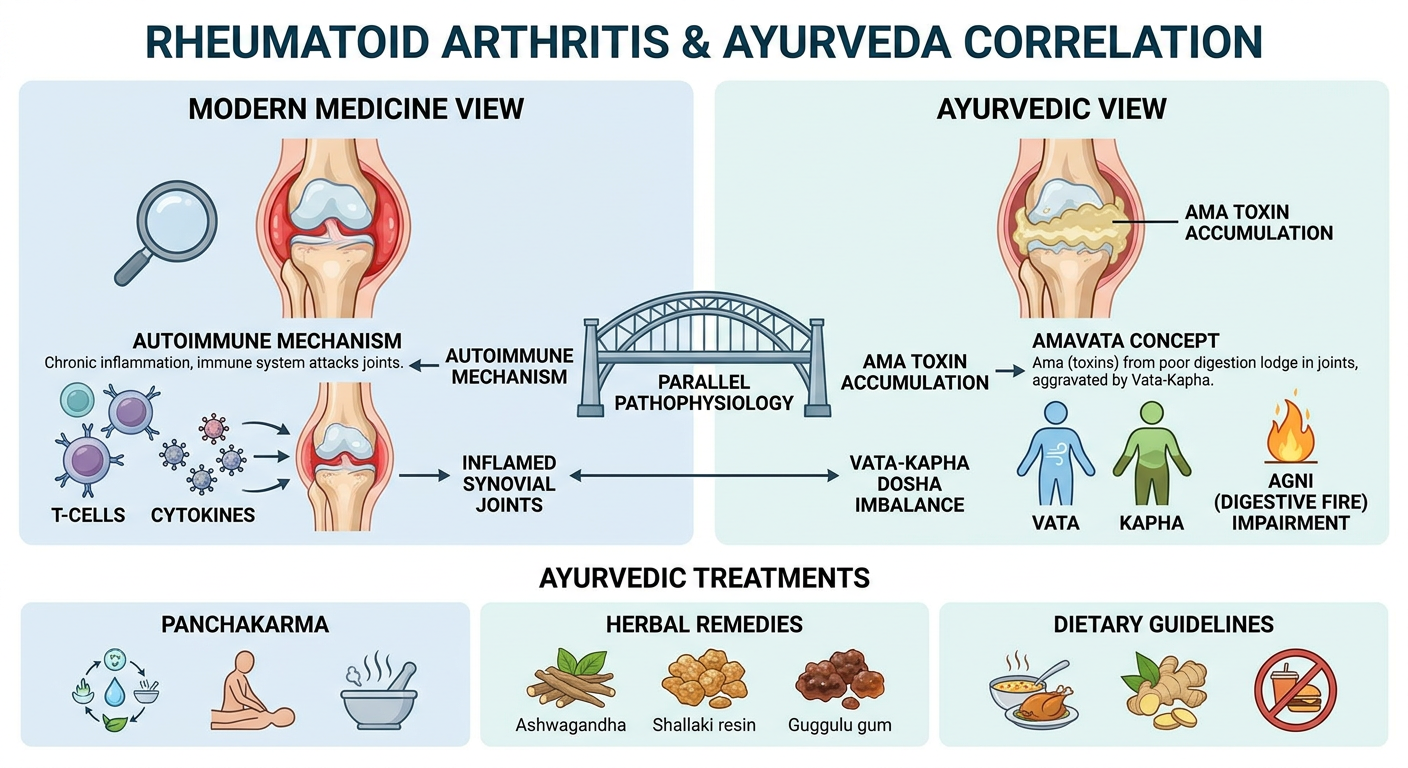
Rheumatoid Arthritis (RA) and Ayurveda: Correlation with Amavata
1. Overview of Rheumatoid Arthritis (Modern Medicine)
RA is a chronic, systemic autoimmune inflammatory disease that primarily destroys the synovium - the lining of joints. Key facts:
- Prevalence: 1-2% of adults worldwide; women are affected 3:1 over men
- Peak onset: Ages 20-50 years
- Genetics: HLA-DR antigens confer susceptibility; higher concordance in monozygotic twins
- Pathology: Synovial lining cells proliferate forming a pannus; leukocyte invasion triggers cytokine and protease cascades leading to cartilage/bone erosion
- Hallmark: Symmetric synovitis with morning stiffness lasting >1 hour
- Biomarkers: Rheumatoid Factor (RF), anti-CCP antibodies, elevated CRP/ESR
(Textbook of Family Medicine 9e)
2. Ayurvedic Correlation: Amavata
In Ayurveda, RA corresponds most closely to Amavata - a term derived from two Sanskrit roots:
| Term | Meaning | Modern Parallel |
|---|---|---|
| Ama | Undigested/toxic metabolic product | Pro-inflammatory immune complexes, uncleared metabolites |
| Vata | Governing biophysiological force of movement | Neuromotor and inflammatory pathways |
Amavata is first described in Madhav Nidana (Laghutrayee), not in the earlier Brihatrayee texts, indicating it was recognized as a distinct clinical entity over time.
3. Parallel Pathophysiology
| Feature | Modern Medicine | Ayurveda |
|---|---|---|
| Root cause | Genetic predisposition (HLA-DR) + environmental trigger | Impaired Agni (digestive fire) + Prakriti (body constitution) |
| Toxic mediator | Autoantibodies, TNF-alpha, IL-6 | Ama (incompletely metabolized toxin) |
| Joint involvement | Synovial inflammation, pannus formation | Ama deposited in Sandhis (joints) |
| Symptoms | Joint pain, swelling, morning stiffness | Sandhi Shotha (swelling), Sandhi Shoola (pain), Daurbalya (weakness) |
| Constitution risk | Specific HLA genotypes | Predominant Vata-Kapha Prakriti |
| Strategy | Offensive - suppress inflammation | Defensive - eliminate root cause (Ama, restore Agni) |
Modern medicine attacks the inflammatory cascade directly (DMARDs, biologics). Ayurveda targets the upstream etiological process - impaired digestion producing Ama - following a defense strategy (PMC3665188).
4. Ayurvedic Classification of Amavata Prognosis
- Sukha Sadhya - easily manageable (early, mild disease)
- Krichra Sadhya - difficult but manageable (moderate, established disease)
- Yapya - maintainable but not curable (chronic, deforming)
- Asadhya - poor prognosis (end-stage, severe disability)
5. Ayurvedic Treatment Approach
A. Nidana Parivarjana (Avoidance of Causative Factors)
- First and foremost step - remove dietary and lifestyle triggers
- Avoid incompatible foods (Viruddha Ahara), excessive physical exertion after meals, exposure to cold
B. Samana Therapy (Pacification/Internal Medicine)
Preferred in early and mild stages:
| Herb | Sanskrit Name | Mechanism |
|---|---|---|
| Ashwagandha | Withania somnifera | Anti-inflammatory, immunomodulatory |
| Shallaki | Boswellia serrata | Inhibits leukotriene synthesis |
| Guggulu | Commiphora mukul | Anti-inflammatory, lipid-modulating |
| Licorice | Glycyrrhiza glabra | Cortisol-sparing, anti-inflammatory (PMID 41177239) |
| Castor oil | Eranda | Deepana-Pachana (kindles Agni, digests Ama) |
C. Shodhana Therapy (Detoxification/Panchakarma)
Used for moderate-to-severe or chronic cases:
- Virechanakarma - therapeutic purgation to expel vitiated Pitta and Ama from the GI tract (PMC5041390)
- Basti - medicated enema, the primary treatment for Vata disorders
- Snehapana - internal oleation (ghee/oil) to loosen Ama from tissues
- Swedana - medicated steam/sudation to reduce stiffness and facilitate Ama mobilization
6. Dietary Guidelines (Pathya-Apathya)
Recommended (Pathya):
- Warm, light, easily digestible foods
- Old rice, barley, horse gram (Kulattha)
- Ginger, garlic, turmeric
- Castor oil in small quantities
Avoided (Apathya):
- Cold, heavy, oily foods
- Curd (yogurt), fish, black gram
- Day sleep, exposure to cold water/wind
- Contradictory food combinations
7. Integrative Perspective
The 2025 systematic review on Indian herbs (PMID 40154100) confirms that many Ayurvedic anti-inflammatory herbs act through molecular pathways - inhibiting NF-kB, COX-2, TNF-alpha, and IL-1beta - providing a biological basis for traditional use. An integrative dual-strategy approach using both systems is increasingly advocated:
- Ayurvedic therapies (Deepana-Pachana, Basti) can be used as adjuncts to lower DMARD dosages and reduce drug-induced toxicities
- Early-stage patients benefit most from Ayurvedic intervention
- Advanced RA may still gain quality-of-life benefits through Panchakarma
Summary
Rheumatoid Arthritis and Amavata show striking conceptual parallels:
- Both recognize a constitutional/genetic susceptibility
- Both identify a toxic mediator (autoantibodies vs. Ama) accumulating in joints
- Modern medicine manages the inflammatory end-stage; Ayurveda targets the upstream metabolic cause
- Combined approaches offer promising, cost-effective, and safer long-term management strategies
Sources: Textbook of Family Medicine 9e | PMC3665188 | PMC5041390 | PMID 41177239 | PMID 40154100 | Shedge & Dhurve, IJDDT 2026
This is a shared conversation. Sign in to Orris to start your own chat.