
Inj piptaz dose in adults
Quick answer: Piperacillin-tazobactam (Pip-Taz) standard adult dose is 4.5 g (4g pip + 0.5g taz) IV every 6-8 hours. For severe infections like nosocomial pneumonia, the dose is 4.5 g every 6 hours. Renal dose adjustment is needed when CrCl < 40 mL/min.
Searching sources...
Reading File
Finding Sources
Searching the Web
piperacillin tazobactam piptaz adult dose IV 2025 guidelines
Here is a complete dosing reference for Injection Piperacillin-Tazobactam (Pip-Taz) in adults:
Inj. Piperacillin-Tazobactam (Pip-Taz) - Adult Dosing
Standard Doses
| Indication | Dose | Frequency | Duration |
|---|---|---|---|
| Most infections (intra-abdominal, skin/soft tissue, pelvic, UTI) | 3.375 g (3g pip + 0.375g taz) | Every 6 hours | 7-10 days |
| Severe/high-risk infections, Pseudomonas suspected | 4.5 g (4g pip + 0.5g taz) | Every 6 hours | 7-10 days |
| Nosocomial (hospital-acquired) pneumonia | 4.5 g | Every 6 hours + aminoglycoside | 7-14 days |
- Administered as IV infusion over 30 minutes (standard)
- Extended infusion over 4 hours at 4.5 g q8h may be used for PD/PK optimisation against resistant organisms (Goodman & Gilman)
Renal Dose Adjustment
| CrCl (mL/min) | Dose |
|---|---|
| > 40 | No adjustment needed |
| 20-40 | 4.5 g every 8 hours |
| < 20 | 4.5 g every 12 hours |
| Haemodialysis / CAPD | 2.25 g every 8h (nosocomial pneumonia) OR 2.25 g every 12h (other indications) |
| CVVH | 2.25-3.375 g every 8 hours |
- Hepatic impairment: No dose adjustment required
Indication-Specific Notes
- Sepsis / Febrile neutropenia: 4.5 g IV q6h (antipseudomonal coverage)
- Appendicitis / Peritonitis: 3.375 g IV q6h (adults); or 4.5 g q6h for higher-risk patients (Rosen's Emergency Medicine)
- Hospital-acquired pneumonia: 4.5 g IV q6h plus an aminoglycoside (ciprofloxacin or amikacin), especially if Pseudomonas is suspected (Fishman's Pulmonary Diseases; FDA label 2025)
- Washington Manual: 3.375 g IV q6h for general use; 4.5 g IV q6h specifically for Pseudomonas coverage
Key Points
- Pip-Taz covers gram-negatives (including Pseudomonas), gram-positives, and anaerobes - it does not cover MRSA
- For MRSA concern, add vancomycin or linezolid
- The 4-hour extended infusion (4.5 g q8h) improves pharmacodynamic target attainment (time above MIC) for less susceptible organisms - per Goodman & Gilman's Pharmacological Basis of Therapeutics
- Monitor renal function during therapy
Sources: [Goodman & Gilman's Pharmacological Basis of Therapeutics], [Washington Manual of Medical Therapeutics], [Rosen's Emergency Medicine], FDA prescribing label (2025), Drugs.com dosage guide
Urine frequency increased and urge incontinence of urine present without burning micturition in pt os spindle celland dose carcinoma what medication to be given And dose
Quick answer: In a spindle cell carcinoma patient with urinary frequency + urge incontinence but NO dysuria/burning, this is overactive bladder (OAB) / neurogenic bladder - likely due to tumor invasion, nerve involvement, or post-treatment effects rather than UTI. First-line treatment is antimuscarinics (oxybutynin, solifenacin, tolterodine) or beta-3 agonist (mirabegron).
Searching sources...
Finding Sources
Finding Sources
Searching the Web
overactive bladder urge incontinence cancer patient anticholinergic mirabegron dose management
Reading File
Reading File
Here is a complete answer for this clinical scenario:
Clinical Interpretation
Patient: Spindle cell carcinoma with:
- Urinary frequency (increased)
- Urge incontinence
- No dysuria / burning (rules out UTI/cystitis as the primary cause)
This presentation is Overactive Bladder (OAB) / Neurogenic Bladder - likely caused by:
- Direct tumor infiltration of bladder/pelvic nerves
- Post-radiotherapy bladder irritation
- Chemotherapy-related neurotoxicity
First-Line Pharmacotherapy
Option 1 - Beta-3 Adrenergic Agonists (Preferred in cancer patients - fewer anticholinergic side effects)
| Drug | Dose | Frequency |
|---|---|---|
| Mirabegron (Myrbetriq) | Start 25 mg → titrate to 50 mg | Once daily |
| Vibegron | 75 mg | Once daily |
- Mechanism: Relaxes detrusor muscle → increases bladder storage capacity
- Preferred in cancer patients - no cognitive side effects, better tolerated in elderly/frail patients
- Caution: avoid if uncontrolled hypertension (BP > 180/110)
Option 2 - Antimuscarinics (Anticholinergics)
| Drug | Dose | Notes |
|---|---|---|
| Solifenacin (Vesicare) | 5 mg once daily (can increase to 10 mg/day) | Most bladder-selective, preferred |
| Tolterodine (Detrol LA) | 2-4 mg once daily (LA) or 1-2 mg BD | Well tolerated |
| Darifenacin (Enablex) | 7.5 mg/day → 15 mg/day | M3-selective, least CNS effects |
| Trospium (Sanctura XR) | 20 mg BD or 60 mg XR once daily | Doesn't cross BBB - good in elderly |
| Oxybutynin (Ditropan XL) | 5-10 mg/day (XL) or 5 mg BD | Transdermal patch 3.9 mg twice weekly also available |
- Mechanism: Block M2/M3 muscarinic receptors in detrusor → reduce involuntary contractions
- Watch for: dry mouth, constipation, blurred vision, urinary retention, cognitive effects (especially in elderly)
Option 3 - Combination Therapy (if monotherapy fails)
Solifenacin 5 mg + Mirabegron 50 mg once daily
- Proven superior to either agent alone in the SYNERGY trial
- Useful when single agent gives incomplete response
Option 4 - Adjunct / Second-line
| Drug | Dose | Use |
|---|---|---|
| Imipramine (TCA) | 10-50 mg at bedtime (max 150 mg/day) | OAB + nocturia; useful if neuropathic component |
| Botulinum toxin A (intravesical) | 100 units cystoscopically | Refractory OAB; lasts 6-9 months |
Non-Pharmacological (Adjuncts)
- Timed voiding / bladder training
- Fluid restriction (especially evening)
- Pelvic floor exercises (where feasible)
- Avoid caffeine and alcohol
Important Notes for Cancer Patients
- Always rule out UTI first - send urine culture even without dysuria (immunocompromised patients may not show classic symptoms)
- Rule out bladder invasion by tumor with cystoscopy/imaging before attributing symptoms purely to OAB
- Mirabegron is generally preferred over antimuscarinics in cancer patients due to better tolerability and no anticholinergic burden
- Opioid-induced bladder dysfunction is common in cancer patients on morphine - review the medication list
- Antimuscarinics are relatively contraindicated if urinary retention is present - check post-void residual first
Sources: Lippincott Illustrated Reviews Pharmacology (OAB chapter), Textbook of Family Medicine 9e (Table 40-15), Campbell-Walsh-Wein Urology, Mirabegron meta-analysis PMC10371066
Vomitus with ffoul smelling reddish black awith fresh blood at last what investigation and management to be done
Quick answer: Foul-smelling, reddish-black vomitus with fresh blood at the end = hematemesis with altered blood (upper GI bleed) - the dark/black component indicates digested blood (from stomach/duodenum), while fresh red blood at the end suggests active bleeding. This is a medical emergency. Key investigations: urgent endoscopy, CBC, coagulation profile, LFTs. Management: ABC stabilization, IV access, PPI infusion, urgent upper GI endoscopy.
Searching sources...
Reading File
Finding Sources
Finding Sources
Reading File
Reading File
Finding Sources
Reading File
Finding Sources
Loading Image
Reading File
Here is a complete, structured answer for this emergency presentation:
Clinical Scenario Analysis
Vomitus Description:
- Foul-smelling = suggests blood has been sitting in stomach/intestine and undergone bacterial fermentation - altered/digested blood
- Reddish-black = classic "coffee-ground" or altered hematin - old blood digested by gastric acid (proximal to ligament of Treitz)
- Fresh blood at the end = ongoing/active arterial bleeding episode
Diagnosis: Upper GI Hemorrhage (UGIH) - MEDICAL EMERGENCY
Differential Diagnosis (Common Causes)
| Cause | Clue in History |
|---|---|
| Peptic ulcer disease (most common, ~50%) | NSAIDs, H. pylori, epigastric pain |
| Esophageal/gastric varices | Cirrhosis, alcohol use, portal hypertension |
| Mallory-Weiss tear | Preceded by forceful retching/vomiting |
| Gastric erosions | Alcohol, steroids, stress |
| Esophagitis / esophageal cancer | Dysphagia, GERD, weight loss |
| Dieulafoy's lesion / GAVE | Chronic kidney disease, aortic stenosis |
| Aortoenteric fistula | Prior aortic surgery |
STEP 1 - Immediate Resuscitation (ABC)
- Airway - assess for aspiration risk; consider intubation if hemodynamically unstable or altered sensorium
- IV Access - 2 large-bore (16-18G) peripheral IVs immediately
- Vitals + monitoring - HR, BP, SpO2, urine output (catheterize)
- IV fluid resuscitation - Normal saline / Ringer's lactate bolus
- Position - Left lateral decubitus to prevent aspiration
- Nil by mouth (NBM)
- ICU admission if shock, syncope, hemodynamic instability, or active bright red bleeding
STEP 2 - Investigations
Urgent / Bedside (within minutes)
| Investigation | Purpose |
|---|---|
| Blood group & crossmatch | Prepare for transfusion |
| CBC / FBC | Haemoglobin, platelet count |
| Coagulation (PT/INR, aPTT) | Especially if liver disease/anticoagulants |
| Serum electrolytes, urea, creatinine | Raised BUN:creatinine > 20 suggests UGI bleed |
| Liver function tests (LFTs) | Portal hypertension, varices |
| Blood glucose | |
| ABG | In critically ill patients |
Imaging
| Investigation | Purpose |
|---|---|
| Upper GI Endoscopy (EGD) - GOLD STANDARD | Diagnostic + therapeutic (within 6-12h if active bleeding; within 24h if stable) |
| CXR / AXR | Perforation, aspiration |
| CT angiography | If endoscopy fails or massive bleed |
| NG tube aspiration | Confirm UGI source; characterize blood |
Scoring Systems
- Glasgow-Blatchford Score (GBS): Pre-endoscopy risk stratification (Hb, BUN, systolic BP, HR, syncope, liver disease, cardiac failure)
- Rockall Score: Post-endoscopy prognosis (age, shock, comorbidities, endoscopy findings)
STEP 3 - Management Algorithm
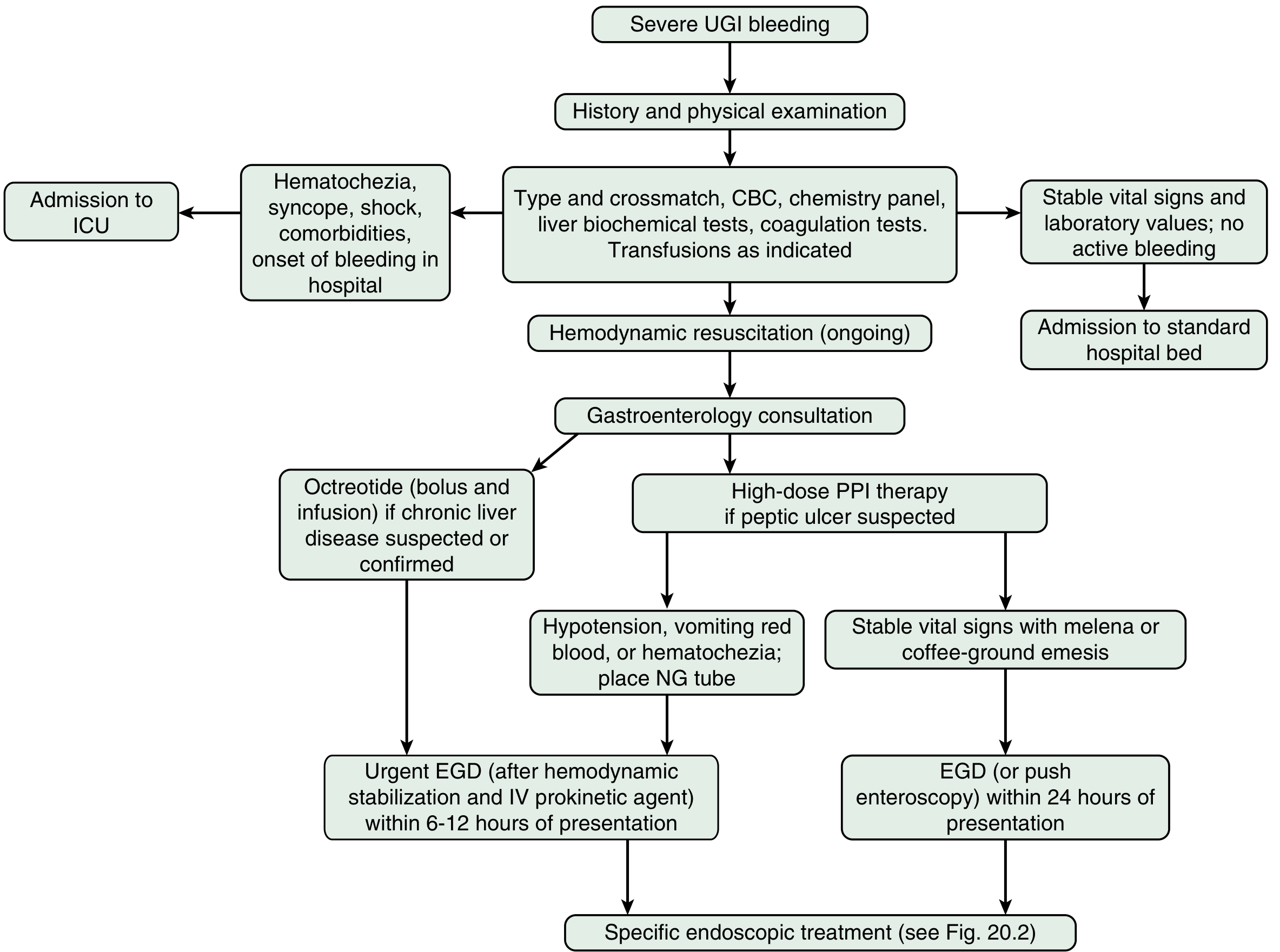
A. Non-Variceal Bleed (Peptic Ulcer, Mallory-Weiss, Erosions)
Medical:
| Drug | Dose | Route |
|---|---|---|
| Pantoprazole / Omeprazole (PPI) | 80 mg IV bolus → 8 mg/hr infusion for 72h | IV |
| Transfuse pRBC | Target Hb ≥ 7-8 g/dL (7 g/dL in stable; 9 g/dL if cardiac disease) | |
| FFP | If INR > 1.5 | IV |
| Platelets | If < 50,000 | IV |
| Erythromycin | 250 mg IV 30-90 min before EGD | IV prokinetic to clear stomach |
| Metoclopramide | 10 mg IV | Alternative prokinetic |
Endoscopic (EGD):
- Adrenaline injection (1:10,000) + thermal coagulation or clips
- Band ligation for Mallory-Weiss
- Hemostatic spray (Hemospray)
If EGD fails:
- Interventional radiology - angioembolisation
- Surgery - oversewing / gastrectomy
B. Variceal Bleed (if cirrhosis/portal hypertension suspected)
Medical:
| Drug | Dose | Purpose |
|---|---|---|
| Terlipressin | 2 mg IV q6h → 1 mg q6h after hemostasis | Reduce portal pressure (drug of choice) |
| OR Octreotide | 50-100 mcg IV bolus → 25-50 mcg/hr infusion | Splanchnic vasoconstrictor |
| Ceftriaxone | 1 g IV once daily x 7 days | Antibiotic prophylaxis (reduces mortality in cirrhosis) |
| Propranolol | 20-40 mg BD (after acute phase) | Secondary prevention |
Endoscopic:
- Band ligation (EVL) - preferred
- Sclerotherapy if ligation not possible
- Sengstaken-Blakemore tube (balloon tamponade) as bridge if massive bleed
If above fails:
- TIPS (Transjugular Intrahepatic Portosystemic Shunt)
Summary Flowchart (Quick Reference)
Hematemesis (dark + fresh blood)
        ↓
ABC + 2 large-bore IVs + resuscitation
        ↓
CBC, coagulation, LFT, BUN, crossmatch
        ↓
NG lavage → confirm UGI source
        ↓
High-dose PPI (80mg bolus + 8mg/hr) + Terlipressin if varices suspected
        ↓
Urgent EGD (within 6-12h if active / 24h if stable)
        ↓
Endoscopic hemostasis (clips / band / injection)
        ↓
Transfuse if Hb < 7 g/dL
        ↓
If failed → Angioembolization → Surgery
Sources: Sleisenger & Fordtran's Gastrointestinal and Liver Disease (Ch. 20), Frameworks for Internal Medicine, Current Surgical Therapy 14e, Roberts & Hedges' Clinical Procedures in Emergency Medicine
This is a shared conversation. Sign in to Orris to start your own chat.